ABSTRACT
Using Korea as a policy case, this article examines why an import-dependent but digitally capable Asian economy must prepare for climate-driven food-system shocks before they become visible food-security risks. Korea’s recent experience should not be read as a success story. It points instead to a double vulnerability: dependence on overseas feed, grain, fertilizer, and edible-oil supply chains exposes domestic markets to global weather, logistics, and geopolitical shocks, while an aging production base and climate-sensitive fresh foods transmit local weather quickly into consumer prices. Existing instruments - stockholding, tariff-rate quotas, insurance, discount support, online wholesale markets, and food-welfare programs - remain indispensable, but they are not sufficient for a climate-risk environment in which shocks move across production, logistics, markets, and household food access. They still operate more as post-shock stabilizers than as an integrated anticipatory system. This paper argues that Korea needs Artificial Intelligence (AI) not as an automated decision-maker, but as public decision-support infrastructure for earlier risk detection, cross-stage coordination, scenario comparison, and policy evaluation. The resulting policy architecture links production-risk detection, midstream supply-chain management, and downstream consumer-response modules. For Asian countries facing similar import dependence, aging rural labor, fresh-food volatility, and food-access concerns, Korea’s case offers a practical warning: food-security policy in the climate-crisis era must move beyond commodity-by-commodity stabilization toward system-level resilience that anticipates potential risks before they become household-level food-security problems.
Keywords: climate crisis, agri-food supply chain, price shock, AI-enabled policy, integrated AI platform, food access, Korean policy case, food security
BACKGROUND AND POLICY CONTEXT
Climate crisis and cascading risks in food systems
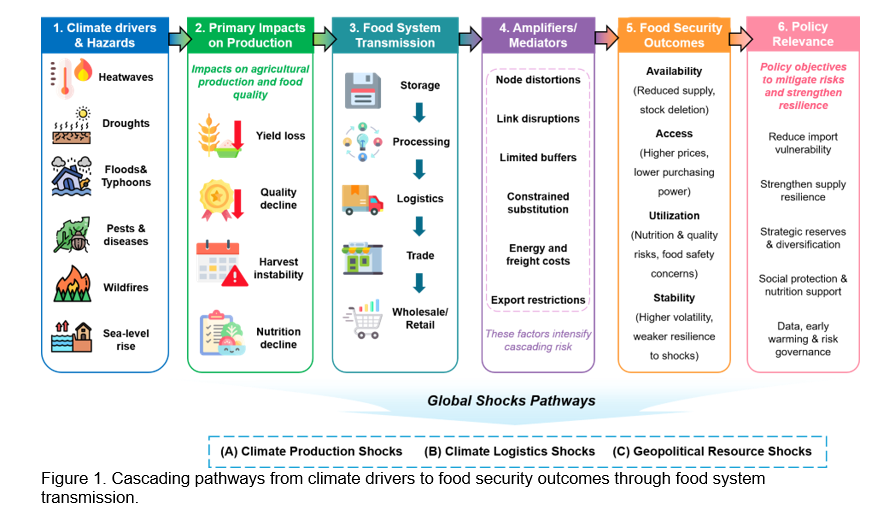
The climate crisis is no longer only a farm-level production problem; it has become a cascading food-system risk. Food systems integrate production, storage, processing, distribution, trade, wholesale, retail, and consumption, while food environments are shaped by prices, income, and physical accessibility. Climate shocks such as heatwaves, droughts, floods, and pests do not remain localized. They reduce output and quality, move through storage, processing, transportation, and trade networks, and create broader disruptions. Food security consequently depends not only on whether enough food is produced, but also on whether food moves, remains affordable, and reaches consumers in usable form.
In this article, food security is understood through four interrelated dimensions: availability, access, utilization, and stability. Availability refers to production, imports, and reserves; access refers to prices, income, physical access, and welfare support; utilization refers to nutrition, quality, and food safety; and stability refers to the capacity of these dimensions to withstand climate, logistics, geopolitical, and market shocks. This framework matters because climate change affects food security through multiple stages rather than through production alone. Climate hazards therefore need to be assessed as system-wide risks, not as isolated farm-level events.
The key policy issue is how climate hazards travel across the food system. Heatwaves reduce yields and quality while increasing labor-safety risks and cold-chain demand; droughts weaken irrigation and can constrain shipping; floods and typhoons damage crops, roads, ports, and storage facilities. These hazards differ in form, but they share one feature: a disruption beginning at one stage can move across connected supply chains and threaten availability, affordability, utilization, and stability at the same time.
The first transmission pathway is the weakening of the production base. According to the IPCC AR6, human-induced warming negatively affected agricultural productivity, crop quality, and harvest stability, especially in mid- and low-latitude regions. These impacts result from the interaction of multiple stressors rather than a single factor. Heat stress, drought, ozone, pests and diseases, and soil degradation amplify crop vulnerability and increase harvest uncertainty. In addition, climate change affects not only the quantity of food produced but also its nutritional quality. Declining protein concentrations in grains and legumes extend the challenge from calorie shortages to nutritional imbalance and hidden hunger. In short, climate change poses risks to both food quantity and food quality.
The second pathway is supply-chain amplification after production shocks. Reduced agricultural output and quality destabilize the supply of raw material for storage, sorting, and processing. At the same time, higher temperatures and humidity increase spoilage, food waste, refrigeration demand, and storage costs. When raw material supply becomes unstable, processing efficiency declines, while rising energy prices further increase operational expenses. Climate-related disruptions also create bottlenecks in logistics and trade networks. Floods, canal droughts, and port congestion can delay shipments and increase freight costs. These pressures then move downstream to wholesale, retail, and consumer stages, where higher procurement and distribution costs are reflected in consumer prices. As a result, localized production shocks can be transmitted through interconnected supply chains and emerge as broader market and price disruptions.
This amplification occurs because food systems operate as interdependent networks of nodes, links, buffers, and substitution capacities. Farms, processing plants, ports, shipping routes, cold chains, inventory systems, and data flows are connected. When one node or link is compromised, buffers can be depleted and substitution options can become costly or slow. A local climate event can therefore become a national supply-chain and market shock when the system lacks visibility, flexibility, and coordinated response capacity.
When internal network vulnerabilities intersect with global market conditions, cascading risks take three main supply-chain forms. First, climate production shocks occur when heatwaves, droughts, or floods reduce harvest volumes and trigger export restrictions or global grain-price spikes. India’s heatwave and subsequent wheat export restrictions show how domestic production losses can travel through international trade channels and affect import-dependent countries. Second, climate logistics shocks emerge when environmental disruptions damage critical transportation networks and strategic chokepoints. The Panama Canal drought demonstrates how reduced water levels and shipping restrictions can disrupt logistics far beyond the affected region. Third, geopolitical resource shocks occur when war, trade conflicts, and energy instability aggravate input-market vulnerabilities. The Russia-Ukraine war shows how geopolitical shocks can spread simultaneously through agricultural input markets and grain trade, driving severe food inflation.
Figure 1 traces this cascading pathway from climate drivers to food-security outcomes. It shows how production and quality shocks can spread through storage, processing, logistics, trade, and markets before affecting prices, access, livelihoods, and nutrition. The global examples are not isolated episodes. They clarify the types of external and domestic shocks that import-dependent Asian economies, including Korea, must now incorporate into food-price and supply-stabilization policy.
These examples show that climate risk is increasingly transmitted through globalized food systems rather than through local production alone. For Korea, this is not a distant problem observed in other countries. A high-income economy with advanced digital infrastructure can still face potential food-security risks if import dependence, climate-sensitive fresh foods, logistics bottlenecks, and vulnerable consumers are managed through separate policy channels.
Domestic supply chain vulnerability, price shocks, and consumer welfare
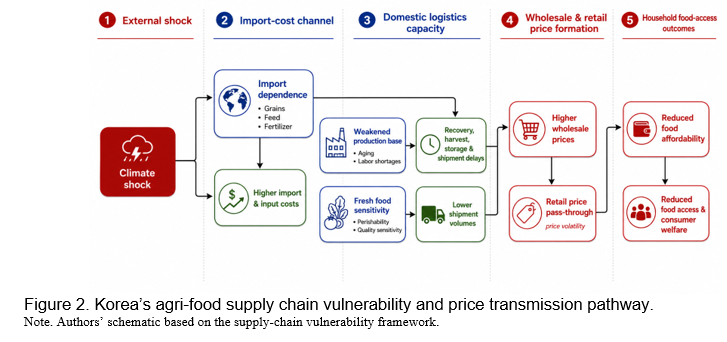
Korea is instructive for Asian readers not as a model of completed resilience, but as a warning case: even a country with advanced administrative and digital capacity remains exposed when climate, import, logistics, market, and welfare data are not governed as one risk system. Korea has sophisticated public institutions and strong data infrastructure, yet its agri-food supply chain can still transmit climate hazards into price instability and consumer welfare losses. Three vulnerabilities overlap: high import dependence on raw inputs, a weakening domestic production base, and the climate sensitivity and low storability of fresh foods.
Figure 2 summarizes this transmission pathway by connecting external climate shocks, import-cost exposure, domestic logistics capacity, wholesale and retail price formation, and household food-access outcomes.
The first vulnerability is high overseas dependence. In 2022, Korea’s food self-sufficiency rate stood at 49.3%, while the grain self-sufficiency rate was only 40.5% (Ministry of Agriculture, Food and Rural Affairs [MAFRA], 2023). This stark deficit leaves the domestic market highly sensitive to external disruptions such as overseas weather disasters, geopolitical conflicts, export restrictions, and energy spikes. Because Korea relies heavily on imported grains, feed, edible oils, and fertilizers, global shocks directly escalate import prices and domestic production costs, which subsequently pass through to downstream livestock, processed foods, and dining-out sectors. Specifically, for these import-dependent items, Korea’s food-security risk operates long before commodities even reach domestic wholesale markets; the ultimate supply cost and timing are heavily shaped by a multi-stage pipeline across upstream procurement, global maritime logistics, and domestic distribution.
The second vulnerability is the weakening domestic production base. According to the 2024 Agriculture, Forestry and Fisheries Survey, Korea’s farm population fell to about 2 million, and people aged 65 or older accounted for 55.8% (Statistics Korea, 2025). Population decline, aging, and labor shortages reduce the system’s ability to harvest, sort, store, and ship products quickly after heatwaves, heavy rainfall, or typhoons. In a climate-crisis setting, labor capacity is therefore not only a rural-demography issue; it is a supply-chain resilience issue.
The third vulnerability is climate sensitivity and low storability of fresh foods. KDI’s analysis suggests that unexpected weather changes can amplify fresh-food price volatility. Because fresh foods have short storage periods and limited substitutes, supply shocks are difficult to buffer and are quickly felt by consumers (KDI Journal of Economic Policy, 2025). Napa cabbage and other fresh vegetables, for example, can show much larger price volatility than rice. Domestic fresh-food shocks are often amplified not only by reduced harvest volume but also by post-harvest bottlenecks such as cold-storage availability, shipment coordination, and local delivery capacity.
These vulnerabilities directly affect consumer welfare. In an economy with high import dependence and a weakening production base, higher costs for energy, transport, storage, and raw materials can quickly reach households through retail prices. Korea’s agri-food supply-chain problem is therefore not only whether food exists in the market, but whether consumers can afford healthy and stable diets. The healthy-diet affordability indicator in FAO SOFI 2024 reinforces this point: physical availability does not guarantee real access when prices and incomes move in opposite directions.
This diagnosis defines Korea’s policy gap. Climate prediction, import procurement, cold-chain logistics, wholesale-market monitoring, and food-access protection cannot be managed as separate policy worlds. The next section therefore evaluates whether existing Korean policy instruments are sufficient for multi-layered supply stability, price volatility, and consumer welfare under compound climate and logistics shocks. The question is no longer whether Korea has policies, but whether those policies can detect and manage potential food-security risks early enough, before shortages and affordability pressures become visible.
EVALUATION OF EXISTING POLICIES
Current supply and price stabilization policies
Analytically, food security should be distinguished from narrower objectives such as supply stabilization, price stabilization, and food access. Supply stabilization concerns physical availability through production, imports, and reserves. Price stabilization concerns volatility and affordability. Food access concerns whether vulnerable households can obtain nutritious food. Food security integrates all four dimensions - availability, access, utilization, and stability - and asks whether the system can function under stress.
This distinction matters because agri-food is an essential good whose consumption is difficult to reduce when prices rise. Lower-income households spend a larger share of their budgets on food, so price shocks are regressive. In 2024, Korea’s fresh-food prices rose 9.8% year on year, about four times the overall consumer inflation rate of 2.3% (Statistics Korea, 2024). In a system where shocks accumulate along the supply chain, fixing a single point rarely contains the prices consumers face.
Korea’s traditional agri-food policy mix still leans toward agricultural marketing and price-stabilization mechanisms. These tools remain necessary, but they tend to intervene at visible pressure points after stresses have appeared. Under climate-crisis conditions, this is not enough. To manage compound shocks, the policy system must break down institutional silos and connect agricultural agencies such as MAFRA and aT (Korea Agro-Fisheries & Food Trade Corporation) with macro-finance, customs, meteorology, maritime logistics, local governments, and welfare administration.
Such coordination must follow the physical pathway of risk. Climate shocks pass through production, storage, processing, transport, wholesale, retail, and consumption. Korea already has policies across these stages, but they are distributed across ministries, commodities, and program units. Before judging whether the system is adequate, it is necessary to map where each policy operates, what purpose it serves, and which actor is responsible.
Table 1 maps government policies along two axes: supply-chain stage and policy purpose. From production to transport, many instruments focus on infrastructure, farm income, or supply volume. At the wholesale stage, institutional reform and distribution efficiency become more visible. At retail and consumption stages, price-burden relief and food access are more prominent. The blank cells are informative. Some reflect natural mismatches, such as the absence of vulnerable-group access instruments at production stage. Others reveal genuine gaps, especially where supply and food-security measures cover storage or processing but leave transport and logistics less explicitly governed.
The policy instruments can also be grouped into four functional categories: structural food-security instruments such as strategic crops, domestic production-base support, and reserves; risk-management instruments such as disaster insurance, revenue insurance, and early warning; market-stabilization instruments such as reserve release, tariff-rate quota, discount support, and online wholesale markets; and welfare/access instruments such as agri-food vouchers, Nutrition Plus, Food Bank support, and school meals.
The important point is that many instruments are present, but their data and feedback loops are not sufficiently integrated. Even when responsibility is concentrated within MAFRA, effectiveness can decline if planning, implementation, monitoring, and evaluation remain separated by commodity, agency, or supply-chain stage. This stage-to-stage disconnection is the core governance problem discussed below.
In sum, Korea already possesses supply and price stabilization instruments across every stage of the supply chain. However, the existence of instruments should not be mistaken for preparedness. The core issue is whether existing policies are fit for climate-crisis conditions and potential food-security risks. The following section reviews the achievements and limitations of current policies and identifies the strategic directions required for comprehensive policy enhancement.
Table 1. Food supply and price stabilization policies, by supply-chain stage and policy purpose. The table maps how existing instruments are distributed across stages and where coordination gaps appear under climate-related compound shocks; note that this is not an exhaustive list of policies.
|
Stage
|
Farm income & management stability
|
Supply & food security
|
Distribution & processing efficiency
|
Consumer price stability
|
Access for
vulnerable groups
|
|
Production
|
Public direct payment, crop disaster & agricultural revenue insurance (MAFRA)
|
Strategic crops direct payments, vegetable price stabilization (MAFRA)
|
–
|
–
|
–
|
|
Storage
|
–
|
Public stockholding (MAFRA),
vegetable procurement & stockpiling (aT)
|
–
|
–
|
–
|
|
Processing
|
–
|
–
|
Rice-flour & wheat industry support (MAFRA)
|
–
|
–
|
|
Transport
|
–
|
–
|
Smart APC hubs,
cold chain (MAFRA)
|
–
|
–
|
|
Wholesale
|
–
|
Price & supply monitoring (MAFRA·aT)
|
Online wholesale market (MAFRA·aT),
Agri-Fishery Products Distribution & Price Stabilization Act
(National Assembly)
|
–
|
–
|
|
Retail
|
–
|
–
|
Local food & direct sales (MAFRA)
|
Discount support and country-of-origin labeling (MAFRA); tariff-rate quota (MOEF)
|
–
|
|
Consumption
|
–
|
–
|
–
|
–
|
Agri-food voucher (MAFRA),
Nutrition Plus (MOHW),
food bank (MAFRA),
school meal program (MOE)
|
Note. – indicates no major dedicated instrument at that stage × purpose. Abbreviations: MAFRA = Ministry of Agriculture, Food and Rural Affairs; MOEF = Ministry of Economy and Finance; MOHW = Ministry of Health and Welfare; MOE = Ministry of Education; aT = Korea Agro-Fisheries and Food Trade Corporation.
Source. Compiled by the authors based on materials from MAFRA, MOEF, and National Assembly Budget Office (NABO).
Achievements and limitations of existing policies
Existing policies have achieved results in ordinary short-term price stabilization and damage compensation. Yet those achievements should not obscure the larger preparedness gap. Korea’s policy framework remains more effective at managing visible disturbances than at anticipating how climate, logistics, import, and household-access risks may interact before a crisis is publicly recognized.
The first limitation is reactivity. Reserve releases, insurance, tariff-rate quotas, and discount support generally operate after a shock has materialized. Korea does have an early-warning system: KREI’s Agricultural Outlook Information Center has operated a four-level alert system since 2014 (KREI, 2014). However, activation criteria, operating methods, and data reliability have limited its ability to trigger agile responses. In 2024, some supply-and-demand plans relied on normal-year temperature assumptions, but actual temperatures exceeded those assumptions and harvests fell short of expectations (KMA, 2025). This illustrates the risk of managing a climate-abnormal world with normal-year administrative routines.
A second limitation is weak end-to-end data visibility across the food supply chain. When data infrastructures are not linked, policy decisions rely on fragmented information and systemic volatility is detected late. The informational gap between regional Agricultural Processing Centers (APCs) and central wholesale markets illustrates the problem. Individual APCs may use localized digital tracking, but these platforms are not yet connected to a nationwide, standardized logistics data grid. Without real-time visibility into in-transit volumes and processing backlogs, localized bottlenecks can be mistaken for wider supply shortages, amplifying wholesale-market volatility and price instability (aT, 2024).
The third limitation concerns fiscal incidence and policy efficiency. Revenue losses from tariff-rate quotas rose from USD 317 million to USD 1.05 billion, of which 66.2% was directed toward price and supply stabilization (NABO, 2025). If a substantial portion of tariff cuts remains with intermediate participants in the supply chain, as suggested by KDI and NABO analyses, the policy cannot be judged only by the size of fiscal sacrifice. It must be judged by timing, pass-through, incidence, targeting, and consumer-visible effects. From an agricultural-economics perspective, tariff-rate quotas, discount support, reserve releases, and food-welfare programs should be compared through a common evaluation framework.
Korea’s current policy system therefore offers a cautionary diagnosis. It has many instruments and considerable administrative capacity, but those instruments remain better at ex-post response than anticipatory risk management. Current policies should not be presented as sufficient. They should be reinforced with greater predictability, precision, coordination, and evaluability. The policy shift should address concrete governance gaps: disconnected data, delayed warning, weak scenario comparison, slow central-local coordination, and limited evaluation of policy incidence and cost-effectiveness.
Table 2. Achievements and key limitations of major policy instruments.
|
Policy instrument
|
Achievement
|
Key limitation
|
Key evaluation concern
|
|
Public stockholding
& release
|
Used to support stabilization of wholesale cabbage prices in autumn 2024 alongside harvest recovery
|
Assumes normal-year temperatures, so lacks timeliness when shocks occur
|
Timeliness
|
|
Crop disaster & agricultural revenue insurance
|
About USD 0.74 billion paid out in 2024, compensating farm losses
|
Compensates after a shock, not ex ante risk management
|
Timing
|
|
Tariff-rate quota
|
Attempts to address prices by lowering import costs
|
Revenue losses rose from USD 0.3 to 1.05 billion; import-cost relief does not automatically pass through to consumer prices
|
Pass-through
|
|
Discount support for agricultural & livestock products
|
Eases short-term retail price burden
|
Reactive, beginning only after prices rise
|
Timing & fiscal efficiency
|
|
Agri-food voucher & Nutrition Plus
|
86% reported help with nutritional supplementation; directly supports vulnerable groups
|
Targeting is selective, with limited reach
|
Targeting
|
|
Online wholesale market
|
Achieved 134% of its transaction-value target
|
Improves distribution infrastructure, but remains weakly linked to early warning
|
Evaluation
|
Note. KRW are converted to USD at each year’s annual average exchange rate (Bank of Korea); USD equivalents are approximated
TOWARD AI-ENABLED ANTICIPATORY RESPONSE STRATEGIES FOR CLIMATE-RESILIENT FOOD SYSTEMS
Climate shocks, policy gaps, and the need for AI as a decision-support tool
Climate change increasingly affects food systems through multiple and interconnected pathways. Risks are no longer confined to agricultural production. They extend through storage, processing, transportation, market distribution, and consumer access. Extreme weather, rising temperatures, logistics disruptions, and market volatility can interact across these stages, amplifying food-security risks.
Although Korea operates a range of policies for food supply, price stabilization, agricultural disaster response, and food assistance, many existing measures remain fragmented by commodity, institution, and stage of the supply chain. This means Korea is not yet institutionally prepared for climate-driven food-security risks that propagate across production, logistics, imports, markets, and household food access.
This limitation shows that the key policy challenge is not the absence of individual policy instruments, but the lack of an integrated information and decision-making structure. In Korea, recent discussions on digital technologies for agricultural supply-demand management show that information is generated and used across production, storage, wholesale markets, and consumer-side distribution. However, when these data remain separated by stage or institution, it becomes difficult to see how an upstream climate or logistics shock may later become a price burden, inventory imbalance, or food-access problem. AI is relevant here because it can connect fragmented data and support earlier, cross-stage responses, but only if it is designed as public risk-governance infrastructure rather than a technology showcase. International experience points in the same direction: the World Food Program’s Prisma and SCOUT systems show how data analytics and optimization tools can support supply-chain planning, risk anticipation, sourcing, storage, delivery, and resource allocation.
The relevant role of AI is therefore not to celebrate digitalization. It is to make preparedness operational by integrating diverse datasets, identifying emerging risks, supporting policy implementation, and improving the timing and accountability of government responses. By linking information across production, supply chains, and consumer markets, AI can help policymakers move from reactive crisis management toward anticipatory food-security governance.
An integrated AI-enabled food-security platform would connect monitoring, forecasting, scenario comparison, and policy-response functions across the food system. Its value lies in helping governments see risks earlier, compare options faster, and evaluate whether interventions protect supply, prices, and food access before potential risks harden into crises.
The platform takes a whole-of-food-system approach in which production, supply-chain, and consumer risks are addressed through coordinated policy actions rather than isolated interventions. Its three modules are organized around the main points at which climate and market shocks enter, spread, and finally reach households.
Integrated AI-enabled agrifood supply chain platform
The integrated platform would translate production, supply-chain, and consumer information into coordinated anticipatory policy action. Korea already operates many policy instruments, but data on climate conditions, production, inventories, logistics, imports, prices, retail markets, and welfare demand are not yet sufficiently linked across stages and institutions. As a result, Korea cannot yet reliably trace how an upstream climate or logistics shock becomes a price burden, inventory imbalance, or food-access gap.
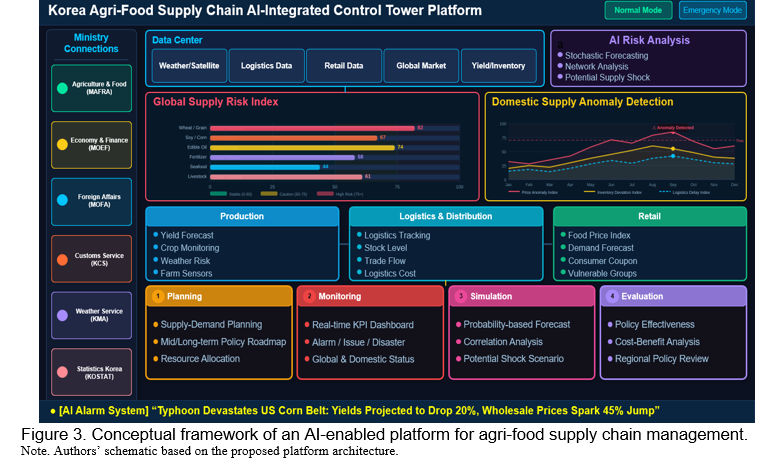
The platform would connect data and policy information managed by relevant ministries, local governments, public agencies, and private logistics, processing, distribution, and retail firms. It would not be a single forecasting model or a symbolic digital project. It would be interagency decision-support infrastructure for risk detection, policy coordination, response simulation, implementation, and evaluation.
The platform is intended to support both routine policy planning and emergency response. Under normal conditions, it can improve monitoring, forecasting, and resource allocation. During climate-related disruptions, it can provide early-warning information, support coordination among institutions, and help prevent localized shocks from developing into broader food-security challenges.
The platform can be organized into three interconnected modules. The first module focuses on agricultural production and climate-risk detection. The second module focuses on storage, processing, transportation, import-arrival risks, and domestic distribution capacity. The third module focuses on consumer protection and food access, especially for vulnerable groups affected by food-price shocks. Information from these modules would be integrated through a shared data and analytics system so that policymakers can assess how risks evolve across stages and prioritize interventions accordingly. Figure 3 presents the conceptual framework of the proposed AI-enabled food-security platform.
Module 1: AI-enabled production risk detection
The production module is the first layer of the platform because climate-related risks often appear at the production stage before moving through the wider food system. Early identification of yield loss, quality deterioration, harvest instability, and climate-related disruptions are essential not only for farm management but also for preventing downstream impacts on supply chains, markets, and consumer welfare.
AI can support a shift from reactive compensation toward proactive risk management. By integrating meteorological observations, climate forecasts, satellite imagery, crop-condition monitoring, and farm-level data, AI can strengthen production-risk assessment and support crop insurance, reserve planning, emergency imports, direct-payment programs, and farmer advisory services.
Since climate risks differ in predictability, this module should distinguish between slow-onset climate change and extreme events. Slow-onset risks, including long-term changes in temperature and precipitation patterns, can be monitored through AI-based analysis of climate and agricultural datasets. Such information can support long-term adaptation planning, cultivation-zone management, and seasonal production forecasting.
In contrast, extreme events and compound shocks—including typhoons, floods, heatwaves, droughts, and pest outbreaks—often require rapid detection rather than precise long-range prediction. AI-enabled monitoring using satellite imagery, drones, remote sensing, and anomaly-detection algorithms can accelerate damage assessment and improve the timeliness of emergency response.
Within the integrated platform, the production module should feed directly into crop-insurance triggers, reserve planning, emergency import decisions, local disaster support, and guidance for farmers and producer organizations. To support responsible decision-making, AI outputs should also include uncertainty estimates, false alarm protocols, and transparent communication procedures.
Module 2: AI-enabled midstream supply chain management
The midstream module focuses on the operational systems that determine whether climate-related disruptions are absorbed or amplified before they reach consumers. Production shocks do not automatically become consumer price shocks. Storage, processing, transportation, import systems, and distribution networks can either buffer disruptions or intensify them. The supply chain is therefore the transmission channel through which production risks become market instability, food-price volatility, and food-security challenges.
For Korea, effective midstream management requires the integration of both international and domestic logistics systems. Internationally, risks can emerge from freight-rate volatility, import delays, port congestion, disruptions to global sourcing networks, and changing trade conditions. Domestically, storage capacity, processing systems, transportation networks, wholesale-market operations, and retail inventories influence how shocks are transmitted throughout the food system. Fragmented information systems often make it difficult to identify emerging supply-chain risks in real time, creating a need for integrated monitoring and decision-support systems capable of detecting risks before they spread across multiple stages of the supply chain.
Within this module, AI functions as a decision-support tool for operational risk management. In storage systems, it can identify spoilage risks, abnormal inventory conditions, and cold-chain vulnerabilities by integrating sensors, warehouse, and inventory data. In processing stages, it can anticipate cost pressures associated with raw materials and energy use. In transportation and logistics, it can detect bottlenecks by combining weather information, port conditions, freight movements, customs data, and distribution records. These insights can help policymakers prioritize reserve releases, emergency logistics support, inventory transfers, and alternative import or distribution options before shortages become visible in consumer markets.
By enabling earlier interventions, AI can help shift supply-chain management from a reactive approach toward a more preventive and resilient system (OECD, 2020). Within the integrated platform, this module connects global supply-chain signals, national import management, and local logistics execution so that risks can be identified early and coordinated across policy responses. By reducing spoilage, food loss, and logistics inefficiencies, it also contributes to SDG 12 (Responsible Consumption and Production) and strengthens food-system resilience under climate-related risks.
Module 3: AI-enabled distribution, consumption, and vulnerable-group response
The consumer module is the final layer of the integrated food-security platform. It focuses on the point at which climate-related disruptions become visible through prices, affordability, availability, and food access. Its objective is to ensure that food-security policy protects consumers, especially vulnerable households, from downstream shocks.
Climate-related disruptions move through production, storage, processing, transportation, wholesale, and retail markets before reaching consumers. Existing policy measures—including reserve releases, tariff adjustments, discount programs, food vouchers, Nutrition Plus initiatives, and Food Banks—remain important, but their impacts are not always coordinated across market and welfare systems. This module therefore addresses three interconnected policy gaps: the quantity gap, the price gap, and the access gap.
The quantity gap occurs when supply and demand are not coordinated in real time. AI-based demand forecasting and surplus-food matching can integrate wholesale transactions, retail sales, inventories, weather conditions, and welfare demand to identify emerging shortages or surpluses and support reserve releases, substitute supply arrangements, and stock redistribution.
The price gap reflects the difference between market stabilization and actual consumer relief. Wholesale-price declines do not always translate into lower retail prices, and benefits may not reach vulnerable households evenly. AI-based price-burden analysis can combine wholesale and retail prices, household food expenditure, and nutritional data to identify high-risk households and regions while evaluating whether market-price stabilization is effectively reaching consumers. Such analysis can support more targeted consumer-assistance programs and improve the allocation of limited public resources.
The access gap arises when food-support programs exist, but practical barriers continue to limit food access. These barriers may include geographic distance, delivery constraints, information gaps, physical accessibility limitations, or limited availability of suitable food options. AI-enabled welfare coordination can integrate voucher systems, retailer accessibility, Food Bank inventories, delivery availability, household characteristics, and nutritional needs to improve program effectiveness. Policy design should distinguish between economic, geographic, physical, and nutritional vulnerabilities rather than treating vulnerable groups as a single category.
AI-enabled consumer support should prioritize service-gap detection, accessibility mapping, benefit-use monitoring, and outreach prioritization rather than intrusive individual profiling. Within the integrated platform, this module links market conditions with food welfare, nutritional adequacy, and consumer protection. It helps policy move beyond production volume, import volume, or wholesale price indicators toward the household-level question that ultimately matters: who can obtain a healthy diet when shocks occur?
Table 3. AI-Enabled Response Strategies Across the Agri-Food Supply Chain
|
Strategy
|
Supply-chain stage
|
Policy gap
addressed
|
AI function and data inputs
|
Policy contribution
|
|
Strategy 1: Production Risk Detection
|
Production
|
Climate risks are often detected after yield loss, quality decline, or harvest instability has already occurred.
|
Use climate data, crop data, satellite images, drone data, and sensor-based anomaly detection for probabilistic early warning with uncertainty communication
|
Shifts production policy from ex-post compensation toward earlier risk detection, timely response, and proactive supply planning.
|
|
Strategy 2: Midstream Supply Chain Management
|
Storage, processing, import, logistics
|
Production shocks can be amplified through spoilage, processing cost increases, logistics delays, and bottlenecks.
|
Use inventory data, storage sensors, raw material prices, energy prices, weather data, port data, and logistics data plus vessel, freight, customs, APC, cold-chain, and wholesale-market data
|
Helps prevent storage, processing, and transportation risks from escalating into market-level shortages and price shocks.
|
|
Strategy 3: Downstream Consumer Response
|
Wholesale, retail, consumption
|
Price stabilization, inventory management, and food welfare programs are not always connected to actual consumer relief.
|
Use wholesale prices, retail sales, inventory records, household food expenditure, substitute food prices, and welfare demand to diagnose quantity, price, and access gaps.
|
Strengthens targeted responses to price burdens, inventory imbalances, and unequal food access for vulnerable groups.
|
|
Integrated AI-Enabled Platform
|
Entire supply chain
|
Data and policy feedback are not sufficiently connected across production, logistics, market, and welfare stages.
|
Connect climate, crop, inventory, logistics, import, price, consumption, and welfare data through an interagency decision-support platform.
|
Improves coordination, predictability, precision, and evaluability across the three strategies.
|
Government action and responsible AI use
For Korea, the challenge is not to add AI on top of existing programs, but to rebuild food-security governance around three foundations: integrated data infrastructure, responsible AI governance, and continuous evaluation.
First, implementation requires interoperable systems that integrate agriculture, climate, trade, logistics, markets, and welfare data across ministries, local governments, public agencies, and private-sector actors. Modern food-security risks span multiple institutional domains, so effective coordination requires systematic information sharing and data integration. In Korea, this means connecting agriculture, meteorology, customs, logistics, welfare, and distribution sectors while bridging global supply-chain signals with domestic market interventions.
Second, AI deployment must be supported by appropriate legal, ethical, and governance safeguards. Responsible AI use in food-security policy should include data governance, privacy protection, explainability, accountability, and accessible non-digital alternatives. Data quality itself is a policy issue, since non-standardized or biased information can generate misleading warnings and poorly targeted interventions. In this context, any household-level application should be subject to informed consent, data minimization, explainable eligibility criteria, and accessible appeal mechanisms.
Third, implementation should be phased through pilots and evaluation before nationwide deployment. Project success should be judged not only by predictive accuracy but also by supply-chain resilience, fiscal efficiency, consumer protection, food-security outcomes, and public trust. Governments also need local capacity, standardized tools, common data protocols, and non-digital alternatives. AI can strengthen climate-driven food-security governance only when technological innovation is embedded in institutions that remain accountable to citizens.
POLICY INSIGHTS FOR ASIAN COUNTRIES
Korea’s experience offers five lessons for Asian countries seeking to strengthen climate-resilient food security. It should be read first as a preparedness warning. Even when a country has strong institutions, price-stabilization tools, and digital capacity, those assets may remain insufficient if they do not work as an integrated anticipatory system.
Second, import dependence requires an external-shock dashboard. For economies that rely on imported grains, feed, fertilizer, edible oils, or energy, food-security risk begins before commodities arrive at domestic ports. Weather events abroad, export restrictions, freight disruptions, exchange-rate movements, and input-price shocks should be monitored together with domestic production and inventory data.
Third, fresh-food volatility is both an agricultural issue and a social-policy issue. Climate-sensitive vegetables and fruits can transmit shocks quickly to households, especially low-income consumers. Policy should therefore connect wholesale-market information, retail-price monitoring, substitute-food availability, and targeted food-access programs rather than treating price stabilization and food welfare as separate domains.
Fourth, AI is useful only when embedded in accountable institutions. It can detect anomalies, compare scenarios, and reveal where policy benefits do or do not reach consumers. But it cannot settle trade-offs among fiscal cost, farmer income, consumer prices, privacy, and equity. Asian governments should therefore build AI systems as public decision-support infrastructure with explainability, data governance, appeal mechanisms, and non-digital service channels.
Finally, Korea should be read less as a model to copy than as a stress test and early warning. Its experience shows that even countries with advanced data systems and active policy instruments can remain vulnerable when climate, logistics, import, price, and welfare risks are governed separately. The central lesson for Asia is not that Korea has solved the problem, but that Korea now has to build the next generation of AI-enabled anticipatory food-security governance.
CONCLUSION
In the climate-crisis era, food security can no longer be understood only as stable production or emergency price stabilization. Climate shocks now move through global trade, logistics, input markets, domestic production, retail prices, and household food access. Korea illustrates this challenge clearly. Existing policy tools such as reserve management, tariff-rate quotas, crop insurance, online wholesale markets, consumer discount support, and food-welfare programs remain indispensable, but they are not enough to manage potential food-security risks under compound climate and supply-chain shocks.
For import-dependent Asian economies facing aging farm populations, climate-sensitive fresh-food markets, global logistics exposure, and growing welfare concerns, Korea’s case offers a practical warning rather than a success story. Advanced institutions do not automatically produce system-level resilience when data and authority remain fragmented. The policy direction is to build an AI-enabled decision-support platform that connects production-risk detection, midstream bottleneck management, and downstream consumer protection within a common framework. In increasingly complex food supply chains, AI can serve as governance infrastructure that makes policy responses more anticipatory, precise, coordinated, and evaluable.
The value of AI therefore lies not in replacing public decision-makers or displaying technological capacity, but in strengthening governments’ capacity to anticipate risks, compare options, evaluate policy incidence, and communicate uncertainty. Final authority should remain with public institutions. The most important lesson from Korea is institutional rather than technological: climate-resilient food security remains an unfinished governance agenda that requires data integration, cross-agency cooperation, privacy protection, explainability, and public accountability.
REFERENCES
Bezner Kerr, R. et al., 2022. “Food, Fibre, and Other Ecosystem Products.” Climate Change 2022: Impacts and Vulnerability, 713–906. Intergovernmental Panel on Climate Change.
Deconinck, K. et al., 2023. “OECD Food, Agriculture and Fisheries Papers No. 205.” OECD Food, Agriculture and Fisheries Papers, 205, 1–40. OECD Publishing.
Dietterich, L. H. et al., 2015. “Impacts of Elevated Atmospheric CO₂ on Nutrient Content of Important Food Crops.” Scientific Data, 2, 150036.
Food and Agriculture Organization. (2024). The State of Food Security and Nutrition in the World 2024: Financing to end hunger, food insecurity and malnutrition in all its forms. Rome: Author.
Food and Fertilizer Technology Center for the Asian and Pacific Region Agricultural Policy Platform (FFTC-AP), 2025. “Major Ten Agri-food Policy Issues in South Korea 2025.”
International Energy Agency (IEA), 2022. “Correlation between Urea Fertiliser and Food Price Indices, 2016–2022.”
Korea Development Institute (KDI), 2025. “Effects of Weather Conditions on Prices in Korea.” KDI Journal of Economic Policy, Vol. 47, No.4, pp. 131–158.
Korea Development Institute (KDI), 2025. “Price Stabilization Effects of the 2022 Tariff-Rate Quota, by Item.”
Korea Meteorological Administration (KMA), 2025. “2024 Abnormal Climate Report.” Joint Report of Related Ministries, April 2025.
Korea Rural Economic Institute (KREI), 2011. “A Study on Measures to Stabilize Vegetable Supply, Demand, and Prices.”
Korea Rural Economic Institute (KREI), Agricultural Outlook Information Center, 2014. “Establishment and Operation of an Early-Warning System for International Grains.”
Korea Agri-Fisheries & Food Trade Corporation (aT), 2024. Annual Report on Agricultural Logistics and Supply Chain Data Infrastructure. Naju, South Korea: aT.
Korea Rural Economic Institute (KREI), 2013. “Evaluation of the Impact of Agricultural Product Prices on Inflation and Its Implications.”
Korea Rural Economic Institute (KREI), 2019. “Current Status and Challenges of Agricultural Product Logistics and Product Standardization in the Global Era.”
Korean National Legal Information Center, 2025. Enforcement Decree of the Framework Act on Supporting Supply Chain Stabilization for Economic Stability.
Ministry of Agriculture, Food and Rural Affairs (MAFRA), (2023). 2023 Principal Statistics of Agriculture, Food and Rural Affairs. Sejong: Author.
Ministry of Agriculture, Food and Rural Affairs (MAFRA), 2024a. “Briefing Materials on Autumn Vegetable Supply-and-Demand Stabilization Measures.” October 2024.
Ministry of Agriculture, Food and Rural Affairs (MAFRA), 2024b. “Improvement Plan for the Rice-Flour Industry Promotion Policy.” December 2024.
Ministry of Agriculture, Food and Rural Affairs (MAFRA), 2025a. “2024 Crop Disaster Insurance Payouts.” Press Release, February 3, 2025.
Ministry of Agriculture, Food and Rural Affairs (MAFRA), 2025b. “Results of the 2024 Agri-food Voucher Pilot Project.”
Ministry of Agriculture, Food and Rural Affairs (MAFRA), 2025c. “2024 Operating Results of the Online Wholesale Market for Agricultural and Fishery Products.”
Myers, S. S. et al., 2014. “Increasing CO₂ Threatens Human Nutrition.” Nature, 510, 139–142. https://doi.org/10.1038/nature13179
National Assembly Budget Office (NABO), 2025. “Current Status of Tariff-Rate Quota Operation and Tasks for Improvement.” NABO Focus No. 114.
Organization for Economic Co-operation and Development (OECD), 2020. “Strengthening Agricultural Resilience in the Face of Multiple Risks.” OECD Report. OECD Publishing.
Organization for Economic Co-operation and Development (OECD), 2022. “The Impacts and Policy Implications of Russia’s Aggression Against Ukraine on Agricultural Markets.” OECD Policy Responses on the Impacts of the War in Ukraine. OECD Publishing.
Organization for Economic Co-operation and Development (OECD), 2024. Digitalisation in Agriculture and Food Systems.
Statistics Korea (KOSTAT), 2024. “Consumer Price Trends for December and Annual 2024.” December 31, 2024.
Statistics Korea (KOSTAT), 2025. “2024 Agriculture, Forestry and Fisheries Survey Results.” April 2025.
United Nations Food Systems Coordination Hub, 2025. “Global Food Systems Transformation 2025.” United Nations Food Systems Coordination Hub Report. United Nations.


AI-Enabled Agri-Food Supply Chain Governance in the Era of Climate and Food Crises: Korea’s Policy Gaps, Anticipatory Risk Management, and Lessons
ABSTRACT
Using Korea as a policy case, this article examines why an import-dependent but digitally capable Asian economy must prepare for climate-driven food-system shocks before they become visible food-security risks. Korea’s recent experience should not be read as a success story. It points instead to a double vulnerability: dependence on overseas feed, grain, fertilizer, and edible-oil supply chains exposes domestic markets to global weather, logistics, and geopolitical shocks, while an aging production base and climate-sensitive fresh foods transmit local weather quickly into consumer prices. Existing instruments - stockholding, tariff-rate quotas, insurance, discount support, online wholesale markets, and food-welfare programs - remain indispensable, but they are not sufficient for a climate-risk environment in which shocks move across production, logistics, markets, and household food access. They still operate more as post-shock stabilizers than as an integrated anticipatory system. This paper argues that Korea needs Artificial Intelligence (AI) not as an automated decision-maker, but as public decision-support infrastructure for earlier risk detection, cross-stage coordination, scenario comparison, and policy evaluation. The resulting policy architecture links production-risk detection, midstream supply-chain management, and downstream consumer-response modules. For Asian countries facing similar import dependence, aging rural labor, fresh-food volatility, and food-access concerns, Korea’s case offers a practical warning: food-security policy in the climate-crisis era must move beyond commodity-by-commodity stabilization toward system-level resilience that anticipates potential risks before they become household-level food-security problems.
Keywords: climate crisis, agri-food supply chain, price shock, AI-enabled policy, integrated AI platform, food access, Korean policy case, food security
BACKGROUND AND POLICY CONTEXT
Climate crisis and cascading risks in food systems
The climate crisis is no longer only a farm-level production problem; it has become a cascading food-system risk. Food systems integrate production, storage, processing, distribution, trade, wholesale, retail, and consumption, while food environments are shaped by prices, income, and physical accessibility. Climate shocks such as heatwaves, droughts, floods, and pests do not remain localized. They reduce output and quality, move through storage, processing, transportation, and trade networks, and create broader disruptions. Food security consequently depends not only on whether enough food is produced, but also on whether food moves, remains affordable, and reaches consumers in usable form.
In this article, food security is understood through four interrelated dimensions: availability, access, utilization, and stability. Availability refers to production, imports, and reserves; access refers to prices, income, physical access, and welfare support; utilization refers to nutrition, quality, and food safety; and stability refers to the capacity of these dimensions to withstand climate, logistics, geopolitical, and market shocks. This framework matters because climate change affects food security through multiple stages rather than through production alone. Climate hazards therefore need to be assessed as system-wide risks, not as isolated farm-level events.
The key policy issue is how climate hazards travel across the food system. Heatwaves reduce yields and quality while increasing labor-safety risks and cold-chain demand; droughts weaken irrigation and can constrain shipping; floods and typhoons damage crops, roads, ports, and storage facilities. These hazards differ in form, but they share one feature: a disruption beginning at one stage can move across connected supply chains and threaten availability, affordability, utilization, and stability at the same time.
The first transmission pathway is the weakening of the production base. According to the IPCC AR6, human-induced warming negatively affected agricultural productivity, crop quality, and harvest stability, especially in mid- and low-latitude regions. These impacts result from the interaction of multiple stressors rather than a single factor. Heat stress, drought, ozone, pests and diseases, and soil degradation amplify crop vulnerability and increase harvest uncertainty. In addition, climate change affects not only the quantity of food produced but also its nutritional quality. Declining protein concentrations in grains and legumes extend the challenge from calorie shortages to nutritional imbalance and hidden hunger. In short, climate change poses risks to both food quantity and food quality.
The second pathway is supply-chain amplification after production shocks. Reduced agricultural output and quality destabilize the supply of raw material for storage, sorting, and processing. At the same time, higher temperatures and humidity increase spoilage, food waste, refrigeration demand, and storage costs. When raw material supply becomes unstable, processing efficiency declines, while rising energy prices further increase operational expenses. Climate-related disruptions also create bottlenecks in logistics and trade networks. Floods, canal droughts, and port congestion can delay shipments and increase freight costs. These pressures then move downstream to wholesale, retail, and consumer stages, where higher procurement and distribution costs are reflected in consumer prices. As a result, localized production shocks can be transmitted through interconnected supply chains and emerge as broader market and price disruptions.
This amplification occurs because food systems operate as interdependent networks of nodes, links, buffers, and substitution capacities. Farms, processing plants, ports, shipping routes, cold chains, inventory systems, and data flows are connected. When one node or link is compromised, buffers can be depleted and substitution options can become costly or slow. A local climate event can therefore become a national supply-chain and market shock when the system lacks visibility, flexibility, and coordinated response capacity.
When internal network vulnerabilities intersect with global market conditions, cascading risks take three main supply-chain forms. First, climate production shocks occur when heatwaves, droughts, or floods reduce harvest volumes and trigger export restrictions or global grain-price spikes. India’s heatwave and subsequent wheat export restrictions show how domestic production losses can travel through international trade channels and affect import-dependent countries. Second, climate logistics shocks emerge when environmental disruptions damage critical transportation networks and strategic chokepoints. The Panama Canal drought demonstrates how reduced water levels and shipping restrictions can disrupt logistics far beyond the affected region. Third, geopolitical resource shocks occur when war, trade conflicts, and energy instability aggravate input-market vulnerabilities. The Russia-Ukraine war shows how geopolitical shocks can spread simultaneously through agricultural input markets and grain trade, driving severe food inflation.
Figure 1 traces this cascading pathway from climate drivers to food-security outcomes. It shows how production and quality shocks can spread through storage, processing, logistics, trade, and markets before affecting prices, access, livelihoods, and nutrition. The global examples are not isolated episodes. They clarify the types of external and domestic shocks that import-dependent Asian economies, including Korea, must now incorporate into food-price and supply-stabilization policy.
These examples show that climate risk is increasingly transmitted through globalized food systems rather than through local production alone. For Korea, this is not a distant problem observed in other countries. A high-income economy with advanced digital infrastructure can still face potential food-security risks if import dependence, climate-sensitive fresh foods, logistics bottlenecks, and vulnerable consumers are managed through separate policy channels.
Domestic supply chain vulnerability, price shocks, and consumer welfare
Korea is instructive for Asian readers not as a model of completed resilience, but as a warning case: even a country with advanced administrative and digital capacity remains exposed when climate, import, logistics, market, and welfare data are not governed as one risk system. Korea has sophisticated public institutions and strong data infrastructure, yet its agri-food supply chain can still transmit climate hazards into price instability and consumer welfare losses. Three vulnerabilities overlap: high import dependence on raw inputs, a weakening domestic production base, and the climate sensitivity and low storability of fresh foods.
Figure 2 summarizes this transmission pathway by connecting external climate shocks, import-cost exposure, domestic logistics capacity, wholesale and retail price formation, and household food-access outcomes.
The first vulnerability is high overseas dependence. In 2022, Korea’s food self-sufficiency rate stood at 49.3%, while the grain self-sufficiency rate was only 40.5% (Ministry of Agriculture, Food and Rural Affairs [MAFRA], 2023). This stark deficit leaves the domestic market highly sensitive to external disruptions such as overseas weather disasters, geopolitical conflicts, export restrictions, and energy spikes. Because Korea relies heavily on imported grains, feed, edible oils, and fertilizers, global shocks directly escalate import prices and domestic production costs, which subsequently pass through to downstream livestock, processed foods, and dining-out sectors. Specifically, for these import-dependent items, Korea’s food-security risk operates long before commodities even reach domestic wholesale markets; the ultimate supply cost and timing are heavily shaped by a multi-stage pipeline across upstream procurement, global maritime logistics, and domestic distribution.
The second vulnerability is the weakening domestic production base. According to the 2024 Agriculture, Forestry and Fisheries Survey, Korea’s farm population fell to about 2 million, and people aged 65 or older accounted for 55.8% (Statistics Korea, 2025). Population decline, aging, and labor shortages reduce the system’s ability to harvest, sort, store, and ship products quickly after heatwaves, heavy rainfall, or typhoons. In a climate-crisis setting, labor capacity is therefore not only a rural-demography issue; it is a supply-chain resilience issue.
The third vulnerability is climate sensitivity and low storability of fresh foods. KDI’s analysis suggests that unexpected weather changes can amplify fresh-food price volatility. Because fresh foods have short storage periods and limited substitutes, supply shocks are difficult to buffer and are quickly felt by consumers (KDI Journal of Economic Policy, 2025). Napa cabbage and other fresh vegetables, for example, can show much larger price volatility than rice. Domestic fresh-food shocks are often amplified not only by reduced harvest volume but also by post-harvest bottlenecks such as cold-storage availability, shipment coordination, and local delivery capacity.
These vulnerabilities directly affect consumer welfare. In an economy with high import dependence and a weakening production base, higher costs for energy, transport, storage, and raw materials can quickly reach households through retail prices. Korea’s agri-food supply-chain problem is therefore not only whether food exists in the market, but whether consumers can afford healthy and stable diets. The healthy-diet affordability indicator in FAO SOFI 2024 reinforces this point: physical availability does not guarantee real access when prices and incomes move in opposite directions.
This diagnosis defines Korea’s policy gap. Climate prediction, import procurement, cold-chain logistics, wholesale-market monitoring, and food-access protection cannot be managed as separate policy worlds. The next section therefore evaluates whether existing Korean policy instruments are sufficient for multi-layered supply stability, price volatility, and consumer welfare under compound climate and logistics shocks. The question is no longer whether Korea has policies, but whether those policies can detect and manage potential food-security risks early enough, before shortages and affordability pressures become visible.
EVALUATION OF EXISTING POLICIES
Current supply and price stabilization policies
Analytically, food security should be distinguished from narrower objectives such as supply stabilization, price stabilization, and food access. Supply stabilization concerns physical availability through production, imports, and reserves. Price stabilization concerns volatility and affordability. Food access concerns whether vulnerable households can obtain nutritious food. Food security integrates all four dimensions - availability, access, utilization, and stability - and asks whether the system can function under stress.
This distinction matters because agri-food is an essential good whose consumption is difficult to reduce when prices rise. Lower-income households spend a larger share of their budgets on food, so price shocks are regressive. In 2024, Korea’s fresh-food prices rose 9.8% year on year, about four times the overall consumer inflation rate of 2.3% (Statistics Korea, 2024). In a system where shocks accumulate along the supply chain, fixing a single point rarely contains the prices consumers face.
Korea’s traditional agri-food policy mix still leans toward agricultural marketing and price-stabilization mechanisms. These tools remain necessary, but they tend to intervene at visible pressure points after stresses have appeared. Under climate-crisis conditions, this is not enough. To manage compound shocks, the policy system must break down institutional silos and connect agricultural agencies such as MAFRA and aT (Korea Agro-Fisheries & Food Trade Corporation) with macro-finance, customs, meteorology, maritime logistics, local governments, and welfare administration.
Such coordination must follow the physical pathway of risk. Climate shocks pass through production, storage, processing, transport, wholesale, retail, and consumption. Korea already has policies across these stages, but they are distributed across ministries, commodities, and program units. Before judging whether the system is adequate, it is necessary to map where each policy operates, what purpose it serves, and which actor is responsible.
Table 1 maps government policies along two axes: supply-chain stage and policy purpose. From production to transport, many instruments focus on infrastructure, farm income, or supply volume. At the wholesale stage, institutional reform and distribution efficiency become more visible. At retail and consumption stages, price-burden relief and food access are more prominent. The blank cells are informative. Some reflect natural mismatches, such as the absence of vulnerable-group access instruments at production stage. Others reveal genuine gaps, especially where supply and food-security measures cover storage or processing but leave transport and logistics less explicitly governed.
The policy instruments can also be grouped into four functional categories: structural food-security instruments such as strategic crops, domestic production-base support, and reserves; risk-management instruments such as disaster insurance, revenue insurance, and early warning; market-stabilization instruments such as reserve release, tariff-rate quota, discount support, and online wholesale markets; and welfare/access instruments such as agri-food vouchers, Nutrition Plus, Food Bank support, and school meals.
The important point is that many instruments are present, but their data and feedback loops are not sufficiently integrated. Even when responsibility is concentrated within MAFRA, effectiveness can decline if planning, implementation, monitoring, and evaluation remain separated by commodity, agency, or supply-chain stage. This stage-to-stage disconnection is the core governance problem discussed below.
In sum, Korea already possesses supply and price stabilization instruments across every stage of the supply chain. However, the existence of instruments should not be mistaken for preparedness. The core issue is whether existing policies are fit for climate-crisis conditions and potential food-security risks. The following section reviews the achievements and limitations of current policies and identifies the strategic directions required for comprehensive policy enhancement.
Table 1. Food supply and price stabilization policies, by supply-chain stage and policy purpose. The table maps how existing instruments are distributed across stages and where coordination gaps appear under climate-related compound shocks; note that this is not an exhaustive list of policies.
Stage
Farm income & management stability
Supply & food security
Distribution & processing efficiency
Consumer price stability
Access for
vulnerable groups
Production
Public direct payment, crop disaster & agricultural revenue insurance (MAFRA)
Strategic crops direct payments, vegetable price stabilization (MAFRA)
–
–
–
Storage
–
Public stockholding (MAFRA),
vegetable procurement & stockpiling (aT)
–
–
–
Processing
–
–
Rice-flour & wheat industry support (MAFRA)
–
–
Transport
–
–
Smart APC hubs,
cold chain (MAFRA)
–
–
Wholesale
–
Price & supply monitoring (MAFRA·aT)
Online wholesale market (MAFRA·aT),
Agri-Fishery Products Distribution & Price Stabilization Act
(National Assembly)
–
–
Retail
–
–
Local food & direct sales (MAFRA)
Discount support and country-of-origin labeling (MAFRA); tariff-rate quota (MOEF)
–
Consumption
–
–
–
–
Agri-food voucher (MAFRA),
Nutrition Plus (MOHW),
food bank (MAFRA),
school meal program (MOE)
Note. – indicates no major dedicated instrument at that stage × purpose. Abbreviations: MAFRA = Ministry of Agriculture, Food and Rural Affairs; MOEF = Ministry of Economy and Finance; MOHW = Ministry of Health and Welfare; MOE = Ministry of Education; aT = Korea Agro-Fisheries and Food Trade Corporation.
Source. Compiled by the authors based on materials from MAFRA, MOEF, and National Assembly Budget Office (NABO).
Achievements and limitations of existing policies
Existing policies have achieved results in ordinary short-term price stabilization and damage compensation. Yet those achievements should not obscure the larger preparedness gap. Korea’s policy framework remains more effective at managing visible disturbances than at anticipating how climate, logistics, import, and household-access risks may interact before a crisis is publicly recognized.
The first limitation is reactivity. Reserve releases, insurance, tariff-rate quotas, and discount support generally operate after a shock has materialized. Korea does have an early-warning system: KREI’s Agricultural Outlook Information Center has operated a four-level alert system since 2014 (KREI, 2014). However, activation criteria, operating methods, and data reliability have limited its ability to trigger agile responses. In 2024, some supply-and-demand plans relied on normal-year temperature assumptions, but actual temperatures exceeded those assumptions and harvests fell short of expectations (KMA, 2025). This illustrates the risk of managing a climate-abnormal world with normal-year administrative routines.
A second limitation is weak end-to-end data visibility across the food supply chain. When data infrastructures are not linked, policy decisions rely on fragmented information and systemic volatility is detected late. The informational gap between regional Agricultural Processing Centers (APCs) and central wholesale markets illustrates the problem. Individual APCs may use localized digital tracking, but these platforms are not yet connected to a nationwide, standardized logistics data grid. Without real-time visibility into in-transit volumes and processing backlogs, localized bottlenecks can be mistaken for wider supply shortages, amplifying wholesale-market volatility and price instability (aT, 2024).
The third limitation concerns fiscal incidence and policy efficiency. Revenue losses from tariff-rate quotas rose from USD 317 million to USD 1.05 billion, of which 66.2% was directed toward price and supply stabilization (NABO, 2025). If a substantial portion of tariff cuts remains with intermediate participants in the supply chain, as suggested by KDI and NABO analyses, the policy cannot be judged only by the size of fiscal sacrifice. It must be judged by timing, pass-through, incidence, targeting, and consumer-visible effects. From an agricultural-economics perspective, tariff-rate quotas, discount support, reserve releases, and food-welfare programs should be compared through a common evaluation framework.
Korea’s current policy system therefore offers a cautionary diagnosis. It has many instruments and considerable administrative capacity, but those instruments remain better at ex-post response than anticipatory risk management. Current policies should not be presented as sufficient. They should be reinforced with greater predictability, precision, coordination, and evaluability. The policy shift should address concrete governance gaps: disconnected data, delayed warning, weak scenario comparison, slow central-local coordination, and limited evaluation of policy incidence and cost-effectiveness.
Table 2. Achievements and key limitations of major policy instruments.
Policy instrument
Achievement
Key limitation
Key evaluation concern
Public stockholding
& release
Used to support stabilization of wholesale cabbage prices in autumn 2024 alongside harvest recovery
Assumes normal-year temperatures, so lacks timeliness when shocks occur
Timeliness
Crop disaster & agricultural revenue insurance
About USD 0.74 billion paid out in 2024, compensating farm losses
Compensates after a shock, not ex ante risk management
Timing
Tariff-rate quota
Attempts to address prices by lowering import costs
Revenue losses rose from USD 0.3 to 1.05 billion; import-cost relief does not automatically pass through to consumer prices
Pass-through
Discount support for agricultural & livestock products
Eases short-term retail price burden
Reactive, beginning only after prices rise
Timing & fiscal efficiency
Agri-food voucher & Nutrition Plus
86% reported help with nutritional supplementation; directly supports vulnerable groups
Targeting is selective, with limited reach
Targeting
Online wholesale market
Achieved 134% of its transaction-value target
Improves distribution infrastructure, but remains weakly linked to early warning
Evaluation
Note. KRW are converted to USD at each year’s annual average exchange rate (Bank of Korea); USD equivalents are approximated
TOWARD AI-ENABLED ANTICIPATORY RESPONSE STRATEGIES FOR CLIMATE-RESILIENT FOOD SYSTEMS
Climate shocks, policy gaps, and the need for AI as a decision-support tool
Climate change increasingly affects food systems through multiple and interconnected pathways. Risks are no longer confined to agricultural production. They extend through storage, processing, transportation, market distribution, and consumer access. Extreme weather, rising temperatures, logistics disruptions, and market volatility can interact across these stages, amplifying food-security risks.
Although Korea operates a range of policies for food supply, price stabilization, agricultural disaster response, and food assistance, many existing measures remain fragmented by commodity, institution, and stage of the supply chain. This means Korea is not yet institutionally prepared for climate-driven food-security risks that propagate across production, logistics, imports, markets, and household food access.
This limitation shows that the key policy challenge is not the absence of individual policy instruments, but the lack of an integrated information and decision-making structure. In Korea, recent discussions on digital technologies for agricultural supply-demand management show that information is generated and used across production, storage, wholesale markets, and consumer-side distribution. However, when these data remain separated by stage or institution, it becomes difficult to see how an upstream climate or logistics shock may later become a price burden, inventory imbalance, or food-access problem. AI is relevant here because it can connect fragmented data and support earlier, cross-stage responses, but only if it is designed as public risk-governance infrastructure rather than a technology showcase. International experience points in the same direction: the World Food Program’s Prisma and SCOUT systems show how data analytics and optimization tools can support supply-chain planning, risk anticipation, sourcing, storage, delivery, and resource allocation.
The relevant role of AI is therefore not to celebrate digitalization. It is to make preparedness operational by integrating diverse datasets, identifying emerging risks, supporting policy implementation, and improving the timing and accountability of government responses. By linking information across production, supply chains, and consumer markets, AI can help policymakers move from reactive crisis management toward anticipatory food-security governance.
An integrated AI-enabled food-security platform would connect monitoring, forecasting, scenario comparison, and policy-response functions across the food system. Its value lies in helping governments see risks earlier, compare options faster, and evaluate whether interventions protect supply, prices, and food access before potential risks harden into crises.
The platform takes a whole-of-food-system approach in which production, supply-chain, and consumer risks are addressed through coordinated policy actions rather than isolated interventions. Its three modules are organized around the main points at which climate and market shocks enter, spread, and finally reach households.
Integrated AI-enabled agrifood supply chain platform
The integrated platform would translate production, supply-chain, and consumer information into coordinated anticipatory policy action. Korea already operates many policy instruments, but data on climate conditions, production, inventories, logistics, imports, prices, retail markets, and welfare demand are not yet sufficiently linked across stages and institutions. As a result, Korea cannot yet reliably trace how an upstream climate or logistics shock becomes a price burden, inventory imbalance, or food-access gap.
The platform would connect data and policy information managed by relevant ministries, local governments, public agencies, and private logistics, processing, distribution, and retail firms. It would not be a single forecasting model or a symbolic digital project. It would be interagency decision-support infrastructure for risk detection, policy coordination, response simulation, implementation, and evaluation.
The platform is intended to support both routine policy planning and emergency response. Under normal conditions, it can improve monitoring, forecasting, and resource allocation. During climate-related disruptions, it can provide early-warning information, support coordination among institutions, and help prevent localized shocks from developing into broader food-security challenges.
The platform can be organized into three interconnected modules. The first module focuses on agricultural production and climate-risk detection. The second module focuses on storage, processing, transportation, import-arrival risks, and domestic distribution capacity. The third module focuses on consumer protection and food access, especially for vulnerable groups affected by food-price shocks. Information from these modules would be integrated through a shared data and analytics system so that policymakers can assess how risks evolve across stages and prioritize interventions accordingly. Figure 3 presents the conceptual framework of the proposed AI-enabled food-security platform.
Module 1: AI-enabled production risk detection
The production module is the first layer of the platform because climate-related risks often appear at the production stage before moving through the wider food system. Early identification of yield loss, quality deterioration, harvest instability, and climate-related disruptions are essential not only for farm management but also for preventing downstream impacts on supply chains, markets, and consumer welfare.
AI can support a shift from reactive compensation toward proactive risk management. By integrating meteorological observations, climate forecasts, satellite imagery, crop-condition monitoring, and farm-level data, AI can strengthen production-risk assessment and support crop insurance, reserve planning, emergency imports, direct-payment programs, and farmer advisory services.
Since climate risks differ in predictability, this module should distinguish between slow-onset climate change and extreme events. Slow-onset risks, including long-term changes in temperature and precipitation patterns, can be monitored through AI-based analysis of climate and agricultural datasets. Such information can support long-term adaptation planning, cultivation-zone management, and seasonal production forecasting.
In contrast, extreme events and compound shocks—including typhoons, floods, heatwaves, droughts, and pest outbreaks—often require rapid detection rather than precise long-range prediction. AI-enabled monitoring using satellite imagery, drones, remote sensing, and anomaly-detection algorithms can accelerate damage assessment and improve the timeliness of emergency response.
Within the integrated platform, the production module should feed directly into crop-insurance triggers, reserve planning, emergency import decisions, local disaster support, and guidance for farmers and producer organizations. To support responsible decision-making, AI outputs should also include uncertainty estimates, false alarm protocols, and transparent communication procedures.
Module 2: AI-enabled midstream supply chain management
The midstream module focuses on the operational systems that determine whether climate-related disruptions are absorbed or amplified before they reach consumers. Production shocks do not automatically become consumer price shocks. Storage, processing, transportation, import systems, and distribution networks can either buffer disruptions or intensify them. The supply chain is therefore the transmission channel through which production risks become market instability, food-price volatility, and food-security challenges.
For Korea, effective midstream management requires the integration of both international and domestic logistics systems. Internationally, risks can emerge from freight-rate volatility, import delays, port congestion, disruptions to global sourcing networks, and changing trade conditions. Domestically, storage capacity, processing systems, transportation networks, wholesale-market operations, and retail inventories influence how shocks are transmitted throughout the food system. Fragmented information systems often make it difficult to identify emerging supply-chain risks in real time, creating a need for integrated monitoring and decision-support systems capable of detecting risks before they spread across multiple stages of the supply chain.
Within this module, AI functions as a decision-support tool for operational risk management. In storage systems, it can identify spoilage risks, abnormal inventory conditions, and cold-chain vulnerabilities by integrating sensors, warehouse, and inventory data. In processing stages, it can anticipate cost pressures associated with raw materials and energy use. In transportation and logistics, it can detect bottlenecks by combining weather information, port conditions, freight movements, customs data, and distribution records. These insights can help policymakers prioritize reserve releases, emergency logistics support, inventory transfers, and alternative import or distribution options before shortages become visible in consumer markets.
By enabling earlier interventions, AI can help shift supply-chain management from a reactive approach toward a more preventive and resilient system (OECD, 2020). Within the integrated platform, this module connects global supply-chain signals, national import management, and local logistics execution so that risks can be identified early and coordinated across policy responses. By reducing spoilage, food loss, and logistics inefficiencies, it also contributes to SDG 12 (Responsible Consumption and Production) and strengthens food-system resilience under climate-related risks.
Module 3: AI-enabled distribution, consumption, and vulnerable-group response
The consumer module is the final layer of the integrated food-security platform. It focuses on the point at which climate-related disruptions become visible through prices, affordability, availability, and food access. Its objective is to ensure that food-security policy protects consumers, especially vulnerable households, from downstream shocks.
Climate-related disruptions move through production, storage, processing, transportation, wholesale, and retail markets before reaching consumers. Existing policy measures—including reserve releases, tariff adjustments, discount programs, food vouchers, Nutrition Plus initiatives, and Food Banks—remain important, but their impacts are not always coordinated across market and welfare systems. This module therefore addresses three interconnected policy gaps: the quantity gap, the price gap, and the access gap.
The quantity gap occurs when supply and demand are not coordinated in real time. AI-based demand forecasting and surplus-food matching can integrate wholesale transactions, retail sales, inventories, weather conditions, and welfare demand to identify emerging shortages or surpluses and support reserve releases, substitute supply arrangements, and stock redistribution.
The price gap reflects the difference between market stabilization and actual consumer relief. Wholesale-price declines do not always translate into lower retail prices, and benefits may not reach vulnerable households evenly. AI-based price-burden analysis can combine wholesale and retail prices, household food expenditure, and nutritional data to identify high-risk households and regions while evaluating whether market-price stabilization is effectively reaching consumers. Such analysis can support more targeted consumer-assistance programs and improve the allocation of limited public resources.
The access gap arises when food-support programs exist, but practical barriers continue to limit food access. These barriers may include geographic distance, delivery constraints, information gaps, physical accessibility limitations, or limited availability of suitable food options. AI-enabled welfare coordination can integrate voucher systems, retailer accessibility, Food Bank inventories, delivery availability, household characteristics, and nutritional needs to improve program effectiveness. Policy design should distinguish between economic, geographic, physical, and nutritional vulnerabilities rather than treating vulnerable groups as a single category.
AI-enabled consumer support should prioritize service-gap detection, accessibility mapping, benefit-use monitoring, and outreach prioritization rather than intrusive individual profiling. Within the integrated platform, this module links market conditions with food welfare, nutritional adequacy, and consumer protection. It helps policy move beyond production volume, import volume, or wholesale price indicators toward the household-level question that ultimately matters: who can obtain a healthy diet when shocks occur?
Table 3. AI-Enabled Response Strategies Across the Agri-Food Supply Chain
Strategy
Supply-chain stage
Policy gap
addressed
AI function and data inputs
Policy contribution
Strategy 1: Production Risk Detection
Production
Climate risks are often detected after yield loss, quality decline, or harvest instability has already occurred.
Use climate data, crop data, satellite images, drone data, and sensor-based anomaly detection for probabilistic early warning with uncertainty communication
Shifts production policy from ex-post compensation toward earlier risk detection, timely response, and proactive supply planning.
Strategy 2: Midstream Supply Chain Management
Storage, processing, import, logistics
Production shocks can be amplified through spoilage, processing cost increases, logistics delays, and bottlenecks.
Use inventory data, storage sensors, raw material prices, energy prices, weather data, port data, and logistics data plus vessel, freight, customs, APC, cold-chain, and wholesale-market data
Helps prevent storage, processing, and transportation risks from escalating into market-level shortages and price shocks.
Strategy 3: Downstream Consumer Response
Wholesale, retail, consumption
Price stabilization, inventory management, and food welfare programs are not always connected to actual consumer relief.
Use wholesale prices, retail sales, inventory records, household food expenditure, substitute food prices, and welfare demand to diagnose quantity, price, and access gaps.
Strengthens targeted responses to price burdens, inventory imbalances, and unequal food access for vulnerable groups.
Integrated AI-Enabled Platform
Entire supply chain
Data and policy feedback are not sufficiently connected across production, logistics, market, and welfare stages.
Connect climate, crop, inventory, logistics, import, price, consumption, and welfare data through an interagency decision-support platform.
Improves coordination, predictability, precision, and evaluability across the three strategies.
Government action and responsible AI use
For Korea, the challenge is not to add AI on top of existing programs, but to rebuild food-security governance around three foundations: integrated data infrastructure, responsible AI governance, and continuous evaluation.
First, implementation requires interoperable systems that integrate agriculture, climate, trade, logistics, markets, and welfare data across ministries, local governments, public agencies, and private-sector actors. Modern food-security risks span multiple institutional domains, so effective coordination requires systematic information sharing and data integration. In Korea, this means connecting agriculture, meteorology, customs, logistics, welfare, and distribution sectors while bridging global supply-chain signals with domestic market interventions.
Second, AI deployment must be supported by appropriate legal, ethical, and governance safeguards. Responsible AI use in food-security policy should include data governance, privacy protection, explainability, accountability, and accessible non-digital alternatives. Data quality itself is a policy issue, since non-standardized or biased information can generate misleading warnings and poorly targeted interventions. In this context, any household-level application should be subject to informed consent, data minimization, explainable eligibility criteria, and accessible appeal mechanisms.
Third, implementation should be phased through pilots and evaluation before nationwide deployment. Project success should be judged not only by predictive accuracy but also by supply-chain resilience, fiscal efficiency, consumer protection, food-security outcomes, and public trust. Governments also need local capacity, standardized tools, common data protocols, and non-digital alternatives. AI can strengthen climate-driven food-security governance only when technological innovation is embedded in institutions that remain accountable to citizens.
POLICY INSIGHTS FOR ASIAN COUNTRIES
Korea’s experience offers five lessons for Asian countries seeking to strengthen climate-resilient food security. It should be read first as a preparedness warning. Even when a country has strong institutions, price-stabilization tools, and digital capacity, those assets may remain insufficient if they do not work as an integrated anticipatory system.
Second, import dependence requires an external-shock dashboard. For economies that rely on imported grains, feed, fertilizer, edible oils, or energy, food-security risk begins before commodities arrive at domestic ports. Weather events abroad, export restrictions, freight disruptions, exchange-rate movements, and input-price shocks should be monitored together with domestic production and inventory data.
Third, fresh-food volatility is both an agricultural issue and a social-policy issue. Climate-sensitive vegetables and fruits can transmit shocks quickly to households, especially low-income consumers. Policy should therefore connect wholesale-market information, retail-price monitoring, substitute-food availability, and targeted food-access programs rather than treating price stabilization and food welfare as separate domains.
Fourth, AI is useful only when embedded in accountable institutions. It can detect anomalies, compare scenarios, and reveal where policy benefits do or do not reach consumers. But it cannot settle trade-offs among fiscal cost, farmer income, consumer prices, privacy, and equity. Asian governments should therefore build AI systems as public decision-support infrastructure with explainability, data governance, appeal mechanisms, and non-digital service channels.
Finally, Korea should be read less as a model to copy than as a stress test and early warning. Its experience shows that even countries with advanced data systems and active policy instruments can remain vulnerable when climate, logistics, import, price, and welfare risks are governed separately. The central lesson for Asia is not that Korea has solved the problem, but that Korea now has to build the next generation of AI-enabled anticipatory food-security governance.
CONCLUSION
In the climate-crisis era, food security can no longer be understood only as stable production or emergency price stabilization. Climate shocks now move through global trade, logistics, input markets, domestic production, retail prices, and household food access. Korea illustrates this challenge clearly. Existing policy tools such as reserve management, tariff-rate quotas, crop insurance, online wholesale markets, consumer discount support, and food-welfare programs remain indispensable, but they are not enough to manage potential food-security risks under compound climate and supply-chain shocks.
For import-dependent Asian economies facing aging farm populations, climate-sensitive fresh-food markets, global logistics exposure, and growing welfare concerns, Korea’s case offers a practical warning rather than a success story. Advanced institutions do not automatically produce system-level resilience when data and authority remain fragmented. The policy direction is to build an AI-enabled decision-support platform that connects production-risk detection, midstream bottleneck management, and downstream consumer protection within a common framework. In increasingly complex food supply chains, AI can serve as governance infrastructure that makes policy responses more anticipatory, precise, coordinated, and evaluable.
The value of AI therefore lies not in replacing public decision-makers or displaying technological capacity, but in strengthening governments’ capacity to anticipate risks, compare options, evaluate policy incidence, and communicate uncertainty. Final authority should remain with public institutions. The most important lesson from Korea is institutional rather than technological: climate-resilient food security remains an unfinished governance agenda that requires data integration, cross-agency cooperation, privacy protection, explainability, and public accountability.
REFERENCES
Bezner Kerr, R. et al., 2022. “Food, Fibre, and Other Ecosystem Products.” Climate Change 2022: Impacts and Vulnerability, 713–906. Intergovernmental Panel on Climate Change.
Deconinck, K. et al., 2023. “OECD Food, Agriculture and Fisheries Papers No. 205.” OECD Food, Agriculture and Fisheries Papers, 205, 1–40. OECD Publishing.
Dietterich, L. H. et al., 2015. “Impacts of Elevated Atmospheric CO₂ on Nutrient Content of Important Food Crops.” Scientific Data, 2, 150036.
Food and Agriculture Organization. (2024). The State of Food Security and Nutrition in the World 2024: Financing to end hunger, food insecurity and malnutrition in all its forms. Rome: Author.
Food and Fertilizer Technology Center for the Asian and Pacific Region Agricultural Policy Platform (FFTC-AP), 2025. “Major Ten Agri-food Policy Issues in South Korea 2025.”
International Energy Agency (IEA), 2022. “Correlation between Urea Fertiliser and Food Price Indices, 2016–2022.”
Korea Development Institute (KDI), 2025. “Effects of Weather Conditions on Prices in Korea.” KDI Journal of Economic Policy, Vol. 47, No.4, pp. 131–158.
Korea Development Institute (KDI), 2025. “Price Stabilization Effects of the 2022 Tariff-Rate Quota, by Item.”
Korea Meteorological Administration (KMA), 2025. “2024 Abnormal Climate Report.” Joint Report of Related Ministries, April 2025.
Korea Rural Economic Institute (KREI), 2011. “A Study on Measures to Stabilize Vegetable Supply, Demand, and Prices.”
Korea Rural Economic Institute (KREI), Agricultural Outlook Information Center, 2014. “Establishment and Operation of an Early-Warning System for International Grains.”
Korea Agri-Fisheries & Food Trade Corporation (aT), 2024. Annual Report on Agricultural Logistics and Supply Chain Data Infrastructure. Naju, South Korea: aT.
Korea Rural Economic Institute (KREI), 2013. “Evaluation of the Impact of Agricultural Product Prices on Inflation and Its Implications.”
Korea Rural Economic Institute (KREI), 2019. “Current Status and Challenges of Agricultural Product Logistics and Product Standardization in the Global Era.”
Korean National Legal Information Center, 2025. Enforcement Decree of the Framework Act on Supporting Supply Chain Stabilization for Economic Stability.
Ministry of Agriculture, Food and Rural Affairs (MAFRA), (2023). 2023 Principal Statistics of Agriculture, Food and Rural Affairs. Sejong: Author.
Ministry of Agriculture, Food and Rural Affairs (MAFRA), 2024a. “Briefing Materials on Autumn Vegetable Supply-and-Demand Stabilization Measures.” October 2024.
Ministry of Agriculture, Food and Rural Affairs (MAFRA), 2024b. “Improvement Plan for the Rice-Flour Industry Promotion Policy.” December 2024.
Ministry of Agriculture, Food and Rural Affairs (MAFRA), 2025a. “2024 Crop Disaster Insurance Payouts.” Press Release, February 3, 2025.
Ministry of Agriculture, Food and Rural Affairs (MAFRA), 2025b. “Results of the 2024 Agri-food Voucher Pilot Project.”
Ministry of Agriculture, Food and Rural Affairs (MAFRA), 2025c. “2024 Operating Results of the Online Wholesale Market for Agricultural and Fishery Products.”
Myers, S. S. et al., 2014. “Increasing CO₂ Threatens Human Nutrition.” Nature, 510, 139–142. https://doi.org/10.1038/nature13179
National Assembly Budget Office (NABO), 2025. “Current Status of Tariff-Rate Quota Operation and Tasks for Improvement.” NABO Focus No. 114.
Organization for Economic Co-operation and Development (OECD), 2020. “Strengthening Agricultural Resilience in the Face of Multiple Risks.” OECD Report. OECD Publishing.
Organization for Economic Co-operation and Development (OECD), 2022. “The Impacts and Policy Implications of Russia’s Aggression Against Ukraine on Agricultural Markets.” OECD Policy Responses on the Impacts of the War in Ukraine. OECD Publishing.
Organization for Economic Co-operation and Development (OECD), 2024. Digitalisation in Agriculture and Food Systems.
Statistics Korea (KOSTAT), 2024. “Consumer Price Trends for December and Annual 2024.” December 31, 2024.
Statistics Korea (KOSTAT), 2025. “2024 Agriculture, Forestry and Fisheries Survey Results.” April 2025.
United Nations Food Systems Coordination Hub, 2025. “Global Food Systems Transformation 2025.” United Nations Food Systems Coordination Hub Report. United Nations.