ABSTRACT
Amid the global transition toward net-zero emissions and the shift toward sustainable consumption, the disclosure of low-carbon information on agricultural products has become an important mechanism for linking producers’ carbon-reduction efforts to consumer choices. Prior studies suggest that environmental labels and carbon footprint labels can influence consumers’ purchase intentions and willingness to pay, particularly when the information provided is clear, credible, and easy to understand. Drawing on the experiences of Japan and South Korea, this article examines how low-carbon information disclosure can facilitate consumer communication and consumer acceptance. Japan translates carbon-reduction and biodiversity conservation efforts into visual star-rating labels, whereas South Korea operates a low-carbon certification system that combines certification marks, market communication, and consumer incentives. Consumer studies further indicate that such labels may increase purchase intentions. However, their effectiveness depends on consumers’ understanding of and trust in the labels, as well as the design of accompanying incentives, rather than arising automatically from the mere presence of a label. Although Taiwan has established a product carbon footprint labeling system and has developed a foundation for agricultural certification, it still lacks a dedicated labeling scheme specifically focused on communicating the low-carbon performance of agricultural products. This article argues that Taiwan could build on these existing foundations to develop a more consumer-oriented model for disclosing low-carbon information on agricultural products.
Keywords: low-carbon agricultural product labeling; carbon footprint label; consumer purchase intention; Japan; Korea; low-carbon agricultural product certification
INTRODUCTION
In the context of the global transition toward net-zero emissions and the growing trend toward sustainable consumption, the environmental impacts of food systems have received growing attention from policymakers, the food industry, and consumers. Greenhouse gas emissions and other environmental burdens may arise at every stage of the food supply chain, from raw material production and processing to transportation, retailing, and consumption. Accordingly, translating complex environmental information into clear, product-level messages that consumers can understand has become an important issue in promoting low-carbon food supply chains.
Previous systematic reviews and meta-analyses have shown that environmental sustainability labels on food products can increase consumers’ willingness to pay for more sustainable food products. Based on findings from more than 40,000 respondents, Bastounis et al. (2021) found that consumers are generally willing to pay a premium for foods carrying environmental labels. This finding suggests that labeling schemes have the potential to encourage sustainable consumption. However, the effectiveness of such labels may vary depending on the product category, label type, and consumer characteristics.
Among the various types of environmental labels used on food products, carbon footprint labels are more directly linked to product life cycles and climate-related impacts. Rondoni and Grasso (2021) noted that food carbon footprint labels are intended to disclose the environmental impacts associated with food production and to help consumers make more sustainable purchasing choices. However, their review also found that consumers’ understanding of carbon-emission values and existing carbon footprint labeling schemes remains limited.
In real-world purchasing situations, information such as price, shelf life, sensory quality, origin, and other sustainability labels may interact with carbon footprint information to shape consumer choices. In other words, for carbon footprint labels to function effectively, they require not only a sound basis for emissions calculation and verification but also clear, understandable, and trustworthy label design, together with effective policy communication. These elements are essential for lowering barriers to consumer understanding and increasing the likelihood that low-carbon information will be incorporated into purchasing decisions.
This issue is particularly relevant to agricultural products, which form the upstream foundation of the food supply chain. Agricultural production is not only a major contributor to the environmental footprint of food but is also increasingly affected by climate change, resource constraints, and pressures associated with market transformation.
Bartzas et al. (2025) indicated that low-carbon certification systems in agriculture can help producers identify emission hotspots, promote low-carbon production practices, and communicate their environmental performance to the market through farm-level data collection, the establishment of emissions baselines, the adoption of carbon-reduction measures, and third-party certification. However, the study also noted that low-carbon agricultural certification still faces several challenges, including the assessment of farm-level emissions, limited data availability, certification costs, complex certification standards, smallholder participation, and consumer understanding. Without effective coordination with label design, in-store and retail-channel presentation, and purchase incentives, low-carbon certification may fail to generate tangible market demand and consumer support.
Based on this context, the central issue in low-carbon agricultural product labeling is not only how to calculate and certify carbon emissions, but also how to ensure that low-carbon information is understood, trusted, and incorporated into consumers’ purchasing decisions.
In Asia, Japan and South Korea offer two distinct approaches to low-carbon information disclosure for agricultural products. In recent years, Japan has promoted visualization-oriented labeling schemes for agricultural practices aimed at reducing environmental burdens, seeking to translate production-side carbon-reduction efforts and biodiversity conservation practices into information that consumers can more easily recognize and understand. South Korea, by contrast, has generated a growing body of research on consumer awareness, purchasing behavior, and willingness to pay for certified low-carbon agricultural products in connection with its low-carbon agricultural and livestock product certification system.
Accordingly, this article first reviews consumer research concerning food environmental labels and carbon footprint labels and then analyzes the experiences of Japan and South Korea in disclosing low-carbon information on agricultural products. On this basis, it draws policy lessons for Taiwan regarding the development of low-carbon agricultural product labeling and market communication.
JAPAN’S EXPERIENCE IN LOW-CARBON INFORMATION DISCLOSURE AND CONSUMER COMMUNICATION FOR AGRICULTURAL PRODUCTS
In recent years, Japan’s approach to low-carbon information disclosure for agricultural products has not simply relied on the numerical disclosure of full product carbon footprints. Instead, its main policy direction has been the “visualization of environmental burden reduction practices for agricultural products” (mieruka). Based on the MIDORI Strategy for Sustainable Food Systems, the Ministry of Agriculture, Forestry and Fisheries (MAFF) has promoted the reduction of environmental burdens across the food system and sought to enhance public understanding. Through a tiered labeling scheme, Japan communicates producers’ efforts to reduce greenhouse gas emissions and conserve biodiversity in a more accessible form, enabling consumers to recognize environmental burden reduction practices when purchasing agricultural products. To illustrate the operational logic of the Japanese system, this article summarizes it in Figure 1.
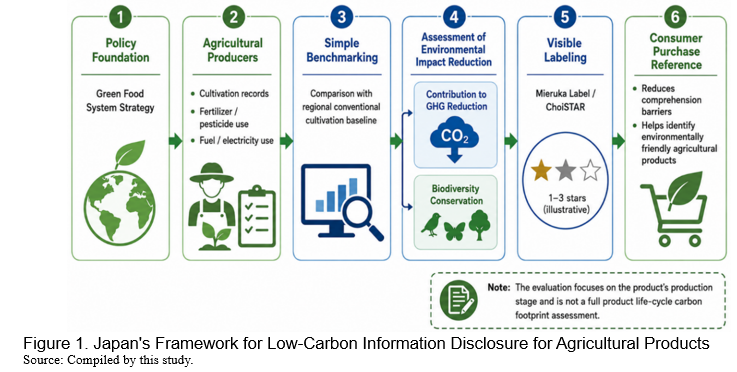
In recent years, Japan’s approach to disclosing low-carbon information on agricultural products has not been based solely on the numerical disclosure of product-level carbon footprints. Instead, its main policy direction has been the “visualization of environmental burden reduction practices for agricultural products” (mieruka). Under the MIDORI Strategy for Sustainable Food Systems, the Ministry of Agriculture, Forestry and Fisheries (MAFF) has promoted efforts to reduce environmental burdens throughout the food system while enhancing public understanding of these efforts. Through a tiered labeling scheme, Japan communicates producers’ contributions to greenhouse gas emissions reductions and biodiversity conservation in a more accessible manner, enabling consumers to recognize such practices when purchasing agricultural products. Figure 1 summarizes the operational framework of the Japanese system.
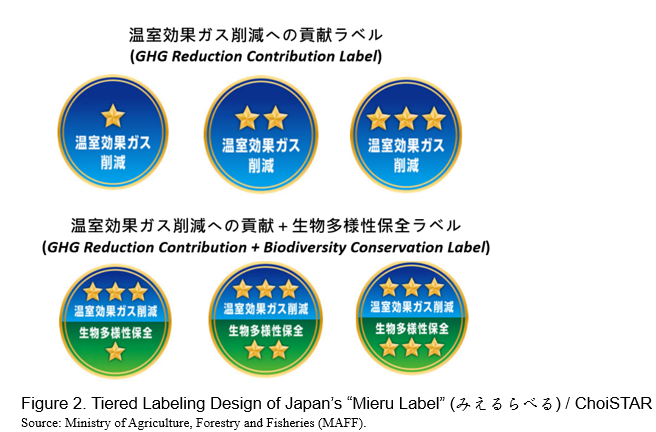
The core of this institutional framework is a process in which agricultural producers first compile information such as cultivation records, fertilizer and pesticide use, and fuel and electricity consumption. These data are then processed using the simplified assessment tool provided by MAFF, and the results are compared with regional benchmarks for conventional cultivation. As shown in Figure 2, the estimated contributions to greenhouse gas reduction and biodiversity conservation are subsequently translated into visually recognizable labels. For the GHG Reduction Contribution Label, the number of stars indicates the level of reduction contribution compared with the regional conventional cultivation baseline: one star represents a reduction contribution rate of 5% or above, two stars 10% or above, and three stars 20% or above. By contrast, the biodiversity conservation label for rice is based on the number of eligible conservation practices implemented, rather than on a greenhouse gas reduction rate.
In other words, the Japanese system does not merely emphasize the technical calculation of carbon emissions. Rather, it translates producers’ efforts to reduce environmental burdens into information that consumers can understand and use when making purchasing decisions. MAFF’s *Guidelines for Evaluation and Labeling Concerning Environmental Burden Reduction of Agricultural Products* refer to this tiered label as the “Mieru Label / ChoiSTAR.” The guidelines note that, compared with industrial products, precise assessments of the environmental burdens associated with agricultural products are more difficult to conduct. In addition, because agricultural products are everyday consumer goods, labels must be readily understandable and visually recognizable.
For this reason, the system adopts a three-level labeling design. Participation in the tiered labeling scheme is voluntary. Its purpose is not to provide precise comparisons between products, but to help consumers identify agricultural products associated with greenhouse gas emissions-reduction or biodiversity conservation practices. Through this approach, the system seeks to create a consumer environment in which people can choose agricultural products with lower environmental burdens.
From the perspective of consumer research, studies in Japan suggest that providing low-carbon or environmentally friendly information on agricultural products involves more than the institutional design of labels. It also concerns whether consumers can understand and trust such information and whether they incorporate it into their purchasing decisions.
Aoki and Akai (2022) examined Japanese mandarin oranges using a choice experiment, analyzing consumers’ responses to product price and carbon-emission information. Their findings showed that, when price and carbon emissions were presented simultaneously as product attributes, consumers evaluated oranges with lower carbon emissions more positively, which enabled the authors to estimate their willingness to pay for reductions in carbon emissions. This result does not imply that low-carbon information necessarily translates directly into actual purchasing behavior. However, it suggests that, when carbon-emission information is presented as a concrete and comparable product attribute, low-carbon performance may become one of the factors influencing consumers’ product choices.
Nevertheless, consumers’ use of low-carbon or environmentally friendly information still depends on its comprehensibility and credibility. Yang, Takashino, and Fuyuki (2022b) analyzed Japanese consumers’ trust in and willingness to pay for environmentally friendly agricultural products. They found that consumers’ trust in such products was influenced by factors such as information sources, educational attainment, and income. Their study further suggests that informal information sources, such as family and friends, may positively influence consumers’ trust in environmentally friendly agricultural products. After receiving relevant information, consumers may also develop stronger immediate preferences for such products.
In other words, for environmentally friendly agricultural products to gain consumer support, it is not sufficient that the products possess environmentally friendly attributes. They also require credible information sources and effective communication strategies so that consumers can understand what the labels signify.
In addition, Yang, Fuyuki, and Minakshi (2022a) examined how information on environmentally friendly agricultural products influenced Japanese consumers’ purchasing decisions from the perspective of information provision and consumer choice. Although the study compared consumers in China and Japan, the results for the Japanese sample indicated that consumers’ levels of awareness differed across various environmentally friendly agricultural product schemes and types of labeling information. Compared with organic agricultural products, Japanese consumers had a more limited understanding of certain environmentally friendly production methods or labels.
This suggests that, even when relevant schemes or production practices already exist, their market effects may remain limited if the information is not communicated in a clear, consistent, and easily recognizable manner. This finding also implies that, if low-carbon agricultural product labeling remains limited to institutional development or technical calculation without being translated into information that consumers can easily understand, its influence on purchasing decisions may be limited.
Taken together, the institutional framework and consumer studies discussed above suggest that Japanese consumers are not entirely indifferent to information on low-carbon or environmentally friendly agricultural products. In specific product and choice contexts, lower carbon emissions or environmentally friendly attributes may indeed enhance product evaluations or consumer preferences. However, such effects do not occur automatically. They are shaped by factors such as label format, information clarity, consumer trust, information sources, educational attainment, and income.
Therefore, if low-carbon labels can translate producers’ efforts to reduce environmental burdens into clear, concise, and easily recognizable information, they may help lower barriers to consumer understanding, strengthen the communication of low-carbon performance to consumers, and increase the likelihood that environmentally friendly or low-carbon attributes will be incorporated into consumers’ purchasing decisions.
SOUTH KOREA’S EXPERIENCE IN LOW-CARBON LABELING, AGRICULTURAL PRODUCT CERTIFICATION, AND CONSUMER PURCHASE INTENTION
In terms of low-carbon information disclosure, South Korea has developed not only an environmental information labeling system for general products but also a separate certification system for low-carbon agricultural products. According to the 2025 Environmental Product Declaration Certification Guide issued by the Korea Environmental Industry & Technology Institute (KEITI), the environmental performance label primarily quantifies and discloses the environmental impacts associated with products or services throughout their life cycles. Within this framework, the low-carbon product label further certifies products that have achieved reductions in greenhouse gas emissions through improvements in raw materials, fuels, production processes, or energy and resource efficiency. This system provides important context for understanding South Korea’s approach to low-carbon information disclosure and label design for general products. It also demonstrates how the country has sought to translate environmental information into recognizable product-level indicators of environmental performance.
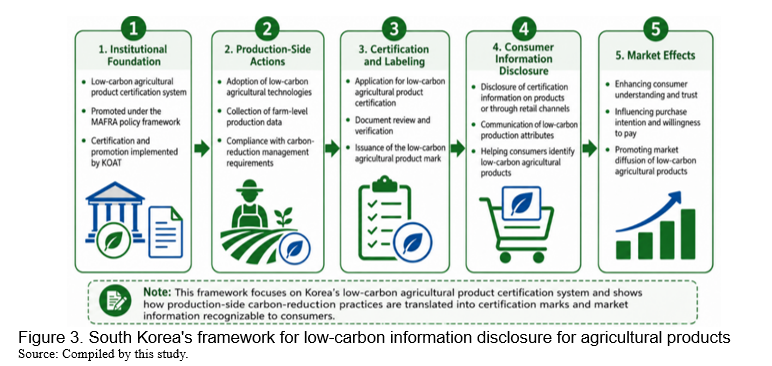
By contrast, South Korea’s low-carbon agricultural product certification system serves as a mechanism for low-carbon information disclosure and market communication specifically within the agricultural sector. This system is promoted under the policy framework of the Ministry of Agriculture, Food and Rural Affairs (MAFRA), while certification and promotional activities are implemented by organizations such as the Korea Agriculture Technology Promotion Agency (KOAT). Its primary focus is on promoting the adoption of low-carbon technologies at the agricultural production stage, collecting production data, conducting certification reviews, and disclosing certification status through a certification mark. By displaying this information on product packaging or through retail channels, the system enables consumers to identify agricultural products that meet low-carbon production requirements.
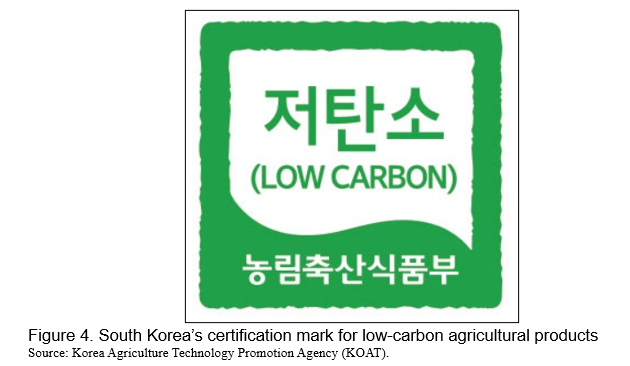
To illustrate the institutional process and market communication mechanism underlying South Korea’s disclosure of low-carbon information on agricultural products, Figure 3 summarizes the overall framework. Figure 4 presents the certification mark used for low-carbon agricultural products in South Korea, which serves as an important visual cue that helps consumers identify certified products. In other words, KEITI’s environmental performance labeling system is primarily oriented toward disclosing life-cycle environmental information for general products and services, whereas the low-carbon agricultural product certification system promoted by KOAT places greater emphasis on carbon-reduction practices in agricultural production and on their recognition and communication in agricultural markets.
Related consumer studies suggest that the market effects of South Korea’s low-carbon labels and certified low-carbon agricultural products do not depend solely on the visibility of a label. Rather, they are closely associated with consumers’ understanding of the system, awareness of climate change and the benefits of carbon reduction, and the design of purchasing incentives. Hong and Ahn (2026) analyzed long-term changes in consumers’ purchase intentions regarding carbon-footprint-labeled products in South Korea. Their findings indicated that environmental concern, the perceived seriousness of climate change, understanding of the carbon footprint labeling system, and exposure to low-carbon and green media were all positively associated with purchase intention. Among these factors, consumers’ belief that carbon footprint labeling contributes to reducing greenhouse gas emissions emerged as a relatively stable and influential determinant. This finding suggests that label visibility alone is insufficient for low-carbon labels to influence consumer choices. Consumers must also understand how the label relates to tangible carbon-reduction outcomes.
Regarding certified low-carbon agricultural products, Jo et al. (2024) estimated the willingness to pay among South Korean consumers in their twenties. Their findings showed that these consumers were willing to pay a premium of approximately 27% for certified low-carbon agricultural products compared with conventional alternatives. Environmental concern had a statistically significant effect on willingness to pay, while information provision, perceived experience with climate change, and previous purchasing experience were also associated with differences in willingness to pay. However, the study noted that, although consumers in their twenties demonstrated relatively high awareness of climate change and environmental issues, their awareness of certified low-carbon agricultural products remained limited. This finding suggests that low-carbon agricultural product labeling has the potential to generate market support, but that further institutional promotion, clearer label explanations, and greater opportunities to accumulate purchasing experience are needed to lower barriers to consumer understanding.
In recent years, South Korea has also begun to explore the promotion of low-carbon agricultural products through consumer-side incentives. Lee and Kim (2026) examined the possibility of extending the carbon neutrality point system to the consumption of low-carbon agri-food products. They found that norm-based environmental attitudes could increase both consumers’ intentions to purchase low-carbon foods and their willingness to participate in the point system. However, value-based environmental attitudes did not necessarily translate into participation. The study also indicated that the convenience of the system was an important factor influencing participation intentions. This suggests that promoting the consumption of low-carbon agricultural products requires certification and labeling to be accompanied by supporting measures, such as simplified participation procedures, greater perceived value and flexibility of point-based rewards, and enhanced transparency in the certification process.
Based on the above discussion, South Korea’s experience can be understood as a case in which agricultural low-carbon certification and consumer incentives have been further developed within the broader framework of environmental information labeling for general products. Compared with Japan, which simplifies information on the environmental burdens of agricultural products through star-rating labels, South Korea has established a more institutionalized framework for low-carbon information disclosure encompassing environmental performance labels, low-carbon product labels, and low-carbon agricultural product certification. Related studies also show that labels do not necessarily translate directly into purchasing behavior. Important conditions influencing the market uptake of low-carbon agricultural products include whether consumers understand what the label signifies, trust its claimed carbon-reduction benefits, and perceive the purchasing process and associated incentive programs as convenient and rewarding.
LESSONS FROM JAPAN AND SOUTH KOREA FOR TAIWAN’S LOW-CARBON AGRICULTURAL PRODUCT LABELING
For agricultural products, Taiwan has not yet established a dedicated labeling system specifically designed to communicate their low-carbon performance, comparable to Japan’s visualization-based labeling scheme for environmentally friendly agricultural practices or South Korea’s low-carbon agricultural product certification system. Existing agricultural product certification, verification, and traceability schemes in Taiwan mainly include organic agricultural product certification, traceable agricultural products, the Certified Agricultural Standards (CAS) mark, and traceability QR codes. Through the promotion of these labels, policies encouraging the use of domestically produced traceable ingredients in school lunches, and related public communication efforts, Taiwan has developed a degree of consumer familiarity with agricultural product labels, traceability information, and domestically produced ingredients (Office of Food Safety, Executive Yuan, n.d.). These schemes demonstrate that Taiwan already has experience in agricultural product labeling, governance and information disclosure. However, they primarily focus on food safety, quality, traceability, organic production, and good agricultural practices, rather than directly addressing the carbon performance of agricultural production or consumers’ low-carbon purchasing choices.
Taiwan also has an institutional foundation for product carbon footprint labeling, and existing studies suggest that Taiwanese consumers are responsive to carbon labels and low-carbon information. Using carbon-labeled packaged tea products in Taiwan as a case study, Liang et al. (2020) found that consumers’ subjective knowledge of carbon labels and perceived consumer effectiveness were both positively associated with their intentions to purchase carbon-labeled products. In other words, when consumers understand the information conveyed by carbon labels and believe that their purchasing choices can contribute to environmental improvement, they are more likely to consider carbon labels when making purchasing decisions. Focusing on Taiwanese consumers, Laksmawati, Hsieh, and Yang (2024) further indicated that personal experiences of climate-related events, together with social influences from family members and peers, may affect consumers’ behavioral intentions toward products carrying carbon footprint labels. These findings suggest that Taiwan already has a consumer-side foundation for promoting low-carbon product labeling. The key issue is whether such labels can be readily understood and trusted and whether consumers perceive them as meaningful guides for making low-carbon choices.
However, when applying this experience to the agricultural sector, Taiwan’s future development of low-carbon agricultural product labeling should not be framed solely as a question of whether agricultural products should be required to obtain product carbon footprint labels. The product carbon footprint labeling system administered by the Ministry of Environment is based on full life-cycle assessment, verification, and approval. Its relatively rigorous institutional design helps provide a credible data foundation. Nevertheless, agricultural products are characterized by variations in production location, seasonality, cultivation methods, farm size, data collection capacity, and profit margins. If agricultural products were required to follow the same procedures as general products under the carbon footprint labeling system, the costs of applying for and maintaining certification could become burdensome. In particular, approval for the current product carbon footprint label is valid for two years and continued use after expiration requires a renewal application (Climate Change Administration, Ministry of Environment, 2025). For agricultural products with relatively narrow profit margins and highly variable production and supply patterns, this system may not be the most accessible way to help consumers identify low-carbon products.
Therefore, drawing on the experiences of Japan and South Korea, Taiwan could consider using the product carbon footprint system administered by the Ministry of Environment as a foundation for formal assessment and institutional credibility, while allowing the agricultural sector to develop low-carbon information disclosure and labeling mechanisms that are better suited to the distinctive characteristics of agricultural products. Japan’s experience shows that translating producers’ efforts to reduce environmental burdens into concise and visually recognizable labels can help lower barriers to consumer understanding. South Korea’s experience, by contrast, suggests that low-carbon agricultural product certification can strengthen consumer recognition by combining production-stage carbon-reduction requirements, certification marks, and market communication.
For Taiwan, future efforts to promote low-carbon labeling for agricultural products could establish a complementary disclosure framework that operates alongside the existing product carbon footprint system. Such a framework could translate carbon-reduction practices at the agricultural production stage into consumer communication tools, including simplified carbon estimation methods, tiered or visual labels, disclosure through retail channels, and consumer education. Figure 5 presents a conceptual framework for building on the existing product carbon footprint system to develop low-carbon agricultural product labels and strengthen consumer-oriented communication.

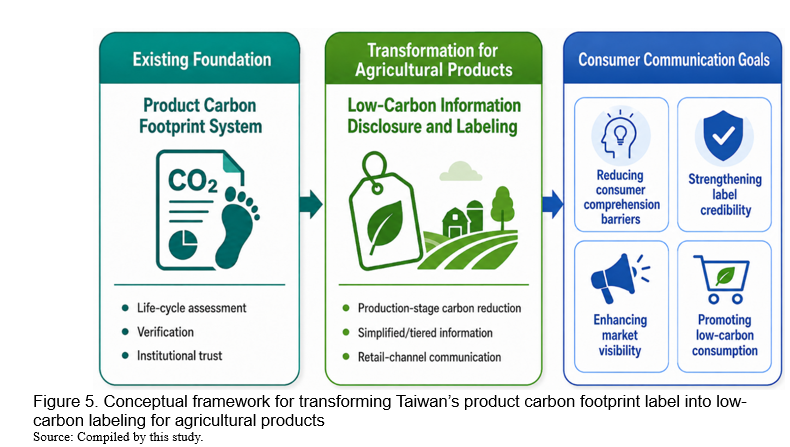
In other words, low-carbon labeling for agricultural products should not be limited to the technical disclosure of carbon emission information. Rather, it should serve as a market communication tool that connects producers’ carbon-reduction efforts with consumers’ sustainable purchasing choices. More specifically, carbon-reduction practices adopted during agricultural production could be translated into more accessible forms of information, such as simplified assessment methods, tiered or visual labels, information disclosure through retail channels, and consumer education.
Through this process, low-carbon labels for agricultural products could help lower barriers to consumer understanding, strengthen consumer trust in the labeling system, enhance market visibility, and promote low-carbon consumption. In this way, low-carbon information could move beyond the mere presentation of carbon-emissions data and be transformed into a recognizable product attribute that consumers can understand and incorporate into their purchasing decisions.
CONCLUSION
Taken together, the experiences of Japan and South Korea suggest that the promotion of low-carbon labeling for agricultural products should not be viewed merely as a matter of disclosing carbon-emission data or obtaining certification. Rather, it should be understood as a communication mechanism linking producers’ carbon-reduction efforts with consumers’ sustainable purchasing choices.
The Japanese experience highlights the importance of visual and easily recognizable labels in lowering barriers to consumer understanding, while the South Korean experience demonstrates the importance of integrating low-carbon agricultural product certification, institutional credibility, and consumer incentives.
For Taiwan, the existing product carbon footprint system can provide a foundation for formal assessment and institutional credibility. However, to enhance the market impact of low-carbon information on agricultural products, it remains necessary to develop labeling and communication approaches that better suit the distinctive characteristics of agricultural products and real-world purchasing contexts.
Future efforts may therefore focus on simplified assessment methods, tiered or visual labels, information disclosure through retail channels, and consumer education. Through these measures, low-carbon labeling for agricultural products could be transformed from a mechanism for disclosing technical information into an effective market communication tool that consumers can understand, trust, and incorporate into their purchasing decisions.
REFERENCES
Aoki, K., & Akai, K. (2022). Testing hypothetical bias in a choice experiment: An application to the value of the carbon footprint of mandarin oranges. PLOS ONE, 17(1), e0261369. https://doi.org/10.1371/journal.pone.0261369
Bartzas, G., Doula, M., & Komnitsas, K. (2025). Low-carbon certification systems in agriculture: A review. Applied Sciences, 15, 5285. https://doi.org/10.3390/app15105285
Bastounis, A., Buckell, J., Hartmann-Boyce, J., Cook, B., King, S., Potter, C., Bianchi, F., Rayner, M., & Jebb, S. A. (2021). The impact of environmental sustainability labels on willingness-to-pay for foods: A systematic review and meta-analysis of discrete choice experiments. Nutrients, 13(8), 2677. https://doi.org/10.3390/nu13082677
Climate Change Administration, Ministry of Environment. (2025, March 20). The Ministry of Environment promulgated the Regulations Governing Voluntary Product Carbon Footprint Approval Labeling and Management and amended parts of the Regulations Governing Greenhouse Gas Certification Bodies and Verification Bodies: Effective management to promote low-carbon production [環境部發布「自願性產品碳足跡核定標示及管理辦法」及修正「溫室氣體認證機構及查驗機構管理辦法」部分條文:有效管理,帶動低碳生產]. Ministry of Environment News. https://enews.moenv.gov.tw/moenv-news/zh-tw/News/2506
Hong, E., & Ahn, Y.-H. (2026). Trends in consumer purchase intention for carbon-footprint-labeled products in Korea. Sustainability, 18(10), 4716. https://doi.org/10.3390/su18104716
Jo, Y.-B., Kim, Y.-G., Lee, E.-H., Lee, G.-H., Lee, J.-Y., Lim, S.-H., & Jang, S.-W. (2024). Analysis of willingness to pay for low-carbon agrifood for sustainable agriculture: The case of the 20s. Journal of the Korea Academia-Industrial Cooperation Society, 25(1), 172–183. https://doi.org/10.5762/KAIS.2024.25.1.172
Korea Agriculture Technology Promotion Agency. (2026, June 8). 2026년 하반기 「저탄소 농산물 인증 지원사업」 신규·갱신 희망 농가 모집 공고 [Recruitment announcement for new and renewal applicants for the 2026 second-half low-carbon agricultural products certification support project]. https://www.koat.or.kr/board/business/16289/view.do
Korea Environmental Industry & Technology Institute. (2025). 2025 환경성적표지 인증안내서 [2025 environmental product declaration certification guide]. https://www.keiti.re.kr/site/keiti/ex/board/View.do?bcIdx=39527&cbIdx=274
Laksmawati, W. K., Hsieh, C.-M., & Yang, S.-H. (2024). Social influence and climate change issues affecting consumer behavioral intention toward carbon footprint label: A study of Taiwanese consumers. Journal of Cleaner Production, 444, 141092. https://doi.org/10.1016/j.jclepro.2024.141092
Lee, S., & Kim, J. (2026). Determinants of consumer participation in a carbon neutrality point system for the agri-food sector in Chungnam Province, South Korea. Journal of People, Plants, and Environment, 29(1), 41–52. https://doi.org/10.11628/ksppe.2026.29.1.41
Liang, T.-C., Situmorang, R. O. P., Liao, M.-C., & Chang, S.-C. (2020). The relationship of perceived consumer effectiveness, subjective knowledge, and purchase intention on carbon label products—A case study of carbon-labeled packaged tea products in Taiwan. Sustainability, 12(19), 7892. https://doi.org/10.3390/su12197892
Ministry of Agriculture, Forestry and Fisheries. (2026). 農産物の環境負荷低減に関する評価・表示ガイドライン [Guidelines for evaluation and labeling concerning environmental burden reduction of agricultural products]. https://www.maff.go.jp/j/kanbo/kankyo/seisaku/being_sustainable/mieruka/guideline_all.pdf
Office of Food Safety, Executive Yuan. (n.d.). Policy on the use of domestically produced traceable local ingredients in school lunches. Food Safety Information Website. Retrieved July 13, 2026, from https://www.ey.gov.tw/ofs/2C1F4D9638BC759A
Rondoni, A., & Grasso, S. (2021). Consumers behaviour towards carbon footprint labels on food: A review of the literature and discussion of industry implications. Journal of Cleaner Production, 301, 127031. https://doi.org/10.1016/j.jclepro.2021.127031
Yang, R., Fuyuki, K., & Minakshi, K. (2022a). How does information influence consumers’ purchase decisions for environmentally friendly farming produce? Evidence from China and Japan based on choice experiment. Sustainability, 14(15), 9470. https://doi.org/10.3390/su14159470
Yang, R., Takashino, N., & Fuyuki, K. (2022b). Japanese consumers’ willingness to pay for environmentally friendly farming produce based on consumer trustfulness. Journal of Agricultural & Food Industrial Organization, 20(1), 1–14. https://doi.org/10.1515/jafio-2020-0036




Low-Carbon Information Disclosure and Consumer Purchase Intention: Lessons from Japan and Korea for Taiwan’s Low-Carbon Agricultural Product Labeling
ABSTRACT
Amid the global transition toward net-zero emissions and the shift toward sustainable consumption, the disclosure of low-carbon information on agricultural products has become an important mechanism for linking producers’ carbon-reduction efforts to consumer choices. Prior studies suggest that environmental labels and carbon footprint labels can influence consumers’ purchase intentions and willingness to pay, particularly when the information provided is clear, credible, and easy to understand. Drawing on the experiences of Japan and South Korea, this article examines how low-carbon information disclosure can facilitate consumer communication and consumer acceptance. Japan translates carbon-reduction and biodiversity conservation efforts into visual star-rating labels, whereas South Korea operates a low-carbon certification system that combines certification marks, market communication, and consumer incentives. Consumer studies further indicate that such labels may increase purchase intentions. However, their effectiveness depends on consumers’ understanding of and trust in the labels, as well as the design of accompanying incentives, rather than arising automatically from the mere presence of a label. Although Taiwan has established a product carbon footprint labeling system and has developed a foundation for agricultural certification, it still lacks a dedicated labeling scheme specifically focused on communicating the low-carbon performance of agricultural products. This article argues that Taiwan could build on these existing foundations to develop a more consumer-oriented model for disclosing low-carbon information on agricultural products.
Keywords: low-carbon agricultural product labeling; carbon footprint label; consumer purchase intention; Japan; Korea; low-carbon agricultural product certification
INTRODUCTION
In the context of the global transition toward net-zero emissions and the growing trend toward sustainable consumption, the environmental impacts of food systems have received growing attention from policymakers, the food industry, and consumers. Greenhouse gas emissions and other environmental burdens may arise at every stage of the food supply chain, from raw material production and processing to transportation, retailing, and consumption. Accordingly, translating complex environmental information into clear, product-level messages that consumers can understand has become an important issue in promoting low-carbon food supply chains.
Previous systematic reviews and meta-analyses have shown that environmental sustainability labels on food products can increase consumers’ willingness to pay for more sustainable food products. Based on findings from more than 40,000 respondents, Bastounis et al. (2021) found that consumers are generally willing to pay a premium for foods carrying environmental labels. This finding suggests that labeling schemes have the potential to encourage sustainable consumption. However, the effectiveness of such labels may vary depending on the product category, label type, and consumer characteristics.
Among the various types of environmental labels used on food products, carbon footprint labels are more directly linked to product life cycles and climate-related impacts. Rondoni and Grasso (2021) noted that food carbon footprint labels are intended to disclose the environmental impacts associated with food production and to help consumers make more sustainable purchasing choices. However, their review also found that consumers’ understanding of carbon-emission values and existing carbon footprint labeling schemes remains limited.
In real-world purchasing situations, information such as price, shelf life, sensory quality, origin, and other sustainability labels may interact with carbon footprint information to shape consumer choices. In other words, for carbon footprint labels to function effectively, they require not only a sound basis for emissions calculation and verification but also clear, understandable, and trustworthy label design, together with effective policy communication. These elements are essential for lowering barriers to consumer understanding and increasing the likelihood that low-carbon information will be incorporated into purchasing decisions.
This issue is particularly relevant to agricultural products, which form the upstream foundation of the food supply chain. Agricultural production is not only a major contributor to the environmental footprint of food but is also increasingly affected by climate change, resource constraints, and pressures associated with market transformation.
Bartzas et al. (2025) indicated that low-carbon certification systems in agriculture can help producers identify emission hotspots, promote low-carbon production practices, and communicate their environmental performance to the market through farm-level data collection, the establishment of emissions baselines, the adoption of carbon-reduction measures, and third-party certification. However, the study also noted that low-carbon agricultural certification still faces several challenges, including the assessment of farm-level emissions, limited data availability, certification costs, complex certification standards, smallholder participation, and consumer understanding. Without effective coordination with label design, in-store and retail-channel presentation, and purchase incentives, low-carbon certification may fail to generate tangible market demand and consumer support.
Based on this context, the central issue in low-carbon agricultural product labeling is not only how to calculate and certify carbon emissions, but also how to ensure that low-carbon information is understood, trusted, and incorporated into consumers’ purchasing decisions.
In Asia, Japan and South Korea offer two distinct approaches to low-carbon information disclosure for agricultural products. In recent years, Japan has promoted visualization-oriented labeling schemes for agricultural practices aimed at reducing environmental burdens, seeking to translate production-side carbon-reduction efforts and biodiversity conservation practices into information that consumers can more easily recognize and understand. South Korea, by contrast, has generated a growing body of research on consumer awareness, purchasing behavior, and willingness to pay for certified low-carbon agricultural products in connection with its low-carbon agricultural and livestock product certification system.
Accordingly, this article first reviews consumer research concerning food environmental labels and carbon footprint labels and then analyzes the experiences of Japan and South Korea in disclosing low-carbon information on agricultural products. On this basis, it draws policy lessons for Taiwan regarding the development of low-carbon agricultural product labeling and market communication.
JAPAN’S EXPERIENCE IN LOW-CARBON INFORMATION DISCLOSURE AND CONSUMER COMMUNICATION FOR AGRICULTURAL PRODUCTS
In recent years, Japan’s approach to low-carbon information disclosure for agricultural products has not simply relied on the numerical disclosure of full product carbon footprints. Instead, its main policy direction has been the “visualization of environmental burden reduction practices for agricultural products” (mieruka). Based on the MIDORI Strategy for Sustainable Food Systems, the Ministry of Agriculture, Forestry and Fisheries (MAFF) has promoted the reduction of environmental burdens across the food system and sought to enhance public understanding. Through a tiered labeling scheme, Japan communicates producers’ efforts to reduce greenhouse gas emissions and conserve biodiversity in a more accessible form, enabling consumers to recognize environmental burden reduction practices when purchasing agricultural products. To illustrate the operational logic of the Japanese system, this article summarizes it in Figure 1.
In recent years, Japan’s approach to disclosing low-carbon information on agricultural products has not been based solely on the numerical disclosure of product-level carbon footprints. Instead, its main policy direction has been the “visualization of environmental burden reduction practices for agricultural products” (mieruka). Under the MIDORI Strategy for Sustainable Food Systems, the Ministry of Agriculture, Forestry and Fisheries (MAFF) has promoted efforts to reduce environmental burdens throughout the food system while enhancing public understanding of these efforts. Through a tiered labeling scheme, Japan communicates producers’ contributions to greenhouse gas emissions reductions and biodiversity conservation in a more accessible manner, enabling consumers to recognize such practices when purchasing agricultural products. Figure 1 summarizes the operational framework of the Japanese system.
The core of this institutional framework is a process in which agricultural producers first compile information such as cultivation records, fertilizer and pesticide use, and fuel and electricity consumption. These data are then processed using the simplified assessment tool provided by MAFF, and the results are compared with regional benchmarks for conventional cultivation. As shown in Figure 2, the estimated contributions to greenhouse gas reduction and biodiversity conservation are subsequently translated into visually recognizable labels. For the GHG Reduction Contribution Label, the number of stars indicates the level of reduction contribution compared with the regional conventional cultivation baseline: one star represents a reduction contribution rate of 5% or above, two stars 10% or above, and three stars 20% or above. By contrast, the biodiversity conservation label for rice is based on the number of eligible conservation practices implemented, rather than on a greenhouse gas reduction rate.
In other words, the Japanese system does not merely emphasize the technical calculation of carbon emissions. Rather, it translates producers’ efforts to reduce environmental burdens into information that consumers can understand and use when making purchasing decisions. MAFF’s *Guidelines for Evaluation and Labeling Concerning Environmental Burden Reduction of Agricultural Products* refer to this tiered label as the “Mieru Label / ChoiSTAR.” The guidelines note that, compared with industrial products, precise assessments of the environmental burdens associated with agricultural products are more difficult to conduct. In addition, because agricultural products are everyday consumer goods, labels must be readily understandable and visually recognizable.
For this reason, the system adopts a three-level labeling design. Participation in the tiered labeling scheme is voluntary. Its purpose is not to provide precise comparisons between products, but to help consumers identify agricultural products associated with greenhouse gas emissions-reduction or biodiversity conservation practices. Through this approach, the system seeks to create a consumer environment in which people can choose agricultural products with lower environmental burdens.
From the perspective of consumer research, studies in Japan suggest that providing low-carbon or environmentally friendly information on agricultural products involves more than the institutional design of labels. It also concerns whether consumers can understand and trust such information and whether they incorporate it into their purchasing decisions.
Aoki and Akai (2022) examined Japanese mandarin oranges using a choice experiment, analyzing consumers’ responses to product price and carbon-emission information. Their findings showed that, when price and carbon emissions were presented simultaneously as product attributes, consumers evaluated oranges with lower carbon emissions more positively, which enabled the authors to estimate their willingness to pay for reductions in carbon emissions. This result does not imply that low-carbon information necessarily translates directly into actual purchasing behavior. However, it suggests that, when carbon-emission information is presented as a concrete and comparable product attribute, low-carbon performance may become one of the factors influencing consumers’ product choices.
Nevertheless, consumers’ use of low-carbon or environmentally friendly information still depends on its comprehensibility and credibility. Yang, Takashino, and Fuyuki (2022b) analyzed Japanese consumers’ trust in and willingness to pay for environmentally friendly agricultural products. They found that consumers’ trust in such products was influenced by factors such as information sources, educational attainment, and income. Their study further suggests that informal information sources, such as family and friends, may positively influence consumers’ trust in environmentally friendly agricultural products. After receiving relevant information, consumers may also develop stronger immediate preferences for such products.
In other words, for environmentally friendly agricultural products to gain consumer support, it is not sufficient that the products possess environmentally friendly attributes. They also require credible information sources and effective communication strategies so that consumers can understand what the labels signify.
In addition, Yang, Fuyuki, and Minakshi (2022a) examined how information on environmentally friendly agricultural products influenced Japanese consumers’ purchasing decisions from the perspective of information provision and consumer choice. Although the study compared consumers in China and Japan, the results for the Japanese sample indicated that consumers’ levels of awareness differed across various environmentally friendly agricultural product schemes and types of labeling information. Compared with organic agricultural products, Japanese consumers had a more limited understanding of certain environmentally friendly production methods or labels.
This suggests that, even when relevant schemes or production practices already exist, their market effects may remain limited if the information is not communicated in a clear, consistent, and easily recognizable manner. This finding also implies that, if low-carbon agricultural product labeling remains limited to institutional development or technical calculation without being translated into information that consumers can easily understand, its influence on purchasing decisions may be limited.
Taken together, the institutional framework and consumer studies discussed above suggest that Japanese consumers are not entirely indifferent to information on low-carbon or environmentally friendly agricultural products. In specific product and choice contexts, lower carbon emissions or environmentally friendly attributes may indeed enhance product evaluations or consumer preferences. However, such effects do not occur automatically. They are shaped by factors such as label format, information clarity, consumer trust, information sources, educational attainment, and income.
Therefore, if low-carbon labels can translate producers’ efforts to reduce environmental burdens into clear, concise, and easily recognizable information, they may help lower barriers to consumer understanding, strengthen the communication of low-carbon performance to consumers, and increase the likelihood that environmentally friendly or low-carbon attributes will be incorporated into consumers’ purchasing decisions.
SOUTH KOREA’S EXPERIENCE IN LOW-CARBON LABELING, AGRICULTURAL PRODUCT CERTIFICATION, AND CONSUMER PURCHASE INTENTION
In terms of low-carbon information disclosure, South Korea has developed not only an environmental information labeling system for general products but also a separate certification system for low-carbon agricultural products. According to the 2025 Environmental Product Declaration Certification Guide issued by the Korea Environmental Industry & Technology Institute (KEITI), the environmental performance label primarily quantifies and discloses the environmental impacts associated with products or services throughout their life cycles. Within this framework, the low-carbon product label further certifies products that have achieved reductions in greenhouse gas emissions through improvements in raw materials, fuels, production processes, or energy and resource efficiency. This system provides important context for understanding South Korea’s approach to low-carbon information disclosure and label design for general products. It also demonstrates how the country has sought to translate environmental information into recognizable product-level indicators of environmental performance.
By contrast, South Korea’s low-carbon agricultural product certification system serves as a mechanism for low-carbon information disclosure and market communication specifically within the agricultural sector. This system is promoted under the policy framework of the Ministry of Agriculture, Food and Rural Affairs (MAFRA), while certification and promotional activities are implemented by organizations such as the Korea Agriculture Technology Promotion Agency (KOAT). Its primary focus is on promoting the adoption of low-carbon technologies at the agricultural production stage, collecting production data, conducting certification reviews, and disclosing certification status through a certification mark. By displaying this information on product packaging or through retail channels, the system enables consumers to identify agricultural products that meet low-carbon production requirements.
To illustrate the institutional process and market communication mechanism underlying South Korea’s disclosure of low-carbon information on agricultural products, Figure 3 summarizes the overall framework. Figure 4 presents the certification mark used for low-carbon agricultural products in South Korea, which serves as an important visual cue that helps consumers identify certified products. In other words, KEITI’s environmental performance labeling system is primarily oriented toward disclosing life-cycle environmental information for general products and services, whereas the low-carbon agricultural product certification system promoted by KOAT places greater emphasis on carbon-reduction practices in agricultural production and on their recognition and communication in agricultural markets.
Related consumer studies suggest that the market effects of South Korea’s low-carbon labels and certified low-carbon agricultural products do not depend solely on the visibility of a label. Rather, they are closely associated with consumers’ understanding of the system, awareness of climate change and the benefits of carbon reduction, and the design of purchasing incentives. Hong and Ahn (2026) analyzed long-term changes in consumers’ purchase intentions regarding carbon-footprint-labeled products in South Korea. Their findings indicated that environmental concern, the perceived seriousness of climate change, understanding of the carbon footprint labeling system, and exposure to low-carbon and green media were all positively associated with purchase intention. Among these factors, consumers’ belief that carbon footprint labeling contributes to reducing greenhouse gas emissions emerged as a relatively stable and influential determinant. This finding suggests that label visibility alone is insufficient for low-carbon labels to influence consumer choices. Consumers must also understand how the label relates to tangible carbon-reduction outcomes.
Regarding certified low-carbon agricultural products, Jo et al. (2024) estimated the willingness to pay among South Korean consumers in their twenties. Their findings showed that these consumers were willing to pay a premium of approximately 27% for certified low-carbon agricultural products compared with conventional alternatives. Environmental concern had a statistically significant effect on willingness to pay, while information provision, perceived experience with climate change, and previous purchasing experience were also associated with differences in willingness to pay. However, the study noted that, although consumers in their twenties demonstrated relatively high awareness of climate change and environmental issues, their awareness of certified low-carbon agricultural products remained limited. This finding suggests that low-carbon agricultural product labeling has the potential to generate market support, but that further institutional promotion, clearer label explanations, and greater opportunities to accumulate purchasing experience are needed to lower barriers to consumer understanding.
In recent years, South Korea has also begun to explore the promotion of low-carbon agricultural products through consumer-side incentives. Lee and Kim (2026) examined the possibility of extending the carbon neutrality point system to the consumption of low-carbon agri-food products. They found that norm-based environmental attitudes could increase both consumers’ intentions to purchase low-carbon foods and their willingness to participate in the point system. However, value-based environmental attitudes did not necessarily translate into participation. The study also indicated that the convenience of the system was an important factor influencing participation intentions. This suggests that promoting the consumption of low-carbon agricultural products requires certification and labeling to be accompanied by supporting measures, such as simplified participation procedures, greater perceived value and flexibility of point-based rewards, and enhanced transparency in the certification process.
Based on the above discussion, South Korea’s experience can be understood as a case in which agricultural low-carbon certification and consumer incentives have been further developed within the broader framework of environmental information labeling for general products. Compared with Japan, which simplifies information on the environmental burdens of agricultural products through star-rating labels, South Korea has established a more institutionalized framework for low-carbon information disclosure encompassing environmental performance labels, low-carbon product labels, and low-carbon agricultural product certification. Related studies also show that labels do not necessarily translate directly into purchasing behavior. Important conditions influencing the market uptake of low-carbon agricultural products include whether consumers understand what the label signifies, trust its claimed carbon-reduction benefits, and perceive the purchasing process and associated incentive programs as convenient and rewarding.
LESSONS FROM JAPAN AND SOUTH KOREA FOR TAIWAN’S LOW-CARBON AGRICULTURAL PRODUCT LABELING
For agricultural products, Taiwan has not yet established a dedicated labeling system specifically designed to communicate their low-carbon performance, comparable to Japan’s visualization-based labeling scheme for environmentally friendly agricultural practices or South Korea’s low-carbon agricultural product certification system. Existing agricultural product certification, verification, and traceability schemes in Taiwan mainly include organic agricultural product certification, traceable agricultural products, the Certified Agricultural Standards (CAS) mark, and traceability QR codes. Through the promotion of these labels, policies encouraging the use of domestically produced traceable ingredients in school lunches, and related public communication efforts, Taiwan has developed a degree of consumer familiarity with agricultural product labels, traceability information, and domestically produced ingredients (Office of Food Safety, Executive Yuan, n.d.). These schemes demonstrate that Taiwan already has experience in agricultural product labeling, governance and information disclosure. However, they primarily focus on food safety, quality, traceability, organic production, and good agricultural practices, rather than directly addressing the carbon performance of agricultural production or consumers’ low-carbon purchasing choices.
Taiwan also has an institutional foundation for product carbon footprint labeling, and existing studies suggest that Taiwanese consumers are responsive to carbon labels and low-carbon information. Using carbon-labeled packaged tea products in Taiwan as a case study, Liang et al. (2020) found that consumers’ subjective knowledge of carbon labels and perceived consumer effectiveness were both positively associated with their intentions to purchase carbon-labeled products. In other words, when consumers understand the information conveyed by carbon labels and believe that their purchasing choices can contribute to environmental improvement, they are more likely to consider carbon labels when making purchasing decisions. Focusing on Taiwanese consumers, Laksmawati, Hsieh, and Yang (2024) further indicated that personal experiences of climate-related events, together with social influences from family members and peers, may affect consumers’ behavioral intentions toward products carrying carbon footprint labels. These findings suggest that Taiwan already has a consumer-side foundation for promoting low-carbon product labeling. The key issue is whether such labels can be readily understood and trusted and whether consumers perceive them as meaningful guides for making low-carbon choices.
However, when applying this experience to the agricultural sector, Taiwan’s future development of low-carbon agricultural product labeling should not be framed solely as a question of whether agricultural products should be required to obtain product carbon footprint labels. The product carbon footprint labeling system administered by the Ministry of Environment is based on full life-cycle assessment, verification, and approval. Its relatively rigorous institutional design helps provide a credible data foundation. Nevertheless, agricultural products are characterized by variations in production location, seasonality, cultivation methods, farm size, data collection capacity, and profit margins. If agricultural products were required to follow the same procedures as general products under the carbon footprint labeling system, the costs of applying for and maintaining certification could become burdensome. In particular, approval for the current product carbon footprint label is valid for two years and continued use after expiration requires a renewal application (Climate Change Administration, Ministry of Environment, 2025). For agricultural products with relatively narrow profit margins and highly variable production and supply patterns, this system may not be the most accessible way to help consumers identify low-carbon products.
Therefore, drawing on the experiences of Japan and South Korea, Taiwan could consider using the product carbon footprint system administered by the Ministry of Environment as a foundation for formal assessment and institutional credibility, while allowing the agricultural sector to develop low-carbon information disclosure and labeling mechanisms that are better suited to the distinctive characteristics of agricultural products. Japan’s experience shows that translating producers’ efforts to reduce environmental burdens into concise and visually recognizable labels can help lower barriers to consumer understanding. South Korea’s experience, by contrast, suggests that low-carbon agricultural product certification can strengthen consumer recognition by combining production-stage carbon-reduction requirements, certification marks, and market communication.
For Taiwan, future efforts to promote low-carbon labeling for agricultural products could establish a complementary disclosure framework that operates alongside the existing product carbon footprint system. Such a framework could translate carbon-reduction practices at the agricultural production stage into consumer communication tools, including simplified carbon estimation methods, tiered or visual labels, disclosure through retail channels, and consumer education. Figure 5 presents a conceptual framework for building on the existing product carbon footprint system to develop low-carbon agricultural product labels and strengthen consumer-oriented communication.
In other words, low-carbon labeling for agricultural products should not be limited to the technical disclosure of carbon emission information. Rather, it should serve as a market communication tool that connects producers’ carbon-reduction efforts with consumers’ sustainable purchasing choices. More specifically, carbon-reduction practices adopted during agricultural production could be translated into more accessible forms of information, such as simplified assessment methods, tiered or visual labels, information disclosure through retail channels, and consumer education.
Through this process, low-carbon labels for agricultural products could help lower barriers to consumer understanding, strengthen consumer trust in the labeling system, enhance market visibility, and promote low-carbon consumption. In this way, low-carbon information could move beyond the mere presentation of carbon-emissions data and be transformed into a recognizable product attribute that consumers can understand and incorporate into their purchasing decisions.
CONCLUSION
Taken together, the experiences of Japan and South Korea suggest that the promotion of low-carbon labeling for agricultural products should not be viewed merely as a matter of disclosing carbon-emission data or obtaining certification. Rather, it should be understood as a communication mechanism linking producers’ carbon-reduction efforts with consumers’ sustainable purchasing choices.
The Japanese experience highlights the importance of visual and easily recognizable labels in lowering barriers to consumer understanding, while the South Korean experience demonstrates the importance of integrating low-carbon agricultural product certification, institutional credibility, and consumer incentives.
For Taiwan, the existing product carbon footprint system can provide a foundation for formal assessment and institutional credibility. However, to enhance the market impact of low-carbon information on agricultural products, it remains necessary to develop labeling and communication approaches that better suit the distinctive characteristics of agricultural products and real-world purchasing contexts.
Future efforts may therefore focus on simplified assessment methods, tiered or visual labels, information disclosure through retail channels, and consumer education. Through these measures, low-carbon labeling for agricultural products could be transformed from a mechanism for disclosing technical information into an effective market communication tool that consumers can understand, trust, and incorporate into their purchasing decisions.
REFERENCES
Aoki, K., & Akai, K. (2022). Testing hypothetical bias in a choice experiment: An application to the value of the carbon footprint of mandarin oranges. PLOS ONE, 17(1), e0261369. https://doi.org/10.1371/journal.pone.0261369
Bartzas, G., Doula, M., & Komnitsas, K. (2025). Low-carbon certification systems in agriculture: A review. Applied Sciences, 15, 5285. https://doi.org/10.3390/app15105285
Bastounis, A., Buckell, J., Hartmann-Boyce, J., Cook, B., King, S., Potter, C., Bianchi, F., Rayner, M., & Jebb, S. A. (2021). The impact of environmental sustainability labels on willingness-to-pay for foods: A systematic review and meta-analysis of discrete choice experiments. Nutrients, 13(8), 2677. https://doi.org/10.3390/nu13082677
Climate Change Administration, Ministry of Environment. (2025, March 20). The Ministry of Environment promulgated the Regulations Governing Voluntary Product Carbon Footprint Approval Labeling and Management and amended parts of the Regulations Governing Greenhouse Gas Certification Bodies and Verification Bodies: Effective management to promote low-carbon production [環境部發布「自願性產品碳足跡核定標示及管理辦法」及修正「溫室氣體認證機構及查驗機構管理辦法」部分條文:有效管理,帶動低碳生產]. Ministry of Environment News. https://enews.moenv.gov.tw/moenv-news/zh-tw/News/2506
Hong, E., & Ahn, Y.-H. (2026). Trends in consumer purchase intention for carbon-footprint-labeled products in Korea. Sustainability, 18(10), 4716. https://doi.org/10.3390/su18104716
Jo, Y.-B., Kim, Y.-G., Lee, E.-H., Lee, G.-H., Lee, J.-Y., Lim, S.-H., & Jang, S.-W. (2024). Analysis of willingness to pay for low-carbon agrifood for sustainable agriculture: The case of the 20s. Journal of the Korea Academia-Industrial Cooperation Society, 25(1), 172–183. https://doi.org/10.5762/KAIS.2024.25.1.172
Korea Agriculture Technology Promotion Agency. (2026, June 8). 2026년 하반기 「저탄소 농산물 인증 지원사업」 신규·갱신 희망 농가 모집 공고 [Recruitment announcement for new and renewal applicants for the 2026 second-half low-carbon agricultural products certification support project]. https://www.koat.or.kr/board/business/16289/view.do
Korea Environmental Industry & Technology Institute. (2025). 2025 환경성적표지 인증안내서 [2025 environmental product declaration certification guide]. https://www.keiti.re.kr/site/keiti/ex/board/View.do?bcIdx=39527&cbIdx=274
Laksmawati, W. K., Hsieh, C.-M., & Yang, S.-H. (2024). Social influence and climate change issues affecting consumer behavioral intention toward carbon footprint label: A study of Taiwanese consumers. Journal of Cleaner Production, 444, 141092. https://doi.org/10.1016/j.jclepro.2024.141092
Lee, S., & Kim, J. (2026). Determinants of consumer participation in a carbon neutrality point system for the agri-food sector in Chungnam Province, South Korea. Journal of People, Plants, and Environment, 29(1), 41–52. https://doi.org/10.11628/ksppe.2026.29.1.41
Liang, T.-C., Situmorang, R. O. P., Liao, M.-C., & Chang, S.-C. (2020). The relationship of perceived consumer effectiveness, subjective knowledge, and purchase intention on carbon label products—A case study of carbon-labeled packaged tea products in Taiwan. Sustainability, 12(19), 7892. https://doi.org/10.3390/su12197892
Ministry of Agriculture, Forestry and Fisheries. (2026). 農産物の環境負荷低減に関する評価・表示ガイドライン [Guidelines for evaluation and labeling concerning environmental burden reduction of agricultural products]. https://www.maff.go.jp/j/kanbo/kankyo/seisaku/being_sustainable/mieruka/guideline_all.pdf
Office of Food Safety, Executive Yuan. (n.d.). Policy on the use of domestically produced traceable local ingredients in school lunches. Food Safety Information Website. Retrieved July 13, 2026, from https://www.ey.gov.tw/ofs/2C1F4D9638BC759A
Rondoni, A., & Grasso, S. (2021). Consumers behaviour towards carbon footprint labels on food: A review of the literature and discussion of industry implications. Journal of Cleaner Production, 301, 127031. https://doi.org/10.1016/j.jclepro.2021.127031
Yang, R., Fuyuki, K., & Minakshi, K. (2022a). How does information influence consumers’ purchase decisions for environmentally friendly farming produce? Evidence from China and Japan based on choice experiment. Sustainability, 14(15), 9470. https://doi.org/10.3390/su14159470
Yang, R., Takashino, N., & Fuyuki, K. (2022b). Japanese consumers’ willingness to pay for environmentally friendly farming produce based on consumer trustfulness. Journal of Agricultural & Food Industrial Organization, 20(1), 1–14. https://doi.org/10.1515/jafio-2020-0036