ABSTRACT
Indonesia has long pursued food self-sufficiency as a strategic national objective, yet climate change, environmental degradation, and market volatility continue to challenge agricultural sustainability and food security. This study examines how technology-driven policy innovation within Indonesia's Food Self-Sufficiency Program enhances food system performance, governance, and resilience. A mixed-methods case study integrates policy document analysis, FAOSTAT and Statistics Indonesia (BPS) data, and recent peer-reviewed literature to assess policy design, implementation, and outcomes. The findings show that digital agricultural extension, precision farming, mechanization, and integrated agricultural data systems improve production efficiency, strengthen governance coordination, and support adaptive policy learning. However, their impacts remain uneven across regions and commodities because of disparities in infrastructure, institutional capacity, digital readiness, market integration, and access to finance. The study further demonstrates that technological innovation alone is insufficient to overcome structural constraints such as spatial inequality, environmental pressures, and fragmented value chains. Sustainable food security therefore depends on integrating technological advancement with institutional strengthening, coordinated governance, and investments in infrastructure and human capital. These findings highlight the role of digital technologies as both production and governance infrastructure, offering policy insights for emerging economies seeking to promote sustainable agricultural transformation, resilient food systems, and inclusive rural development.
Keywords: Policy innovation; Sustainable agriculture; Food security; Digital agriculture; Governance; Indonesia
INTRODUCTION
Food security and sustainable agriculture are central to Indonesia's national development strategy and the global Sustainable Development Goals (SDG 2: Zero Hunger and SDG 12: Responsible Consumption and Production). However, climate change, land degradation, demographic pressures, urbanization, and global market volatility continue to threaten agricultural productivity and food system resilience, requiring adaptive and innovation-oriented policy responses (Barrett, 2021; Pingali et al., 2019; Pretty et al., 2018). Beyond increasing production, sustainable food systems increasingly depend on governance quality, institutional capacity, and resilience to environmental and economic shocks (Headey & Alderman, 2019; United Nations, 2023).
Recent advances in digital agriculture—including precision farming, digital extension, mechanization, remote sensing, and integrated data platforms—offer new opportunities to improve productivity, resource efficiency, and policy coordination (Klerkx et al., 2019; Rose et al., 2021; Zilberman et al., 2019). These technologies enhance real-time monitoring, evidence-based decision-making, and adaptive governance. Nevertheless, their effectiveness remains constrained by inadequate infrastructure, digital literacy, institutional fragmentation, and limited access to finance, particularly in developing economies (World Bank, 2020; Fan et al., 2021). Consequently, technology deployment must be accompanied by institutional reform and governance innovation (Howlett, 2021; Howlett & Mukherjee, 2018).
Indonesia has long pursued food self-sufficiency to strengthen national food security and reduce dependence on imports. Although substantial progress has been achieved in staple crop production, persistent challenges—including fragmented landholdings, regional disparities, climate risks, and uneven institutional capacity—continue to limit sustainable agricultural transformation (FAO, 2017; Lowder et al., 2016; World Bank, 2020). These challenges highlight the need for policy approaches that integrate technological innovation with effective governance and institutional coordination.
Although the literature widely recognizes the potential of digital agriculture, existing studies primarily examine farm-level technology adoption and productivity impacts. Comparatively little attention has been paid to how technology-driven policy innovation reshapes governance systems, institutional coordination, and long-term food system resilience in large developing economies (Birner & Resnick, 2020; Fan et al., 2021). Addressing this gap, this study examines Indonesia's Food Self-Sufficiency Program as a case of technology-driven policy innovation.
Specifically, the study investigates (1) how digital technologies are integrated into Indonesia's food self-sufficiency policy framework, (2) how these innovations influence national and provincial food system performance, and (3) what policy lessons can support sustainable agricultural transformation in emerging economies. By integrating policy analysis with FAOSTAT and Statistics Indonesia (BPS) data, the study contributes to a better understanding of how digital technologies can function not only as productivity-enhancing tools but also as governance infrastructure that strengthens resilience, adaptive policymaking, and sustainable food security.
CONCEPTUAL FRAMEWORK
The analytical framework builds on three complementary bodies of literature: policy innovation and design, digital agriculture and innovation systems, and sustainable food systems and resilience. Policy design scholarship emphasizes that effective policies require coherent alignment between goals, instruments, and governance arrangements, supported by feedback mechanisms and adaptive learning (Howlett, 2021; Howlett & Mukherjee, 2018). Political economy perspectives further highlight that institutional credibility, coordination capacity, and stakeholder incentives shape policy performance over time (Anderson et al., 2021; Birner & Resnick, 2020).
Digital agriculture literature conceptualizes technologies as socio-technical systems embedded within institutional and organizational contexts rather than isolated productivity tools. Precision agriculture, digital extension platforms, and remote sensing systems reshape knowledge flows, decision cycles, and accountability structures across agricultural systems (Klerkx et al., 2019; Rose et al., 2021; Zhang & Kovacs, 2016). These technologies enable scalability, interoperability, and data-driven governance when supported by appropriate regulatory frameworks and human capital development (OECD, 2019; Zilberman et al., 2019).
Sustainable food systems research extends the analytical lens beyond yields toward resilience, environmental stewardship, nutritional outcomes, and social inclusion. Sustainable intensification literature argues that productivity gains must be decoupled from ecological degradation through efficient resource management and climate-smart practices (Pretty et al., 2018; Lobell et al., 2011). Food systems transformation frameworks further emphasize the role of institutional coordination and value-chain governance in translating productivity gains into welfare improvements (Pingali et al., 2019; Barrett, 2021).
Rather than presenting a standalone literature review, this section synthesizes and integrates key theoretical insights into an analytical framework that guides empirical analysis. The framework combines three interrelated dimensions: policy innovation, digital agriculture systems, and sustainable food system outcomes (Howlett, 2021; Howlett & Mukherjee, 2018; Klerkx et al., 2019; Zilberman et al., 2019).
Policy innovation involves intentionally redesigning policy goals, instruments, and governance arrangements to enhance adaptability, coordination, and effectiveness in complex environments. Innovation may occur at the level of policy objectives, policy instruments, and institutional processes, enabling governments to respond dynamically to uncertainty and policy feedback (Howlett, 2021; Anderson et al., 2021).
Digital agriculture systems encompass technologies such as precision farming, remote sensing, digital advisory services, mechanisation platforms, and integrated agricultural databases. These technologies reduce information asymmetry, improve the timing and accuracy of farm operations, and enhance traceability and coordination across value chains (Klerkx et al., 2019; Zhang & Kovacs, 2016; Rose et al., 2021).
Sustainable food system outcomes include productivity growth, environmental efficiency, resilience to climate and market shocks, and inclusive rural development. Sustainable intensification literature emphasizes that productivity gains must be aligned with ecosystem protection and social equity to ensure long-term welfare impacts (Pretty et al., 2018; Barrett, 2021; Pingali et al., 2019).
Figure 1 conceptualizes these relationships and provides the analytical logic used to interpret the empirical evidence presented in Section 4 (see Figure 1). Policy innovation shapes the deployment and governance of digital technologies, which in turn influence farm-level practices and system-level performance. Feedback loops generated by real-time data systems enable continuous policy adjustment and institutional learning, strengthening long-term resilience and sustainability (Rose et al., 2021; Zilberman et al., 2019; OECD, 2019).
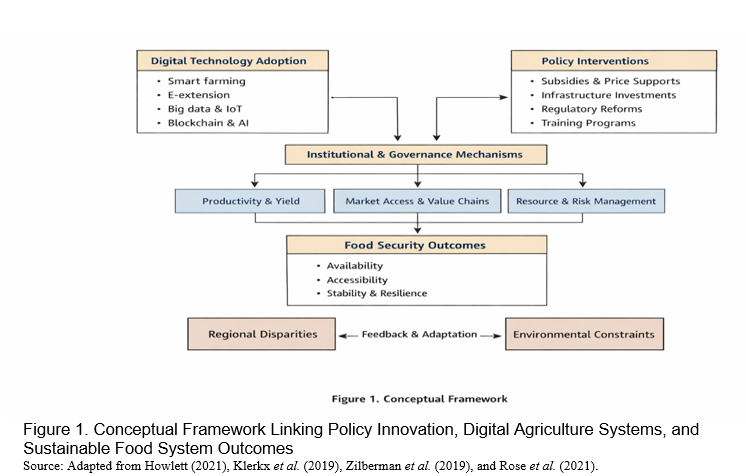
The framework shown in Figure 1 illustrates how policy innovation (policy goals, instruments, and governance arrangements) shapes the deployment of digital agriculture systems (precision farming, digital extension, mechanization platforms, and integrated data infrastructures). These systems influence farm-level practices and system-level performance, generating sustainable food system outcomes, including productivity growth, environmental efficiency, resilience to climate and market shocks, and inclusive rural development. Continuous feedback loops enabled by real-time data and monitoring systems support adaptive policy learning, iterative policy adjustment, and institutional capacity strengthening.
RESEARCH METHODOLOGY
This study employs a mixed-methods case study to examine the institutional mechanisms and performance outcomes of Indonesia's Food Self-Sufficiency Program. Combining qualitative and quantitative evidence enables triangulation and provides a comprehensive assessment of policy innovation and food system performance (Creswell & Plano Clark, 2018; Yin, 2018).
The qualitative analysis is based on national policy documents, ministerial regulations, program guidelines, and official evaluation reports related to digital agriculture, mechanization, and food self-sufficiency. Structured content analysis is used to examine policy objectives, governance arrangements, implementation mechanisms, and institutional coordination, following established approaches in policy design and institutional analysis (Howlett, 2021; Howlett & Mukherjee, 2018).
The quantitative analysis uses secondary time-series and panel data from FAOSTAT (2010–2023) and Statistics Indonesia (BPS, 2010–2025). These datasets provide national and provincial indicators on agricultural production, yields, harvested area, and food self-sufficiency. Descriptive trend analysis is applied to assess productivity, stability, and regional disparities over time (OECD, 2019; Pingali et al., 2019).
Qualitative and quantitative findings are integrated through triangulation to evaluate how policy innovations influence productivity, governance capacity, and food system resilience. Cross-validation between FAOSTAT and BPS enhances data reliability (World Bank, 2020).
The analysis covers 2010–2025, encompassing the pre-digital, early adoption, and consolidation phases of agricultural digitalization. Values for 2025 are treated as projections where official statistics are unavailable. Although the use of secondary data limits causal inference, the mixed-methods design provides a robust system-level assessment of technology-driven policy innovation and sustainable agricultural transformation.
RESULTS AND DISCUSSION
Policy instruments: mechanism, uptake, and bottlenecks
Interpretation of empirical trends is informed by comparative evidence on productivity growth, structural transformation, climate risk exposure, and digital governance in food systems. Cross-country studies indicate that sustained productivity improvements increasingly depend on institutional quality, technological diffusion, and value-chain integration rather than land expansion alone (Pingali et al., 2019; Zilberman et al., 2019; OECD, 2019). Climate science literature further highlights rising yield volatility and the growing importance of adaptive management strategies (Lobell et al., 2011; Thornton & Herrero, 2015).
Food systems research emphasizes that resilience emerges from diversified production portfolios, efficient logistics, reliable information flows, and responsive governance institutions (Barrett, 2021; Pretty et al., 2018). Digital governance frameworks demonstrate that real-time data integration enhances monitoring accuracy, policy feedback cycles, and inter-agency coordination, thereby strengthening system-level adaptability (Rose et al., 2021; Klerkx et al., 2019).
Table 1. Policy Innovations and Technology Instruments Supporting the Food Self-Sufficiency Programme in Indonesia.
|
Policy instrument
|
Technology component
|
Primary function
|
Expected impact
|
Implementation level
|
|
Digital Extension System (e-Penyuluhan)
|
Mobile apps, cloud databases, AI advisory
|
Real-time farmer advisory, pest alerts, input recommendations
|
Yield stability, reduced information asymmetry
|
National–Provincial
|
|
Mechanization Service Units (UPJA)
|
Smart tractors, harvesters, GPS tracking
|
Timely land preparation and harvesting
|
Labor efficiency, reduced post-harvest loss
|
Provincial–District
|
|
Precision Fertilizer Subsidy
|
Digital farmer registry, e-voucher system
|
Targeted fertilizer allocation
|
Input efficiency, fiscal savings
|
National
|
|
Smart Irrigation Pilots
|
IoT sensors, remote monitoring
|
Water-use optimization
|
Climate resilience, water productivity
|
District
|
|
Agricultural Big Data Platform
|
Integrated farm and market databases
|
Policy monitoring and forecasting
|
Evidence-based policymaking
|
National
|
Source: Ministry of Agriculture of Indonesia (various years); OECD (2019); Klerkx et al. (2019); Rose et al. (2021).
Sustained agricultural productivity increasingly depends on institutional quality, technological diffusion, and effective governance rather than land expansion alone (Pingali et al., 2019; Zilberman et al., 2019). Digital technologies strengthen food system resilience by improving information flows, policy coordination, and adaptive decision-making (Barrett, 2021; Klerkx et al., 2019).
Table 1 summarizes the principal policy instruments supporting Indonesia's Food Self-Sufficiency Program. Digital extension, mechanization services, precision fertilizer subsidies, smart irrigation, and integrated agricultural data platforms enhance productivity while improving governance through real-time monitoring, targeted interventions, and evidence-based policymaking. Digital extension reduces information asymmetry and accelerates technology adoption, mechanization improves operational efficiency and reduces post-harvest losses, while digital registries and integrated databases strengthen subsidy targeting, transparency, and policy coordination (Howlett, 2021; Rose et al., 2021).
Despite these advances, implementation remains uneven. Limited digital infrastructure, weak institutional capacity, fragmented databases, and insufficient coordination across administrative levels constrain technology adoption and reduce policy effectiveness (World Bank, 2020; Fan et al., 2021). Financial constraints, inadequate technical skills, and weak public–private collaboration further limit the sustainability and scalability of mechanization and digital service delivery.
Overall, the evidence indicates that digital technologies function not only as productivity-enhancing tools but also as governance infrastructure. However, their long-term impact depends on complementary investments in digital connectivity, institutional capacity, human capital, and integrated value-chain development to ensure inclusive and sustainable agricultural transformation (Birner & Resnick, 2020; OECD, 2019).
National performance dynamics: Food Self-Sufficiency Indicators
Table 2 reveals stabilization of rice self-sufficiency at high levels, gradual improvement in maize, and persistent structural weakness in soybean. Rice stability reflects long-term institutional layering—irrigation, subsidy systems, extension services, and price stabilization—which buffers shocks but also signals diminishing marginal returns and rising environmental pressures (Pingali et al., 2019; Pretty et al., 2018; Lobell et al., 2011). Incremental yield gains align with mechanization and digital advisory diffusion, suggesting efficiency enhancement rather than transformational growth (Zilberman et al., 2019; Rose et al., 2021). Maize volatility reflects sensitivity to feed markets, logistics constraints, and climate variability, while soybean’s low self-sufficiency indicates comparative disadvantage and high fiscal opportunity costs of import substitution strategies (Birner & Resnick, 2020; Headey & Alderman, 2019; World Bank, 2020). These trends underscore the importance of differentiated commodity strategies and of integrating sustainability and resilience indicators into performance monitoring, rather than relying exclusively on output targets (Barrett, 2021; OECD, 2019).
Table 2. National Trends in Food Self-Sufficiency Indicators in Indonesia, 2010–2025.
|
Year
|
Rice Self-Sufficiency (%)
|
Maize Self-Sufficiency (%)
|
Soybean Self-Sufficiency (%)
|
Rice Yield (t/ha)
|
|
2010
|
95.0
|
88.2
|
35.1
|
5.02
|
|
2012
|
96.1
|
89.5
|
36.0
|
5.10
|
|
2014
|
97.8
|
91.3
|
38.5
|
5.18
|
|
2016
|
96.9
|
92.0
|
39.2
|
5.25
|
|
2018
|
96.3
|
92.8
|
40.0
|
5.31
|
|
2020
|
95.8
|
93.4
|
41.2
|
5.36
|
|
2022
|
96.5
|
94.1
|
42.8
|
5.42
|
|
2023
|
97.1
|
95.0
|
43.5
|
5.45
|
|
2024
|
97.5
|
95.4
|
44.0
|
5.48
|
|
2025*
|
98.0
|
96.0
|
45.0
|
5.52
|
Note: 2025 values are projections; n.a. where official data are unavailable.
Source: FAOSTAT (2010–2023); Statistics Indonesia / BPS (2010–2025).
Table 2’s national trends show rice self-sufficiency stabilizing at high levels, maize improving gradually, and soybean remaining structurally low. A deeper analytical reading yields five interrelated insights.
Stability versus diminishing returns by rice stability (≈95–98%) reflects decades of institutional layering through irrigation rehabilitation, fertilizer subsidies, extension systems, and price stabilization policies that collectively buffer production shocks (Pingali et al., 2019). However, marginal yield gains have slowed while water stress, soil degradation, and input dependency have increased, indicating diminishing returns to conventional intensification strategies (Pretty et al., 2018; Lobell et al., 2011).
Technology contribution and saturation effects with incremental yield gains since 2015 coincide with expanding mechanization coverage and digital advisory penetration, suggesting technology has supported stabilization rather than transformational growth. This pattern aligns with international evidence that digital technologies initially generate efficiency gains before encountering institutional and ecological ceilings (Zilberman et al., 2019; Rose et al., 2021).
Commodity-specific structural constraints in maize demonstrate upward momentum but higher volatility due to feed market exposure, storage constraints, and climate sensitivity. Soybeans’ persistently low ratio reflects comparative disadvantage in land suitability, fragmented seed systems, and weak domestic processing competitiveness, implying that aggressive self-sufficiency targets generate high fiscal and opportunity costs (Birner & Resnick, 2020; Headey & Alderman, 2019; World Bank, 2020).
Policy learning cycles and time lags observed improvements follow multi-year cycles, whereby pilot programs gradually scale as institutions adapt and coordination improves. Such lags are consistent with adaptive governance theory and caution against short-term performance evaluation horizons (Howlett, 2021; Anderson et al., 2021).
Trade-offs and externalities, persistent trade-offs remain between price stabilization, fiscal sustainability, environmental pressure, and farmer income protection. Table 2 reinforces the need for integrated performance metrics incorporating productivity, environmental sustainability, resilience, and equity rather than narrow output indicators (Barrett, 2021; OECD, 2019; Pretty et al., 2018).
Spatial heterogeneity and provincial pathways
Table 3 highlights the persistent spatial concentration of rice production in Java, driven by historical irrigation density, logistics connectivity, proximity to milling clusters, and dense extension networks, reinforcing path dependency and cumulative advantage (Lowder et al., 2016; Fan et al., 2021). While selected non‑Java provinces exhibit growth potential due to land availability and mechanization diffusion, production remains vulnerable to rainfall variability, weak irrigation, limited storage, and constrained market access (World Bank, 2020; OECD, 2019). Provinces with stronger digital infrastructure and administrative coordination show more stable output trajectories, indicating that digital agriculture enhances institutional capacity alongside productivity (Klerkx et al., 2019; Rose et al., 2021). Persistent spatial inequality has distributional implications for income stability and resilience, requiring territorially differentiated policy mixes that combine infrastructure upgrading, targeted finance, and extension strengthening while avoiding inefficient blanket subsidies (Birner & Resnick, 2020; Barrett, 2021).
Table 3. Provincial Rice Production and Contributions to National Food Self-Sufficiency in Indonesia, 2010–2025 (million tonnes).
|
Province
|
2010
|
2015
|
2020
|
2023
|
2024
|
2025*
|
|
East Java
|
12.1
|
13.2
|
9.9
|
5.40
|
5.35
|
5.60
|
|
Central Java
|
10.1
|
11.3
|
9.5
|
5.20
|
5.11
|
5.30
|
|
West Java
|
11.6
|
11.9
|
9.8
|
4.80
|
4.90
|
5.00
|
|
South Sulawesi
|
4.1
|
4.6
|
4.9
|
5.10
|
5.05
|
5.20
|
|
North Sumatra
|
3.7
|
3.9
|
4.1
|
4.30
|
4.25
|
4.40
|
|
South Sumatra
|
3.5
|
3.8
|
4.0
|
4.10
|
4.05
|
4.20
|
|
Lampung
|
3.2
|
3.4
|
3.6
|
3.80
|
3.75
|
3.90
|
|
West Nusa Tenggara
|
2.6
|
2.8
|
3.0
|
3.10
|
3.05
|
3.20
|
|
East Nusa Tenggara
|
1.1
|
1.2
|
1.3
|
1.40
|
1.35
|
1.45
|
|
Papua
|
0.4
|
0.5
|
0.6
|
0.70
|
n.a.
|
n.a.
|
Note: 2025 values are projections; n.a. indicates unavailable provincial reporting.
Source: Statistics Indonesia / BPS Provincial Production Statistics (2010–2025); FAOSTAT (2010–2023).
Table 3 highlights the persistent spatial concentration of rice production in Java alongside the gradual expansion in selected non-Java provinces. A more granular interpretation identifies structural drivers, transition pathways, and distributional implications.
Agglomeration and path dependency in Java historical irrigation density, superior logistics connectivity, proximity to milling clusters, and dense extension networks generate cumulative advantages that sustain Java’s dominance despite land fragmentation and urban pressure (Lowder et al., 2016; Fan et al., 2021). Institutional path dependency reinforces investment concentration, making spatial diversification politically and administratively challenging (Anderson et al., 2021).
Emerging growth corridors outside Java, such as South Sulawesi and North Sumatra, benefit from land availability and the diffusion of mechanization, yet remain vulnerable to rainfall variability, limited irrigation coverage, and weak downstream processing. Without parallel investments in storage, cold chains, and market access, production growth risks stagnation or price volatility (World Bank, 2020; OECD, 2019).
Digital readiness and institutional capacity in provinces exhibiting stronger digital infrastructure and administrative coordination demonstrate more stable output trajectories, indicating that digital agriculture strengthens institutional capability and governance quality in addition to farm productivity (Klerkx et al., 2019; Rose et al., 2021).
Equity and regional convergence challenges arising from persistent spatial concentration generate uneven income opportunities and resilience capacities. Addressing convergence requires territorially differentiated policy mixes that combine infrastructure investment, extension and upgrading, and targeted finance, while avoiding inefficient blanket subsidies (Birner & Resnick, 2020; Fan et al., 2021; Barrett, 2021).
System resilience, shocks, and adaptive capacity
The synthesizes long-term self-sufficiency dynamics and illustrates how policy innovation and digitalization strengthen system resilience rather than solely expanding output. Digital monitoring, logistics coordination, and mechanization improve shock absorption capacity by reducing response times and enhancing situational awareness during climate and market disruptions (OECD, 2019; Barrett, 2021; Rose et al., 2021). Integrated data systems support adaptive governance through faster feedback loops and evidence-based adjustment of policy instruments (Howlett, 2021; Klerkx et al., 2019). Nevertheless, ecological constraints—water scarcity, soil degradation, and climate stress—impose biophysical ceilings on intensification, highlighting the limits of purely technological solutions (Pretty et al., 2018; Lobell et al., 2011; Zilberman et al., 2019). Persistent soybean deficits further support portfolio-based food security strategies that integrate domestic production with strategic imports and nutrition objectives rather than rigid commodity self-sufficiency mandates (Headey & Alderman, 2019; Birner & Resnick, 2020).
Table 2 shows long-term performance across staple crops and highlights the interaction between policy innovation, technology adoption, and resilience capacity. Shock absorption and continuity digital monitoring systems, improved logistics coordination, and mechanization have increased the system’s capacity to absorb shocks such as pandemic disruptions, climate anomalies, and input market volatility by shortening response times and improving situational awareness (OECD, 2019; Barrett, 2021; Rose et al., 2021). Adaptive governance and feedback loops integrated data platforms enable faster identification of stress points and more precise targeting of interventions, strengthening policy learning cycles and institutional adaptability (Howlett, 2021; Klerkx et al., 2019). Structural limits of technological solutions, despite resilience gains, ecological constraints, water scarcity, and soil degradation, impose biophysical ceilings on intensification. Without complementary investments in ecosystem restoration, climate-smart practices, and diversified diets, technology-driven gains risk plateauing (Pretty et al., 2018; Lobell et al., 2011; Zilberman et al., 2019). Portfolio-based food security strategy, persistent soybean deficits underscore the importance of diversified import strategies and nutritional objectives rather than rigid commodity self-sufficiency, consistent with food systems resilience theory (Headey & Alderman, 2019; Birner & Resnick, 2020).
Cross-table synthesis: productivity–governance–resilience interactions
The technology–institution complementarity shown in Table 1 indicates that digital instruments simultaneously target farm-level efficiency and governance capability, while Tables 2–4 indicate that stabilization gains materialize primarily where institutional coordination is strong and service delivery is reliable. This confirms that technology generates durable productivity and stability benefits only when embedded in coherent institutional architectures that align incentives, data standards, and administrative accountability. Provinces with higher digital readiness and administrative coordination exhibit more stable production trajectories (Table 3), supporting the argument that institutional capacity acts as a multiplier on technological investment rather than a passive backdrop.
Spatial concentration and diminishing marginal returns by the persistence of Java-dominated production (Table 3) alongside plateauing rice yield growth (Table 2) illustrate a classic agglomeration–saturation dynamic. Early productivity gains were driven by irrigation density, logistics proximity, and extension intensity, but marginal returns decline as land constraints, environmental pressure, and congestion effects intensify. This pattern suggests that future national productivity growth is increasingly contingent on spatial diversification and infrastructure upgrading in secondary regions rather than further intensification in already mature production zones.
Resilience trade-offs under climate and market volatility improved shock absorption capacity, yet Table 2 shows commodity-specific vulnerabilities, especially for maize and soybean. This divergence highlights that resilience is uneven across value chains and that system-wide stability can mask underlying fragilities. Digital monitoring improves short-term responsiveness, but long-term resilience requires diversification of production portfolios, logistics redundancy, risk financing, and ecosystem protection to prevent correlated failures during extreme climate or market shocks.
Collectively, these interactions indicate that policy effectiveness is driven less by the volume of technological investment and more by the coherence between institutional design, spatial strategy, and risk governance. From an economic perspective, the evidence suggests declining marginal returns to isolated capital deepening in mature regions and increasing returns to institutional complementarity in digitally ready provinces. Yield stabilization reflects efficiency gains and risk reduction rather than structural productivity acceleration, implying that future growth will increasingly depend on transaction-cost reduction, logistics efficiency, and coordination externalities rather than input intensification alone. Policy sequencing, therefore, matters: investments in connectivity, data interoperability, administrative capability, and market integration must precede or accompany digital tool deployment to avoid underutilization, lock‑in effects, and widening regional divergence.
Theoretical contribution in these findings extend policy innovation theory by empirically demonstrating how digital technologies operate as endogenous governance infrastructure that reshapes feedback loops, incentive alignment, and institutional learning capacity within food systems. The results also refine food systems resilience theory by showing that aggregate stability can coexist with latent spatial and commodity vulnerabilities, underscoring the importance of portfolio diversification and institutional redundancy as resilience mechanisms rather than purely technological buffering.
Synthesis of the empirical insights suggests four program design priorities. Bundle interventions. Combine digital advisory, mechanization services, logistics investment, and finance (credit/insurance) to address interconnected constraints (Klerkx et al., 2019; Fan et al., 2021). Differentiated strategies. Develop province-specific policy mixes that reflect agro-ecological conditions, market access, and institutional readiness rather than national one-size-fits-all programmes (OECD, 2019; World Bank, 2020). Performance metrics. Move beyond output targets to include sustainability, equity, and resilience indicators in programme monitoring (Pretty et al., 2018; Barrett, 2021). Learning and feedback. Institutionalize rigorous monitoring and evaluation linked to adaptive funding windows that allow scaling successful pilots and redirecting ineffective ones (Howlett, 2021; Rose et al., 2021).
CONCLUSION, POLICY IMPLICATIONS, AND STRATEGIC RECOMMENDATIONS
Conclusion
This study demonstrates that technology-driven policy innovation has strengthened Indonesia's Food Self-Sufficiency Program by improving both agricultural productivity and governance capacity. Digital extension, mechanization, precision input management, and integrated agricultural data systems have enhanced production efficiency, policy coordination, and evidence-based decision-making. The findings indicate that digital technologies function not only as production tools but also as governance infrastructure that supports adaptive policymaking and food system resilience.
However, Indonesia's experience also reveals that technological innovation alone cannot overcome structural constraints. Although rice production has remained relatively stable, maize continues to face climate and logistics risks, while soybean remains structurally dependent on imports because of limited comparative advantage. These differences reflect Indonesia's diverse agroecological conditions, fragmented landholdings, unequal digital infrastructure, and varying institutional capacity across provinces. Consequently, aggregate national performance masks substantial regional disparities.
The results suggest that the effectiveness of digital agriculture depends on complementary investments in rural infrastructure, extension services, institutional coordination, and human capital. Rather than pursuing commodity self-sufficiency through uniform national interventions, Indonesia requires a systems-based approach that integrates productivity, resilience, environmental sustainability, and regional equity. For an archipelagic country characterized by diverse farming systems and decentralized governance, adaptive and place-based policies are likely to generate greater long-term food security than standardized national programmes.
Overall, Indonesia illustrates that sustainable food security is achieved through the interaction of technological innovation, effective institutions, and coordinated governance. This experience offers valuable lessons for other emerging economies seeking to balance food security, climate resilience, and inclusive rural transformation.
Policy implications and strategic recommendations
Based on the findings, six policy priorities are proposed.
- Institutionalize digital agriculture as national public infrastructure. Strengthen interoperability among farmer registries, extension platforms, market information systems, and agricultural databases to support integrated and evidence-based policymaking.
- Adopt region-specific agricultural strategies. Replace uniform national interventions with province-based policies reflecting agroecological conditions, infrastructure availability, commodity specialization, and institutional readiness, particularly by strengthening production corridors outside Java.
- Strengthen value-chain resilience. Complement productivity programs with investments in irrigation, storage, logistics, processing facilities, digital market access, climate information services, and agricultural risk-financing mechanisms to reduce post-harvest losses and improve farmer incomes.
- Invest in institutional and human capacity. Expand digital competencies among extension officers, local governments, farmer organizations, and agribusiness actors to maximize technology adoption and governance effectiveness.
- Broaden food system performance indicators. Move beyond production-oriented targets by incorporating resilience, environmental sustainability, resource-use efficiency, farmer welfare, and nutritional outcomes into national monitoring and evaluation systems.
- Reorient food security toward strategic resilience. While maintaining rice as a strategic staple, policies for maize and soybean should emphasize comparative advantage, diversified sourcing, strategic reserves, and sustainable domestic production rather than rigid self-sufficiency targets.
Policy Contribution. The Indonesian case demonstrates that digital transformation generates the greatest impact when combined with institutional reform, territorial policy differentiation, and resilient value-chain development. Future food security policies should therefore prioritize governance innovation alongside technological advancement to build adaptive, inclusive, and climate-resilient agricultural systems.
REFERENCES
Anderson, K., Rausser, G., & Swinnen, J. (2021). Political economy of public policies: Insights from agricultural and food policies. Journal of Economic Literature, 59(2), 473–528. https://doi.org/10.1257/jel.20191530
Barrett, C. B. (2021). Overcoming global food security challenges through science and policy. Proceedings of the National Academy of Sciences, 118(13), e2022239118. https://doi.org/10.1073/pnas.2022239118
Birner, R., & Resnick, D. (2020). The political economy of policies for smallholder agriculture. World Development, 125, 104646. https://doi.org/10.1016/j.worlddev.2019.104646
Creswell, J. W., & Plano Clark, V. L. (2018). Designing and conducting mixed methods research (3rd ed.). Sage.
Fan, S., Teng, P., Chew, P., Smith, G., & Copeland, L. (2021). Food system resilience and transformation in Asia. Global Food Security, 28, 100484. https://doi.org/10.1016/j.gfs.2020.100484
FAO. (2017). The future of food and agriculture: Trends and challenges. Food and Agriculture Organization of the United Nations.
FAOSTAT. (2010–2023). Food and agriculture data. Food and Agriculture Organization of the United Nations.
Headey, D., & Alderman, H. (2019). The relative caloric prices of healthy and unhealthy foods differ systematically across income levels. The Journal of Nutrition, 149(11), 2020–2033. https://doi.org/10.1093/jn/nxz158
Howlett, M. (2021). Designing public policies: Principles and instruments (2nd ed.). Routledge.
Howlett, M., & Mukherjee, I. (2018). Policy design and non-design: Towards a spectrum of policy formulation types. Policy and Society, 37(1), 1–19. https://doi.org/10.1080/14494035.2017.1381532
Klerkx, L., Jakku, E., & Labarthe, P. (2019). A review of social science on digital agriculture, smart farming and agriculture 4.0: New contributions and a future research agenda. NJAS – Wageningen Journal of Life Sciences, 90–91, 100315. https://doi.org/10.1016/j.njas.2019.100315
Lobell, D. B., Schlenker, W., & Costa-Roberts, J. (2011). Climate trends and global crop production since 1980. Science, 333(6042), 616–620. https://doi.org/10.1126/science.1204531
Lowder, S. K., Skoet, J., & Raney, T. (2016). The number, size, and distribution of farms, smallholder farms, and family farms worldwide. World Development, 87, 16–29. https://doi.org/10.1016/j.worlddev.2015.10.041
OECD. (2019). Innovation, productivity and sustainability in food and agriculture. OECD Publishing. https://doi.org/10.1787/innov_food_agri-2019-en
Pingali, P., Aiyar, A., Abraham, M., & Rahman, A. (2019). Transforming food systems for a rising India. Palgrave Macmillan. https://doi.org/10.1007/978-3-030-14409-8
Pretty, J., Benton, T. G., Bharucha, Z. P., Dicks, L. V., Flora, C. B., Godfray, H. C. J., ... & Wratten, S. (2018). Global assessment of agricultural system redesign for sustainable intensification. Nature Sustainability, 1(8), 441–446. https://doi.org/10.1038/s41893-018-0114-0
Rose, D. C., Wheeler, R., Winter, M., Lobley, M., & Chivers, C. (2021). Agriculture 4.0: Making it work for people, production, and the planet. Land Use Policy, 100, 104933. https://doi.org/10.1016/j.landusepol.2020.104933
Rusliyadi, M., & Chen, Y.-H. (2024). An Analysis of the Food Security Policy Implementation Framework: The Case of Food Self-Sufficiency and Extension Policy in Indonesia An Analysis of the Food Security Policy Implementation Framework: The Case of Food Self-Sufficiency and Extension Policy in Indonesia. Retrieved January 12, 2026, from https://ap.fftc.org.tw/article/3607
Statistics Indonesia (BPS). (2010–2025). Food crop production statistics. BPS.
Thornton, P. K., & Herrero, M. (2015). Adapting to climate change in the mixed crop and livestock farming systems in sub-Saharan Africa. Nature Climate Change, 5(9), 830–836. https://doi.org/10.1038/nclimate2754
United Nations. (2023). The Sustainable Development Goals Report 2023. United Nations.
World Bank. (2020). Transforming agriculture for growth and jobs. World Bank Group.
Yin, R. K. (2018). Case study research and applications: Design and methods (6th ed.). Sage.
Zhang, C., & Kovacs, J. M. (2016). The application of small unmanned aerial systems for precision agriculture: A review. Precision Agriculture, 13(6), 693–712. https://doi.org/10.1007/s11119-012-9274-5
Zilberman, D., Lu, L., & Reardon, T. (2019). Innovation-induced food supply chain design. American Journal of Agricultural Economics, 101(2), 505–513. https://doi.org/10.1093/ajae/aay098


Policy Innovation for Sustainable Agriculture and Food Security in Indonesia: A Case Study of the Technology-Driven Implementation of the Food Self-Sufficiency Program
ABSTRACT
Indonesia has long pursued food self-sufficiency as a strategic national objective, yet climate change, environmental degradation, and market volatility continue to challenge agricultural sustainability and food security. This study examines how technology-driven policy innovation within Indonesia's Food Self-Sufficiency Program enhances food system performance, governance, and resilience. A mixed-methods case study integrates policy document analysis, FAOSTAT and Statistics Indonesia (BPS) data, and recent peer-reviewed literature to assess policy design, implementation, and outcomes. The findings show that digital agricultural extension, precision farming, mechanization, and integrated agricultural data systems improve production efficiency, strengthen governance coordination, and support adaptive policy learning. However, their impacts remain uneven across regions and commodities because of disparities in infrastructure, institutional capacity, digital readiness, market integration, and access to finance. The study further demonstrates that technological innovation alone is insufficient to overcome structural constraints such as spatial inequality, environmental pressures, and fragmented value chains. Sustainable food security therefore depends on integrating technological advancement with institutional strengthening, coordinated governance, and investments in infrastructure and human capital. These findings highlight the role of digital technologies as both production and governance infrastructure, offering policy insights for emerging economies seeking to promote sustainable agricultural transformation, resilient food systems, and inclusive rural development.
Keywords: Policy innovation; Sustainable agriculture; Food security; Digital agriculture; Governance; Indonesia
INTRODUCTION
Food security and sustainable agriculture are central to Indonesia's national development strategy and the global Sustainable Development Goals (SDG 2: Zero Hunger and SDG 12: Responsible Consumption and Production). However, climate change, land degradation, demographic pressures, urbanization, and global market volatility continue to threaten agricultural productivity and food system resilience, requiring adaptive and innovation-oriented policy responses (Barrett, 2021; Pingali et al., 2019; Pretty et al., 2018). Beyond increasing production, sustainable food systems increasingly depend on governance quality, institutional capacity, and resilience to environmental and economic shocks (Headey & Alderman, 2019; United Nations, 2023).
Recent advances in digital agriculture—including precision farming, digital extension, mechanization, remote sensing, and integrated data platforms—offer new opportunities to improve productivity, resource efficiency, and policy coordination (Klerkx et al., 2019; Rose et al., 2021; Zilberman et al., 2019). These technologies enhance real-time monitoring, evidence-based decision-making, and adaptive governance. Nevertheless, their effectiveness remains constrained by inadequate infrastructure, digital literacy, institutional fragmentation, and limited access to finance, particularly in developing economies (World Bank, 2020; Fan et al., 2021). Consequently, technology deployment must be accompanied by institutional reform and governance innovation (Howlett, 2021; Howlett & Mukherjee, 2018).
Indonesia has long pursued food self-sufficiency to strengthen national food security and reduce dependence on imports. Although substantial progress has been achieved in staple crop production, persistent challenges—including fragmented landholdings, regional disparities, climate risks, and uneven institutional capacity—continue to limit sustainable agricultural transformation (FAO, 2017; Lowder et al., 2016; World Bank, 2020). These challenges highlight the need for policy approaches that integrate technological innovation with effective governance and institutional coordination.
Although the literature widely recognizes the potential of digital agriculture, existing studies primarily examine farm-level technology adoption and productivity impacts. Comparatively little attention has been paid to how technology-driven policy innovation reshapes governance systems, institutional coordination, and long-term food system resilience in large developing economies (Birner & Resnick, 2020; Fan et al., 2021). Addressing this gap, this study examines Indonesia's Food Self-Sufficiency Program as a case of technology-driven policy innovation.
Specifically, the study investigates (1) how digital technologies are integrated into Indonesia's food self-sufficiency policy framework, (2) how these innovations influence national and provincial food system performance, and (3) what policy lessons can support sustainable agricultural transformation in emerging economies. By integrating policy analysis with FAOSTAT and Statistics Indonesia (BPS) data, the study contributes to a better understanding of how digital technologies can function not only as productivity-enhancing tools but also as governance infrastructure that strengthens resilience, adaptive policymaking, and sustainable food security.
CONCEPTUAL FRAMEWORK
The analytical framework builds on three complementary bodies of literature: policy innovation and design, digital agriculture and innovation systems, and sustainable food systems and resilience. Policy design scholarship emphasizes that effective policies require coherent alignment between goals, instruments, and governance arrangements, supported by feedback mechanisms and adaptive learning (Howlett, 2021; Howlett & Mukherjee, 2018). Political economy perspectives further highlight that institutional credibility, coordination capacity, and stakeholder incentives shape policy performance over time (Anderson et al., 2021; Birner & Resnick, 2020).
Digital agriculture literature conceptualizes technologies as socio-technical systems embedded within institutional and organizational contexts rather than isolated productivity tools. Precision agriculture, digital extension platforms, and remote sensing systems reshape knowledge flows, decision cycles, and accountability structures across agricultural systems (Klerkx et al., 2019; Rose et al., 2021; Zhang & Kovacs, 2016). These technologies enable scalability, interoperability, and data-driven governance when supported by appropriate regulatory frameworks and human capital development (OECD, 2019; Zilberman et al., 2019).
Sustainable food systems research extends the analytical lens beyond yields toward resilience, environmental stewardship, nutritional outcomes, and social inclusion. Sustainable intensification literature argues that productivity gains must be decoupled from ecological degradation through efficient resource management and climate-smart practices (Pretty et al., 2018; Lobell et al., 2011). Food systems transformation frameworks further emphasize the role of institutional coordination and value-chain governance in translating productivity gains into welfare improvements (Pingali et al., 2019; Barrett, 2021).
Rather than presenting a standalone literature review, this section synthesizes and integrates key theoretical insights into an analytical framework that guides empirical analysis. The framework combines three interrelated dimensions: policy innovation, digital agriculture systems, and sustainable food system outcomes (Howlett, 2021; Howlett & Mukherjee, 2018; Klerkx et al., 2019; Zilberman et al., 2019).
Policy innovation involves intentionally redesigning policy goals, instruments, and governance arrangements to enhance adaptability, coordination, and effectiveness in complex environments. Innovation may occur at the level of policy objectives, policy instruments, and institutional processes, enabling governments to respond dynamically to uncertainty and policy feedback (Howlett, 2021; Anderson et al., 2021).
Digital agriculture systems encompass technologies such as precision farming, remote sensing, digital advisory services, mechanisation platforms, and integrated agricultural databases. These technologies reduce information asymmetry, improve the timing and accuracy of farm operations, and enhance traceability and coordination across value chains (Klerkx et al., 2019; Zhang & Kovacs, 2016; Rose et al., 2021).
Sustainable food system outcomes include productivity growth, environmental efficiency, resilience to climate and market shocks, and inclusive rural development. Sustainable intensification literature emphasizes that productivity gains must be aligned with ecosystem protection and social equity to ensure long-term welfare impacts (Pretty et al., 2018; Barrett, 2021; Pingali et al., 2019).
Figure 1 conceptualizes these relationships and provides the analytical logic used to interpret the empirical evidence presented in Section 4 (see Figure 1). Policy innovation shapes the deployment and governance of digital technologies, which in turn influence farm-level practices and system-level performance. Feedback loops generated by real-time data systems enable continuous policy adjustment and institutional learning, strengthening long-term resilience and sustainability (Rose et al., 2021; Zilberman et al., 2019; OECD, 2019).
The framework shown in Figure 1 illustrates how policy innovation (policy goals, instruments, and governance arrangements) shapes the deployment of digital agriculture systems (precision farming, digital extension, mechanization platforms, and integrated data infrastructures). These systems influence farm-level practices and system-level performance, generating sustainable food system outcomes, including productivity growth, environmental efficiency, resilience to climate and market shocks, and inclusive rural development. Continuous feedback loops enabled by real-time data and monitoring systems support adaptive policy learning, iterative policy adjustment, and institutional capacity strengthening.
RESEARCH METHODOLOGY
This study employs a mixed-methods case study to examine the institutional mechanisms and performance outcomes of Indonesia's Food Self-Sufficiency Program. Combining qualitative and quantitative evidence enables triangulation and provides a comprehensive assessment of policy innovation and food system performance (Creswell & Plano Clark, 2018; Yin, 2018).
The qualitative analysis is based on national policy documents, ministerial regulations, program guidelines, and official evaluation reports related to digital agriculture, mechanization, and food self-sufficiency. Structured content analysis is used to examine policy objectives, governance arrangements, implementation mechanisms, and institutional coordination, following established approaches in policy design and institutional analysis (Howlett, 2021; Howlett & Mukherjee, 2018).
The quantitative analysis uses secondary time-series and panel data from FAOSTAT (2010–2023) and Statistics Indonesia (BPS, 2010–2025). These datasets provide national and provincial indicators on agricultural production, yields, harvested area, and food self-sufficiency. Descriptive trend analysis is applied to assess productivity, stability, and regional disparities over time (OECD, 2019; Pingali et al., 2019).
Qualitative and quantitative findings are integrated through triangulation to evaluate how policy innovations influence productivity, governance capacity, and food system resilience. Cross-validation between FAOSTAT and BPS enhances data reliability (World Bank, 2020).
The analysis covers 2010–2025, encompassing the pre-digital, early adoption, and consolidation phases of agricultural digitalization. Values for 2025 are treated as projections where official statistics are unavailable. Although the use of secondary data limits causal inference, the mixed-methods design provides a robust system-level assessment of technology-driven policy innovation and sustainable agricultural transformation.
RESULTS AND DISCUSSION
Policy instruments: mechanism, uptake, and bottlenecks
Interpretation of empirical trends is informed by comparative evidence on productivity growth, structural transformation, climate risk exposure, and digital governance in food systems. Cross-country studies indicate that sustained productivity improvements increasingly depend on institutional quality, technological diffusion, and value-chain integration rather than land expansion alone (Pingali et al., 2019; Zilberman et al., 2019; OECD, 2019). Climate science literature further highlights rising yield volatility and the growing importance of adaptive management strategies (Lobell et al., 2011; Thornton & Herrero, 2015).
Food systems research emphasizes that resilience emerges from diversified production portfolios, efficient logistics, reliable information flows, and responsive governance institutions (Barrett, 2021; Pretty et al., 2018). Digital governance frameworks demonstrate that real-time data integration enhances monitoring accuracy, policy feedback cycles, and inter-agency coordination, thereby strengthening system-level adaptability (Rose et al., 2021; Klerkx et al., 2019).
Table 1. Policy Innovations and Technology Instruments Supporting the Food Self-Sufficiency Programme in Indonesia.
Policy instrument
Technology component
Primary function
Expected impact
Implementation level
Digital Extension System (e-Penyuluhan)
Mobile apps, cloud databases, AI advisory
Real-time farmer advisory, pest alerts, input recommendations
Yield stability, reduced information asymmetry
National–Provincial
Mechanization Service Units (UPJA)
Smart tractors, harvesters, GPS tracking
Timely land preparation and harvesting
Labor efficiency, reduced post-harvest loss
Provincial–District
Precision Fertilizer Subsidy
Digital farmer registry, e-voucher system
Targeted fertilizer allocation
Input efficiency, fiscal savings
National
Smart Irrigation Pilots
IoT sensors, remote monitoring
Water-use optimization
Climate resilience, water productivity
District
Agricultural Big Data Platform
Integrated farm and market databases
Policy monitoring and forecasting
Evidence-based policymaking
National
Source: Ministry of Agriculture of Indonesia (various years); OECD (2019); Klerkx et al. (2019); Rose et al. (2021).
Sustained agricultural productivity increasingly depends on institutional quality, technological diffusion, and effective governance rather than land expansion alone (Pingali et al., 2019; Zilberman et al., 2019). Digital technologies strengthen food system resilience by improving information flows, policy coordination, and adaptive decision-making (Barrett, 2021; Klerkx et al., 2019).
Table 1 summarizes the principal policy instruments supporting Indonesia's Food Self-Sufficiency Program. Digital extension, mechanization services, precision fertilizer subsidies, smart irrigation, and integrated agricultural data platforms enhance productivity while improving governance through real-time monitoring, targeted interventions, and evidence-based policymaking. Digital extension reduces information asymmetry and accelerates technology adoption, mechanization improves operational efficiency and reduces post-harvest losses, while digital registries and integrated databases strengthen subsidy targeting, transparency, and policy coordination (Howlett, 2021; Rose et al., 2021).
Despite these advances, implementation remains uneven. Limited digital infrastructure, weak institutional capacity, fragmented databases, and insufficient coordination across administrative levels constrain technology adoption and reduce policy effectiveness (World Bank, 2020; Fan et al., 2021). Financial constraints, inadequate technical skills, and weak public–private collaboration further limit the sustainability and scalability of mechanization and digital service delivery.
Overall, the evidence indicates that digital technologies function not only as productivity-enhancing tools but also as governance infrastructure. However, their long-term impact depends on complementary investments in digital connectivity, institutional capacity, human capital, and integrated value-chain development to ensure inclusive and sustainable agricultural transformation (Birner & Resnick, 2020; OECD, 2019).
National performance dynamics: Food Self-Sufficiency Indicators
Table 2 reveals stabilization of rice self-sufficiency at high levels, gradual improvement in maize, and persistent structural weakness in soybean. Rice stability reflects long-term institutional layering—irrigation, subsidy systems, extension services, and price stabilization—which buffers shocks but also signals diminishing marginal returns and rising environmental pressures (Pingali et al., 2019; Pretty et al., 2018; Lobell et al., 2011). Incremental yield gains align with mechanization and digital advisory diffusion, suggesting efficiency enhancement rather than transformational growth (Zilberman et al., 2019; Rose et al., 2021). Maize volatility reflects sensitivity to feed markets, logistics constraints, and climate variability, while soybean’s low self-sufficiency indicates comparative disadvantage and high fiscal opportunity costs of import substitution strategies (Birner & Resnick, 2020; Headey & Alderman, 2019; World Bank, 2020). These trends underscore the importance of differentiated commodity strategies and of integrating sustainability and resilience indicators into performance monitoring, rather than relying exclusively on output targets (Barrett, 2021; OECD, 2019).
Table 2. National Trends in Food Self-Sufficiency Indicators in Indonesia, 2010–2025.
Year
Rice Self-Sufficiency (%)
Maize Self-Sufficiency (%)
Soybean Self-Sufficiency (%)
Rice Yield (t/ha)
2010
95.0
88.2
35.1
5.02
2012
96.1
89.5
36.0
5.10
2014
97.8
91.3
38.5
5.18
2016
96.9
92.0
39.2
5.25
2018
96.3
92.8
40.0
5.31
2020
95.8
93.4
41.2
5.36
2022
96.5
94.1
42.8
5.42
2023
97.1
95.0
43.5
5.45
2024
97.5
95.4
44.0
5.48
2025*
98.0
96.0
45.0
5.52
Note: 2025 values are projections; n.a. where official data are unavailable.
Source: FAOSTAT (2010–2023); Statistics Indonesia / BPS (2010–2025).
Table 2’s national trends show rice self-sufficiency stabilizing at high levels, maize improving gradually, and soybean remaining structurally low. A deeper analytical reading yields five interrelated insights.
Stability versus diminishing returns by rice stability (≈95–98%) reflects decades of institutional layering through irrigation rehabilitation, fertilizer subsidies, extension systems, and price stabilization policies that collectively buffer production shocks (Pingali et al., 2019). However, marginal yield gains have slowed while water stress, soil degradation, and input dependency have increased, indicating diminishing returns to conventional intensification strategies (Pretty et al., 2018; Lobell et al., 2011).
Technology contribution and saturation effects with incremental yield gains since 2015 coincide with expanding mechanization coverage and digital advisory penetration, suggesting technology has supported stabilization rather than transformational growth. This pattern aligns with international evidence that digital technologies initially generate efficiency gains before encountering institutional and ecological ceilings (Zilberman et al., 2019; Rose et al., 2021).
Commodity-specific structural constraints in maize demonstrate upward momentum but higher volatility due to feed market exposure, storage constraints, and climate sensitivity. Soybeans’ persistently low ratio reflects comparative disadvantage in land suitability, fragmented seed systems, and weak domestic processing competitiveness, implying that aggressive self-sufficiency targets generate high fiscal and opportunity costs (Birner & Resnick, 2020; Headey & Alderman, 2019; World Bank, 2020).
Policy learning cycles and time lags observed improvements follow multi-year cycles, whereby pilot programs gradually scale as institutions adapt and coordination improves. Such lags are consistent with adaptive governance theory and caution against short-term performance evaluation horizons (Howlett, 2021; Anderson et al., 2021).
Trade-offs and externalities, persistent trade-offs remain between price stabilization, fiscal sustainability, environmental pressure, and farmer income protection. Table 2 reinforces the need for integrated performance metrics incorporating productivity, environmental sustainability, resilience, and equity rather than narrow output indicators (Barrett, 2021; OECD, 2019; Pretty et al., 2018).
Spatial heterogeneity and provincial pathways
Table 3 highlights the persistent spatial concentration of rice production in Java, driven by historical irrigation density, logistics connectivity, proximity to milling clusters, and dense extension networks, reinforcing path dependency and cumulative advantage (Lowder et al., 2016; Fan et al., 2021). While selected non‑Java provinces exhibit growth potential due to land availability and mechanization diffusion, production remains vulnerable to rainfall variability, weak irrigation, limited storage, and constrained market access (World Bank, 2020; OECD, 2019). Provinces with stronger digital infrastructure and administrative coordination show more stable output trajectories, indicating that digital agriculture enhances institutional capacity alongside productivity (Klerkx et al., 2019; Rose et al., 2021). Persistent spatial inequality has distributional implications for income stability and resilience, requiring territorially differentiated policy mixes that combine infrastructure upgrading, targeted finance, and extension strengthening while avoiding inefficient blanket subsidies (Birner & Resnick, 2020; Barrett, 2021).
Table 3. Provincial Rice Production and Contributions to National Food Self-Sufficiency in Indonesia, 2010–2025 (million tonnes).
Province
2010
2015
2020
2023
2024
2025*
East Java
12.1
13.2
9.9
5.40
5.35
5.60
Central Java
10.1
11.3
9.5
5.20
5.11
5.30
West Java
11.6
11.9
9.8
4.80
4.90
5.00
South Sulawesi
4.1
4.6
4.9
5.10
5.05
5.20
North Sumatra
3.7
3.9
4.1
4.30
4.25
4.40
South Sumatra
3.5
3.8
4.0
4.10
4.05
4.20
Lampung
3.2
3.4
3.6
3.80
3.75
3.90
West Nusa Tenggara
2.6
2.8
3.0
3.10
3.05
3.20
East Nusa Tenggara
1.1
1.2
1.3
1.40
1.35
1.45
Papua
0.4
0.5
0.6
0.70
n.a.
n.a.
Note: 2025 values are projections; n.a. indicates unavailable provincial reporting.
Source: Statistics Indonesia / BPS Provincial Production Statistics (2010–2025); FAOSTAT (2010–2023).
Table 3 highlights the persistent spatial concentration of rice production in Java alongside the gradual expansion in selected non-Java provinces. A more granular interpretation identifies structural drivers, transition pathways, and distributional implications.
Agglomeration and path dependency in Java historical irrigation density, superior logistics connectivity, proximity to milling clusters, and dense extension networks generate cumulative advantages that sustain Java’s dominance despite land fragmentation and urban pressure (Lowder et al., 2016; Fan et al., 2021). Institutional path dependency reinforces investment concentration, making spatial diversification politically and administratively challenging (Anderson et al., 2021).
Emerging growth corridors outside Java, such as South Sulawesi and North Sumatra, benefit from land availability and the diffusion of mechanization, yet remain vulnerable to rainfall variability, limited irrigation coverage, and weak downstream processing. Without parallel investments in storage, cold chains, and market access, production growth risks stagnation or price volatility (World Bank, 2020; OECD, 2019).
Digital readiness and institutional capacity in provinces exhibiting stronger digital infrastructure and administrative coordination demonstrate more stable output trajectories, indicating that digital agriculture strengthens institutional capability and governance quality in addition to farm productivity (Klerkx et al., 2019; Rose et al., 2021).
Equity and regional convergence challenges arising from persistent spatial concentration generate uneven income opportunities and resilience capacities. Addressing convergence requires territorially differentiated policy mixes that combine infrastructure investment, extension and upgrading, and targeted finance, while avoiding inefficient blanket subsidies (Birner & Resnick, 2020; Fan et al., 2021; Barrett, 2021).
System resilience, shocks, and adaptive capacity
The synthesizes long-term self-sufficiency dynamics and illustrates how policy innovation and digitalization strengthen system resilience rather than solely expanding output. Digital monitoring, logistics coordination, and mechanization improve shock absorption capacity by reducing response times and enhancing situational awareness during climate and market disruptions (OECD, 2019; Barrett, 2021; Rose et al., 2021). Integrated data systems support adaptive governance through faster feedback loops and evidence-based adjustment of policy instruments (Howlett, 2021; Klerkx et al., 2019). Nevertheless, ecological constraints—water scarcity, soil degradation, and climate stress—impose biophysical ceilings on intensification, highlighting the limits of purely technological solutions (Pretty et al., 2018; Lobell et al., 2011; Zilberman et al., 2019). Persistent soybean deficits further support portfolio-based food security strategies that integrate domestic production with strategic imports and nutrition objectives rather than rigid commodity self-sufficiency mandates (Headey & Alderman, 2019; Birner & Resnick, 2020).
Table 2 shows long-term performance across staple crops and highlights the interaction between policy innovation, technology adoption, and resilience capacity. Shock absorption and continuity digital monitoring systems, improved logistics coordination, and mechanization have increased the system’s capacity to absorb shocks such as pandemic disruptions, climate anomalies, and input market volatility by shortening response times and improving situational awareness (OECD, 2019; Barrett, 2021; Rose et al., 2021). Adaptive governance and feedback loops integrated data platforms enable faster identification of stress points and more precise targeting of interventions, strengthening policy learning cycles and institutional adaptability (Howlett, 2021; Klerkx et al., 2019). Structural limits of technological solutions, despite resilience gains, ecological constraints, water scarcity, and soil degradation, impose biophysical ceilings on intensification. Without complementary investments in ecosystem restoration, climate-smart practices, and diversified diets, technology-driven gains risk plateauing (Pretty et al., 2018; Lobell et al., 2011; Zilberman et al., 2019). Portfolio-based food security strategy, persistent soybean deficits underscore the importance of diversified import strategies and nutritional objectives rather than rigid commodity self-sufficiency, consistent with food systems resilience theory (Headey & Alderman, 2019; Birner & Resnick, 2020).
Cross-table synthesis: productivity–governance–resilience interactions
The technology–institution complementarity shown in Table 1 indicates that digital instruments simultaneously target farm-level efficiency and governance capability, while Tables 2–4 indicate that stabilization gains materialize primarily where institutional coordination is strong and service delivery is reliable. This confirms that technology generates durable productivity and stability benefits only when embedded in coherent institutional architectures that align incentives, data standards, and administrative accountability. Provinces with higher digital readiness and administrative coordination exhibit more stable production trajectories (Table 3), supporting the argument that institutional capacity acts as a multiplier on technological investment rather than a passive backdrop.
Spatial concentration and diminishing marginal returns by the persistence of Java-dominated production (Table 3) alongside plateauing rice yield growth (Table 2) illustrate a classic agglomeration–saturation dynamic. Early productivity gains were driven by irrigation density, logistics proximity, and extension intensity, but marginal returns decline as land constraints, environmental pressure, and congestion effects intensify. This pattern suggests that future national productivity growth is increasingly contingent on spatial diversification and infrastructure upgrading in secondary regions rather than further intensification in already mature production zones.
Resilience trade-offs under climate and market volatility improved shock absorption capacity, yet Table 2 shows commodity-specific vulnerabilities, especially for maize and soybean. This divergence highlights that resilience is uneven across value chains and that system-wide stability can mask underlying fragilities. Digital monitoring improves short-term responsiveness, but long-term resilience requires diversification of production portfolios, logistics redundancy, risk financing, and ecosystem protection to prevent correlated failures during extreme climate or market shocks.
Collectively, these interactions indicate that policy effectiveness is driven less by the volume of technological investment and more by the coherence between institutional design, spatial strategy, and risk governance. From an economic perspective, the evidence suggests declining marginal returns to isolated capital deepening in mature regions and increasing returns to institutional complementarity in digitally ready provinces. Yield stabilization reflects efficiency gains and risk reduction rather than structural productivity acceleration, implying that future growth will increasingly depend on transaction-cost reduction, logistics efficiency, and coordination externalities rather than input intensification alone. Policy sequencing, therefore, matters: investments in connectivity, data interoperability, administrative capability, and market integration must precede or accompany digital tool deployment to avoid underutilization, lock‑in effects, and widening regional divergence.
Theoretical contribution in these findings extend policy innovation theory by empirically demonstrating how digital technologies operate as endogenous governance infrastructure that reshapes feedback loops, incentive alignment, and institutional learning capacity within food systems. The results also refine food systems resilience theory by showing that aggregate stability can coexist with latent spatial and commodity vulnerabilities, underscoring the importance of portfolio diversification and institutional redundancy as resilience mechanisms rather than purely technological buffering.
Synthesis of the empirical insights suggests four program design priorities. Bundle interventions. Combine digital advisory, mechanization services, logistics investment, and finance (credit/insurance) to address interconnected constraints (Klerkx et al., 2019; Fan et al., 2021). Differentiated strategies. Develop province-specific policy mixes that reflect agro-ecological conditions, market access, and institutional readiness rather than national one-size-fits-all programmes (OECD, 2019; World Bank, 2020). Performance metrics. Move beyond output targets to include sustainability, equity, and resilience indicators in programme monitoring (Pretty et al., 2018; Barrett, 2021). Learning and feedback. Institutionalize rigorous monitoring and evaluation linked to adaptive funding windows that allow scaling successful pilots and redirecting ineffective ones (Howlett, 2021; Rose et al., 2021).
CONCLUSION, POLICY IMPLICATIONS, AND STRATEGIC RECOMMENDATIONS
Conclusion
This study demonstrates that technology-driven policy innovation has strengthened Indonesia's Food Self-Sufficiency Program by improving both agricultural productivity and governance capacity. Digital extension, mechanization, precision input management, and integrated agricultural data systems have enhanced production efficiency, policy coordination, and evidence-based decision-making. The findings indicate that digital technologies function not only as production tools but also as governance infrastructure that supports adaptive policymaking and food system resilience.
However, Indonesia's experience also reveals that technological innovation alone cannot overcome structural constraints. Although rice production has remained relatively stable, maize continues to face climate and logistics risks, while soybean remains structurally dependent on imports because of limited comparative advantage. These differences reflect Indonesia's diverse agroecological conditions, fragmented landholdings, unequal digital infrastructure, and varying institutional capacity across provinces. Consequently, aggregate national performance masks substantial regional disparities.
The results suggest that the effectiveness of digital agriculture depends on complementary investments in rural infrastructure, extension services, institutional coordination, and human capital. Rather than pursuing commodity self-sufficiency through uniform national interventions, Indonesia requires a systems-based approach that integrates productivity, resilience, environmental sustainability, and regional equity. For an archipelagic country characterized by diverse farming systems and decentralized governance, adaptive and place-based policies are likely to generate greater long-term food security than standardized national programmes.
Overall, Indonesia illustrates that sustainable food security is achieved through the interaction of technological innovation, effective institutions, and coordinated governance. This experience offers valuable lessons for other emerging economies seeking to balance food security, climate resilience, and inclusive rural transformation.
Policy implications and strategic recommendations
Based on the findings, six policy priorities are proposed.
Policy Contribution. The Indonesian case demonstrates that digital transformation generates the greatest impact when combined with institutional reform, territorial policy differentiation, and resilient value-chain development. Future food security policies should therefore prioritize governance innovation alongside technological advancement to build adaptive, inclusive, and climate-resilient agricultural systems.
REFERENCES
Anderson, K., Rausser, G., & Swinnen, J. (2021). Political economy of public policies: Insights from agricultural and food policies. Journal of Economic Literature, 59(2), 473–528. https://doi.org/10.1257/jel.20191530
Barrett, C. B. (2021). Overcoming global food security challenges through science and policy. Proceedings of the National Academy of Sciences, 118(13), e2022239118. https://doi.org/10.1073/pnas.2022239118
Birner, R., & Resnick, D. (2020). The political economy of policies for smallholder agriculture. World Development, 125, 104646. https://doi.org/10.1016/j.worlddev.2019.104646
Creswell, J. W., & Plano Clark, V. L. (2018). Designing and conducting mixed methods research (3rd ed.). Sage.
Fan, S., Teng, P., Chew, P., Smith, G., & Copeland, L. (2021). Food system resilience and transformation in Asia. Global Food Security, 28, 100484. https://doi.org/10.1016/j.gfs.2020.100484
FAO. (2017). The future of food and agriculture: Trends and challenges. Food and Agriculture Organization of the United Nations.
FAOSTAT. (2010–2023). Food and agriculture data. Food and Agriculture Organization of the United Nations.
Headey, D., & Alderman, H. (2019). The relative caloric prices of healthy and unhealthy foods differ systematically across income levels. The Journal of Nutrition, 149(11), 2020–2033. https://doi.org/10.1093/jn/nxz158
Howlett, M. (2021). Designing public policies: Principles and instruments (2nd ed.). Routledge.
Howlett, M., & Mukherjee, I. (2018). Policy design and non-design: Towards a spectrum of policy formulation types. Policy and Society, 37(1), 1–19. https://doi.org/10.1080/14494035.2017.1381532
Klerkx, L., Jakku, E., & Labarthe, P. (2019). A review of social science on digital agriculture, smart farming and agriculture 4.0: New contributions and a future research agenda. NJAS – Wageningen Journal of Life Sciences, 90–91, 100315. https://doi.org/10.1016/j.njas.2019.100315
Lobell, D. B., Schlenker, W., & Costa-Roberts, J. (2011). Climate trends and global crop production since 1980. Science, 333(6042), 616–620. https://doi.org/10.1126/science.1204531
Lowder, S. K., Skoet, J., & Raney, T. (2016). The number, size, and distribution of farms, smallholder farms, and family farms worldwide. World Development, 87, 16–29. https://doi.org/10.1016/j.worlddev.2015.10.041
OECD. (2019). Innovation, productivity and sustainability in food and agriculture. OECD Publishing. https://doi.org/10.1787/innov_food_agri-2019-en
Pingali, P., Aiyar, A., Abraham, M., & Rahman, A. (2019). Transforming food systems for a rising India. Palgrave Macmillan. https://doi.org/10.1007/978-3-030-14409-8
Pretty, J., Benton, T. G., Bharucha, Z. P., Dicks, L. V., Flora, C. B., Godfray, H. C. J., ... & Wratten, S. (2018). Global assessment of agricultural system redesign for sustainable intensification. Nature Sustainability, 1(8), 441–446. https://doi.org/10.1038/s41893-018-0114-0
Rose, D. C., Wheeler, R., Winter, M., Lobley, M., & Chivers, C. (2021). Agriculture 4.0: Making it work for people, production, and the planet. Land Use Policy, 100, 104933. https://doi.org/10.1016/j.landusepol.2020.104933
Rusliyadi, M., & Chen, Y.-H. (2024). An Analysis of the Food Security Policy Implementation Framework: The Case of Food Self-Sufficiency and Extension Policy in Indonesia An Analysis of the Food Security Policy Implementation Framework: The Case of Food Self-Sufficiency and Extension Policy in Indonesia. Retrieved January 12, 2026, from https://ap.fftc.org.tw/article/3607
Statistics Indonesia (BPS). (2010–2025). Food crop production statistics. BPS.
Thornton, P. K., & Herrero, M. (2015). Adapting to climate change in the mixed crop and livestock farming systems in sub-Saharan Africa. Nature Climate Change, 5(9), 830–836. https://doi.org/10.1038/nclimate2754
United Nations. (2023). The Sustainable Development Goals Report 2023. United Nations.
World Bank. (2020). Transforming agriculture for growth and jobs. World Bank Group.
Yin, R. K. (2018). Case study research and applications: Design and methods (6th ed.). Sage.
Zhang, C., & Kovacs, J. M. (2016). The application of small unmanned aerial systems for precision agriculture: A review. Precision Agriculture, 13(6), 693–712. https://doi.org/10.1007/s11119-012-9274-5
Zilberman, D., Lu, L., & Reardon, T. (2019). Innovation-induced food supply chain design. American Journal of Agricultural Economics, 101(2), 505–513. https://doi.org/10.1093/ajae/aay098