ABSTRACT
The palm oil industry is a major pillar of Indonesia’s economy, providing large-scale employment, generating substantial foreign exchange earnings, creating strong multiplier effects, and supporting regional economic growth and infrastructure development. Sumatra Island is one of Indonesia’s main palm oil production centers. However, large-scale land conversion, peatland drainage, and monoculture expansion have contributed to watershed degradation, altered hydrological regimes, and increased flood and landslide risks. Empirical evidence from Sumatra shows that forest loss and oil palm expansion are strongly associated with increased flood frequency and severity, particularly in the Batanghari watershed and Aceh Province. Peatland subsidence shows that plantation expansion increases surface runoff and sediment yield. These dynamics point to structural limitations in the dominant linear development model of the palm oil sector. This article proposes mainstreaming a circular economy (CE) framework as a policy pathway to transform Indonesia’s palm oil industry into an environmentally restorative and disaster-resilient system. The circular economy is conceptualized not merely as a waste management strategy but as an integrated landscape governance model linking production systems, ecosystem regeneration, and disaster risk mitigation. Drawing on comparative experiences from Malaysia, Thailand, and the Philippines, the article outlines policy lessons and options to align palm oil development with watershed protection, climate resilience, and sustainable rural livelihoods.
Keywords: environmentally friendly, policy pathway, regional economics, sustainable agriculture, watershed management
INTRODUCTION
The palm oil industry is a strategic pillar of Indonesia’s economy, generating export revenues, employment, and rural development benefits. While the sector has contributed to poverty reduction and regional growth, it has also generated significant environmental externalities. This dual role underscores the need for policy frameworks that can reconcile economic objectives with long-term ecological stability and risk resilience (Judijanto, 2025; Juliawan et al., 2025).
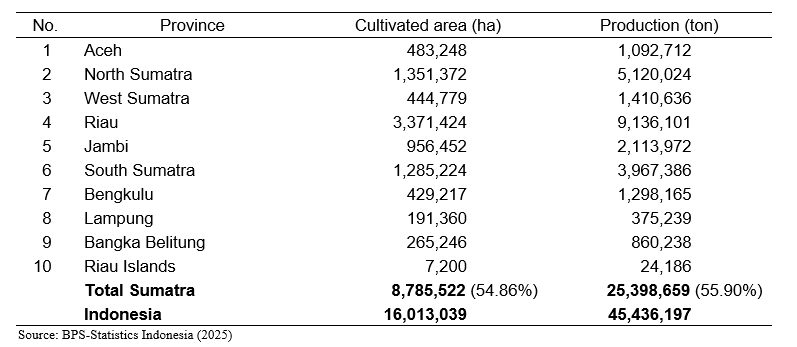
Sumatra Island is one of Indonesia’s major palm oil production centers, accounting for approximately 55 percent of the national oil palm area and output (Table 1). Major producing provinces include Riau, North Sumatra, and South Sumatra. Research by Lokahita Foundation indicates that oil palm plantations in Sumatra have exceeded the island’s environmental carrying and assimilative capacity (Sabang Merauke News, 2024). This condition has significant environmental, social, economic, and policy implications.
Over the past two decades, Sumatra has experienced a marked increase in flood and landslide events, particularly in regions undergoing intensive oil palm expansion. Severe floods and landslides in late 2025 across Aceh, North Sumatra, and West Sumatra resulted in extensive human casualties and infrastructure damage (Tempo, 2025). Extreme rainfall associated with Tropical Cyclone Senyar, combined with deforestation-driven loss of infiltration areas, triggered widespread flooding and landslides across Sumatra (Simanjuntak, 2025). Environmental specialists and local authorities indicate that deforestation has significantly contributed to heightened disaster impacts, including loss of life, underscoring critical weaknesses in land-use governance (The Jakarta Post, 2025).
Table 1. Cultivated area and production of crude palm oil (CPO) by province in Sumatra, 2024
Empirical evidence consistently links land-use change to heightened flood risk. In Jambi Province, the conversion of forests to oil palm and rubber monocultures has significantly increased flood frequency in the Batanghari watershed (Tarigan, 2016). More recent spatial–statistical analyses from Aceh confirm that lower forest cover and higher plantation density are associated with more frequent and severe flood events (Lubis et al., 2024). Hydrological modeling further demonstrates that oil palm expansion increases surface runoff and sediment yield, thereby reducing infiltration capacity and destabilizing river systems (Asmara and Randhir, 2024). In peatland areas, drainage for plantation development causes irreversible subsidence, rendering large areas increasingly flood-prone and unsuitable for long-term cultivation (Hein et al., 2022). These findings indicate that flood and landslide disasters in Sumatra are not solely climate-driven phenomena but are structurally linked to land-use change and plantation management practices.
Despite these risks, current regulatory instruments, including environmental impact assessments (AMDAL), the Indonesian Sustainable Palm Oil (ISPO) standard, and the forest and peatland moratoria, remain insufficiently integrated with disaster risk reduction and watershed-scale governance (Government of Indonesia, 2020). Taken together, the spatial concentration of oil palm plantations in Sumatra and the rising incidence of floods and landslides point to a structural governance challenge rather than isolated climatic events. This paper, therefore, advances a circular-economy–based policy framework as an integrative approach to align palm oil development with watershed protection, disaster risk mitigation, and long-term environmental sustainability.
LIMITATIONS OF THE LINEAR PALM OIL DEVELOPMENT MODEL
The traditional linear economic model relies on the “take–make–dispose” paradigm (Vogiantzi and Tserpes, 2023) and is predicated on the assumption that natural resources are inexhaustible and resilient to sustained production pressures (Goyal et al., 2018). This paradigm incentivizes continued resource extraction and consumption, generates escalating waste streams, and reflects a persistent failure of policy frameworks to account for ecological limits and long-term sustainability objectives.
Within the palm oil industry, the linear economic model is characterized by the extraction of natural resources, their conversion into crude palm oil and related products, and their subsequent distribution to markets. This model operates on the implicit assumption that land, biomass, and other natural resources are sufficiently abundant and will not be significantly depleted through continued production and processing activities.
Despite intensified sustainability discourse, Indonesia’s palm oil industry remains structurally locked into a linear economic model. Governance and investment priorities continue to favor land expansion as the principal mechanism for production growth, despite regulatory moratoria, while value creation remains narrowly concentrated on crude palm oil (CPO) and its derivatives. At the same time, waste streams and residual biomass remain largely untapped, particularly among smallholders and small- to medium-scale processors, underscoring persistent policy and implementation gaps. Conventional oil palm cultivation under a linear model relies on forest-clearing expansion, intensive chemical inputs, inadequate biomass recycling, and unsustainable replanting practices, collectively undermining environmental sustainability and ecosystem resilience, including biodiversity (Azhar et al., 2023).
The dominant linear model of palm oil development prioritizes short-term production efficiency, land expansion, and biomass extraction, with limited emphasis on ecosystem regeneration. This approach has generated multiple environmental externalities, including declining soil quality, loss of vegetative cover, hydrological disruption, and escalating disaster-related losses (Obidzinski et al., 2012).
In Indonesia’s peatland and upland plantation zones, linear practices, such as canal drainage, slope cultivation, and riparian encroachment, have directly undermined watershed stability (Asmara and Randhir, 2024; Hein et al., 2022). These impacts mirror broader regional patterns observed across Southeast Asia, where monoculture plantation systems intensify environmental vulnerability (Cheah et al., 2023). As a result, economic gains from palm oil expansion in many plantation landscapes are increasingly offset by rising ecological and social costs.
CIRCULAR ECONOMY AS A LANDSCAPE GOVERNANCE FRAMEWORK
The circular economy (CE) is a model of production and consumption that involves sharing, leasing, reusing, repairing, refurbishing, and recycling existing materials and products for as long as possible, thereby extending their life cycles and minimizing waste (Kirchherr, 2017). Integrating CE principles into palm oil production can generate substantial environmental, social, and economic benefits, enhancing sustainability across the entire value chain.
Sustainability in the palm oil sector cannot be achieved without comprehensive, system-level interventions that depart fundamentally from traditional linear production models. The circular economy represents a paradigm shift that aims to address these challenges by systematically reducing, reusing, recycling, and regenerating resources, while breaking the long-standing link between economic growth, resource consumption, and environmental decline (Siagian et al., 2024).
The circular economy offers a shift from extractive land use toward regenerative production systems. In the palm oil sector, circularity entails reducing waste and emissions, reusing biomass and by-products, and regenerating natural systems (Cheah et al., 2023).). However, effective application requires extending circular principles beyond mills to plantations and entire watersheds.
Evidence from multiple countries indicates that circular economy approaches are increasingly being integrated into agriculture-based industries, with clear implications for environmental outcomes. Malaysia’s National Biomass Action Plan 2023-2030 illustrates how palm oil residues can be valorized into bioenergy and biochemicals while reducing environmental footprints (Ministry of Plantation and Commodities of Malaysia, 2023; Hishamuddin, 2025). Thailand’s Bio-Circular-Green (BCG) Economy Model integrates agriculture, climate resilience, and ecosystem restoration within a unified policy framework (Chutipat et al., 2023). In the Philippines, the Integrated Water Resources Management (IWRM) approach emphasizes land-use zoning, riparian restoration, and inter-jurisdictional coordination to protect river basins (Cacal et al., 2023).
These regional experiences demonstrate that circular economy approaches are most effective when embedded within landscape-scale governance and supported by coherent regulatory and fiscal instruments. Such instruments include integrated land-use planning, cross-sectoral coordination, targeted incentives, and dedicated investment mechanisms. Across ASEAN and other regions, these enabling policy environments have proven critical for aligning economic productivity with environmental stewardship, enhancing resource efficiency, and scaling up sustainable practices across interconnected value chains.
POLICY OPTIONS FOR INDONESIA
Estate-level circular practices
At the plantation scale, circular economy implementation should treat soil, water, and biomass as core production assets rather than externalities. This perspective shifts plantation management from short-term yield maximization toward long-term productivity and ecosystem functionality. Empirical evidence from Indonesian watersheds shows that oil palm expansion alters surface runoff and sediment dynamics, highlighting the importance of preventive, on-site interventions.
Key measures include soil and water conservation practices such as terracing, contour planting, and sediment traps; systematic use of leguminous cover crops and organic mulches to improve soil structure and infiltration; integration of agroforestry systems with timber and fruit trees to enhance vegetative complexity; and strict limitations on plantation development in peat domes, steep slopes, and riparian buffer zones. Collectively, these practices help stabilize hydrological flows, reduce erosion, and enhance resilience to extreme rainfall events. These measures can be operationalized through revised good agricultural practices and strengthened ISPO technical guidelines, with support from extension services and compliance monitoring.
Watershed-based circular governance
Because flooding and landslides are inherently watershed-scale phenomena, estate-level interventions alone are insufficient to address their underlying drivers. Land-use decisions at individual plots accumulate into systemic hydrological impacts at the river-basin level, where declining forest cover and increasing plantation density translate into higher flood frequency and intensity (Tarigan, 2016). This reality necessitates a transition from fragmented, plot-based regulation toward integrated watershed governance.
Priority actions include restoring riparian corridors, headwater catchments, and degraded forest patches as functional components of production landscapes to enhance infiltration, sediment retention, and peak-flow attenuation. These efforts should be complemented by the formal zoning of watershed protection areas within provincial and district spatial plans (RTRW) to restrict plantation expansion in hydrologically sensitive zones. Integrating oil palm estates with community forests and diversified smallholder farming systems can further create heterogeneous landscape mosaics that reduce runoff concentration, improve ecological connectivity, and strengthen local livelihoods. In addition, establishing cross-district watershed management authorities is essential to coordinate spatial planning, licensing, monitoring, and restoration investments within single river basins, thereby improving policy coherence and implementation effectiveness.
This approach aligns with the Philippines’ institutionalized Integrated Water Resources Management (IWRM) approach, which formalizes basin-level planning and inter-jurisdictional coordination among government agencies and local stakeholders (Cacal et al., 2023), and reflects landscape governance principles advocated in Southeast Asian plantation sustainability studies (Obidzinski et al., 2012).
Institutional strengthening and economic incentives
Effective mainstreaming of circular economy principles requires their systematic integration into Indonesia’s regulatory and fiscal architecture. Existing instruments, such as environmental impact assessments (AMDAL) and the Indonesian Sustainable Palm Oil (ISPO) standard, remain largely compliance-oriented and are insufficiently linked to hydrological performance, ecosystem services, or disaster risk indicators (Government of Indonesia, 2020). The effectiveness of Environmental Impact Assessments (EIAs) is critically determined by enforceable implementation and sustained participatory oversight; when EIAs are treated as procedural formalities or subject to weak supervision, their capacity to influence environmental outcomes and policy decisions is significantly undermined (Febriani et al., 2025).
Policy reform in this area should therefore move beyond administrative compliance toward performance-based governance. Key measures include incorporating circular-economy metrics and watershed-protection indicators into plantation licensing, AMDAL approval, and ISPO certification processes, ensuring that regulatory compliance is directly linked to landscape-scale environmental outcomes. Fiscal instruments also play a central role, particularly through targeted incentives, tax credits, and accelerated depreciation schemes for companies that undertake verified ecological restoration, riparian rehabilitation, and peatland rewetting.
In parallel, the development of green financing instruments, including sustainability-linked loans, blended finance facilities, and public–private investment mechanisms, can help mobilize long-term capital for landscape restoration and circular bioeconomy initiatives. Complementary payment for ecosystem services (PES) schemes can further align incentives by compensating estates and smallholders for maintaining forest cover, riparian buffers, and critical hydrological functions, thereby reinforcing the economic viability of conservation-oriented land management.
Comparative regional experience provides useful policy lessons. Malaysia’s National biomass action plan 2023‒2030 demonstrates how coordinated fiscal and industrial policy instruments can stimulate investments in the circular bioeconomy by valorizing palm oil residues (Ministry of Plantation and Commodities of Malaysia, 2023; Hishamuddin, 2025). Thailand’s Bio-Circular-Green (BCG) Economy Model similarly illustrates how national development strategies can integrate agriculture, climate resilience, and ecosystem restoration within a coherent policy framework (Chutipat et al., 2023).
Taken together, these regional experiences suggest that Indonesia can operationalize circular economy principles in the palm oil sector through a strategic combination of regulatory reform, fiscal incentives, and the mobilization of green finance, thereby strengthening environmental governance and supporting sustainable economic development.
IMPLICATIONS FOR POLICY AND PRACTICE
Recent floods and landslides in Sumatra have resulted in significant human casualties, alongside extensive material and ecological losses. Beyond the influence of extreme weather events, these disasters reveal persistent weaknesses in natural resource governance, particularly those associated with the expansion of oil palm plantations. A key policy implication is that economic development in the palm oil sector should proceed only in conjunction with strict environmental regulation, landscape-scale management, ecosystem restoration, and effective accountability and law enforcement. In practice, policy priorities should focus on safeguarding upstream catchments, strengthening critical ecological functions, and systematically embedding disaster risk reduction into sustainable oil palm planning. Accordingly, flood and landslide mitigation should emphasize prevention and risk reduction through risk map–based spatial planning, watershed (DAS) rehabilitation, forest conservation, tighter control of land-use conversion, and the strategic development of flood-control infrastructure (Simanjuntak, 2025).
Mainstreaming circular economy principles in Indonesia’s palm oil sector offers a viable pathway to reduce flood and landslide risks, enhance ecosystem resilience, and secure long-term productivity. Empirical evidence from Sumatra indicates that the absence of substantive land-use governance reform will continue to amplify disaster vulnerability and associated socio-economic losses (Lubis et al., 2024; Tarigan, 2016). Conversely, adopting watershed-based circular strategies can reposition the palm oil industry as an active contributor to Indonesia’s green economy agenda and climate resilience commitments, while strengthening the sector’s domestic and international legitimacy.
Based on these findings, flood risk management policies in Sumatra should be strengthened through a nationally coordinated framework that explicitly links environmental management, spatial planning, public health, and health system resilience. Fragmented, sector-based approaches remain inadequate for addressing complex and recurrent hydrometeorological disasters. At the national level, this requires stronger alignment between plantation regulation, watershed governance, disaster risk reduction strategies, and public health planning. In practical terms, policies supporting watershed ecosystem rehabilitation, deforestation control, and peatland restoration should be institutionalized as core components of Indonesia’s flood risk management and climate adaptation agenda, and embedded within national development planning and sectoral regulatory frameworks. Such an approach is consistent with a Planetary Health perspective that recognizes the interdependence between ecological integrity, disaster resilience, and human well-being (Budiman and Chu, 2026).
CONCLUSION AND RECOMMENDATIONS
Transforming Indonesia’s palm oil industry through a landscape-based circular economy framework represents a strategically important priority to ensure both economic viability and ecological sustainability. Without a fundamental shift in land-use governance and production models, flood and landslide risks will continue to escalate, undermining development gains and increasing social and environmental costs.
Based on the analysis presented in this paper, several key policy recommendations emerge:
- Integrate circular economy principles and disaster risk mitigation requirements into palm oil licensing, plantation management regulations, and spatial planning frameworks, with explicit links to watershed protection and hydrological performance.
- Strengthen the Indonesian Sustainable Palm Oil (ISPO) standard by incorporating watershed- and landscape-based performance indicators that move beyond plot-level compliance toward basin-scale environmental outcomes.
- Establish coherent fiscal and non-fiscal incentive schemes, including tax incentives, green financing facilities, and targeted subsidies, for companies, cooperatives, and smallholders implementing verified restorative and circular practices.
- Promote inclusive, multi-stakeholder collaboration among government agencies, private firms, smallholders, and local communities to support integrated and sustainable landscape management.
With appropriate regulatory reform, well-designed fiscal incentives, and stronger institutional coordination, Indonesia’s palm oil sector has the potential to transition from a source of environmental risk to an integral component of sustainable development and disaster risk reduction. Aligning plantation management with ecosystem resilience and long-term land-use sustainability will not only reduce vulnerability to floods and landslides but also enhance the sector’s legitimacy, productivity, and contribution to Indonesia’s green economy agenda.
REFERENCES
Asmara, B. and T. O. Randhir. 2024. Modeling the impacts of oil palm plantations on water quantity and quality in the Kais River watershed of Indonesia. Sci. Total Environ. 928: 172456. DOI: 10.1016/j.scitotenv.2024.172456
Azhar, B., A. Oon, A. M. Lechner, A. Ashton-Butt, M. S. Yahya and D. B. Lindenmayer. 2023. Large-scale industrial plantations are more likely than smallholdings to threaten biodiversity from oil palm replanting spatial disturbances. Glob. Ecol. Conserv. 45: e02513. DOI: 10.1016/j.gecco.2023.e02513
BPS-Statistics Indonesia. 2025. Indonesia permanent estate crops statistics 2024 (In Indonesian). BPS-Statistics Indonesia, Jakarta.
Budiman, D. and C. Chu. 2026. Flood crisis, ecological degradation, and hospital resilience in Sumatra: A one health perspective. Soc. J. Public Heal. Serv. 5(1): 1–9. DOI: 10.24252/sjphs.v5i1.63464
Cacal, J. C., E. B. Taboada and M. S. Mehboob. 2023. Strategic implementation of integrated water resource management in selected areas of Palawan: SWOT-AHP Method. Sustain. (Switzerland) 15(4): 2922. DOI: 10.3390/su15042922
Cheah, W. Y., R. P. Siti-Dina, S. T. K. Leng, A. C. Er and P. L. Show. 2023. Circular bioeconomy in palm oil industry: Current practices and future perspectives. Environ. Technol. Innov. 30: 103050. DOI: 10.1016/j.eti.2023.103050
Chutipat, V., R. Sonsuphap and W. Pintong. 2023. Bio-Circular-Green model in a developing economy. Corp. Gov. Organ. Behav. Rev. 7(1): 150–157. DOI: 10.22495/cgobrv7i1p14
Febriani, W. P., N. Sasgita and Gepri. 2025. Literature review: Environmental impacts of oil palm plantations from an environmental impact assessment (EIA) perspective. HIRADIKA J. Pendidik. Pembelajaran, 2(1): 50–55 (In Indonesian with English abstract). https://jurnal.penerbithira.com/index.php/hiradika/article/view/65
Goyal, S., M. Esposito and A. Kapoor. 2018. Circular economy business models in developing economies: Lessons from India on reduce, recycle, and reuse paradigms. Thunderbird Int. Bus. Rev. 60(5): 729–740. DOI: 10.1002/tie.21883
Government of Indonesia. 2020. Regulation of the President of the Republic of Indonesia Number 44 of 2020 regarding Indonesian Sustainable Palm Oil Plantation Certification. https://ditjenbun.pertanian.go.id/template/uploads/2020/06/EN_Perpres-44...
Hein, L., E. Sumarga, M. Quiñones and A. Suwarno. 2022. Effects of soil subsidence on plantation agriculture in Indonesian peatlands. Reg. Environ. Chang. 22: 121. DOI: 10.1007/s10113-022-01979-z
Hishamuddin, E. 2025. Advancing biomass circularity: Insights from industry experts on sustainable solutions. Palm Oil Eng. Bul. 148: 30‒34. https://palmoilis.mpob.gov.my/publications/POEB/poeb148-elina.pdf
Judijanto, L. 2025. Beyond the plantation: Palm oil as a strategic lever for regional development and economic transformation growth in Indonesia. Growth, 12(1): 25–32. https://doi.org/10.20448/growth.v12i1.6842
Juliawan, W. I., Mubarak and Zulkarnain. 2025. Literature review: Evaluation of environmental policies in the palm oil industry. Integr. Perspect. Soc. Sci. J. 2(6): 8543–8550. https://ipssj.com/index.php/ojs/article/view/997
Lubis, M. I., M. Linkie and J. S. H. Lee 2024. Tropical forest cover, oil palm plantations, and precipitation drive flooding events in Aceh, Indonesia, and hit the poorest people hardest. Plos One, 19(10), e0311759. DOI: 10.1371/journal.pone.0311759
Ministry of Plantation and Commodities of Malaysia. 2023. National biomass action plan 2023-2030. Ministry of Plantation and Commodities of Malaysia, Putrajaya. https://seip-api.seda.gov.my/storage/211/27122023-National_Biomass_Actio...
Obidzinski, K., R. Andriani, H. Komarudin, A. Andrianto, K. Obidzinski, R. Andriani, H. Komarudin and A. Andrianto. 2012. Environmental and social impacts of oil palm plantations and their implications for biofuel production in Indonesia. Ecol. Soc 17(1): 25. DOI: 10.575/ES-04775-170125
Sabang Merauke News. 2024. Research reveals oil palm plantation area in Sumatra has exceeded the threshold (In Indonesian). https://www.sabangmeraukenews.com/berita/22092/riset-ini-ungkap-luas-keb...?
Siagian, U. W. R., I. G. Wenten and K. Khoiruddin. 2024. Circular economy approaches in the palm oil industry: Enhancing profitability through waste reduction and product diversification. J. Eng. Technol. Sci. 56(1): 25–49. DOI: 10.5614/j.eng.technol.sci.2024.56.1.3
Simanjuntak, D. 2025. Sumatra floods–landslides 2025: Disaster mitigation and preparedness. Info Singk. Comm. VIII. 17(23): 1–5. https://berkas.dpr.go.id/pusaka/files/info_singkat/Info Singkat-XVII-23-I-P3DI-Desember-2025-2441-EN.pdf
Tarigan, S. D. 2016. Land cover change and its impact on flooding frequency of Batanghari watershed, Jambi Province, Indonesia. Procedia Environ. Sci. 33, 386–392. DOI: 10.1016/j.proenv.2016.03.089
Tempo. 2025. BNPB: 916 people have died in flood disasters across Sumatra (In Indonesian). https://www.tempo.co/politik/bnpb-916-orang-meninggal-dalam-bencana-banj...
The Jakarta Post. 2025. Death toll from Sumatra floods and landslides passes 700. https://www.thejakartapost.com/indonesia/2025/12/03/death-toll-from-suma...
Vogiantzi, C. and K. Tserpes. 2023. On the definition, assessment, and enhancement of circular economy across various industrial sectors: A literature review and recent findings. Sustain. (Switzerland) 15(23): 16532. DOI: 10.3390/su152316532


Toward Circular Economy–Based Policies for Sustainable Palm Oil Development: Lessons from Flood and Landslide Risks in Sumatra
ABSTRACT
The palm oil industry is a major pillar of Indonesia’s economy, providing large-scale employment, generating substantial foreign exchange earnings, creating strong multiplier effects, and supporting regional economic growth and infrastructure development. Sumatra Island is one of Indonesia’s main palm oil production centers. However, large-scale land conversion, peatland drainage, and monoculture expansion have contributed to watershed degradation, altered hydrological regimes, and increased flood and landslide risks. Empirical evidence from Sumatra shows that forest loss and oil palm expansion are strongly associated with increased flood frequency and severity, particularly in the Batanghari watershed and Aceh Province. Peatland subsidence shows that plantation expansion increases surface runoff and sediment yield. These dynamics point to structural limitations in the dominant linear development model of the palm oil sector. This article proposes mainstreaming a circular economy (CE) framework as a policy pathway to transform Indonesia’s palm oil industry into an environmentally restorative and disaster-resilient system. The circular economy is conceptualized not merely as a waste management strategy but as an integrated landscape governance model linking production systems, ecosystem regeneration, and disaster risk mitigation. Drawing on comparative experiences from Malaysia, Thailand, and the Philippines, the article outlines policy lessons and options to align palm oil development with watershed protection, climate resilience, and sustainable rural livelihoods.
Keywords: environmentally friendly, policy pathway, regional economics, sustainable agriculture, watershed management
INTRODUCTION
The palm oil industry is a strategic pillar of Indonesia’s economy, generating export revenues, employment, and rural development benefits. While the sector has contributed to poverty reduction and regional growth, it has also generated significant environmental externalities. This dual role underscores the need for policy frameworks that can reconcile economic objectives with long-term ecological stability and risk resilience (Judijanto, 2025; Juliawan et al., 2025).
Sumatra Island is one of Indonesia’s major palm oil production centers, accounting for approximately 55 percent of the national oil palm area and output (Table 1). Major producing provinces include Riau, North Sumatra, and South Sumatra. Research by Lokahita Foundation indicates that oil palm plantations in Sumatra have exceeded the island’s environmental carrying and assimilative capacity (Sabang Merauke News, 2024). This condition has significant environmental, social, economic, and policy implications.
Over the past two decades, Sumatra has experienced a marked increase in flood and landslide events, particularly in regions undergoing intensive oil palm expansion. Severe floods and landslides in late 2025 across Aceh, North Sumatra, and West Sumatra resulted in extensive human casualties and infrastructure damage (Tempo, 2025). Extreme rainfall associated with Tropical Cyclone Senyar, combined with deforestation-driven loss of infiltration areas, triggered widespread flooding and landslides across Sumatra (Simanjuntak, 2025). Environmental specialists and local authorities indicate that deforestation has significantly contributed to heightened disaster impacts, including loss of life, underscoring critical weaknesses in land-use governance (The Jakarta Post, 2025).
Table 1. Cultivated area and production of crude palm oil (CPO) by province in Sumatra, 2024
Empirical evidence consistently links land-use change to heightened flood risk. In Jambi Province, the conversion of forests to oil palm and rubber monocultures has significantly increased flood frequency in the Batanghari watershed (Tarigan, 2016). More recent spatial–statistical analyses from Aceh confirm that lower forest cover and higher plantation density are associated with more frequent and severe flood events (Lubis et al., 2024). Hydrological modeling further demonstrates that oil palm expansion increases surface runoff and sediment yield, thereby reducing infiltration capacity and destabilizing river systems (Asmara and Randhir, 2024). In peatland areas, drainage for plantation development causes irreversible subsidence, rendering large areas increasingly flood-prone and unsuitable for long-term cultivation (Hein et al., 2022). These findings indicate that flood and landslide disasters in Sumatra are not solely climate-driven phenomena but are structurally linked to land-use change and plantation management practices.
Despite these risks, current regulatory instruments, including environmental impact assessments (AMDAL), the Indonesian Sustainable Palm Oil (ISPO) standard, and the forest and peatland moratoria, remain insufficiently integrated with disaster risk reduction and watershed-scale governance (Government of Indonesia, 2020). Taken together, the spatial concentration of oil palm plantations in Sumatra and the rising incidence of floods and landslides point to a structural governance challenge rather than isolated climatic events. This paper, therefore, advances a circular-economy–based policy framework as an integrative approach to align palm oil development with watershed protection, disaster risk mitigation, and long-term environmental sustainability.
LIMITATIONS OF THE LINEAR PALM OIL DEVELOPMENT MODEL
The traditional linear economic model relies on the “take–make–dispose” paradigm (Vogiantzi and Tserpes, 2023) and is predicated on the assumption that natural resources are inexhaustible and resilient to sustained production pressures (Goyal et al., 2018). This paradigm incentivizes continued resource extraction and consumption, generates escalating waste streams, and reflects a persistent failure of policy frameworks to account for ecological limits and long-term sustainability objectives.
Within the palm oil industry, the linear economic model is characterized by the extraction of natural resources, their conversion into crude palm oil and related products, and their subsequent distribution to markets. This model operates on the implicit assumption that land, biomass, and other natural resources are sufficiently abundant and will not be significantly depleted through continued production and processing activities.
Despite intensified sustainability discourse, Indonesia’s palm oil industry remains structurally locked into a linear economic model. Governance and investment priorities continue to favor land expansion as the principal mechanism for production growth, despite regulatory moratoria, while value creation remains narrowly concentrated on crude palm oil (CPO) and its derivatives. At the same time, waste streams and residual biomass remain largely untapped, particularly among smallholders and small- to medium-scale processors, underscoring persistent policy and implementation gaps. Conventional oil palm cultivation under a linear model relies on forest-clearing expansion, intensive chemical inputs, inadequate biomass recycling, and unsustainable replanting practices, collectively undermining environmental sustainability and ecosystem resilience, including biodiversity (Azhar et al., 2023).
The dominant linear model of palm oil development prioritizes short-term production efficiency, land expansion, and biomass extraction, with limited emphasis on ecosystem regeneration. This approach has generated multiple environmental externalities, including declining soil quality, loss of vegetative cover, hydrological disruption, and escalating disaster-related losses (Obidzinski et al., 2012).
In Indonesia’s peatland and upland plantation zones, linear practices, such as canal drainage, slope cultivation, and riparian encroachment, have directly undermined watershed stability (Asmara and Randhir, 2024; Hein et al., 2022). These impacts mirror broader regional patterns observed across Southeast Asia, where monoculture plantation systems intensify environmental vulnerability (Cheah et al., 2023). As a result, economic gains from palm oil expansion in many plantation landscapes are increasingly offset by rising ecological and social costs.
CIRCULAR ECONOMY AS A LANDSCAPE GOVERNANCE FRAMEWORK
The circular economy (CE) is a model of production and consumption that involves sharing, leasing, reusing, repairing, refurbishing, and recycling existing materials and products for as long as possible, thereby extending their life cycles and minimizing waste (Kirchherr, 2017). Integrating CE principles into palm oil production can generate substantial environmental, social, and economic benefits, enhancing sustainability across the entire value chain.
Sustainability in the palm oil sector cannot be achieved without comprehensive, system-level interventions that depart fundamentally from traditional linear production models. The circular economy represents a paradigm shift that aims to address these challenges by systematically reducing, reusing, recycling, and regenerating resources, while breaking the long-standing link between economic growth, resource consumption, and environmental decline (Siagian et al., 2024).
The circular economy offers a shift from extractive land use toward regenerative production systems. In the palm oil sector, circularity entails reducing waste and emissions, reusing biomass and by-products, and regenerating natural systems (Cheah et al., 2023).). However, effective application requires extending circular principles beyond mills to plantations and entire watersheds.
Evidence from multiple countries indicates that circular economy approaches are increasingly being integrated into agriculture-based industries, with clear implications for environmental outcomes. Malaysia’s National Biomass Action Plan 2023-2030 illustrates how palm oil residues can be valorized into bioenergy and biochemicals while reducing environmental footprints (Ministry of Plantation and Commodities of Malaysia, 2023; Hishamuddin, 2025). Thailand’s Bio-Circular-Green (BCG) Economy Model integrates agriculture, climate resilience, and ecosystem restoration within a unified policy framework (Chutipat et al., 2023). In the Philippines, the Integrated Water Resources Management (IWRM) approach emphasizes land-use zoning, riparian restoration, and inter-jurisdictional coordination to protect river basins (Cacal et al., 2023).
These regional experiences demonstrate that circular economy approaches are most effective when embedded within landscape-scale governance and supported by coherent regulatory and fiscal instruments. Such instruments include integrated land-use planning, cross-sectoral coordination, targeted incentives, and dedicated investment mechanisms. Across ASEAN and other regions, these enabling policy environments have proven critical for aligning economic productivity with environmental stewardship, enhancing resource efficiency, and scaling up sustainable practices across interconnected value chains.
POLICY OPTIONS FOR INDONESIA
Estate-level circular practices
At the plantation scale, circular economy implementation should treat soil, water, and biomass as core production assets rather than externalities. This perspective shifts plantation management from short-term yield maximization toward long-term productivity and ecosystem functionality. Empirical evidence from Indonesian watersheds shows that oil palm expansion alters surface runoff and sediment dynamics, highlighting the importance of preventive, on-site interventions.
Key measures include soil and water conservation practices such as terracing, contour planting, and sediment traps; systematic use of leguminous cover crops and organic mulches to improve soil structure and infiltration; integration of agroforestry systems with timber and fruit trees to enhance vegetative complexity; and strict limitations on plantation development in peat domes, steep slopes, and riparian buffer zones. Collectively, these practices help stabilize hydrological flows, reduce erosion, and enhance resilience to extreme rainfall events. These measures can be operationalized through revised good agricultural practices and strengthened ISPO technical guidelines, with support from extension services and compliance monitoring.
Watershed-based circular governance
Because flooding and landslides are inherently watershed-scale phenomena, estate-level interventions alone are insufficient to address their underlying drivers. Land-use decisions at individual plots accumulate into systemic hydrological impacts at the river-basin level, where declining forest cover and increasing plantation density translate into higher flood frequency and intensity (Tarigan, 2016). This reality necessitates a transition from fragmented, plot-based regulation toward integrated watershed governance.
Priority actions include restoring riparian corridors, headwater catchments, and degraded forest patches as functional components of production landscapes to enhance infiltration, sediment retention, and peak-flow attenuation. These efforts should be complemented by the formal zoning of watershed protection areas within provincial and district spatial plans (RTRW) to restrict plantation expansion in hydrologically sensitive zones. Integrating oil palm estates with community forests and diversified smallholder farming systems can further create heterogeneous landscape mosaics that reduce runoff concentration, improve ecological connectivity, and strengthen local livelihoods. In addition, establishing cross-district watershed management authorities is essential to coordinate spatial planning, licensing, monitoring, and restoration investments within single river basins, thereby improving policy coherence and implementation effectiveness.
This approach aligns with the Philippines’ institutionalized Integrated Water Resources Management (IWRM) approach, which formalizes basin-level planning and inter-jurisdictional coordination among government agencies and local stakeholders (Cacal et al., 2023), and reflects landscape governance principles advocated in Southeast Asian plantation sustainability studies (Obidzinski et al., 2012).
Institutional strengthening and economic incentives
Effective mainstreaming of circular economy principles requires their systematic integration into Indonesia’s regulatory and fiscal architecture. Existing instruments, such as environmental impact assessments (AMDAL) and the Indonesian Sustainable Palm Oil (ISPO) standard, remain largely compliance-oriented and are insufficiently linked to hydrological performance, ecosystem services, or disaster risk indicators (Government of Indonesia, 2020). The effectiveness of Environmental Impact Assessments (EIAs) is critically determined by enforceable implementation and sustained participatory oversight; when EIAs are treated as procedural formalities or subject to weak supervision, their capacity to influence environmental outcomes and policy decisions is significantly undermined (Febriani et al., 2025).
Policy reform in this area should therefore move beyond administrative compliance toward performance-based governance. Key measures include incorporating circular-economy metrics and watershed-protection indicators into plantation licensing, AMDAL approval, and ISPO certification processes, ensuring that regulatory compliance is directly linked to landscape-scale environmental outcomes. Fiscal instruments also play a central role, particularly through targeted incentives, tax credits, and accelerated depreciation schemes for companies that undertake verified ecological restoration, riparian rehabilitation, and peatland rewetting.
In parallel, the development of green financing instruments, including sustainability-linked loans, blended finance facilities, and public–private investment mechanisms, can help mobilize long-term capital for landscape restoration and circular bioeconomy initiatives. Complementary payment for ecosystem services (PES) schemes can further align incentives by compensating estates and smallholders for maintaining forest cover, riparian buffers, and critical hydrological functions, thereby reinforcing the economic viability of conservation-oriented land management.
Comparative regional experience provides useful policy lessons. Malaysia’s National biomass action plan 2023‒2030 demonstrates how coordinated fiscal and industrial policy instruments can stimulate investments in the circular bioeconomy by valorizing palm oil residues (Ministry of Plantation and Commodities of Malaysia, 2023; Hishamuddin, 2025). Thailand’s Bio-Circular-Green (BCG) Economy Model similarly illustrates how national development strategies can integrate agriculture, climate resilience, and ecosystem restoration within a coherent policy framework (Chutipat et al., 2023).
Taken together, these regional experiences suggest that Indonesia can operationalize circular economy principles in the palm oil sector through a strategic combination of regulatory reform, fiscal incentives, and the mobilization of green finance, thereby strengthening environmental governance and supporting sustainable economic development.
IMPLICATIONS FOR POLICY AND PRACTICE
Recent floods and landslides in Sumatra have resulted in significant human casualties, alongside extensive material and ecological losses. Beyond the influence of extreme weather events, these disasters reveal persistent weaknesses in natural resource governance, particularly those associated with the expansion of oil palm plantations. A key policy implication is that economic development in the palm oil sector should proceed only in conjunction with strict environmental regulation, landscape-scale management, ecosystem restoration, and effective accountability and law enforcement. In practice, policy priorities should focus on safeguarding upstream catchments, strengthening critical ecological functions, and systematically embedding disaster risk reduction into sustainable oil palm planning. Accordingly, flood and landslide mitigation should emphasize prevention and risk reduction through risk map–based spatial planning, watershed (DAS) rehabilitation, forest conservation, tighter control of land-use conversion, and the strategic development of flood-control infrastructure (Simanjuntak, 2025).
Mainstreaming circular economy principles in Indonesia’s palm oil sector offers a viable pathway to reduce flood and landslide risks, enhance ecosystem resilience, and secure long-term productivity. Empirical evidence from Sumatra indicates that the absence of substantive land-use governance reform will continue to amplify disaster vulnerability and associated socio-economic losses (Lubis et al., 2024; Tarigan, 2016). Conversely, adopting watershed-based circular strategies can reposition the palm oil industry as an active contributor to Indonesia’s green economy agenda and climate resilience commitments, while strengthening the sector’s domestic and international legitimacy.
Based on these findings, flood risk management policies in Sumatra should be strengthened through a nationally coordinated framework that explicitly links environmental management, spatial planning, public health, and health system resilience. Fragmented, sector-based approaches remain inadequate for addressing complex and recurrent hydrometeorological disasters. At the national level, this requires stronger alignment between plantation regulation, watershed governance, disaster risk reduction strategies, and public health planning. In practical terms, policies supporting watershed ecosystem rehabilitation, deforestation control, and peatland restoration should be institutionalized as core components of Indonesia’s flood risk management and climate adaptation agenda, and embedded within national development planning and sectoral regulatory frameworks. Such an approach is consistent with a Planetary Health perspective that recognizes the interdependence between ecological integrity, disaster resilience, and human well-being (Budiman and Chu, 2026).
CONCLUSION AND RECOMMENDATIONS
Transforming Indonesia’s palm oil industry through a landscape-based circular economy framework represents a strategically important priority to ensure both economic viability and ecological sustainability. Without a fundamental shift in land-use governance and production models, flood and landslide risks will continue to escalate, undermining development gains and increasing social and environmental costs.
Based on the analysis presented in this paper, several key policy recommendations emerge:
With appropriate regulatory reform, well-designed fiscal incentives, and stronger institutional coordination, Indonesia’s palm oil sector has the potential to transition from a source of environmental risk to an integral component of sustainable development and disaster risk reduction. Aligning plantation management with ecosystem resilience and long-term land-use sustainability will not only reduce vulnerability to floods and landslides but also enhance the sector’s legitimacy, productivity, and contribution to Indonesia’s green economy agenda.
REFERENCES
Asmara, B. and T. O. Randhir. 2024. Modeling the impacts of oil palm plantations on water quantity and quality in the Kais River watershed of Indonesia. Sci. Total Environ. 928: 172456. DOI: 10.1016/j.scitotenv.2024.172456
Azhar, B., A. Oon, A. M. Lechner, A. Ashton-Butt, M. S. Yahya and D. B. Lindenmayer. 2023. Large-scale industrial plantations are more likely than smallholdings to threaten biodiversity from oil palm replanting spatial disturbances. Glob. Ecol. Conserv. 45: e02513. DOI: 10.1016/j.gecco.2023.e02513
BPS-Statistics Indonesia. 2025. Indonesia permanent estate crops statistics 2024 (In Indonesian). BPS-Statistics Indonesia, Jakarta.
Budiman, D. and C. Chu. 2026. Flood crisis, ecological degradation, and hospital resilience in Sumatra: A one health perspective. Soc. J. Public Heal. Serv. 5(1): 1–9. DOI: 10.24252/sjphs.v5i1.63464
Cacal, J. C., E. B. Taboada and M. S. Mehboob. 2023. Strategic implementation of integrated water resource management in selected areas of Palawan: SWOT-AHP Method. Sustain. (Switzerland) 15(4): 2922. DOI: 10.3390/su15042922
Cheah, W. Y., R. P. Siti-Dina, S. T. K. Leng, A. C. Er and P. L. Show. 2023. Circular bioeconomy in palm oil industry: Current practices and future perspectives. Environ. Technol. Innov. 30: 103050. DOI: 10.1016/j.eti.2023.103050
Chutipat, V., R. Sonsuphap and W. Pintong. 2023. Bio-Circular-Green model in a developing economy. Corp. Gov. Organ. Behav. Rev. 7(1): 150–157. DOI: 10.22495/cgobrv7i1p14
Febriani, W. P., N. Sasgita and Gepri. 2025. Literature review: Environmental impacts of oil palm plantations from an environmental impact assessment (EIA) perspective. HIRADIKA J. Pendidik. Pembelajaran, 2(1): 50–55 (In Indonesian with English abstract). https://jurnal.penerbithira.com/index.php/hiradika/article/view/65
Goyal, S., M. Esposito and A. Kapoor. 2018. Circular economy business models in developing economies: Lessons from India on reduce, recycle, and reuse paradigms. Thunderbird Int. Bus. Rev. 60(5): 729–740. DOI: 10.1002/tie.21883
Government of Indonesia. 2020. Regulation of the President of the Republic of Indonesia Number 44 of 2020 regarding Indonesian Sustainable Palm Oil Plantation Certification. https://ditjenbun.pertanian.go.id/template/uploads/2020/06/EN_Perpres-44...
Hein, L., E. Sumarga, M. Quiñones and A. Suwarno. 2022. Effects of soil subsidence on plantation agriculture in Indonesian peatlands. Reg. Environ. Chang. 22: 121. DOI: 10.1007/s10113-022-01979-z
Hishamuddin, E. 2025. Advancing biomass circularity: Insights from industry experts on sustainable solutions. Palm Oil Eng. Bul. 148: 30‒34. https://palmoilis.mpob.gov.my/publications/POEB/poeb148-elina.pdf
Judijanto, L. 2025. Beyond the plantation: Palm oil as a strategic lever for regional development and economic transformation growth in Indonesia. Growth, 12(1): 25–32. https://doi.org/10.20448/growth.v12i1.6842
Juliawan, W. I., Mubarak and Zulkarnain. 2025. Literature review: Evaluation of environmental policies in the palm oil industry. Integr. Perspect. Soc. Sci. J. 2(6): 8543–8550. https://ipssj.com/index.php/ojs/article/view/997
Lubis, M. I., M. Linkie and J. S. H. Lee 2024. Tropical forest cover, oil palm plantations, and precipitation drive flooding events in Aceh, Indonesia, and hit the poorest people hardest. Plos One, 19(10), e0311759. DOI: 10.1371/journal.pone.0311759
Ministry of Plantation and Commodities of Malaysia. 2023. National biomass action plan 2023-2030. Ministry of Plantation and Commodities of Malaysia, Putrajaya. https://seip-api.seda.gov.my/storage/211/27122023-National_Biomass_Actio...
Obidzinski, K., R. Andriani, H. Komarudin, A. Andrianto, K. Obidzinski, R. Andriani, H. Komarudin and A. Andrianto. 2012. Environmental and social impacts of oil palm plantations and their implications for biofuel production in Indonesia. Ecol. Soc 17(1): 25. DOI: 10.575/ES-04775-170125
Sabang Merauke News. 2024. Research reveals oil palm plantation area in Sumatra has exceeded the threshold (In Indonesian). https://www.sabangmeraukenews.com/berita/22092/riset-ini-ungkap-luas-keb...?
Siagian, U. W. R., I. G. Wenten and K. Khoiruddin. 2024. Circular economy approaches in the palm oil industry: Enhancing profitability through waste reduction and product diversification. J. Eng. Technol. Sci. 56(1): 25–49. DOI: 10.5614/j.eng.technol.sci.2024.56.1.3
Simanjuntak, D. 2025. Sumatra floods–landslides 2025: Disaster mitigation and preparedness. Info Singk. Comm. VIII. 17(23): 1–5. https://berkas.dpr.go.id/pusaka/files/info_singkat/Info Singkat-XVII-23-I-P3DI-Desember-2025-2441-EN.pdf
Tarigan, S. D. 2016. Land cover change and its impact on flooding frequency of Batanghari watershed, Jambi Province, Indonesia. Procedia Environ. Sci. 33, 386–392. DOI: 10.1016/j.proenv.2016.03.089
Tempo. 2025. BNPB: 916 people have died in flood disasters across Sumatra (In Indonesian). https://www.tempo.co/politik/bnpb-916-orang-meninggal-dalam-bencana-banj...
The Jakarta Post. 2025. Death toll from Sumatra floods and landslides passes 700. https://www.thejakartapost.com/indonesia/2025/12/03/death-toll-from-suma...
Vogiantzi, C. and K. Tserpes. 2023. On the definition, assessment, and enhancement of circular economy across various industrial sectors: A literature review and recent findings. Sustain. (Switzerland) 15(23): 16532. DOI: 10.3390/su152316532