ABSTRACT
Coffee farming plays an important role as a source of cash income for smallholder farmers and sources of foreign exchange earnings, and creates a multiplier effect and added value in the processing industry and marketing. Domestic consumption and export market show very strong growth as the economy continues to expand along with changes in lifestyles. Indonesia’s coffee specialty has shown an important role in the international market. However, coffee production growth does not respond well to these opportunities, as planted area, production, and productivity are almost stagnant. This reflects the fact that smallholder farmers produce more than 95.70% of coffee production with low capacity in accessing new technology and limited financial resources. Despite these limitations, coffee farming plays an important role in rural transformation and environmental conservation. Government policies should put priority on research and development to promote the adoption of modern technology by smallholder farmers.
Keywords: coffee, production, market, rural economy
INTRODUCTION
The main beverage commodities in Indonesia are coffee, cocoa, and tea. Historically, tea has been developed as a traditional export commodity since colonial times, but currently its performance is declining and considered a sunset industry. On the other hand, coffee and cocoa are two commodities which have emerged as new sources of growth. Among the two, coffee shows a more diverse role not only in the economy but also contributes to environmental and cultural dimensions. Coffee is the fourth-largest foreign exchange earner (after palm oil, rubber, and cocoa). It also provides income to more than one million Indonesian smallholder farmers and provides raw materials to the industrial sector.
Coffee was first introduced in Indonesia around the 1700s by a joint venture company of the Dutch and India, based in Sri Lanka (Sudjatmoko, 2013). Subsequently, a planting trial by the Dutch in several sites of Indonesia had shown good results. Dutch colony then established a policy that coffee is compulsory (cultural steelsel) to be planted by farmers in some parts of Java.
Currently, coffee is planted by farmers and companies all over Indonesia. On the on-farm segment, coffee production continues to grow responding to market demand, both domestic and the global markets. In the domestic market, coffee farms have been developed in response to the growth of café businesses to meet the demand for drinking coffee, particularly for the millennial segment of the population. In a broader context of rural economy, coffee as high value crop has been part of rural transformation process.
The purpose of this paper is to review the development of the coffee value chain, which includes production, consumption, market, and trade, the role in the rural economy, and government policy.
THE CURRENT STATUS OF COFFEE INDUSTRY IN INDONESIA
Production
Indonesia is one of the world’s leading coffee producers, ranking among the top four globally after Brazil, Vietnam, and Colombia (Mulya, 2025). With a total coffee farm area of approximately 1.327 million hectares in 2023, Indonesia’s coffee industry plays a crucial role in the country’s economy.
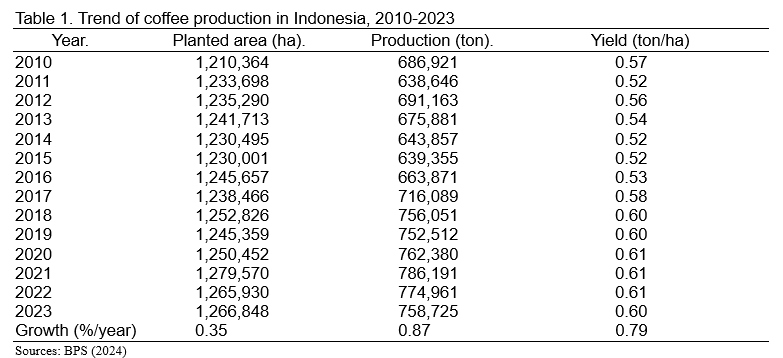
As presented in Table 1, during 2010-2023, the planted area and production of coffee have been stagnant, with the growth rate of only 0.35% and 0.87% respectively (BPS, 2024). Similar trend is also observed for coffee yield which growth only 0.79% in the same period. Relatively low production growth is partially explained by the fact that the largest share (95.7%) of coffee production was produced by smallholder farms, with traditional farming practices. Mulya (2025) also mentioned that this is among the key reasons why Indonesia has difficulty to show a stable supply (including stable quality) of coffee beans in the global market. Moreover, smallholders also typically lack the best farming technologies while having limited money to invest in the farming technology (such as tree rejuvenation or the best fertilizers). State owned enterprises and private company farms were accounted for only 2.6%, and 1.7% respectively. Some private and state-owned coffee farms have been closed over the past two decades (some were converted into oil palm plantations, which are more profitable).
Even though coffee production is spread over all provinces of Indonesia, the largest coffee-producing provinces are South Sumatra (26.0%). Lampung (14.2%), North Sumatra (11.6%), Aceh (9.4%), and Bengkulu (7.2%). The combined share of the four provinces in coffee production is 68.4%.
In terms of coffee variety, Robusta coffee, which thrives at lower altitudes, dominates Indonesia’s coffee production, accounting for about 80–90% of total output. Meanwhile, highland regions like Aceh and North Sumatra are well known for their premium arabica beans. The country is also famous for its specialty coffees, such as kopi luwak, known as one of the world’s most expensive coffee varieties.
To identify the sources of productivity growth, an estimate of Total Factor Productivity (TFP) Growth from the most recent study is presented. The available data represent estimates for three commodities pooled together, namely coffee, cocoa, and tea. It is assumed that the three commodities show the same TFP growth.
As indicated in Table 2 the production of other crops (cocoa, coffee, and tea) increased by an average of 1.8% per annum during 1996-2020. The primary driver of this output growth was the expansion of land, which contributed 3.4%, along with machinery, contributing 1.8%, indicating that the growth was largely due to extensification in farming practices. In the first two decades, output growth decreases significantly from 4.4% to -1.4%, driven by decreasing in TFP from -2.8% to -7.4%, and land from 7.1% to 2.0% per annum. However, in 2016-2020, annual growth of output increased sharply to 3.2%. The increase in production from 2016 to 2020 was primarily due to a significant rise in labor and the use of fertilizers and pesticides. These trends suggest that coffee production in Indonesia continues to rely heavily on extensification rather than intensification. Therefore, to boost coffee production, efforts should focus on agricultural intensification and TFP enhancement.

In addition to its economic role, coffee production shows a very important environmental function. For instance, in the Upper Citarum Watershed regions of West Java Province, farmers traditionally grow vegetables due to high profit, but this poses a negative environmental impact, such as soil and water pollution. To mitigate this problem, the Ministry of Agriculture and local government encourage the conversion of vegetable crops into coffee with similar or higher profit but more environmentally friendly (Sumaryanto et al., 2022).
Consumption
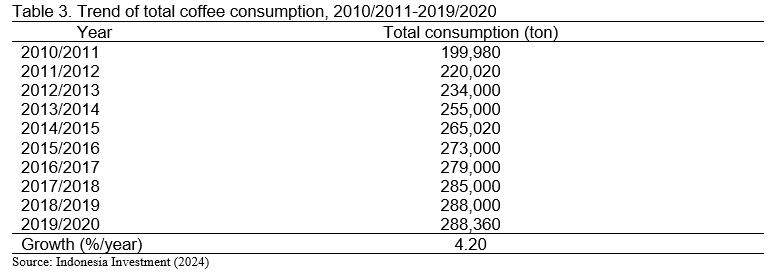
Per capita coffee consumption in Indonesia is still very low, 0.8kg/year, whereas in other countries, such as Brazil, it reaches 6.0kg/year, Norway 10.6kg/year, and Finland 11.4kg/year (Sudjatmoko, 2023). Total coffee consumption increased strongly at 4.2% per annum during 2010/2011-2019/2020 as shown in Table 3. The trend is predicted to continue as economic growth and changing lifestyles drive coffee consumption away from home (restaurants, cafes, etc.). This is an opportunity for farmers and other actors to expand coffee production while improving quality.
Market and trade
Coffee production creates substantial downstream economic activities, such as processing, marketing and trade. Semi processing activities include washing, grinding to make coffee readily served in restaurants, coffee shops which grow significantly along with lifestyles to drink coffee away from home, in particular among millennial segment of population. Coffee processing from primary form as green bean into the secondary form such as coffee powder creates added value in the range of 11.2% to 72.9% (Dewi, et al.,2022). The value added will be even larger if coffee is sold in terms of final products, such as coffee drinking served in cafes or restaurants. The market structure in the coffee processing industry in Indonesia is oligopoly with fairly high market barriers (Apriani, 2024). This segment also creates services of barista which require certain certified skill, professional training. The trend is expected to grow continuously along with economic and income growth.
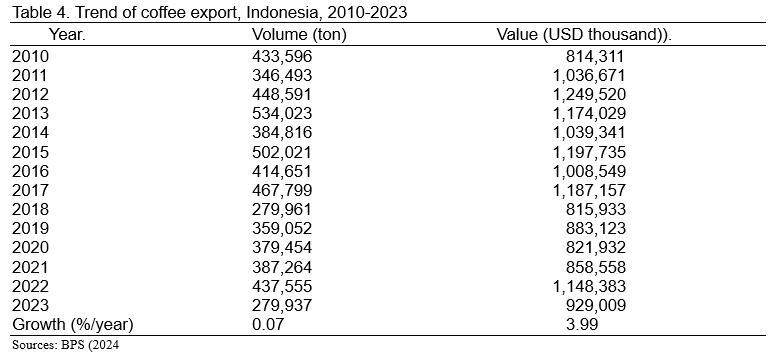
Around 60% of coffee production is marketed in the international market. Table 4 shows that even though export volume is fluctuating, but it grows positively at 0.07%. In terms of value, coffee export indicates strong growth at 3.99% per annum, meaning a strong price increase during this period. Major destination countries of Indonesia's coffee export are the United States, India, Egypt, Germany, and Malaysia.
There are so many specific types of coffee plantations from various regions in Indonesia registered and obtained Geographical Indication (GI) certificates, such as: Arabica Gayo, Arabica North Simalungun, Arabica Sumatra Mandailing, Arabica Java Preanger, Arabica Sindoro-Sumbing, Liberica Tunggal Jambi, Liberica Rangsang Meranti, Robusta Semendo, Robusta Empat Lawang, Robusta Lampung, and Robusta Temanggung. Coffee with a geographical indication certificate has a huge export opportunity in the global market (Indonesia Investment, 2024).
Global coffee consumption continues to rise (disrupted temporarily during the COVID-19 crisis in 2020-2021) due to the expanding world population and growing 'coffee consumption lifestyles' in populous countries like China and Indonesia, where the rapidly rising middle classes increasingly like to visit the booming coffee shops (including international chains) for a cup of coffee. It is noteworthy that coffee consumption is particularly rising in Asia. Recent trend shows that Asian demand is gradually shifting from robusta to the higher quality arabica beans (Mulya, 2024).
Coffee in rural economy
As part of economic transformation, rural areas and agriculture have experienced rural transformation. According to Huang and Shi (2021), rural transformation in Asia is characterized by two indicators, namely: (a) an increase in the share of high-value agricultural commodities production; and (b) an increase in the share of rural non-farm employment. In the case of Indonesia, high-value agricultural commodities consist of horticulture, estate crops, and livestock. Among estate crops, coffee play a central role in rural transformation. The share of high-value commodities’ production has increased significantly from 40.6% in 1990-1999 to 50.2% in 2010-2019 (Sudaryanto et al., 2021; Sudaryanto et al., 2023). In the contrary, the share of staple food production has declined from 59.3% in 1990-1999 to 49.7% in 2010-2019.
The coffee business also creates substantial off-farm employment in processing, wholesale and retail, and services sectors, including in rural regions. This is in line with the second indicator of rural transformation, the increase in the share of rural non-farm employment. The percentage share of rural non-farm employment increased from 48.0% in 1990-1999 to 66.0% in 2010-2019.
Increased share of high value commodities production along with the increased rural non-farm employment ultimately lead to higher rural household income and lower poverty rate (Sudaryanto et al., 2023). Furthermore, rural transformation also implies better food security status and gender balance.
GOVERNMENT POLICIES
Performance of the coffee sector as described in the earlier section is influenced by natural resources, the level of human resources who manage the sector, the global market, and a set of government policies. The following section reviews major policy initiatives to further develop the sector (Sudjatmoko, 2033).
- Improve coffee productivity and quality. Some specific steps to implement this policy are: (a) replanting of smallholder coffee crop with superior varieties and high quality seedling; (b) conversion of robusta coffee into arabica coffee in the appropriate regions; (c) expansion of arabica coffee, in particular in the eastern part of Indonesia; (d) encourage conversion of seasonal crops (such as vegetables) into coffee in the upland areas; (e) pilot project on speciality and organic coffee; (f) promote smallholder multiplication business on superior coffee variety; and (g) promote integration of coffee and animal husbandry.
- Increase coffee export and value added. As shown in the earlier section, coffee exports are fluctuating, and average growth is almost stagnant, despite substantial opportunities in the global market. Some policy measures to promote expansion of coffee exports are: (a) as mandated by the decree of Minister of Trade No.10/2011, the government has phased out the export fee requirement and simplified the reporting requirement; and (b) established a national standard (SNI) for coffee products.
- Financing support. The government provides people with enterprise credit (Kredit Usaha Rakyat, KUR) at a subsidised interest rate. This facility is available for micro, small, and medium enterprises at the on-farm as well as off-farm segment of the coffee value chain, with a maximum credit of IDR 500 million (US$31,552). The subsidised interest rate is 3%-9% depending on the enterprise's category.
- Farmers' empowerment. Empowerment of coffee farmers is conducted by establishing or strengthening farmers' institutions, training, and mentoring to improve their capacity in accessing new technology, other support services, and market opportunities.
- Support for research and development. To promote technology innovation in coffee, the government has established the Indonesian Coffee and Cocoa Research Institute (ICCRI) since colonial times. The ICCRI is funded by state-owned enterprises and the state budget. The ICCRI provides services on: (a) supplying planting material for various types of superior coffee varieties; (b) supplying equipment related to coffee farming; providing consultancy on crop management; and (c) providing training and consultancy services to coffee growers, processors, related ministries, and local government.
CONCLUSION
Despite substantial growth of coffee demand for both the domestic and global markets, the growth of coffee area, production, and productivity is almost stagnant. The primary driver of production growth is area expansion, whereas total factor productivity shows negative growth, indicating a lack of technology development on this crop. Therefore, to accelerate production and quality improvement, priority should be given to strengthening research and development by allocating a higher budget and improving governance of the R&D system.
Coffee farming plays a central role in the rural transformation process, which ultimately contributes to higher rural household income and reduces rural poverty rate. Coffee farming also plays an important role in maintaining the sustainability of land resources and protecting the environment. Therefore, promoting coffee farming should be seen not only from a business perspective but also its broader role in the rural economy and environmental protection.
REFERENCES
Apriani,D., A.Bashir, F,Marissa, Mukhlis.2024. The Structure-Conduct-Performance of Indonesian Coffee Processing Industry, 8th Sriwijaya Economics, Accounting, and Business Conference
[BPS] Badan Pusat Statistik. 2024.. Statistik Kopi Indonesia (Indonesia Coffee Statistic), 2023,Volume 8, 2024, BPD, Jakarta.
Dewi, N.L.M.I. M., I.I.P.Putra, I.Astama.2022. The Study of Added Value Analysis of Coffee Processing in Indonesia, Agribusiness Journal, 5(2), https://doi.org/10.31327/aj.v5i2.1839
Huang J, Shi P. 2021. Regional Rural and Structural Transformations and Farmer’s Income in the Past Four Decades in China. China Agricultural Economic Review, 13:278–301.
Indonesia Investment.2024. Coffee Industry in Indonesia Report: Production & Export Analysis. Last updated on 23 May 2024, downloaded in 30 October 2025 https://share.google/nXSuQXu3hnTRToVKm
Jamal, E., Sahara, S.Izzulhaq, S.Amaliah,F.S.Ahmad, Komalawati, P.Buhaerah, I.Martino, W.Metafurry, D.J.Mutaqin, I.T.Firdaus, D.Setyawati, A.Pradesha, V.Yulaswati, I.S.Beik, I.W.Wardhana, J.Indarto, A.E.Nugroho, B.Arifin,T.Sudaryanto. 2024. Foresight and Metrics to Accelerate Food, Land, and Water System Transformation: Indonesia Case. Final Report. International Food Policy Research, Bioversity International, IPB University, National Research and Innovation Agency, Ministry of National Development Planning.
Mulya, A. 2025. Indonesia’s Coffee Industry: An In-Depth Look. Invest in Asia, blog on Business and Investment Insight, updated in 30 January 2025, downloaded in 30 October 2025,
https://share.google/BB40xw08MqHYRxZbA
Sudaryanto,T, H.J.Purba, R.R.Rachmawati, Erwidodo, S.K.Dermoredjo, E.S.Yusuf, N.Nuryantono, S.H.Pasaribu, S.Amalia, M.Amin. 2021. After Three Decades of Agricultural and Rural Transformation in Indonesia. In: Proceedings of the ICANaRD 2021. IOP Conference Series: Earth and Environmental Science 892 012056. Indonesia.
Sudaryanto,T, Erwidodo, S.K.Dermoredjo, H.J.Purba, R.R.Rachmawati, A.R.Irawan. 2023. Regional Rural Transformation and Its Association with Household Income and Poverty Incidence in Indonesia in the Last Two Decades. Journal of Integrative Agriculture 2023, 22(12): 2–14 .
Sudjarmoko.B. 2023. Prospek Pengembangan Industrialisasi Kopi Indonesia (Prospects of Indonesian Coffee Industrialization Development). SIRINOV, 1(3): 99 – 110.
Sumaryanto, S.H.Susilowati, F.Nurfatriani, H. Tarigan, Erwidodo, T.Sudaryanto, H.W.Perkasa. 2022.Determinants of Farmers’ Behavior Towards Land Conservation Practices in the Upper Citarum Watershed in West Java, Indonesia Land 11(10), https://doi.org/10.3390/land11101827

Beverage Crops in Rural Economy: The Case of Coffee in Indonesia
ABSTRACT
Coffee farming plays an important role as a source of cash income for smallholder farmers and sources of foreign exchange earnings, and creates a multiplier effect and added value in the processing industry and marketing. Domestic consumption and export market show very strong growth as the economy continues to expand along with changes in lifestyles. Indonesia’s coffee specialty has shown an important role in the international market. However, coffee production growth does not respond well to these opportunities, as planted area, production, and productivity are almost stagnant. This reflects the fact that smallholder farmers produce more than 95.70% of coffee production with low capacity in accessing new technology and limited financial resources. Despite these limitations, coffee farming plays an important role in rural transformation and environmental conservation. Government policies should put priority on research and development to promote the adoption of modern technology by smallholder farmers.
Keywords: coffee, production, market, rural economy
INTRODUCTION
The main beverage commodities in Indonesia are coffee, cocoa, and tea. Historically, tea has been developed as a traditional export commodity since colonial times, but currently its performance is declining and considered a sunset industry. On the other hand, coffee and cocoa are two commodities which have emerged as new sources of growth. Among the two, coffee shows a more diverse role not only in the economy but also contributes to environmental and cultural dimensions. Coffee is the fourth-largest foreign exchange earner (after palm oil, rubber, and cocoa). It also provides income to more than one million Indonesian smallholder farmers and provides raw materials to the industrial sector.
Coffee was first introduced in Indonesia around the 1700s by a joint venture company of the Dutch and India, based in Sri Lanka (Sudjatmoko, 2013). Subsequently, a planting trial by the Dutch in several sites of Indonesia had shown good results. Dutch colony then established a policy that coffee is compulsory (cultural steelsel) to be planted by farmers in some parts of Java.
Currently, coffee is planted by farmers and companies all over Indonesia. On the on-farm segment, coffee production continues to grow responding to market demand, both domestic and the global markets. In the domestic market, coffee farms have been developed in response to the growth of café businesses to meet the demand for drinking coffee, particularly for the millennial segment of the population. In a broader context of rural economy, coffee as high value crop has been part of rural transformation process.
The purpose of this paper is to review the development of the coffee value chain, which includes production, consumption, market, and trade, the role in the rural economy, and government policy.
THE CURRENT STATUS OF COFFEE INDUSTRY IN INDONESIA
Production
Indonesia is one of the world’s leading coffee producers, ranking among the top four globally after Brazil, Vietnam, and Colombia (Mulya, 2025). With a total coffee farm area of approximately 1.327 million hectares in 2023, Indonesia’s coffee industry plays a crucial role in the country’s economy.
As presented in Table 1, during 2010-2023, the planted area and production of coffee have been stagnant, with the growth rate of only 0.35% and 0.87% respectively (BPS, 2024). Similar trend is also observed for coffee yield which growth only 0.79% in the same period. Relatively low production growth is partially explained by the fact that the largest share (95.7%) of coffee production was produced by smallholder farms, with traditional farming practices. Mulya (2025) also mentioned that this is among the key reasons why Indonesia has difficulty to show a stable supply (including stable quality) of coffee beans in the global market. Moreover, smallholders also typically lack the best farming technologies while having limited money to invest in the farming technology (such as tree rejuvenation or the best fertilizers). State owned enterprises and private company farms were accounted for only 2.6%, and 1.7% respectively. Some private and state-owned coffee farms have been closed over the past two decades (some were converted into oil palm plantations, which are more profitable).
Even though coffee production is spread over all provinces of Indonesia, the largest coffee-producing provinces are South Sumatra (26.0%). Lampung (14.2%), North Sumatra (11.6%), Aceh (9.4%), and Bengkulu (7.2%). The combined share of the four provinces in coffee production is 68.4%.
In terms of coffee variety, Robusta coffee, which thrives at lower altitudes, dominates Indonesia’s coffee production, accounting for about 80–90% of total output. Meanwhile, highland regions like Aceh and North Sumatra are well known for their premium arabica beans. The country is also famous for its specialty coffees, such as kopi luwak, known as one of the world’s most expensive coffee varieties.
To identify the sources of productivity growth, an estimate of Total Factor Productivity (TFP) Growth from the most recent study is presented. The available data represent estimates for three commodities pooled together, namely coffee, cocoa, and tea. It is assumed that the three commodities show the same TFP growth.
As indicated in Table 2 the production of other crops (cocoa, coffee, and tea) increased by an average of 1.8% per annum during 1996-2020. The primary driver of this output growth was the expansion of land, which contributed 3.4%, along with machinery, contributing 1.8%, indicating that the growth was largely due to extensification in farming practices. In the first two decades, output growth decreases significantly from 4.4% to -1.4%, driven by decreasing in TFP from -2.8% to -7.4%, and land from 7.1% to 2.0% per annum. However, in 2016-2020, annual growth of output increased sharply to 3.2%. The increase in production from 2016 to 2020 was primarily due to a significant rise in labor and the use of fertilizers and pesticides. These trends suggest that coffee production in Indonesia continues to rely heavily on extensification rather than intensification. Therefore, to boost coffee production, efforts should focus on agricultural intensification and TFP enhancement.
In addition to its economic role, coffee production shows a very important environmental function. For instance, in the Upper Citarum Watershed regions of West Java Province, farmers traditionally grow vegetables due to high profit, but this poses a negative environmental impact, such as soil and water pollution. To mitigate this problem, the Ministry of Agriculture and local government encourage the conversion of vegetable crops into coffee with similar or higher profit but more environmentally friendly (Sumaryanto et al., 2022).
Consumption
Per capita coffee consumption in Indonesia is still very low, 0.8kg/year, whereas in other countries, such as Brazil, it reaches 6.0kg/year, Norway 10.6kg/year, and Finland 11.4kg/year (Sudjatmoko, 2023). Total coffee consumption increased strongly at 4.2% per annum during 2010/2011-2019/2020 as shown in Table 3. The trend is predicted to continue as economic growth and changing lifestyles drive coffee consumption away from home (restaurants, cafes, etc.). This is an opportunity for farmers and other actors to expand coffee production while improving quality.
Market and trade
Coffee production creates substantial downstream economic activities, such as processing, marketing and trade. Semi processing activities include washing, grinding to make coffee readily served in restaurants, coffee shops which grow significantly along with lifestyles to drink coffee away from home, in particular among millennial segment of population. Coffee processing from primary form as green bean into the secondary form such as coffee powder creates added value in the range of 11.2% to 72.9% (Dewi, et al.,2022). The value added will be even larger if coffee is sold in terms of final products, such as coffee drinking served in cafes or restaurants. The market structure in the coffee processing industry in Indonesia is oligopoly with fairly high market barriers (Apriani, 2024). This segment also creates services of barista which require certain certified skill, professional training. The trend is expected to grow continuously along with economic and income growth.

Around 60% of coffee production is marketed in the international market. Table 4 shows that even though export volume is fluctuating, but it grows positively at 0.07%. In terms of value, coffee export indicates strong growth at 3.99% per annum, meaning a strong price increase during this period. Major destination countries of Indonesia's coffee export are the United States, India, Egypt, Germany, and Malaysia.
There are so many specific types of coffee plantations from various regions in Indonesia registered and obtained Geographical Indication (GI) certificates, such as: Arabica Gayo, Arabica North Simalungun, Arabica Sumatra Mandailing, Arabica Java Preanger, Arabica Sindoro-Sumbing, Liberica Tunggal Jambi, Liberica Rangsang Meranti, Robusta Semendo, Robusta Empat Lawang, Robusta Lampung, and Robusta Temanggung. Coffee with a geographical indication certificate has a huge export opportunity in the global market (Indonesia Investment, 2024).
Global coffee consumption continues to rise (disrupted temporarily during the COVID-19 crisis in 2020-2021) due to the expanding world population and growing 'coffee consumption lifestyles' in populous countries like China and Indonesia, where the rapidly rising middle classes increasingly like to visit the booming coffee shops (including international chains) for a cup of coffee. It is noteworthy that coffee consumption is particularly rising in Asia. Recent trend shows that Asian demand is gradually shifting from robusta to the higher quality arabica beans (Mulya, 2024).
Coffee in rural economy
As part of economic transformation, rural areas and agriculture have experienced rural transformation. According to Huang and Shi (2021), rural transformation in Asia is characterized by two indicators, namely: (a) an increase in the share of high-value agricultural commodities production; and (b) an increase in the share of rural non-farm employment. In the case of Indonesia, high-value agricultural commodities consist of horticulture, estate crops, and livestock. Among estate crops, coffee play a central role in rural transformation. The share of high-value commodities’ production has increased significantly from 40.6% in 1990-1999 to 50.2% in 2010-2019 (Sudaryanto et al., 2021; Sudaryanto et al., 2023). In the contrary, the share of staple food production has declined from 59.3% in 1990-1999 to 49.7% in 2010-2019.
The coffee business also creates substantial off-farm employment in processing, wholesale and retail, and services sectors, including in rural regions. This is in line with the second indicator of rural transformation, the increase in the share of rural non-farm employment. The percentage share of rural non-farm employment increased from 48.0% in 1990-1999 to 66.0% in 2010-2019.
Increased share of high value commodities production along with the increased rural non-farm employment ultimately lead to higher rural household income and lower poverty rate (Sudaryanto et al., 2023). Furthermore, rural transformation also implies better food security status and gender balance.
GOVERNMENT POLICIES
Performance of the coffee sector as described in the earlier section is influenced by natural resources, the level of human resources who manage the sector, the global market, and a set of government policies. The following section reviews major policy initiatives to further develop the sector (Sudjatmoko, 2033).
CONCLUSION
Despite substantial growth of coffee demand for both the domestic and global markets, the growth of coffee area, production, and productivity is almost stagnant. The primary driver of production growth is area expansion, whereas total factor productivity shows negative growth, indicating a lack of technology development on this crop. Therefore, to accelerate production and quality improvement, priority should be given to strengthening research and development by allocating a higher budget and improving governance of the R&D system.
Coffee farming plays a central role in the rural transformation process, which ultimately contributes to higher rural household income and reduces rural poverty rate. Coffee farming also plays an important role in maintaining the sustainability of land resources and protecting the environment. Therefore, promoting coffee farming should be seen not only from a business perspective but also its broader role in the rural economy and environmental protection.
REFERENCES
Apriani,D., A.Bashir, F,Marissa, Mukhlis.2024. The Structure-Conduct-Performance of Indonesian Coffee Processing Industry, 8th Sriwijaya Economics, Accounting, and Business Conference
[BPS] Badan Pusat Statistik. 2024.. Statistik Kopi Indonesia (Indonesia Coffee Statistic), 2023,Volume 8, 2024, BPD, Jakarta.
Dewi, N.L.M.I. M., I.I.P.Putra, I.Astama.2022. The Study of Added Value Analysis of Coffee Processing in Indonesia, Agribusiness Journal, 5(2), https://doi.org/10.31327/aj.v5i2.1839
Huang J, Shi P. 2021. Regional Rural and Structural Transformations and Farmer’s Income in the Past Four Decades in China. China Agricultural Economic Review, 13:278–301.
Indonesia Investment.2024. Coffee Industry in Indonesia Report: Production & Export Analysis. Last updated on 23 May 2024, downloaded in 30 October 2025 https://share.google/nXSuQXu3hnTRToVKm
Jamal, E., Sahara, S.Izzulhaq, S.Amaliah,F.S.Ahmad, Komalawati, P.Buhaerah, I.Martino, W.Metafurry, D.J.Mutaqin, I.T.Firdaus, D.Setyawati, A.Pradesha, V.Yulaswati, I.S.Beik, I.W.Wardhana, J.Indarto, A.E.Nugroho, B.Arifin,T.Sudaryanto. 2024. Foresight and Metrics to Accelerate Food, Land, and Water System Transformation: Indonesia Case. Final Report. International Food Policy Research, Bioversity International, IPB University, National Research and Innovation Agency, Ministry of National Development Planning.
Mulya, A. 2025. Indonesia’s Coffee Industry: An In-Depth Look. Invest in Asia, blog on Business and Investment Insight, updated in 30 January 2025, downloaded in 30 October 2025,
https://share.google/BB40xw08MqHYRxZbA
Sudaryanto,T, H.J.Purba, R.R.Rachmawati, Erwidodo, S.K.Dermoredjo, E.S.Yusuf, N.Nuryantono, S.H.Pasaribu, S.Amalia, M.Amin. 2021. After Three Decades of Agricultural and Rural Transformation in Indonesia. In: Proceedings of the ICANaRD 2021. IOP Conference Series: Earth and Environmental Science 892 012056. Indonesia.
Sudaryanto,T, Erwidodo, S.K.Dermoredjo, H.J.Purba, R.R.Rachmawati, A.R.Irawan. 2023. Regional Rural Transformation and Its Association with Household Income and Poverty Incidence in Indonesia in the Last Two Decades. Journal of Integrative Agriculture 2023, 22(12): 2–14 .
Sudjarmoko.B. 2023. Prospek Pengembangan Industrialisasi Kopi Indonesia (Prospects of Indonesian Coffee Industrialization Development). SIRINOV, 1(3): 99 – 110.
Sumaryanto, S.H.Susilowati, F.Nurfatriani, H. Tarigan, Erwidodo, T.Sudaryanto, H.W.Perkasa. 2022.Determinants of Farmers’ Behavior Towards Land Conservation Practices in the Upper Citarum Watershed in West Java, Indonesia Land 11(10), https://doi.org/10.3390/land11101827