ABSTRACT
Agricultural resource circularity is increasingly promoted as a strategy for improving resource efficiency, reducing environmental pressures, and advancing sustainable agricultural development. Yet, existing research has focused primarily on technologies and resource-recovery pathways, with less attention to the governance challenges that emerge as resource circulation expands beyond individual farms. Using Taiwan’s circular agriculture policies as a case study, this study examines how governance requirements change as agricultural resource circulation develops toward regional and cross-sector systems. The analysis draws on policy documents and initiatives, together with available official estimates of agricultural residual-resource generation, utilization pathways, statistical limitations, and long-term circularity targets. The findings indicate that scaling up resource circulation increases coordination demands across geographically dispersed resources, multiple stakeholders, administrative jurisdictions, and downstream uses. Four complementary governance functions are identified as particularly important for regional-scale implementation: resource integration, stakeholder coordination, institutional support, and market facilitation. The analysis further highlights that incomplete statistical coverage and fragmented policy arrangements constrain the monitoring, coordination, and evaluation of increasingly complex resource flows. Based on these findings, this study proposes a Governance Scaling Framework linking the scale and complexity of agricultural resource circulation to the governance capacities required for implementation. The framework suggests that circular-agriculture policy should move beyond isolated technological interventions and individual policy instruments toward integrated governance arrangements that coordinate resource flows, institutional support, stakeholder participation, information systems, and market development. Rather than presenting Taiwan as a universally replicable model, the framework provides an analytical perspective for assessing governance readiness and designing scalable circular-agriculture strategies across different institutional contexts.
Keywords: circular agriculture, agricultural resource circularity, governance transition, collaborative governance, integrated policy instruments
INTRODUCTION
Agricultural resource circularity has become an important strategy for improving resource efficiency and environmental sustainability. Against the backdrop of rising resource consumption, climate change, and mounting environmental pressures, the circular economy has evolved from a primarily environmental concept into a central component of the international policy agenda. UNEP projects that global resource extraction could increase by 60% by 2060 relative to 2020 levels unless substantial policy changes are implemented. Meanwhile, the OECD, the European Commission, and the FAO have all identified circular economy and sustainable bioeconomy strategies as key pathways for transforming agrifood systems (UNEP, 2024; OECD, 2022; European Commission, 2020; FAO, 2022).
Unlike circular systems in industrial sectors, however, agricultural resource circularity is shaped by the biological and spatial characteristics of agricultural resources. Livestock manure, agricultural wastewater, crop residues, and other agricultural by-products are heterogeneous, seasonally variable, geographically dispersed, and highly dependent on local environmental conditions (Kirchherr et al., 2017; Geissdoerfer et al., 2017). As agricultural resource circulation expands beyond individual farms, successful implementation depends increasingly not only on recycling technologies but also on the coordination of resource flows across farms, sectors, and administrative boundaries (Velasco-Muñoz et al., 2022; van Selm et al., 2024; Pearson et al., 2024).
Scaling process introduces governance challenges that cannot be addressed through technological innovation alone. Previous studies on common-pool resource governance and collaborative governance have shown that, when resource use involves multiple actors and interdependent relationships, institutional arrangements, coordination mechanisms, and governance capacity become critical determinants of policy effectiveness (Ostrom, 1990; Ansell & Gash, 2008, 2018; Emerson et al., 2012; Emerson & Nabatchi, 2015; Bodin, 2017; Wu et al., 2015). Although recent studies have examined technological pathways, life-cycle assessment, and the transformative potential of circular agriculture, relatively little attention has been paid to how governance arrangements must evolve as agricultural resource circulation expands from farm-level management to regional-scale implementation (Cong & Thomsen, 2021; Silvius et al., 2023; Pearson et al., 2024).
Against this background, this study asks how governance requirements change as agricultural resource circulation expands from individual farms to regional-scale implementation. Through qualitative policy analysis, it examines the relationships among agricultural resource characteristics, governance complexity, and governmental responses in Taiwan. Based on the analysis, the study proposes a Governance Scaling Framework that links the scale and complexity of agricultural resource circulation to four complementary governance functions: resource integration, stakeholder coordination, institutional support, and market facilitation. Rather than presenting Taiwan as a universally replicable governance model, the framework provides an analytical perspective for understanding governance transformation, identifying capacity gaps, and assessing governance readiness across diverse policy contexts.
WHY GOVERNANCE TRANSITION BECOMES NECESSARY FOR AGRICULTURAL RESOURCE CIRCULARITY
Characteristics of agricultural resource circularity
Agricultural resource circularity differs fundamentally from circular systems in conventional industrial sectors because agricultural resources possess distinctive biological, spatial, and temporal characteristics. Unlike standardized industrial materials, agricultural resources are heterogeneous in composition, seasonally variable in availability, geographically dispersed across numerous production sites, and strongly influenced by local environmental conditions.
These characteristics make agricultural resource circulation inherently more complex. Livestock manure, agricultural wastewater, crop residues, and other agricultural by-products differ substantially in their nutrient composition, storage requirements, transportation costs, and potential uses. Moreover, these resources are generated by numerous independent farms operating under diverse production conditions, resulting in a fragmented spatial distribution across rural landscapes.
Consequently, successful agricultural resource circulation depends not only on technological feasibility but also on spatial coordination between resource suppliers and users, transportation logistics, environmental regulation, and institutional coordination. Agricultural resource circularity should therefore be understood not merely as a technological process but also as a governance challenge requiring coordination across multiple actors, sectors, and locations.
From technology to governance
Technological innovation has substantially improved the feasibility of agricultural resource utilization through anaerobic digestion, composting, nutrient recovery, wastewater reuse, and biomass utilization. However, technological feasibility alone cannot ensure successful implementation beyond individual farms.
As agricultural resource circulation expands, implementation increasingly depends on governments’ ability to integrate dispersed resources, coordinate diverse stakeholders, establish supportive institutional arrangements, and facilitate the development of viable and sustainable markets. These enabling conditions extend beyond the capacity of individual producers and therefore require governance-oriented policy interventions.
Consequently, the central policy challenge shifts from improving individual recycling technologies to strengthening governance arrangements capable of supporting increasingly complex regional resource circulation. Research on collaborative governance similarly suggests that the effective implementation of complex public policies increasingly depends on governance capacity, institutional coordination, and cross-sector collaboration (Ansell & Gash, 2008, 2018; Emerson & Nabatchi, 2015). Building on this perspective, this study argues that governance capacity becomes increasingly important as agricultural resource circularity scales up.
Governance complexity increases with the scale of resource circulation
The expansion of agricultural resource circulation fundamentally changes the nature of policy implementation. At the farm level, individual producers largely control resource management, allowing technological improvements to generate relatively direct environmental benefits. As circulation expands to the regional scale, however, resource flows increasingly cross farm boundaries, administrative jurisdictions, industrial sectors, and agricultural value chains.
Regional-scale implementation therefore requires coordination among multiple public and private stakeholders, including producers, local governments, research organizations, service providers, and downstream industries. Because these actors have different resources, responsibilities, interests, and policy objectives, governance complexity increases with the scale of agricultural resource circulation.
This relationship suggests that governance complexity is not simply a by-product of implementation but an inherent consequence of scaling up agricultural resource circulation.
Governance scaling framework
The increasing complexity of agricultural resource circulation requires governments to move beyond technology-oriented interventions toward governance-oriented implementation strategies. Previous studies have shown that collaborative governance provides important institutional arrangements for addressing complex coordination problems through communication, trust building, joint decision-making, and cross-sector collaboration (Ansell & Gash, 2008; Emerson et al., 2012; Emerson & Nabatchi, 2015; Bodin, 2017). Rather than reflecting a simple institutional choice, this study argues that governance transformation represents an adaptive policy response to growing coordination requirements.
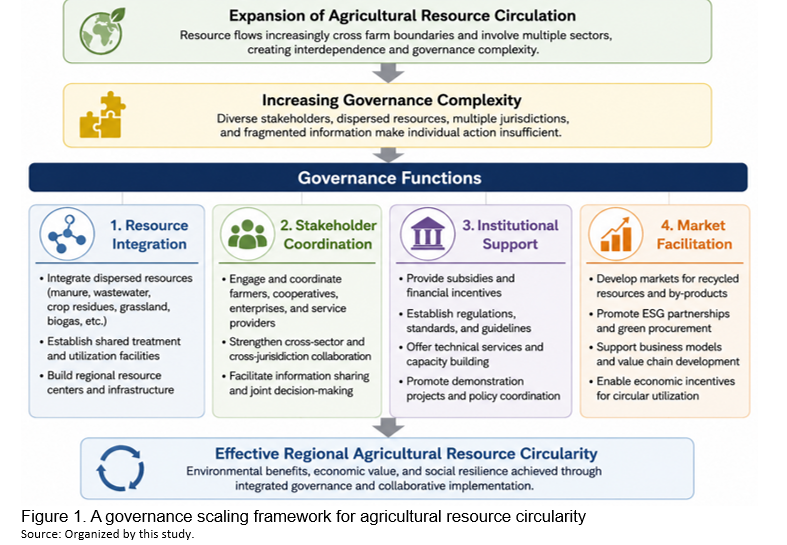
To explain this transformation, this study proposes a Governance Scaling Framework. The framework assumes that governance complexity increases as agricultural resource circulation expands from individual farms to regional-scale implementation. In response, governments must progressively strengthen governance capacity through four complementary governance functions:
• Resource integration
• Stakeholder coordination
• Institutional support
• Market facilitation
These functions should be understood not as isolated policy instruments but as complementary governance capacities that collectively enable agricultural resource circulation at the regional scale. Figure 1 illustrates the proposed Governance Scaling Framework. It shows how the distinctive characteristics of agricultural resources generate increasing governance complexity as circulation expands, thereby requiring governments to strengthen governance capacity through four interrelated functions. The framework provides the analytical foundation for examining Taiwan’s governance transformation in the following section.
TAIWAN'S GOVERNANCE TRANSITION
Evolution of policy objectives
Taiwan’s agricultural resource circularity has evolved through a gradual transformation of governance objectives rather than through a single, discrete policy reform. This evolution reflects changing perceptions of agricultural by-products—from environmental burdens requiring treatment and disposal to renewable resources that can generate environmental, economic, and social value. More importantly, it illustrates how policy objectives have expanded alongside the increasing scale and complexity of agricultural resource circulation.
In the early stages, agricultural resource management was driven primarily by environmental protection and pollution control. Government interventions focused on mitigating the environmental impacts of livestock production through wastewater treatment infrastructure, manure management, and regulatory compliance. Under this policy paradigm, livestock manure, agricultural wastewater, and other agricultural by-products were largely regarded as waste streams requiring appropriate treatment and disposal. Consequently, policy success was evaluated mainly in terms of pollution reduction and environmental compliance at the individual-farm level.
As international policy attention increasingly focused on the circular economy, climate change mitigation, and sustainable resource management, Taiwan’s agricultural policies gradually adopted a broader perspective on managing and utilizing agricultural resources. Livestock manure, agricultural wastewater, crop residues, and other agricultural by-products were increasingly reconceptualized as renewable biological resources that could be recovered and reused to produce organic fertilizers, renewable energy, soil amendments, and other value-added products. Accordingly, policy objectives expanded beyond pollution prevention to encompass resource recovery, circular agriculture, and the broader goal of sustainable agricultural development.
This policy transition has become increasingly important as the scale and diversity of agricultural residual resources have become more visible. According to information presented by Taiwan's Ministry of Agriculture, agricultural residual-resource streams covered by existing agricultural solid-waste statistics amount to approximately 5.07 million metric tons annually. These include about 2.52 million tons of unused agricultural production residues, 2.265 million tons of solid livestock manure, and 0.278 million tons of residual materials associated with agricultural production. Additional resource streams—including forestry and bamboo residues, orchard branches in mountainous areas, clam shells, and liquid fractions and digestates from livestock manure treatment—remain under inventory (Ministry of Agriculture, Taiwan, 2026). The potential resource base relevant to agricultural circularity is therefore larger than the currently consolidated statistical coverage.
Government information also indicates that agricultural circularity in Taiwan involves multiple resource-utilization pathways. Crop residues may be incorporated into farmland, used as cultivation materials, composted, converted into feed or fuel, or otherwise recovered, while livestock manure is predominantly returned to agricultural use through composting and related pathways. Emerging initiatives also explore higher-value applications involving biomass, biochar, biomaterials, and cross-sector resource use (Ministry of Agriculture, Taiwan, 2026). Taken together, these developments suggest that Taiwan's agricultural circularity is evolving from relatively localized waste treatment and on-farm reuse toward more diversified resource-recovery pathways involving multiple actors, sectors, and locations.
Nevertheless, the economic value generated by these activities cannot yet be reliably aggregated at the national level. The Ministry of Agriculture has identified the lack of comprehensive statistical data as a current challenge for agricultural circularity, together with high transportation costs, insufficient integration between upstream and downstream actors, regulatory conflicts, and incomplete coordination across ministries and levels of government (Ministry of Agriculture, Taiwan, 2026). Given these data limitations, available quantitative information is more appropriately interpreted as estimates of resource generation and material flows rather than as a comprehensive measure of circular-utilization performance or economic benefits.
Looking forward, Taiwan's agricultural net-zero strategy sets a 2040 objective of establishing 1,000 low-carbon and sustainable circular sites across agriculture, forestry, fisheries, and livestock production, while promoting the energy, resource, and material utilization of more than five million metric tons of agricultural residual resources (Ministry of Agriculture, Taiwan, 2026). These objectives indicate a policy transition from individual resource-recovery projects toward broader regional and cross-sector circular systems. They also imply substantially greater requirements for resource matching, transportation, regulatory coordination, stakeholder collaboration, information management, and market development. This policy evolution and expanding resource scale provide an empirical foundation for examining how governance capacity must evolve alongside the scaling up of agricultural resource circularity in Taiwan.
Scaling up agricultural resource circulation
The scale and diversity of Taiwan's agricultural residual-resource base illustrate why governance requirements increase as resource circulation expands. As circularity extends across heterogeneous resource streams and geographically dispersed sources and users, it can no longer be treated solely as a collection of independent farm-level recycling practices. The challenge increasingly involves coordinating resource supply and demand, transportation and treatment capacity, regulatory requirements, and potential markets across multiple jurisdictions and sectors.
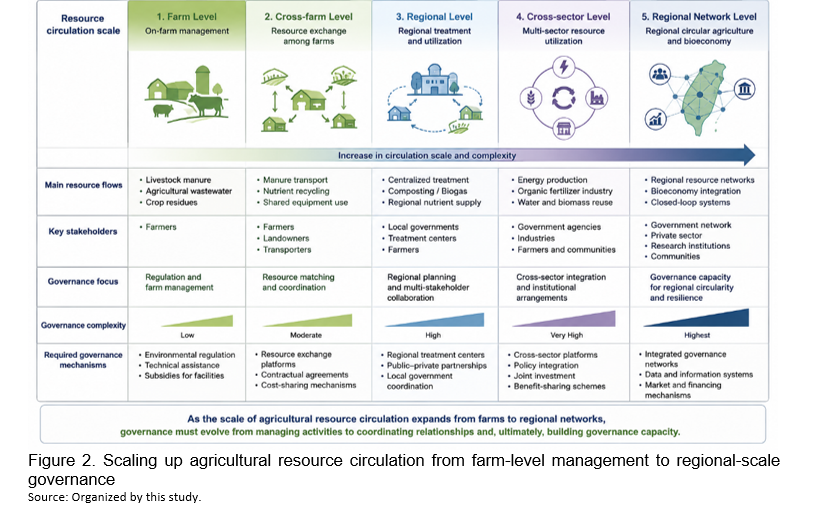
At the farm level, resource management is relatively self-contained and can often be supported through environmental regulation and technology adoption. As resource circulation expands beyond individual farms, however, resource flows increasingly connect multiple producers, treatment facilities, local governments, downstream industries, and surrounding communities. Decisions that were previously made within individual farms must therefore be coordinated across organizational, sectoral, and administrative boundaries, with greater attention to the spatial alignment of resource supply and demand, transportation logistics, land availability, regulatory requirements, and stakeholder cooperation. This transition substantially increases the complexity of policy implementation, making governance complexity an inherent consequence of scaling up agricultural resource circulation.
Figure 2 illustrates this transition from farm-level management to regional-scale governance. It shows that governance complexity increases with the geographical scale and organizational diversity of resource circulation, supporting the argument that governance transformation is an inherent consequence of scaling up agricultural resource circularity. As agricultural resource circulation expands from individual farms to regional networks, the need for resource integration, stakeholder coordination, and institutional support increases accordingly.
Government responses
The government's 2040 circularity targets further institutionalize this transition by shifting the policy horizon from individual recycling practices toward large-scale, low-carbon circular systems. Achieving these targets requires not only technological expansion but also governance arrangements capable of coordinating increasingly diverse resource flows and participating actors. Taiwan's policy development reflects this governance transformation. Recent policies have gradually extended beyond farm-level technological interventions toward regional and integrated approaches to agricultural resource circulation. In the livestock sector, for example, regional resource-treatment arrangements and integrated manure and wastewater utilization have been promoted to connect resource generation, treatment, transportation, and agricultural reuse across multiple farms and users. Similar approaches are emerging for crop residues, biomass resources, and cross-sector resource utilization, reflecting a broader policy orientation toward regional circular systems (Ministry of Agriculture, Taiwan, 2026).
As agricultural resource circulation expands beyond individual farms, governance requirements extend beyond conventional environmental regulation and technology promotion. Taiwan’s policy experience suggests that regional-scale resource circulation increasingly requires governance capacities capable of responding to growing coordination demands. Based on the policy analysis, these capacities can be organized into four complementary governance functions: resource integration, stakeholder coordination, institutional support, and market facilitation.
The first governance function is resource integration, which addresses the fragmented spatial distribution of agricultural resources. Livestock manure, agricultural wastewater, crop residues, and other agricultural by-products are generated across numerous geographically dispersed farms, while potential users and end uses—including cropland applications, forage crop producers, biogas facilities, and organic fertilizer manufacturers—are often located elsewhere. Without mechanisms to connect these dispersed resource suppliers, users, and end uses, valuable agricultural resources may remain underutilized despite their technical potential for recovery and reuse. In Taiwan, policy measures such as regional livestock resource treatment centers and integrated manure and wastewater utilization systems represent efforts to connect dispersed resource generation, treatment, and reuse across multiple farms and users (Ministry of Agriculture, Taiwan, 2026a; Kuo et al., 2025). From the perspective of the Governance Scaling Framework, these measures can be understood as forms of resource integration intended to improve the regional alignment of resource supply and demand.
The second governance function is stakeholder coordination. As agricultural resource circulation expands geographically, implementation increasingly depends on cooperation among livestock producers, crop farmers, cooperatives, local governments, research institutions, transportation providers, private enterprises, and rural communities. These actors possess different resources, responsibilities, interests, and policy objectives, making effective coordination essential for successful implementation. In Taiwan, demonstration projects, technical extension activities, and collaborative initiatives involving public and private actors provide practical settings in which different participants can engage in agricultural resource circulation (Ministry of Agriculture, Taiwan, 2026a; Kuo et al., 2025). From the perspective of the Governance Scaling Framework, these arrangements can be understood as mechanisms for stakeholder coordination, because they create opportunities to align responsibilities, resource needs, and implementation activities among participating actors. The third governance function is institutional support, which provides the regulatory, financial, and organizational foundations necessary for long-term implementation. Regional agricultural resource circulation requires consistent policy incentives, financial assistance, technical guidance, regulatory coordination, and administrative collaboration across multiple government agencies. In Taiwan, subsidies, technical guidance, demonstration programs, and interagency coordination constitute important forms of institutional support for agricultural resource circulation (Ministry of Agriculture, Taiwan, 2026b; Kuo et al., 2025). From the perspective of the Governance Scaling Framework, these measures provide institutional resources for implementation, although their effectiveness increasingly depends on how well they are coordinated across programs, agencies, and administrative levels.
The fourth governance function is market facilitation, which supports the long-term economic viability of agricultural resource circulation. Environmental objectives alone may be insufficient to sustain large-scale resource utilization if recovered agricultural resources lack stable demand and economically viable applications. In Taiwan, current circular-agriculture initiatives include efforts to develop diversified and higher-value uses of agricultural residual resources, including biomass, biochar, biomaterials, and other value-added applications (Ministry of Agriculture, Taiwan, 2026). From the perspective of the Governance Scaling Framework, these efforts represent an emerging market-facilitation function because sustained resource circulation ultimately depends on connecting resource recovery with viable downstream uses and market demand.
Together, these four governance functions illustrate how governance requirements evolve as agricultural resource circulation expands. Rather than representing isolated policy measures, they operate as complementary components of an integrated governance system. Resource integration connects dispersed resource flows, stakeholder coordination aligns participating actors, institutional support provides regulatory, financial, and organizational foundations, and market facilitation links resource recovery with viable downstream uses and market demand. Taiwan's policy experience illustrates how these governance functions become increasingly relevant as agricultural resource circulation expands beyond individual farms and involves more diverse resource flows, actors, and institutional arrangements.
Table 1 summarizes the four governance functions identified in this study, the governance challenges they address, representative practices observed in Taiwan, and the governance roles associated with each function. Rather than representing independent policy instruments, these functions constitute complementary governance capacities for supporting regional agricultural resource circulation. The table therefore translates the proposed analytical framework into practical governance dimensions that can be applied in comparative policy analysis.
Table 1. Governance functions, governance challenges, representative practices, and governance roles
|
Governance Function
|
Governance Challenge
|
Taiwan's Representative Practices
|
Governance Role
|
|
Resource Integration
|
Spatially fragmented resources
|
Regional livestock resource treatment; integrated manure and wastewater utilization
|
Connect dispersed resource generation, treatment, and reuse
|
|
Stakeholder Coordination
|
Multiple actors with different responsibilities and interests
|
Demonstration projects, technical extension activities, and public–private collaborative initiatives
|
Align actors, responsibilities, and implementation activities
|
|
Institutional Support
|
Fragmented policies and administrative responsibilities
|
Subsidies, technical guidance, demonstration programs, and interagency coordination
|
Provide regulatory, financial, technical, and organizational support
|
|
Market Facilitation
|
Limited downstream uses and market demand
|
Development of biomass, biochar, biomaterials, and other value-added applications
|
Connect resource recovery with viable downstream uses and market demand
|
Source: Organized by this study.
Governance scaling in practice
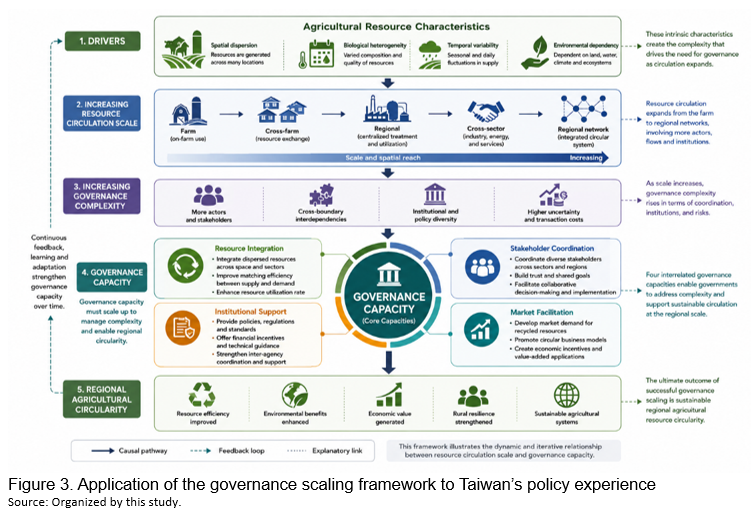
Taiwan's policy experience illustrates that governance scaling involves more than the expansion of individual policy measures. As agricultural resource circulation becomes more spatially extensive and organizationally complex, effective implementation increasingly depends on the integration of resource integration, stakeholder coordination, institutional support, and market facilitation. Figure 3 synthesizes these relationships by linking the four governance functions identified in the policy analysis with the policy instruments through which they may be operationalized.
POLICY IMPLICATIONS
Governance implications
The findings suggest that agricultural resource circularity should be understood not only as a technological issue but also as a governance challenge. While technological innovation remains essential for improving resource recovery and environmental performance, successful implementation at the regional scale increasingly depends on governance systems' capacity to coordinate dispersed resources, multiple stakeholders, institutional arrangements, and market development.
The Governance Scaling Framework proposed in this study offers a governance-oriented perspective on this transformation. As agricultural resource circulation expands beyond individual farms, governments need to strengthen their governance capacity through four complementary functions: resource integration, stakeholder coordination, institutional support, and market facilitation. These functions should not be viewed as independent policy instruments but as mutually reinforcing governance capacities that collectively enable agricultural resource circulation at the regional scale.
This perspective extends previous studies that have primarily emphasized technological innovation, resource efficiency, and environmental outcomes (Velasco-Muñoz et al., 2022; Silvius et al., 2023; van Selm et al., 2024) by identifying governance as a critical enabling condition for scaling up agricultural resource circulation. Rather than treating governance as a secondary or supporting element of policy implementation, this study suggests that governance capacity becomes increasingly important as agricultural resource circulation systems expand and become more interconnected. This argument is consistent with broader discussions of governance capacity in collaborative governance research (Ansell & Gash, 2018; Emerson & Nabatchi, 2015; Wu et al., 2015).
From governance functions to integrated policy instruments
Applying the Governance Scaling Framework to Taiwan’s policy experience suggests that future policy development should move beyond expanding individual recycling projects and toward integrated policy instruments that systematically support agricultural resource circularity. Although Taiwan has introduced a range of subsidies, demonstration programs, and infrastructure investments to promote agricultural resource circularity, these measures remain distributed across different programs and administrative domains. The policy challenge therefore lies not simply in the availability of individual measures, but in strengthening their integration across regulatory requirements, financial support, technical assistance, stakeholder coordination, and market development. Government support—including subsidies, infrastructure investment, technical assistance, and demonstration programs—continues to play an important role in the development of agricultural resource circularity in Taiwan (Ministry of Agriculture, Taiwan, 2026b; Kuo et al., 2025). However, the expansion of circularity toward regional and cross-sector systems also increases the importance of developing more durable market mechanisms and private-sector participation.
The findings indicate that a major governance gap is the absence of integrated policy instruments that link environmental objectives, agricultural production, industrial development, regional governance, and market incentives. Existing policies primarily encourage technology adoption and pollution control but provide relatively limited mechanisms for coordinating cross-sector collaboration and creating long-term economic incentives for resource circulation. As agricultural resource circulation expands across farms, industries, and administrative boundaries, governments should increasingly adopt policy instruments that integrate regulatory measures, financial incentives, technical services, regional coordination, and market development within a coherent governance framework.
In particular, stronger mechanisms are needed to connect agricultural resource circularity with environmental, social, and governance (ESG) initiatives and private-sector participation. Rather than relying primarily on government subsidies, future policies should facilitate partnerships between agricultural producers and enterprises seeking to meet ESG commitments, carbon-reduction objectives, and sustainable supply-chain requirements. Such partnerships could transform recycled agricultural resources from environmental burdens into economic assets by creating stable market demand and diversified revenue streams. This approach could not only reduce long-term dependence on public funding but also strengthen economic resilience and the potential to scale up agricultural resource circularity.
More broadly, Taiwan’s experience suggests that the role of government should gradually evolve from directly supporting individual projects to designing and coordinating integrated governance arrangements that align public policies, market mechanisms, and stakeholder collaboration. In this respect, integrated policy instruments represent an important next step in strengthening the governance capacity required to scale up agricultural resource circulation. The Governance Scaling Framework therefore provides policymakers with an analytical basis for identifying governance gaps and designing policy instruments that can support the long-term operation of agricultural resource circulation systems at the regional scale.
Future research
This study is based on a qualitative policy analysis of Taiwan’s circular agriculture policies as a case study. Future research may compare governance scaling across different countries to examine how institutions shape the implementation and scaling up of agricultural resource circularity in diverse institutional and policy contexts.
Additional studies may also develop quantitative indicators to assess governance capacity and governance readiness, enabling more systematic evaluation of governance performance across farm, local, and regional scales.
Finally, future research may further investigate how digital technologies, market innovation, and adaptive governance may strengthen governance capacity for regional agricultural resource circulation. Such research would provide additional evidence to refine the Governance Scaling Framework and inform the design and implementation of future agricultural policies.
CONCLUSIONS
Agricultural resource circularity has become an important strategy for improving resource efficiency and environmental sustainability. Existing research has largely emphasized recycling technologies, resource recovery pathways, and environmental performance. This study argues, however, that scaling up agricultural resource circulation also creates significant governance challenges. As circulation extends beyond individual farms and develops into regional resource networks, the number of participating actors, spatial interdependencies, administrative boundaries, and coordination requirements all increase. Governance complexity therefore rises in parallel with the scale of agricultural resource circulation.
Using Taiwan’s circular agriculture policies as a case study, this study examines how governmental responses have evolved as agricultural resource circulation has expanded from farm-level management to regional-scale implementation. The analysis indicates that effective resource circulation at the regional scale increasingly depends on four complementary governance functions: resource integration, stakeholder coordination, institutional support, and market facilitation. Resource integration connects geographically dispersed resource suppliers and users; stakeholder coordination facilitates cooperation among actors with different interests and responsibilities; institutional support provides the necessary regulatory, financial, technical, and organizational foundations; and market facilitation creates economic incentives for sustained private-sector participation. These functions are analytically distinct but operationally interdependent.
Based on these findings, the study proposes a Governance Scaling Framework. The framework explains how scaling up agricultural resource circulation generates increasing governance complexity, which, in turn, requires a corresponding strengthening of governance capacity. Its principal contribution is to establish an analytical link between the characteristics and scale of agricultural resource circulation and the governance functions required for regional-scale implementation. Rather than treating Taiwan as a model for direct replication, the framework offers an analytical perspective for examining governance transformation, identifying capacity gaps, and assessing governance readiness across different institutional and policy contexts.
Applying the framework to Taiwan also reveals important governance gaps. Although Taiwan has introduced a range of subsidies, demonstration programs, technical services, regional treatment facilities, and interagency coordination mechanisms, these measures remain distributed across different programs and administrative domains. Incomplete statistical coverage also limits the ability to comprehensively assess material-utilization performance and economic outcomes, highlighting the growing importance of information and monitoring capacity as agricultural resource circularity scales up. The policy challenge therefore lies not simply in the availability of individual measures but in strengthening their integration across regulatory requirements, financial support, technical assistance, stakeholder coordination, information management, and market development. Fragmented policy measures may facilitate individual projects, but they are less capable of supporting sustained resource circulation across sectors and regions.
Accordingly, an important next step in policy development should focus on developing integrated policy instruments that translate the four governance functions into a coherent implementation system. Such instruments should combine regulatory measures, financial incentives, technical services, regional coordination mechanisms, information and resource-matching platforms, and market-development strategies. Their purpose should not be to increase the number of circular projects but to align public objectives, implementation responsibilities, resource flows, and economic incentives, thereby providing participating actors with clear and sustained incentives to cooperate.
Within this integrated approach, ESG partnerships could serve as an important market-facilitation mechanism. Governments could facilitate partnerships among agricultural producers, resource recovery and recycling organizations, and enterprises seeking to advance ESG commitments, carbon-reduction objectives, green procurement, or sustainable supply-chain management. Such partnerships could help create more stable demand for recovered agricultural resources, mobilize private investment, and complement existing public support for circular-agriculture development.
This study has several limitations. It is based on a qualitative policy analysis of a single-country case study and does not provide statistical validation of the relationships hypothesized in the framework. It also does not evaluate the comparative effectiveness of individual policy instruments or different models of ESG partnerships. Future research could compare governance scaling across countries or regions, develop indicators to measure the four governance functions, and examine whether different combinations of regulatory, financial, organizational, and market-based instruments produce more durable outcomes for agricultural resource circularity.
Overall, this study concludes that scaling up agricultural resource circulation requires a corresponding strengthening of governance capacity. The four governance functions specify the core capacities required for regional-scale implementation, while integrated policy instruments provide the means to coordinate and operationalize these capacities. The central policy task is therefore not simply to introduce additional technologies, subsidies, or isolated projects, but to construct an integrated governance system that connects public policy, stakeholder collaboration, resource allocation, and market incentives. Such integration is essential for moving agricultural resource circularity beyond project-based implementation toward a more durable and scalable regional system.
REFERENCES
Ansell, C., & Gash, A. (2008). Collaborative governance in theory and practice. Journal of Public Administration Research and Theory, 18(4), 543–571. doi:10.1093/jopart/mum032
Ansell, C., & Gash, A. (2018). Collaborative platforms as a governance strategy. Journal of Public Administration Research and Theory, 28(1), 16–32. doi:10.1093/jopart/mux030
Bodin, Ö. (2017). Collaborative environmental governance: Achieving collective action in social-ecological systems. Science, 357(6352), eaan1114. doi:10.1126/science.aan1114
Cong, R.-G., & Thomsen, M. (2021). Review of ecosystem services in a bio-based circular economy and governance mechanisms. Ecosystem Services, 50, 101298. doi:10.1016/j.ecoser.2021.101298
Emerson, K., Nabatchi, T., & Balogh, S. (2012). An integrative framework for collaborative governance. Journal of Public Administration Research and Theory, 22(1), 1–29. doi:10.1093/jopart/mur011
Emerson, K., & Nabatchi, T. (2015). Collaborative governance regimes. Georgetown University Press.
European Commission. (2020). A new circular economy action plan for a cleaner and more competitive Europe (COM(2020) 98 final). European Commission.
Food and Agriculture Organization of the United Nations. (2022). Sustainable and circular bioeconomy in the climate agenda: Opportunities to transform agrifood systems. FAO.
Geissdoerfer, M., Savaget, P., Bocken, N. M. P., & Hultink, E. J. (2017). The circular economy—A new sustainability paradigm? Journal of Cleaner Production, 143, 757–768. doi:10.1016/j.jclepro.2016.12.048
Kirchherr, J., Reike, D., & Hekkert, M. (2017). Conceptualizing the circular economy: An analysis of 114 definitions. Resources, Conservation and Recycling, 127, 221–232. doi:10.1016/j.resconrec.2017.09.005
Kuo, M.-T., Chen, T.-H., Chen, C.-L., Yu, H.-C., Huang, C.-J., & Chen, Y.-T. (2025). 養牛場廢水循環再利用之關鍵處理觀念與操作 [Key concepts and practices for the circular reuse of cattle farm wastewater]. Taiwan Water Resources and Agriculture Research Institute. ISBN 978-626-92903-0-7.
Ministry of Agriculture, Taiwan. (2026). Research achievements and future prospects for circular agriculture [Presentation]. Agriculture Net-Zero: From Research Innovation to Sustainable Practice, Taipei, Taiwan, September 4, 2026.
OECD. (2022). The OECD RE-CIRCLE project: The economics of the transition to a more resource-efficient, circular economy. OECD Publishing.
Ostrom, E. (1990). Governing the commons: The evolution of institutions for collective action. Cambridge University Press.
Pearson, A. J., Mukherjee, K., Fattori, V., & Lipp, M. (2024). Opportunities and challenges for global food safety in advancing circular policies and practices in agrifood systems. npj Science of Food, 8(1), 60. doi:10.1038/s41538-024-00286-7
Silvius, J., Hoogstra, A. G., Candel, J. J. L., de Olde, E. M., de Boer, I. J. M., & Termeer, C. J. A. M. (2023). Determining the transformative potential of circular agriculture initiatives. Ambio, 52(12), 1968–1980. doi:10.1007/s13280-023-01894-5
United Nations Environment Programme, & International Resource Panel. (2024). Global Resources Outlook 2024: Bend the trend—Pathways to a liveable planet as resource use spikes. United Nations Environment Programme.
van Selm, B., van Zanten, H. H. E., Hijbeek, R., van Middelaar, C. E., Schop, M., van Ittersum, M. K., & de Boer, I. J. M. (2024). Interventions to increase circularity and reduce environmental impacts in food systems. Ambio, 53(3), 359–375. doi:10.1007/s13280-023-01953-x
Velasco-Muñoz, J. F., Aznar-Sánchez, J. A., López-Felices, B., & Román-Sánchez, I. M. (2022). Circular economy in agriculture. An analysis of the state of research based on the life cycle. Sustainable Production and Consumption, 34, 257–270. doi:10.1016/j.spc.2022.09.017
Wu, X., Ramesh, M., & Howlett, M. (2015). Policy capacity: A conceptual framework for understanding policy competences and capabilities. Policy and Society, 34(3–4), 165–171. doi:10.1016/j.polsoc.2015.09.001


The Scaling Challenge of Agricultural Circularity: Lessons from Taiwan's Circular Agricultural Policies
ABSTRACT
Agricultural resource circularity is increasingly promoted as a strategy for improving resource efficiency, reducing environmental pressures, and advancing sustainable agricultural development. Yet, existing research has focused primarily on technologies and resource-recovery pathways, with less attention to the governance challenges that emerge as resource circulation expands beyond individual farms. Using Taiwan’s circular agriculture policies as a case study, this study examines how governance requirements change as agricultural resource circulation develops toward regional and cross-sector systems. The analysis draws on policy documents and initiatives, together with available official estimates of agricultural residual-resource generation, utilization pathways, statistical limitations, and long-term circularity targets. The findings indicate that scaling up resource circulation increases coordination demands across geographically dispersed resources, multiple stakeholders, administrative jurisdictions, and downstream uses. Four complementary governance functions are identified as particularly important for regional-scale implementation: resource integration, stakeholder coordination, institutional support, and market facilitation. The analysis further highlights that incomplete statistical coverage and fragmented policy arrangements constrain the monitoring, coordination, and evaluation of increasingly complex resource flows. Based on these findings, this study proposes a Governance Scaling Framework linking the scale and complexity of agricultural resource circulation to the governance capacities required for implementation. The framework suggests that circular-agriculture policy should move beyond isolated technological interventions and individual policy instruments toward integrated governance arrangements that coordinate resource flows, institutional support, stakeholder participation, information systems, and market development. Rather than presenting Taiwan as a universally replicable model, the framework provides an analytical perspective for assessing governance readiness and designing scalable circular-agriculture strategies across different institutional contexts.
Keywords: circular agriculture, agricultural resource circularity, governance transition, collaborative governance, integrated policy instruments
INTRODUCTION
Agricultural resource circularity has become an important strategy for improving resource efficiency and environmental sustainability. Against the backdrop of rising resource consumption, climate change, and mounting environmental pressures, the circular economy has evolved from a primarily environmental concept into a central component of the international policy agenda. UNEP projects that global resource extraction could increase by 60% by 2060 relative to 2020 levels unless substantial policy changes are implemented. Meanwhile, the OECD, the European Commission, and the FAO have all identified circular economy and sustainable bioeconomy strategies as key pathways for transforming agrifood systems (UNEP, 2024; OECD, 2022; European Commission, 2020; FAO, 2022).
Unlike circular systems in industrial sectors, however, agricultural resource circularity is shaped by the biological and spatial characteristics of agricultural resources. Livestock manure, agricultural wastewater, crop residues, and other agricultural by-products are heterogeneous, seasonally variable, geographically dispersed, and highly dependent on local environmental conditions (Kirchherr et al., 2017; Geissdoerfer et al., 2017). As agricultural resource circulation expands beyond individual farms, successful implementation depends increasingly not only on recycling technologies but also on the coordination of resource flows across farms, sectors, and administrative boundaries (Velasco-Muñoz et al., 2022; van Selm et al., 2024; Pearson et al., 2024).
Scaling process introduces governance challenges that cannot be addressed through technological innovation alone. Previous studies on common-pool resource governance and collaborative governance have shown that, when resource use involves multiple actors and interdependent relationships, institutional arrangements, coordination mechanisms, and governance capacity become critical determinants of policy effectiveness (Ostrom, 1990; Ansell & Gash, 2008, 2018; Emerson et al., 2012; Emerson & Nabatchi, 2015; Bodin, 2017; Wu et al., 2015). Although recent studies have examined technological pathways, life-cycle assessment, and the transformative potential of circular agriculture, relatively little attention has been paid to how governance arrangements must evolve as agricultural resource circulation expands from farm-level management to regional-scale implementation (Cong & Thomsen, 2021; Silvius et al., 2023; Pearson et al., 2024).
Against this background, this study asks how governance requirements change as agricultural resource circulation expands from individual farms to regional-scale implementation. Through qualitative policy analysis, it examines the relationships among agricultural resource characteristics, governance complexity, and governmental responses in Taiwan. Based on the analysis, the study proposes a Governance Scaling Framework that links the scale and complexity of agricultural resource circulation to four complementary governance functions: resource integration, stakeholder coordination, institutional support, and market facilitation. Rather than presenting Taiwan as a universally replicable governance model, the framework provides an analytical perspective for understanding governance transformation, identifying capacity gaps, and assessing governance readiness across diverse policy contexts.
WHY GOVERNANCE TRANSITION BECOMES NECESSARY FOR AGRICULTURAL RESOURCE CIRCULARITY
Characteristics of agricultural resource circularity
Agricultural resource circularity differs fundamentally from circular systems in conventional industrial sectors because agricultural resources possess distinctive biological, spatial, and temporal characteristics. Unlike standardized industrial materials, agricultural resources are heterogeneous in composition, seasonally variable in availability, geographically dispersed across numerous production sites, and strongly influenced by local environmental conditions.
These characteristics make agricultural resource circulation inherently more complex. Livestock manure, agricultural wastewater, crop residues, and other agricultural by-products differ substantially in their nutrient composition, storage requirements, transportation costs, and potential uses. Moreover, these resources are generated by numerous independent farms operating under diverse production conditions, resulting in a fragmented spatial distribution across rural landscapes.
Consequently, successful agricultural resource circulation depends not only on technological feasibility but also on spatial coordination between resource suppliers and users, transportation logistics, environmental regulation, and institutional coordination. Agricultural resource circularity should therefore be understood not merely as a technological process but also as a governance challenge requiring coordination across multiple actors, sectors, and locations.
From technology to governance
Technological innovation has substantially improved the feasibility of agricultural resource utilization through anaerobic digestion, composting, nutrient recovery, wastewater reuse, and biomass utilization. However, technological feasibility alone cannot ensure successful implementation beyond individual farms.
As agricultural resource circulation expands, implementation increasingly depends on governments’ ability to integrate dispersed resources, coordinate diverse stakeholders, establish supportive institutional arrangements, and facilitate the development of viable and sustainable markets. These enabling conditions extend beyond the capacity of individual producers and therefore require governance-oriented policy interventions.
Consequently, the central policy challenge shifts from improving individual recycling technologies to strengthening governance arrangements capable of supporting increasingly complex regional resource circulation. Research on collaborative governance similarly suggests that the effective implementation of complex public policies increasingly depends on governance capacity, institutional coordination, and cross-sector collaboration (Ansell & Gash, 2008, 2018; Emerson & Nabatchi, 2015). Building on this perspective, this study argues that governance capacity becomes increasingly important as agricultural resource circularity scales up.
Governance complexity increases with the scale of resource circulation
The expansion of agricultural resource circulation fundamentally changes the nature of policy implementation. At the farm level, individual producers largely control resource management, allowing technological improvements to generate relatively direct environmental benefits. As circulation expands to the regional scale, however, resource flows increasingly cross farm boundaries, administrative jurisdictions, industrial sectors, and agricultural value chains.
Regional-scale implementation therefore requires coordination among multiple public and private stakeholders, including producers, local governments, research organizations, service providers, and downstream industries. Because these actors have different resources, responsibilities, interests, and policy objectives, governance complexity increases with the scale of agricultural resource circulation.
This relationship suggests that governance complexity is not simply a by-product of implementation but an inherent consequence of scaling up agricultural resource circulation.
Governance scaling framework
The increasing complexity of agricultural resource circulation requires governments to move beyond technology-oriented interventions toward governance-oriented implementation strategies. Previous studies have shown that collaborative governance provides important institutional arrangements for addressing complex coordination problems through communication, trust building, joint decision-making, and cross-sector collaboration (Ansell & Gash, 2008; Emerson et al., 2012; Emerson & Nabatchi, 2015; Bodin, 2017). Rather than reflecting a simple institutional choice, this study argues that governance transformation represents an adaptive policy response to growing coordination requirements.
To explain this transformation, this study proposes a Governance Scaling Framework. The framework assumes that governance complexity increases as agricultural resource circulation expands from individual farms to regional-scale implementation. In response, governments must progressively strengthen governance capacity through four complementary governance functions:
• Resource integration
• Stakeholder coordination
• Institutional support
• Market facilitation
These functions should be understood not as isolated policy instruments but as complementary governance capacities that collectively enable agricultural resource circulation at the regional scale. Figure 1 illustrates the proposed Governance Scaling Framework. It shows how the distinctive characteristics of agricultural resources generate increasing governance complexity as circulation expands, thereby requiring governments to strengthen governance capacity through four interrelated functions. The framework provides the analytical foundation for examining Taiwan’s governance transformation in the following section.
TAIWAN'S GOVERNANCE TRANSITION
Evolution of policy objectives
Taiwan’s agricultural resource circularity has evolved through a gradual transformation of governance objectives rather than through a single, discrete policy reform. This evolution reflects changing perceptions of agricultural by-products—from environmental burdens requiring treatment and disposal to renewable resources that can generate environmental, economic, and social value. More importantly, it illustrates how policy objectives have expanded alongside the increasing scale and complexity of agricultural resource circulation.
In the early stages, agricultural resource management was driven primarily by environmental protection and pollution control. Government interventions focused on mitigating the environmental impacts of livestock production through wastewater treatment infrastructure, manure management, and regulatory compliance. Under this policy paradigm, livestock manure, agricultural wastewater, and other agricultural by-products were largely regarded as waste streams requiring appropriate treatment and disposal. Consequently, policy success was evaluated mainly in terms of pollution reduction and environmental compliance at the individual-farm level.
As international policy attention increasingly focused on the circular economy, climate change mitigation, and sustainable resource management, Taiwan’s agricultural policies gradually adopted a broader perspective on managing and utilizing agricultural resources. Livestock manure, agricultural wastewater, crop residues, and other agricultural by-products were increasingly reconceptualized as renewable biological resources that could be recovered and reused to produce organic fertilizers, renewable energy, soil amendments, and other value-added products. Accordingly, policy objectives expanded beyond pollution prevention to encompass resource recovery, circular agriculture, and the broader goal of sustainable agricultural development.
This policy transition has become increasingly important as the scale and diversity of agricultural residual resources have become more visible. According to information presented by Taiwan's Ministry of Agriculture, agricultural residual-resource streams covered by existing agricultural solid-waste statistics amount to approximately 5.07 million metric tons annually. These include about 2.52 million tons of unused agricultural production residues, 2.265 million tons of solid livestock manure, and 0.278 million tons of residual materials associated with agricultural production. Additional resource streams—including forestry and bamboo residues, orchard branches in mountainous areas, clam shells, and liquid fractions and digestates from livestock manure treatment—remain under inventory (Ministry of Agriculture, Taiwan, 2026). The potential resource base relevant to agricultural circularity is therefore larger than the currently consolidated statistical coverage.
Government information also indicates that agricultural circularity in Taiwan involves multiple resource-utilization pathways. Crop residues may be incorporated into farmland, used as cultivation materials, composted, converted into feed or fuel, or otherwise recovered, while livestock manure is predominantly returned to agricultural use through composting and related pathways. Emerging initiatives also explore higher-value applications involving biomass, biochar, biomaterials, and cross-sector resource use (Ministry of Agriculture, Taiwan, 2026). Taken together, these developments suggest that Taiwan's agricultural circularity is evolving from relatively localized waste treatment and on-farm reuse toward more diversified resource-recovery pathways involving multiple actors, sectors, and locations.
Nevertheless, the economic value generated by these activities cannot yet be reliably aggregated at the national level. The Ministry of Agriculture has identified the lack of comprehensive statistical data as a current challenge for agricultural circularity, together with high transportation costs, insufficient integration between upstream and downstream actors, regulatory conflicts, and incomplete coordination across ministries and levels of government (Ministry of Agriculture, Taiwan, 2026). Given these data limitations, available quantitative information is more appropriately interpreted as estimates of resource generation and material flows rather than as a comprehensive measure of circular-utilization performance or economic benefits.
Looking forward, Taiwan's agricultural net-zero strategy sets a 2040 objective of establishing 1,000 low-carbon and sustainable circular sites across agriculture, forestry, fisheries, and livestock production, while promoting the energy, resource, and material utilization of more than five million metric tons of agricultural residual resources (Ministry of Agriculture, Taiwan, 2026). These objectives indicate a policy transition from individual resource-recovery projects toward broader regional and cross-sector circular systems. They also imply substantially greater requirements for resource matching, transportation, regulatory coordination, stakeholder collaboration, information management, and market development. This policy evolution and expanding resource scale provide an empirical foundation for examining how governance capacity must evolve alongside the scaling up of agricultural resource circularity in Taiwan.
Scaling up agricultural resource circulation
The scale and diversity of Taiwan's agricultural residual-resource base illustrate why governance requirements increase as resource circulation expands. As circularity extends across heterogeneous resource streams and geographically dispersed sources and users, it can no longer be treated solely as a collection of independent farm-level recycling practices. The challenge increasingly involves coordinating resource supply and demand, transportation and treatment capacity, regulatory requirements, and potential markets across multiple jurisdictions and sectors.
At the farm level, resource management is relatively self-contained and can often be supported through environmental regulation and technology adoption. As resource circulation expands beyond individual farms, however, resource flows increasingly connect multiple producers, treatment facilities, local governments, downstream industries, and surrounding communities. Decisions that were previously made within individual farms must therefore be coordinated across organizational, sectoral, and administrative boundaries, with greater attention to the spatial alignment of resource supply and demand, transportation logistics, land availability, regulatory requirements, and stakeholder cooperation. This transition substantially increases the complexity of policy implementation, making governance complexity an inherent consequence of scaling up agricultural resource circulation.
Figure 2 illustrates this transition from farm-level management to regional-scale governance. It shows that governance complexity increases with the geographical scale and organizational diversity of resource circulation, supporting the argument that governance transformation is an inherent consequence of scaling up agricultural resource circularity. As agricultural resource circulation expands from individual farms to regional networks, the need for resource integration, stakeholder coordination, and institutional support increases accordingly.
Government responses
The government's 2040 circularity targets further institutionalize this transition by shifting the policy horizon from individual recycling practices toward large-scale, low-carbon circular systems. Achieving these targets requires not only technological expansion but also governance arrangements capable of coordinating increasingly diverse resource flows and participating actors. Taiwan's policy development reflects this governance transformation. Recent policies have gradually extended beyond farm-level technological interventions toward regional and integrated approaches to agricultural resource circulation. In the livestock sector, for example, regional resource-treatment arrangements and integrated manure and wastewater utilization have been promoted to connect resource generation, treatment, transportation, and agricultural reuse across multiple farms and users. Similar approaches are emerging for crop residues, biomass resources, and cross-sector resource utilization, reflecting a broader policy orientation toward regional circular systems (Ministry of Agriculture, Taiwan, 2026).
As agricultural resource circulation expands beyond individual farms, governance requirements extend beyond conventional environmental regulation and technology promotion. Taiwan’s policy experience suggests that regional-scale resource circulation increasingly requires governance capacities capable of responding to growing coordination demands. Based on the policy analysis, these capacities can be organized into four complementary governance functions: resource integration, stakeholder coordination, institutional support, and market facilitation.
The first governance function is resource integration, which addresses the fragmented spatial distribution of agricultural resources. Livestock manure, agricultural wastewater, crop residues, and other agricultural by-products are generated across numerous geographically dispersed farms, while potential users and end uses—including cropland applications, forage crop producers, biogas facilities, and organic fertilizer manufacturers—are often located elsewhere. Without mechanisms to connect these dispersed resource suppliers, users, and end uses, valuable agricultural resources may remain underutilized despite their technical potential for recovery and reuse. In Taiwan, policy measures such as regional livestock resource treatment centers and integrated manure and wastewater utilization systems represent efforts to connect dispersed resource generation, treatment, and reuse across multiple farms and users (Ministry of Agriculture, Taiwan, 2026a; Kuo et al., 2025). From the perspective of the Governance Scaling Framework, these measures can be understood as forms of resource integration intended to improve the regional alignment of resource supply and demand.
The second governance function is stakeholder coordination. As agricultural resource circulation expands geographically, implementation increasingly depends on cooperation among livestock producers, crop farmers, cooperatives, local governments, research institutions, transportation providers, private enterprises, and rural communities. These actors possess different resources, responsibilities, interests, and policy objectives, making effective coordination essential for successful implementation. In Taiwan, demonstration projects, technical extension activities, and collaborative initiatives involving public and private actors provide practical settings in which different participants can engage in agricultural resource circulation (Ministry of Agriculture, Taiwan, 2026a; Kuo et al., 2025). From the perspective of the Governance Scaling Framework, these arrangements can be understood as mechanisms for stakeholder coordination, because they create opportunities to align responsibilities, resource needs, and implementation activities among participating actors. The third governance function is institutional support, which provides the regulatory, financial, and organizational foundations necessary for long-term implementation. Regional agricultural resource circulation requires consistent policy incentives, financial assistance, technical guidance, regulatory coordination, and administrative collaboration across multiple government agencies. In Taiwan, subsidies, technical guidance, demonstration programs, and interagency coordination constitute important forms of institutional support for agricultural resource circulation (Ministry of Agriculture, Taiwan, 2026b; Kuo et al., 2025). From the perspective of the Governance Scaling Framework, these measures provide institutional resources for implementation, although their effectiveness increasingly depends on how well they are coordinated across programs, agencies, and administrative levels.
The fourth governance function is market facilitation, which supports the long-term economic viability of agricultural resource circulation. Environmental objectives alone may be insufficient to sustain large-scale resource utilization if recovered agricultural resources lack stable demand and economically viable applications. In Taiwan, current circular-agriculture initiatives include efforts to develop diversified and higher-value uses of agricultural residual resources, including biomass, biochar, biomaterials, and other value-added applications (Ministry of Agriculture, Taiwan, 2026). From the perspective of the Governance Scaling Framework, these efforts represent an emerging market-facilitation function because sustained resource circulation ultimately depends on connecting resource recovery with viable downstream uses and market demand.
Together, these four governance functions illustrate how governance requirements evolve as agricultural resource circulation expands. Rather than representing isolated policy measures, they operate as complementary components of an integrated governance system. Resource integration connects dispersed resource flows, stakeholder coordination aligns participating actors, institutional support provides regulatory, financial, and organizational foundations, and market facilitation links resource recovery with viable downstream uses and market demand. Taiwan's policy experience illustrates how these governance functions become increasingly relevant as agricultural resource circulation expands beyond individual farms and involves more diverse resource flows, actors, and institutional arrangements.
Table 1 summarizes the four governance functions identified in this study, the governance challenges they address, representative practices observed in Taiwan, and the governance roles associated with each function. Rather than representing independent policy instruments, these functions constitute complementary governance capacities for supporting regional agricultural resource circulation. The table therefore translates the proposed analytical framework into practical governance dimensions that can be applied in comparative policy analysis.
Table 1. Governance functions, governance challenges, representative practices, and governance roles
Governance Function
Governance Challenge
Taiwan's Representative Practices
Governance Role
Resource Integration
Spatially fragmented resources
Regional livestock resource treatment; integrated manure and wastewater utilization
Connect dispersed resource generation, treatment, and reuse
Stakeholder Coordination
Multiple actors with different responsibilities and interests
Demonstration projects, technical extension activities, and public–private collaborative initiatives
Align actors, responsibilities, and implementation activities
Institutional Support
Fragmented policies and administrative responsibilities
Subsidies, technical guidance, demonstration programs, and interagency coordination
Provide regulatory, financial, technical, and organizational support
Market Facilitation
Limited downstream uses and market demand
Development of biomass, biochar, biomaterials, and other value-added applications
Connect resource recovery with viable downstream uses and market demand
Source: Organized by this study.
Governance scaling in practice
Taiwan's policy experience illustrates that governance scaling involves more than the expansion of individual policy measures. As agricultural resource circulation becomes more spatially extensive and organizationally complex, effective implementation increasingly depends on the integration of resource integration, stakeholder coordination, institutional support, and market facilitation. Figure 3 synthesizes these relationships by linking the four governance functions identified in the policy analysis with the policy instruments through which they may be operationalized.
POLICY IMPLICATIONS
Governance implications
The findings suggest that agricultural resource circularity should be understood not only as a technological issue but also as a governance challenge. While technological innovation remains essential for improving resource recovery and environmental performance, successful implementation at the regional scale increasingly depends on governance systems' capacity to coordinate dispersed resources, multiple stakeholders, institutional arrangements, and market development.
The Governance Scaling Framework proposed in this study offers a governance-oriented perspective on this transformation. As agricultural resource circulation expands beyond individual farms, governments need to strengthen their governance capacity through four complementary functions: resource integration, stakeholder coordination, institutional support, and market facilitation. These functions should not be viewed as independent policy instruments but as mutually reinforcing governance capacities that collectively enable agricultural resource circulation at the regional scale.
This perspective extends previous studies that have primarily emphasized technological innovation, resource efficiency, and environmental outcomes (Velasco-Muñoz et al., 2022; Silvius et al., 2023; van Selm et al., 2024) by identifying governance as a critical enabling condition for scaling up agricultural resource circulation. Rather than treating governance as a secondary or supporting element of policy implementation, this study suggests that governance capacity becomes increasingly important as agricultural resource circulation systems expand and become more interconnected. This argument is consistent with broader discussions of governance capacity in collaborative governance research (Ansell & Gash, 2018; Emerson & Nabatchi, 2015; Wu et al., 2015).
From governance functions to integrated policy instruments
Applying the Governance Scaling Framework to Taiwan’s policy experience suggests that future policy development should move beyond expanding individual recycling projects and toward integrated policy instruments that systematically support agricultural resource circularity. Although Taiwan has introduced a range of subsidies, demonstration programs, and infrastructure investments to promote agricultural resource circularity, these measures remain distributed across different programs and administrative domains. The policy challenge therefore lies not simply in the availability of individual measures, but in strengthening their integration across regulatory requirements, financial support, technical assistance, stakeholder coordination, and market development. Government support—including subsidies, infrastructure investment, technical assistance, and demonstration programs—continues to play an important role in the development of agricultural resource circularity in Taiwan (Ministry of Agriculture, Taiwan, 2026b; Kuo et al., 2025). However, the expansion of circularity toward regional and cross-sector systems also increases the importance of developing more durable market mechanisms and private-sector participation.
The findings indicate that a major governance gap is the absence of integrated policy instruments that link environmental objectives, agricultural production, industrial development, regional governance, and market incentives. Existing policies primarily encourage technology adoption and pollution control but provide relatively limited mechanisms for coordinating cross-sector collaboration and creating long-term economic incentives for resource circulation. As agricultural resource circulation expands across farms, industries, and administrative boundaries, governments should increasingly adopt policy instruments that integrate regulatory measures, financial incentives, technical services, regional coordination, and market development within a coherent governance framework.
In particular, stronger mechanisms are needed to connect agricultural resource circularity with environmental, social, and governance (ESG) initiatives and private-sector participation. Rather than relying primarily on government subsidies, future policies should facilitate partnerships between agricultural producers and enterprises seeking to meet ESG commitments, carbon-reduction objectives, and sustainable supply-chain requirements. Such partnerships could transform recycled agricultural resources from environmental burdens into economic assets by creating stable market demand and diversified revenue streams. This approach could not only reduce long-term dependence on public funding but also strengthen economic resilience and the potential to scale up agricultural resource circularity.
More broadly, Taiwan’s experience suggests that the role of government should gradually evolve from directly supporting individual projects to designing and coordinating integrated governance arrangements that align public policies, market mechanisms, and stakeholder collaboration. In this respect, integrated policy instruments represent an important next step in strengthening the governance capacity required to scale up agricultural resource circulation. The Governance Scaling Framework therefore provides policymakers with an analytical basis for identifying governance gaps and designing policy instruments that can support the long-term operation of agricultural resource circulation systems at the regional scale.
Future research
This study is based on a qualitative policy analysis of Taiwan’s circular agriculture policies as a case study. Future research may compare governance scaling across different countries to examine how institutions shape the implementation and scaling up of agricultural resource circularity in diverse institutional and policy contexts.
Additional studies may also develop quantitative indicators to assess governance capacity and governance readiness, enabling more systematic evaluation of governance performance across farm, local, and regional scales.
Finally, future research may further investigate how digital technologies, market innovation, and adaptive governance may strengthen governance capacity for regional agricultural resource circulation. Such research would provide additional evidence to refine the Governance Scaling Framework and inform the design and implementation of future agricultural policies.
CONCLUSIONS
Agricultural resource circularity has become an important strategy for improving resource efficiency and environmental sustainability. Existing research has largely emphasized recycling technologies, resource recovery pathways, and environmental performance. This study argues, however, that scaling up agricultural resource circulation also creates significant governance challenges. As circulation extends beyond individual farms and develops into regional resource networks, the number of participating actors, spatial interdependencies, administrative boundaries, and coordination requirements all increase. Governance complexity therefore rises in parallel with the scale of agricultural resource circulation.
Using Taiwan’s circular agriculture policies as a case study, this study examines how governmental responses have evolved as agricultural resource circulation has expanded from farm-level management to regional-scale implementation. The analysis indicates that effective resource circulation at the regional scale increasingly depends on four complementary governance functions: resource integration, stakeholder coordination, institutional support, and market facilitation. Resource integration connects geographically dispersed resource suppliers and users; stakeholder coordination facilitates cooperation among actors with different interests and responsibilities; institutional support provides the necessary regulatory, financial, technical, and organizational foundations; and market facilitation creates economic incentives for sustained private-sector participation. These functions are analytically distinct but operationally interdependent.
Based on these findings, the study proposes a Governance Scaling Framework. The framework explains how scaling up agricultural resource circulation generates increasing governance complexity, which, in turn, requires a corresponding strengthening of governance capacity. Its principal contribution is to establish an analytical link between the characteristics and scale of agricultural resource circulation and the governance functions required for regional-scale implementation. Rather than treating Taiwan as a model for direct replication, the framework offers an analytical perspective for examining governance transformation, identifying capacity gaps, and assessing governance readiness across different institutional and policy contexts.
Applying the framework to Taiwan also reveals important governance gaps. Although Taiwan has introduced a range of subsidies, demonstration programs, technical services, regional treatment facilities, and interagency coordination mechanisms, these measures remain distributed across different programs and administrative domains. Incomplete statistical coverage also limits the ability to comprehensively assess material-utilization performance and economic outcomes, highlighting the growing importance of information and monitoring capacity as agricultural resource circularity scales up. The policy challenge therefore lies not simply in the availability of individual measures but in strengthening their integration across regulatory requirements, financial support, technical assistance, stakeholder coordination, information management, and market development. Fragmented policy measures may facilitate individual projects, but they are less capable of supporting sustained resource circulation across sectors and regions.
Accordingly, an important next step in policy development should focus on developing integrated policy instruments that translate the four governance functions into a coherent implementation system. Such instruments should combine regulatory measures, financial incentives, technical services, regional coordination mechanisms, information and resource-matching platforms, and market-development strategies. Their purpose should not be to increase the number of circular projects but to align public objectives, implementation responsibilities, resource flows, and economic incentives, thereby providing participating actors with clear and sustained incentives to cooperate.
Within this integrated approach, ESG partnerships could serve as an important market-facilitation mechanism. Governments could facilitate partnerships among agricultural producers, resource recovery and recycling organizations, and enterprises seeking to advance ESG commitments, carbon-reduction objectives, green procurement, or sustainable supply-chain management. Such partnerships could help create more stable demand for recovered agricultural resources, mobilize private investment, and complement existing public support for circular-agriculture development.
This study has several limitations. It is based on a qualitative policy analysis of a single-country case study and does not provide statistical validation of the relationships hypothesized in the framework. It also does not evaluate the comparative effectiveness of individual policy instruments or different models of ESG partnerships. Future research could compare governance scaling across countries or regions, develop indicators to measure the four governance functions, and examine whether different combinations of regulatory, financial, organizational, and market-based instruments produce more durable outcomes for agricultural resource circularity.
Overall, this study concludes that scaling up agricultural resource circulation requires a corresponding strengthening of governance capacity. The four governance functions specify the core capacities required for regional-scale implementation, while integrated policy instruments provide the means to coordinate and operationalize these capacities. The central policy task is therefore not simply to introduce additional technologies, subsidies, or isolated projects, but to construct an integrated governance system that connects public policy, stakeholder collaboration, resource allocation, and market incentives. Such integration is essential for moving agricultural resource circularity beyond project-based implementation toward a more durable and scalable regional system.
REFERENCES
Ansell, C., & Gash, A. (2008). Collaborative governance in theory and practice. Journal of Public Administration Research and Theory, 18(4), 543–571. doi:10.1093/jopart/mum032
Ansell, C., & Gash, A. (2018). Collaborative platforms as a governance strategy. Journal of Public Administration Research and Theory, 28(1), 16–32. doi:10.1093/jopart/mux030
Bodin, Ö. (2017). Collaborative environmental governance: Achieving collective action in social-ecological systems. Science, 357(6352), eaan1114. doi:10.1126/science.aan1114
Cong, R.-G., & Thomsen, M. (2021). Review of ecosystem services in a bio-based circular economy and governance mechanisms. Ecosystem Services, 50, 101298. doi:10.1016/j.ecoser.2021.101298
Emerson, K., Nabatchi, T., & Balogh, S. (2012). An integrative framework for collaborative governance. Journal of Public Administration Research and Theory, 22(1), 1–29. doi:10.1093/jopart/mur011
Emerson, K., & Nabatchi, T. (2015). Collaborative governance regimes. Georgetown University Press.
European Commission. (2020). A new circular economy action plan for a cleaner and more competitive Europe (COM(2020) 98 final). European Commission.
Food and Agriculture Organization of the United Nations. (2022). Sustainable and circular bioeconomy in the climate agenda: Opportunities to transform agrifood systems. FAO.
Geissdoerfer, M., Savaget, P., Bocken, N. M. P., & Hultink, E. J. (2017). The circular economy—A new sustainability paradigm? Journal of Cleaner Production, 143, 757–768. doi:10.1016/j.jclepro.2016.12.048
Kirchherr, J., Reike, D., & Hekkert, M. (2017). Conceptualizing the circular economy: An analysis of 114 definitions. Resources, Conservation and Recycling, 127, 221–232. doi:10.1016/j.resconrec.2017.09.005
Kuo, M.-T., Chen, T.-H., Chen, C.-L., Yu, H.-C., Huang, C.-J., & Chen, Y.-T. (2025). 養牛場廢水循環再利用之關鍵處理觀念與操作 [Key concepts and practices for the circular reuse of cattle farm wastewater]. Taiwan Water Resources and Agriculture Research Institute. ISBN 978-626-92903-0-7.
Ministry of Agriculture, Taiwan. (2026). Research achievements and future prospects for circular agriculture [Presentation]. Agriculture Net-Zero: From Research Innovation to Sustainable Practice, Taipei, Taiwan, September 4, 2026.
OECD. (2022). The OECD RE-CIRCLE project: The economics of the transition to a more resource-efficient, circular economy. OECD Publishing.
Ostrom, E. (1990). Governing the commons: The evolution of institutions for collective action. Cambridge University Press.
Pearson, A. J., Mukherjee, K., Fattori, V., & Lipp, M. (2024). Opportunities and challenges for global food safety in advancing circular policies and practices in agrifood systems. npj Science of Food, 8(1), 60. doi:10.1038/s41538-024-00286-7
Silvius, J., Hoogstra, A. G., Candel, J. J. L., de Olde, E. M., de Boer, I. J. M., & Termeer, C. J. A. M. (2023). Determining the transformative potential of circular agriculture initiatives. Ambio, 52(12), 1968–1980. doi:10.1007/s13280-023-01894-5
United Nations Environment Programme, & International Resource Panel. (2024). Global Resources Outlook 2024: Bend the trend—Pathways to a liveable planet as resource use spikes. United Nations Environment Programme.
van Selm, B., van Zanten, H. H. E., Hijbeek, R., van Middelaar, C. E., Schop, M., van Ittersum, M. K., & de Boer, I. J. M. (2024). Interventions to increase circularity and reduce environmental impacts in food systems. Ambio, 53(3), 359–375. doi:10.1007/s13280-023-01953-x
Velasco-Muñoz, J. F., Aznar-Sánchez, J. A., López-Felices, B., & Román-Sánchez, I. M. (2022). Circular economy in agriculture. An analysis of the state of research based on the life cycle. Sustainable Production and Consumption, 34, 257–270. doi:10.1016/j.spc.2022.09.017
Wu, X., Ramesh, M., & Howlett, M. (2015). Policy capacity: A conceptual framework for understanding policy competences and capabilities. Policy and Society, 34(3–4), 165–171. doi:10.1016/j.polsoc.2015.09.001