ABSTRACT
The Ministry of Agriculture, Food and Rural Affairs (MAFRA) announced the Sixth Basic Plan for Fostering Women Farmers for 2026-2030 as a five-year roadmap to protect women farmers' rights and interests, improve their quality of life, and foster them as professional human resources in agriculture and rural communities. The plan is grounded in the Support for Female Farmers and Fishers Act and covers improvements in status, expansion of economic activity, rural welfare, health support, and policy governance. Its vision is to establish women farmers as respected members of society through stronger rights and a better quality of life. The plan marks four major policy shifts: from formal participation to substantive status, from individual programs to governance, from protection- and welfare-centered support to support for women as core economic actors, and from fragmented care and health measures to tailored rural support. This article summarizes the plan's vision, goals, strategies, and major tasks, while also drawing implications for Asian countries facing rural aging, gender gaps in agricultural decision-making, weak care infrastructure, and changing rural labor markets.
Keywords: Women farmers, rural women, Korea, gender equality, agricultural policy, rural welfare, policy governance
INTRODUCTION
Women farmers are central to the sustainability of Korea's agriculture and rural communities. They participate in production, processing, marketing, household management, care, community activities, and local rural leadership. Yet their contribution has often been less visible than that of male household heads, especially in systems where farm ownership, registration, cooperative leadership, and public decision-making have historically been organized around men. The policy challenge is therefore not only to provide welfare support for women in rural areas, but also to recognize women farmers as independent economic actors and legitimate participants in rural governance.
In March 2026, MAFRA established the Sixth Basic Plan for Fostering Women Farmers for the period 2026-2030. The five-year cycle has a clear legal basis: Article 5 of the Support for Female Farmers and Fishers Act requires the Minister of Agriculture, Food and Rural Affairs and the Minister of Oceans and Fisheries to formulate national master plans for policies on female farmers and female fishers every five years, while metropolitan and provincial governments prepare corresponding local plans. The same article also links the master plan to policy goals, implementation directions, key policy tasks, financing, annual implementation plans, and monitoring. The stated purpose is to protect women farmers' rights and interests, improve their quality of life, strengthen their professional capacity, and thereby contribute to healthy rural families and sustainable agricultural and rural development. The plan covers the improvement of women farmers' legal and social status, the expansion of their economic activity base, and the provision of welfare and health support tailored to rural conditions.
The new plan is important because it reframes women farmers from beneficiaries of protection into core actors of rural development. Previous policies made progress in welfare, education, and participation, but they did not always translate into substantive authority in farm management, cooperative governance, local decision-making, or independent income opportunities. The Sixth Basic Plan responds to this limitation by linking representation, governance, economic independence, technology, care, health, and workplace safety. In this sense, the plan should be read as a gender equality policy, a rural development policy, and a human resources policy simultaneously.
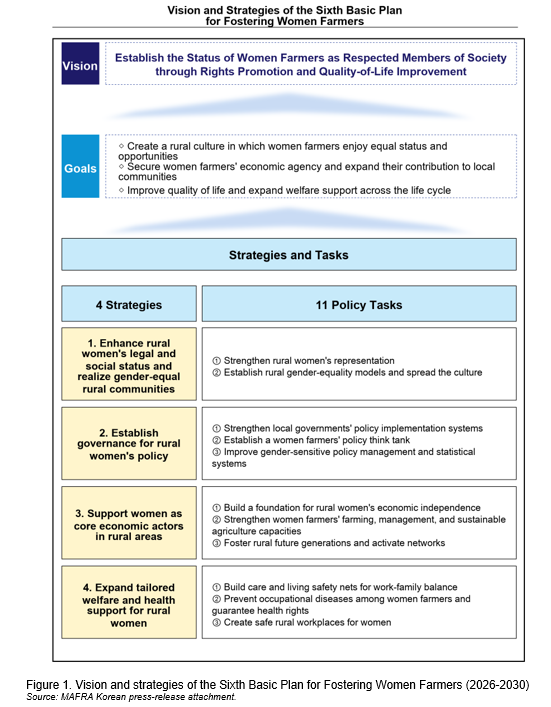
Figure 1 provides a concise overview of the plan's architecture. The plan begins with a vision of establishing women farmers' status as respected members of society, sets three goals related to equal opportunity, economic agency, and life-cycle quality of life, and organizes implementation through four strategies and eleven policy tasks. The next section explains this structure in detail before the article turns to each strategy.
VISION, GOALS, AND POLICY TRANSITION
The vision of the Sixth Basic Plan is to establish the status of women farmers as respected members of society through the promotion of rights and the improvement of the quality of life. This vision is supported by three goals. First, the plan seeks to create a rural culture in which women farmers enjoy equal status and equal opportunities. Second, it aims to secure women farmers' economic agency and expand their contribution to local communities. Third, it seeks to improve the quality of life and expand welfare support across the life cycle.
The policy transition is expressed in four directions. The first is a shift from expanding formal participation to raising substantive status. This means that participation should not stop at attendance, nominal representation, or occasional consultation. Women farmers should be able to exercise real authority in farm management, village leadership, cooperative governance, and policy decision-making. The second is a shift from individual project delivery to policy governance. Rather than operating many separate projects with weak coordination, the plan calls for a governance system linking central government, local governments, and the private sector.
The third transition is from protection- and welfare-centered support to support for women as key economic actors. Welfare remains necessary, but it should not be the only lens through which women farmers are seen. The plan therefore connects women farmers to flexible jobs, family farm management agreements, women-friendly machinery, labor-saving technologies, processing and start-up support, digital training, marketing, eco-friendly agriculture, and networks for young women entering agriculture. The fourth transition is toward tailored support that addresses gaps in care and health services in rural areas. Because rural work and family life often require early morning, nighttime, seasonal, and physically demanding labor, support must reflect the actual rhythms of farming communities.
Table 1. Main policy transition directions
|
Previous emphasis
|
Sixth Basic Plan direction
|
|
Expansion of formal participation
|
Substantive improvement of status and authority
|
|
Individual project-centred delivery
|
Central-local-private policy governance and performance management
|
|
Protection- and welfare-centred support
|
Growth support for women as key economic actors
|
|
Fragmented care and health measures
|
Tailored rural support to close care and health gaps
|
The four strategic pillars derive from these transitions. The first strategy is to enhance the legal and social status of rural women and realize gender-equal rural communities. The second is to establish governance for policies covering rural women. The third is to support the growth of women as key economic actors in rural areas. The fourth is to expand tailored welfare and health support for rural women. Together, these strategies define the main policy architecture for 2026-2030.
STRATEGY 1: LEGAL AND SOCIAL STATUS OF RURAL WOMEN
The first strategy is to enhance the legal and social status of rural women and realize gender-equal rural communities. A central task is strengthening the representation of women farmers. MAFRA plans to continue institutional improvements, including reviewing the introduction of incentives for joint farm operator registration. Joint farm operator registration is significant because it can make the spouse's role in farm management visible in official records. Where women farmers are recorded only as family members or helpers, their status in farm management, access to programs, and recognition as professional farmers can remain limited.
The plan also includes legal amendments to expand the proportion of women directors in regional agricultural cooperatives. This measure addresses an important institutional bottleneck. Cooperatives are not only marketing or financial organizations; in rural Korea, they are also local power structures that shape farm services, credit, input supply, marketing, education, and community influence. If women farmers remain underrepresented on cooperative boards, their perspectives may not be reflected in decisions about services, investment, and local agricultural development.
In addition, MAFRA will review women-friendly rural models, monitor the methods used to elect village leaders, and disseminate good practices. The plan specifically recognizes that the process for selecting village heads can affect gender equality in rural communities. In many rural villages, leadership practices are embedded in custom, seniority, and household representation. Monitoring these practices and spreading good examples can help move gender equality from formal policy language into everyday local institutions.
Another task is developing indicators to assess the level of gender equality in rural areas. Possible indicators include the share of women village leaders, the proportion of women farmers participating in policy processes, the availability of rural employment and start-up support for women, and the gender sensitivity of local rural programs. Such indicators are useful because policy cannot improve what it does not measure. A rural gender equality index or assessment tool can help identify which regions are improving, which issues remain weak, and which local models deserve replication.
The plan also expands gender equality education tailored to rural areas. Training will be provided not only to women farmers, but also to participants in MAFRA projects, employers and workers in the agricultural sector, and other relevant actors. This is important because gender equality is not achieved by supporting women alone. It also requires changes in local norms, workplaces, training institutions, cooperative organizations, and public officials' understanding of rural gender relations. To improve training quality, the plan refers to strengthening instructor management, building instructor databases, monitoring lectures, and introducing feedback systems.
STRATEGY 2: GOVERNANCE FOR RURAL WOMEN'S POLICY
The second strategy is to build governance for rural women's policy. With the establishment of the Rural Women Policy Division within MAFRA on 30 December 2025, the ministry plans to strengthen the implementation system for women farmers' policies. This includes encouraging local governments to secure dedicated departments and personnel. A central government unit can design national priorities, but many practical tasks - outreach, applications, local consultation, program coordination, care service delivery, and monitoring - depend on local administrative capacity.
The plan, therefore, calls for a performance evaluation system for local governments' implementation of action plans. Evaluation can improve effectiveness by making implementation visible. Without evaluation, basic plans risk becoming formal documents that are not reflected in local practice. A performance system can also support incentives such as preferential treatment in agricultural project selection, government awards, or additional points in rural women-friendly city assessments, depending on the program design.
A women farmers' policy consultative body will also be established with participation from the central government, local governments, and the private sector. The body is expected to meet regularly to discuss policy issues and reflect field opinions in policymaking. This is a governance reform because it creates a formal channel through which women farmers, civil society, local officials, and central ministries can identify problems, adjust programs, and propose new measures. For rural women's policy, such a channel is essential because local needs differ greatly by crop, region, age group, household structure, and access to services.
The plan also strengthens the online platform for women farmers. Planned functions include policy information, life-cycle customized information, chatbot counseling, community bulletin boards, policy proposal channels, and mobile services. A stronger digital platform can reduce information gaps, especially where women farmers are not connected to existing organizations or local networks. At the same time, digital services should not replace face-to-face support. Many rural women, especially older farmers, may still need guidance through local extension services, agricultural technology centers, cooperatives, or local government offices.
A further governance task is gender-sensitive policy management and statistical improvement. MAFRA will review its laws and programs for gender-discriminatory elements. It will also improve the Survey on Women Farmers under Article 8 of the Support for Female Farmers and Fishers Act by expanding the sample size, diversifying survey items, and shortening the survey interval. Better statistics are a foundation for better policy. They can show whether women farmers are gaining formal status, whether programs reach different age groups, whether care burdens are changing, and whether women-friendly machinery and safety measures reduce actual labor burden.
STRATEGY 3: WOMEN AS CORE ECONOMIC ACTORS
The third strategy is to support women as core economic actors in rural areas. This strategy begins with building the foundation for economic independence. MAFRA plans to identify and expand time-flexible jobs that can be combined with farming and caregiving. This recognizes a basic feature of rural life: paid work, farm work, family care, elderly care, childcare, and community work often overlap. For many women farmers, a standard full-time job model is difficult to combine with seasonal farm labor and family responsibilities. Flexible work opportunities can therefore expand income while reflecting rural realities.
The plan also promotes family farm management agreements. These agreements can clarify the rights, roles, working conditions, income distribution, and decision-making arrangements within family farms. They are important because family farms often depend on the labor of spouses and family members whose contribution may not be formally recognized. By spreading gender-equal management structures, the plan seeks to strengthen women farmers' economic self-reliance and improve fairness inside farm households.
Women-friendly agricultural machinery and equipment are another major task. The plan calls for expanded development and supply of machinery and equipment that take women's physical characteristics and working conditions into account. During 2020-2024, 27 types of women-friendly agricultural machinery and equipment were developed, and about 14,000 units of 25 types were distributed. For 2026-2030, the Rural Development Administration aims to develop 25 additional types. This measure is not a minor technical issue. Labor burden is a major constraint on women farmers' health, productivity, and continued participation in agriculture, particularly as the rural population ages.
The plan also supports wearable assistive devices and other labor-saving technologies to strengthen farming capacity. Such equipment can reduce physical strain, prevent injuries, and make agricultural work more accessible to older women or women engaged in physically demanding tasks. However, the effectiveness of these technologies depends on affordability, rental availability, training, maintenance, and suitability for different crops and farm sizes. Development alone is not enough; technologies must be distributed in a way that women farmers can actually use.
For entrepreneurship, MAFRA will operate incubation programs to support women farmers in agricultural processing and start-ups. The program covers product planning, production, food hygiene, licensing, distribution, sales, and marketing. In addition, specialized digital training, including artificial intelligence, will be newly introduced. The plan also links women farmers to distribution, marketing, and eco-friendly agriculture policies and training, enabling them to respond to changes in the agricultural distribution environment. These measures are especially important as direct sales, online marketing, local food systems, and value-added processing become more important sources of rural income.
The plan also includes support for the next generation. Career exploration education for young women entering agriculture and rural areas will be improved to better reflect participants' needs. An Integrated Homecoming Day will be promoted to foster sustained, broad exchange among trainees. Women who return to farming or move to rural areas can also receive support for team projects and networking activities. Such networks can help young and new women farmers overcome isolation, access mentors, develop business ideas, and build local communities.
STRATEGY 4: WELFARE, HEALTH, AND SAFE RURAL WORKPLACES
The fourth strategy is to expand welfare and health support tailored to rural women. The plan introduces gap care to address childcare needs during early morning and nighttime periods in the busy farming season. This is a practical response to rural work schedules. Farming households often need labor before ordinary childcare facilities open or after they close. Without flexible care, women farmers may face a double burden: they must participate in farm work while also solving childcare alone. Gap care can therefore support both income activity and family life.
The plan also seeks to recognize and spread the social value of community activities such as caregiving and communal meals. It refers to the development and dissemination of community meal service models and the creation of indicators to measure the social value of village community activities. This is important because much of rural care is informal and community-based. If such activities are treated as private or invisible work, they may be undervalued. Measuring social value can help justify public support, improve program design, and recognize the contribution of women who sustain community life.
Health support is another major pillar. The specialized health screening program for women farmers will be expanded by raising the eligible age range from 51-70 to 51-80 and increasing the number of beneficiaries from 50,000 to 80,000. MAFRA also plans to improve convenience by linking the program with NONGUPeZ, an online agricultural administration service. The plan refers to building and analyzing a screening database and developing customized follow-up service models for occupational disease prevention and management.
The expansion of specialized health screening reflects the occupational realities of farming. Women farmers are exposed to repetitive work, heavy lifting, awkward postures, long working hours, pesticide exposure, heat stress, and limited access to nearby medical services. Aging adds further risk. Screening is useful, but it should be connected to prevention, treatment, rehabilitation, and work redesign. Otherwise, health checks may identify problems without reducing the work conditions that cause them.
The plan also seeks to create safer rural workplaces for women. Measures include the prevention and management of heat-related illnesses, the expansion of participation in agricultural safety insurance, and the improvement of sanitation and convenience facilities. The plan specifically establishes a basis for installing personal restrooms on farmland through amendments to farmland-related laws and regulations, and provides analysis and support for rest areas, rest benches, public restrooms, shade shelters, and other rural work-environment facilities. Such measures may appear basic, but they are closely tied to dignity, health, safety, and women's ability to work in agriculture on equal terms.
Table 2. Selected implementation measures
|
Policy area
|
Selected measures
|
|
Representation
|
Review incentives for joint farm operator registration; expand the number of women directors in regional agricultural cooperatives; monitor village leader selection practices
|
|
Governance
|
Secure local departments and personnel; establish a policy consultative body; strengthen the online platform and mobile services
|
|
Economic activity
|
Expand flexible jobs; promote family farm management agreements; support women-friendly machinery, processing start-ups, AI, and digital training
|
|
Future generation
|
Improve career exploration education; promote Integrated Homecoming Day and networks for young and returning women farmers
|
|
Care and welfare
|
Introduce gap care during early morning and nighttime farming-season periods; develop indicators for the social value of community care and meal activities
|
|
Health and safety
|
Expand specialized health screening from ages 51-70 to 51-80 and from 50,000 to 80,000 beneficiaries; strengthen heat illness prevention and sanitation facilities
|
POLICY IMPLICATIONS FOR ASIAN COUNTRIES
The first implication is that policy for women farmers should move beyond welfare alone. Welfare, care, and health support are essential, but women farmers should not be framed only as vulnerable beneficiaries. Korea's Sixth Basic Plan is noteworthy for connecting welfare to legal status, decision-making, entrepreneurship, technology, and governance. For Asian countries facing rural aging and gendered farm labor structures, this integrated approach is more useful than a narrow support program.
The second implication is that formal recognition matters. Joint farm operator registration, family farm management agreements, cooperative board representation, and village leadership all affect women farmers' ability to exercise agency. Many countries have policies that support rural women, but land records, farm registration, credit systems, cooperatives, and extension services may still identify the male household head as the primary farmer. Without correcting these institutional records and governance structures, women farmers' contributions remain partly invisible.
The third implication is that care infrastructure is agricultural infrastructure. Rural labor policy often focuses on machinery, workers, wages, and training, but childcare and eldercare also determine whether women can participate in farming, processing, marketing, and leadership. The Korean plan's gap care measure recognizes that farm work schedules do not match ordinary childcare hours. Other countries should treat care as a condition for rural economic participation rather than as a separate family issue.
The fourth implication is that technology policy must be gender-responsive. Women-friendly machinery, wearable assistive devices, safe facilities, and sanitation infrastructure are not secondary conveniences. They shape who can work, how safely they can work, and how long they can remain in agriculture. However, gender-responsive technology requires user participation. Equipment should be designed, tested, rented, and maintained with women farmers' actual tasks and body conditions in mind.
The fifth implication is that governance and data are decisive. A five-year plan can only be effective if local governments have dedicated staff, if implementation is evaluated, if field voices are included in policymaking, and if survey data are improved. Countries considering similar policies should build a policy feedback loop from the outset: local implementation, consultation, monitoring, data collection and analysis, and adjustment. Without this loop, gender equality goals can remain declarative.
The sixth implication is that rural gender equality should be measured at the community level. National indicators are useful, but many barriers to women farmers' status are local: village leader selection, cooperative culture, access to training, availability of care, sanitation at worksites, and recognition of unpaid community work. Rural gender equality indicators can help identify where communities are changing and where policy needs stronger intervention.
IMPLEMENTATION CONSIDERATIONS
The first implementation consideration is whether the plan can change incentives in ordinary rural institutions. Measures such as joint farm operator registration, cooperative board representation, village leader selection monitoring, and family farm management agreements will matter only if they affect actual behavior. For example, incentives for joint farm operator registration should be linked to program access, training, credit, insurance, or recognition in a way that gives households a reason to register women farmers more accurately. Similarly, cooperative governance reform should not stop at numerical targets; it should support women directors so that they can participate effectively in board deliberation.
The second consideration is local government capacity. MAFRA's creation of a Rural Women Policy Division is an important national step, but many tasks are implemented locally. Local governments must identify eligible participants, operate care services, support training, maintain information channels, coordinate with cooperatives and agricultural technology centres, and report implementation results. If local governments do not have dedicated staff, women farmer policies may remain fragmented. The performance evaluation system should therefore measure not only whether plans exist, but also whether local governments have personnel, budgets, consultation channels, and follow-up systems.
The third consideration is accessibility for different generations of women farmers. Digital platforms, chatbot counseling, mobile services, AI training, and online marketing education can be valuable for young and middle-aged farmers. However, older women farmers may prefer in-person guidance and may have different priorities, including health, safety, work burden, transportation, and care. A successful implementation strategy should combine digital tools with local field support. It should also recognize differences among full-time farmers, part-time farmers, returning farmers, migrant marriage women, young entrants, and older women who have worked in family farms for decades without formal recognition.
The fourth consideration is evidence. The plan includes many measures, from machinery development to care services and health screening. Each measure needs appropriate indicators. Representation measures can be evaluated by changes in cooperative board membership, village leadership, and policy committee participation. Economic measures can be evaluated by start-up survival, digital sales, processing income, and access to machinery. Welfare and health measures can be evaluated by care service use, screening participation, occupational disease management, and satisfaction. The plan will be more persuasive if annual reporting connects inputs, outputs, and actual changes in women farmers' lives.
The fifth consideration is coordination with adjacent rural policies. Women farmer policy overlaps with childcare, elderly care, health screening, agricultural safety insurance, smart farming education, food processing, local food, cooperatives, rural settlement, and youth return-to-farm policy. If these policy areas are implemented separately, women farmers may face multiple application procedures and fragmented services. A more integrated approach would help women farmers move easily. For example, a woman farmer who receives processing education may also need digital marketing support, access to shared processing facilities, childcare during training hours, and advice on cooperative or local food channels.
The sixth consideration is field participation in the design of specific tools. Women-friendly machinery, gender equality indicators, care models, and online platforms should not be designed solely from an administrative perspective. Women farmers' organizations, local cooperatives, agricultural technology centers, village leaders, young women farmers, and older women farmers should be involved in testing and feedback. This is especially important because the needs of women farmers differ by crop, region, age, farm size, household structure, and market channel. Participatory design can reduce the risk that programs look complete on paper but remain difficult to use in the field.
CONCLUSION
Korea's Sixth Basic Plan for Fostering Women Farmers for 2026-2030 presents a broad policy shift. It aims to protect women farmers' rights and improve the quality of life, but it also seeks to strengthen their status as economic actors, professional farmers, local leaders, and contributors to sustainable rural development. The plan's four strategies cover status, governance, economic growth, welfare, health, and safe workplaces. This breadth is its strength because the problems facing women farmers are interconnected.
The plan also shows that women's agricultural policy is no longer only a matter of individual support. It requires legal recognition, institutional reform, cooperative governance, local government capacity, digital and face-to-face information systems, gender-sensitive data, flexible work design, care services, occupational health, and labor-saving technology. The success of the plan will depend on whether these measures move from announcement to implementation in villages, farms, cooperatives, local governments, and rural workplaces.
For Korea, the key task is disciplined implementation. The plan should be monitored not only by the number of projects delivered but also by changes in women farmers' status, income opportunities, representation, health outcomes, access to care, and satisfaction with policy services. For other Asian countries, the Korean case offers a practical lesson: gender equality in agriculture becomes more credible when it is built into the ordinary systems of rural policy, including registration, machinery, cooperatives, care, health, statistics, and local governance.
REFERENCES
AgTechNavigator. 2026. South Korea reinforces women's role in agriculture with new five-year plans. April 16, 2026. https://www.agtechnavigator.com/Article/2026/04/16/south-korea-reinforces-womens-role-in-agriculture-with-new-five-year-plans/
Korea Policy Briefing. 2026. MAFRA establishes the Sixth Basic Plan for Fostering Women Farmers (2026-2030). March 22, 2026. https://m.korea.kr/briefing/pressReleaseView.do?newsId=156750194
Korea Legislation Research Institute. Support for Female Farmers and Fishers Act, Article 5. https://elaw.klri.re.kr/eng_mobile/viewer.do?hseq=60066&key=24&type=part
Ministry of Agriculture, Food and Rural Affairs (MAFRA). 2026. The MAFRA Completes the 6th Basic Plan for Fostering Women Farmers (2026-2030). English press release, April 10, 2026. https://www.mafra.go.kr/bbs/english/25/577580/artclView.do
The Asia Business Daily. 2026. MAFRA to Promote Incentives for Women Farmers Registering as Joint Managers. March 22, 2026. https://www.asiae.co.kr/en/article/2026032210555161913


The Sixth Basic Plan for Fostering Women Farmers (2026-2030): Formulation and Policy Implications
ABSTRACT
The Ministry of Agriculture, Food and Rural Affairs (MAFRA) announced the Sixth Basic Plan for Fostering Women Farmers for 2026-2030 as a five-year roadmap to protect women farmers' rights and interests, improve their quality of life, and foster them as professional human resources in agriculture and rural communities. The plan is grounded in the Support for Female Farmers and Fishers Act and covers improvements in status, expansion of economic activity, rural welfare, health support, and policy governance. Its vision is to establish women farmers as respected members of society through stronger rights and a better quality of life. The plan marks four major policy shifts: from formal participation to substantive status, from individual programs to governance, from protection- and welfare-centered support to support for women as core economic actors, and from fragmented care and health measures to tailored rural support. This article summarizes the plan's vision, goals, strategies, and major tasks, while also drawing implications for Asian countries facing rural aging, gender gaps in agricultural decision-making, weak care infrastructure, and changing rural labor markets.
Keywords: Women farmers, rural women, Korea, gender equality, agricultural policy, rural welfare, policy governance
INTRODUCTION
Women farmers are central to the sustainability of Korea's agriculture and rural communities. They participate in production, processing, marketing, household management, care, community activities, and local rural leadership. Yet their contribution has often been less visible than that of male household heads, especially in systems where farm ownership, registration, cooperative leadership, and public decision-making have historically been organized around men. The policy challenge is therefore not only to provide welfare support for women in rural areas, but also to recognize women farmers as independent economic actors and legitimate participants in rural governance.
In March 2026, MAFRA established the Sixth Basic Plan for Fostering Women Farmers for the period 2026-2030. The five-year cycle has a clear legal basis: Article 5 of the Support for Female Farmers and Fishers Act requires the Minister of Agriculture, Food and Rural Affairs and the Minister of Oceans and Fisheries to formulate national master plans for policies on female farmers and female fishers every five years, while metropolitan and provincial governments prepare corresponding local plans. The same article also links the master plan to policy goals, implementation directions, key policy tasks, financing, annual implementation plans, and monitoring. The stated purpose is to protect women farmers' rights and interests, improve their quality of life, strengthen their professional capacity, and thereby contribute to healthy rural families and sustainable agricultural and rural development. The plan covers the improvement of women farmers' legal and social status, the expansion of their economic activity base, and the provision of welfare and health support tailored to rural conditions.
The new plan is important because it reframes women farmers from beneficiaries of protection into core actors of rural development. Previous policies made progress in welfare, education, and participation, but they did not always translate into substantive authority in farm management, cooperative governance, local decision-making, or independent income opportunities. The Sixth Basic Plan responds to this limitation by linking representation, governance, economic independence, technology, care, health, and workplace safety. In this sense, the plan should be read as a gender equality policy, a rural development policy, and a human resources policy simultaneously.
Figure 1 provides a concise overview of the plan's architecture. The plan begins with a vision of establishing women farmers' status as respected members of society, sets three goals related to equal opportunity, economic agency, and life-cycle quality of life, and organizes implementation through four strategies and eleven policy tasks. The next section explains this structure in detail before the article turns to each strategy.
VISION, GOALS, AND POLICY TRANSITION
The vision of the Sixth Basic Plan is to establish the status of women farmers as respected members of society through the promotion of rights and the improvement of the quality of life. This vision is supported by three goals. First, the plan seeks to create a rural culture in which women farmers enjoy equal status and equal opportunities. Second, it aims to secure women farmers' economic agency and expand their contribution to local communities. Third, it seeks to improve the quality of life and expand welfare support across the life cycle.
The policy transition is expressed in four directions. The first is a shift from expanding formal participation to raising substantive status. This means that participation should not stop at attendance, nominal representation, or occasional consultation. Women farmers should be able to exercise real authority in farm management, village leadership, cooperative governance, and policy decision-making. The second is a shift from individual project delivery to policy governance. Rather than operating many separate projects with weak coordination, the plan calls for a governance system linking central government, local governments, and the private sector.
The third transition is from protection- and welfare-centered support to support for women as key economic actors. Welfare remains necessary, but it should not be the only lens through which women farmers are seen. The plan therefore connects women farmers to flexible jobs, family farm management agreements, women-friendly machinery, labor-saving technologies, processing and start-up support, digital training, marketing, eco-friendly agriculture, and networks for young women entering agriculture. The fourth transition is toward tailored support that addresses gaps in care and health services in rural areas. Because rural work and family life often require early morning, nighttime, seasonal, and physically demanding labor, support must reflect the actual rhythms of farming communities.
Table 1. Main policy transition directions
Previous emphasis
Sixth Basic Plan direction
Expansion of formal participation
Substantive improvement of status and authority
Individual project-centred delivery
Central-local-private policy governance and performance management
Protection- and welfare-centred support
Growth support for women as key economic actors
Fragmented care and health measures
Tailored rural support to close care and health gaps
The four strategic pillars derive from these transitions. The first strategy is to enhance the legal and social status of rural women and realize gender-equal rural communities. The second is to establish governance for policies covering rural women. The third is to support the growth of women as key economic actors in rural areas. The fourth is to expand tailored welfare and health support for rural women. Together, these strategies define the main policy architecture for 2026-2030.
STRATEGY 1: LEGAL AND SOCIAL STATUS OF RURAL WOMEN
The first strategy is to enhance the legal and social status of rural women and realize gender-equal rural communities. A central task is strengthening the representation of women farmers. MAFRA plans to continue institutional improvements, including reviewing the introduction of incentives for joint farm operator registration. Joint farm operator registration is significant because it can make the spouse's role in farm management visible in official records. Where women farmers are recorded only as family members or helpers, their status in farm management, access to programs, and recognition as professional farmers can remain limited.
The plan also includes legal amendments to expand the proportion of women directors in regional agricultural cooperatives. This measure addresses an important institutional bottleneck. Cooperatives are not only marketing or financial organizations; in rural Korea, they are also local power structures that shape farm services, credit, input supply, marketing, education, and community influence. If women farmers remain underrepresented on cooperative boards, their perspectives may not be reflected in decisions about services, investment, and local agricultural development.
In addition, MAFRA will review women-friendly rural models, monitor the methods used to elect village leaders, and disseminate good practices. The plan specifically recognizes that the process for selecting village heads can affect gender equality in rural communities. In many rural villages, leadership practices are embedded in custom, seniority, and household representation. Monitoring these practices and spreading good examples can help move gender equality from formal policy language into everyday local institutions.
Another task is developing indicators to assess the level of gender equality in rural areas. Possible indicators include the share of women village leaders, the proportion of women farmers participating in policy processes, the availability of rural employment and start-up support for women, and the gender sensitivity of local rural programs. Such indicators are useful because policy cannot improve what it does not measure. A rural gender equality index or assessment tool can help identify which regions are improving, which issues remain weak, and which local models deserve replication.
The plan also expands gender equality education tailored to rural areas. Training will be provided not only to women farmers, but also to participants in MAFRA projects, employers and workers in the agricultural sector, and other relevant actors. This is important because gender equality is not achieved by supporting women alone. It also requires changes in local norms, workplaces, training institutions, cooperative organizations, and public officials' understanding of rural gender relations. To improve training quality, the plan refers to strengthening instructor management, building instructor databases, monitoring lectures, and introducing feedback systems.
STRATEGY 2: GOVERNANCE FOR RURAL WOMEN'S POLICY
The second strategy is to build governance for rural women's policy. With the establishment of the Rural Women Policy Division within MAFRA on 30 December 2025, the ministry plans to strengthen the implementation system for women farmers' policies. This includes encouraging local governments to secure dedicated departments and personnel. A central government unit can design national priorities, but many practical tasks - outreach, applications, local consultation, program coordination, care service delivery, and monitoring - depend on local administrative capacity.
The plan, therefore, calls for a performance evaluation system for local governments' implementation of action plans. Evaluation can improve effectiveness by making implementation visible. Without evaluation, basic plans risk becoming formal documents that are not reflected in local practice. A performance system can also support incentives such as preferential treatment in agricultural project selection, government awards, or additional points in rural women-friendly city assessments, depending on the program design.
A women farmers' policy consultative body will also be established with participation from the central government, local governments, and the private sector. The body is expected to meet regularly to discuss policy issues and reflect field opinions in policymaking. This is a governance reform because it creates a formal channel through which women farmers, civil society, local officials, and central ministries can identify problems, adjust programs, and propose new measures. For rural women's policy, such a channel is essential because local needs differ greatly by crop, region, age group, household structure, and access to services.
The plan also strengthens the online platform for women farmers. Planned functions include policy information, life-cycle customized information, chatbot counseling, community bulletin boards, policy proposal channels, and mobile services. A stronger digital platform can reduce information gaps, especially where women farmers are not connected to existing organizations or local networks. At the same time, digital services should not replace face-to-face support. Many rural women, especially older farmers, may still need guidance through local extension services, agricultural technology centers, cooperatives, or local government offices.
A further governance task is gender-sensitive policy management and statistical improvement. MAFRA will review its laws and programs for gender-discriminatory elements. It will also improve the Survey on Women Farmers under Article 8 of the Support for Female Farmers and Fishers Act by expanding the sample size, diversifying survey items, and shortening the survey interval. Better statistics are a foundation for better policy. They can show whether women farmers are gaining formal status, whether programs reach different age groups, whether care burdens are changing, and whether women-friendly machinery and safety measures reduce actual labor burden.
STRATEGY 3: WOMEN AS CORE ECONOMIC ACTORS
The third strategy is to support women as core economic actors in rural areas. This strategy begins with building the foundation for economic independence. MAFRA plans to identify and expand time-flexible jobs that can be combined with farming and caregiving. This recognizes a basic feature of rural life: paid work, farm work, family care, elderly care, childcare, and community work often overlap. For many women farmers, a standard full-time job model is difficult to combine with seasonal farm labor and family responsibilities. Flexible work opportunities can therefore expand income while reflecting rural realities.
The plan also promotes family farm management agreements. These agreements can clarify the rights, roles, working conditions, income distribution, and decision-making arrangements within family farms. They are important because family farms often depend on the labor of spouses and family members whose contribution may not be formally recognized. By spreading gender-equal management structures, the plan seeks to strengthen women farmers' economic self-reliance and improve fairness inside farm households.
Women-friendly agricultural machinery and equipment are another major task. The plan calls for expanded development and supply of machinery and equipment that take women's physical characteristics and working conditions into account. During 2020-2024, 27 types of women-friendly agricultural machinery and equipment were developed, and about 14,000 units of 25 types were distributed. For 2026-2030, the Rural Development Administration aims to develop 25 additional types. This measure is not a minor technical issue. Labor burden is a major constraint on women farmers' health, productivity, and continued participation in agriculture, particularly as the rural population ages.
The plan also supports wearable assistive devices and other labor-saving technologies to strengthen farming capacity. Such equipment can reduce physical strain, prevent injuries, and make agricultural work more accessible to older women or women engaged in physically demanding tasks. However, the effectiveness of these technologies depends on affordability, rental availability, training, maintenance, and suitability for different crops and farm sizes. Development alone is not enough; technologies must be distributed in a way that women farmers can actually use.
For entrepreneurship, MAFRA will operate incubation programs to support women farmers in agricultural processing and start-ups. The program covers product planning, production, food hygiene, licensing, distribution, sales, and marketing. In addition, specialized digital training, including artificial intelligence, will be newly introduced. The plan also links women farmers to distribution, marketing, and eco-friendly agriculture policies and training, enabling them to respond to changes in the agricultural distribution environment. These measures are especially important as direct sales, online marketing, local food systems, and value-added processing become more important sources of rural income.
The plan also includes support for the next generation. Career exploration education for young women entering agriculture and rural areas will be improved to better reflect participants' needs. An Integrated Homecoming Day will be promoted to foster sustained, broad exchange among trainees. Women who return to farming or move to rural areas can also receive support for team projects and networking activities. Such networks can help young and new women farmers overcome isolation, access mentors, develop business ideas, and build local communities.
STRATEGY 4: WELFARE, HEALTH, AND SAFE RURAL WORKPLACES
The fourth strategy is to expand welfare and health support tailored to rural women. The plan introduces gap care to address childcare needs during early morning and nighttime periods in the busy farming season. This is a practical response to rural work schedules. Farming households often need labor before ordinary childcare facilities open or after they close. Without flexible care, women farmers may face a double burden: they must participate in farm work while also solving childcare alone. Gap care can therefore support both income activity and family life.
The plan also seeks to recognize and spread the social value of community activities such as caregiving and communal meals. It refers to the development and dissemination of community meal service models and the creation of indicators to measure the social value of village community activities. This is important because much of rural care is informal and community-based. If such activities are treated as private or invisible work, they may be undervalued. Measuring social value can help justify public support, improve program design, and recognize the contribution of women who sustain community life.
Health support is another major pillar. The specialized health screening program for women farmers will be expanded by raising the eligible age range from 51-70 to 51-80 and increasing the number of beneficiaries from 50,000 to 80,000. MAFRA also plans to improve convenience by linking the program with NONGUPeZ, an online agricultural administration service. The plan refers to building and analyzing a screening database and developing customized follow-up service models for occupational disease prevention and management.
The expansion of specialized health screening reflects the occupational realities of farming. Women farmers are exposed to repetitive work, heavy lifting, awkward postures, long working hours, pesticide exposure, heat stress, and limited access to nearby medical services. Aging adds further risk. Screening is useful, but it should be connected to prevention, treatment, rehabilitation, and work redesign. Otherwise, health checks may identify problems without reducing the work conditions that cause them.
The plan also seeks to create safer rural workplaces for women. Measures include the prevention and management of heat-related illnesses, the expansion of participation in agricultural safety insurance, and the improvement of sanitation and convenience facilities. The plan specifically establishes a basis for installing personal restrooms on farmland through amendments to farmland-related laws and regulations, and provides analysis and support for rest areas, rest benches, public restrooms, shade shelters, and other rural work-environment facilities. Such measures may appear basic, but they are closely tied to dignity, health, safety, and women's ability to work in agriculture on equal terms.
Table 2. Selected implementation measures
Policy area
Selected measures
Representation
Review incentives for joint farm operator registration; expand the number of women directors in regional agricultural cooperatives; monitor village leader selection practices
Governance
Secure local departments and personnel; establish a policy consultative body; strengthen the online platform and mobile services
Economic activity
Expand flexible jobs; promote family farm management agreements; support women-friendly machinery, processing start-ups, AI, and digital training
Future generation
Improve career exploration education; promote Integrated Homecoming Day and networks for young and returning women farmers
Care and welfare
Introduce gap care during early morning and nighttime farming-season periods; develop indicators for the social value of community care and meal activities
Health and safety
Expand specialized health screening from ages 51-70 to 51-80 and from 50,000 to 80,000 beneficiaries; strengthen heat illness prevention and sanitation facilities
POLICY IMPLICATIONS FOR ASIAN COUNTRIES
The first implication is that policy for women farmers should move beyond welfare alone. Welfare, care, and health support are essential, but women farmers should not be framed only as vulnerable beneficiaries. Korea's Sixth Basic Plan is noteworthy for connecting welfare to legal status, decision-making, entrepreneurship, technology, and governance. For Asian countries facing rural aging and gendered farm labor structures, this integrated approach is more useful than a narrow support program.
The second implication is that formal recognition matters. Joint farm operator registration, family farm management agreements, cooperative board representation, and village leadership all affect women farmers' ability to exercise agency. Many countries have policies that support rural women, but land records, farm registration, credit systems, cooperatives, and extension services may still identify the male household head as the primary farmer. Without correcting these institutional records and governance structures, women farmers' contributions remain partly invisible.
The third implication is that care infrastructure is agricultural infrastructure. Rural labor policy often focuses on machinery, workers, wages, and training, but childcare and eldercare also determine whether women can participate in farming, processing, marketing, and leadership. The Korean plan's gap care measure recognizes that farm work schedules do not match ordinary childcare hours. Other countries should treat care as a condition for rural economic participation rather than as a separate family issue.
The fourth implication is that technology policy must be gender-responsive. Women-friendly machinery, wearable assistive devices, safe facilities, and sanitation infrastructure are not secondary conveniences. They shape who can work, how safely they can work, and how long they can remain in agriculture. However, gender-responsive technology requires user participation. Equipment should be designed, tested, rented, and maintained with women farmers' actual tasks and body conditions in mind.
The fifth implication is that governance and data are decisive. A five-year plan can only be effective if local governments have dedicated staff, if implementation is evaluated, if field voices are included in policymaking, and if survey data are improved. Countries considering similar policies should build a policy feedback loop from the outset: local implementation, consultation, monitoring, data collection and analysis, and adjustment. Without this loop, gender equality goals can remain declarative.
The sixth implication is that rural gender equality should be measured at the community level. National indicators are useful, but many barriers to women farmers' status are local: village leader selection, cooperative culture, access to training, availability of care, sanitation at worksites, and recognition of unpaid community work. Rural gender equality indicators can help identify where communities are changing and where policy needs stronger intervention.
IMPLEMENTATION CONSIDERATIONS
The first implementation consideration is whether the plan can change incentives in ordinary rural institutions. Measures such as joint farm operator registration, cooperative board representation, village leader selection monitoring, and family farm management agreements will matter only if they affect actual behavior. For example, incentives for joint farm operator registration should be linked to program access, training, credit, insurance, or recognition in a way that gives households a reason to register women farmers more accurately. Similarly, cooperative governance reform should not stop at numerical targets; it should support women directors so that they can participate effectively in board deliberation.
The second consideration is local government capacity. MAFRA's creation of a Rural Women Policy Division is an important national step, but many tasks are implemented locally. Local governments must identify eligible participants, operate care services, support training, maintain information channels, coordinate with cooperatives and agricultural technology centres, and report implementation results. If local governments do not have dedicated staff, women farmer policies may remain fragmented. The performance evaluation system should therefore measure not only whether plans exist, but also whether local governments have personnel, budgets, consultation channels, and follow-up systems.
The third consideration is accessibility for different generations of women farmers. Digital platforms, chatbot counseling, mobile services, AI training, and online marketing education can be valuable for young and middle-aged farmers. However, older women farmers may prefer in-person guidance and may have different priorities, including health, safety, work burden, transportation, and care. A successful implementation strategy should combine digital tools with local field support. It should also recognize differences among full-time farmers, part-time farmers, returning farmers, migrant marriage women, young entrants, and older women who have worked in family farms for decades without formal recognition.
The fourth consideration is evidence. The plan includes many measures, from machinery development to care services and health screening. Each measure needs appropriate indicators. Representation measures can be evaluated by changes in cooperative board membership, village leadership, and policy committee participation. Economic measures can be evaluated by start-up survival, digital sales, processing income, and access to machinery. Welfare and health measures can be evaluated by care service use, screening participation, occupational disease management, and satisfaction. The plan will be more persuasive if annual reporting connects inputs, outputs, and actual changes in women farmers' lives.
The fifth consideration is coordination with adjacent rural policies. Women farmer policy overlaps with childcare, elderly care, health screening, agricultural safety insurance, smart farming education, food processing, local food, cooperatives, rural settlement, and youth return-to-farm policy. If these policy areas are implemented separately, women farmers may face multiple application procedures and fragmented services. A more integrated approach would help women farmers move easily. For example, a woman farmer who receives processing education may also need digital marketing support, access to shared processing facilities, childcare during training hours, and advice on cooperative or local food channels.
The sixth consideration is field participation in the design of specific tools. Women-friendly machinery, gender equality indicators, care models, and online platforms should not be designed solely from an administrative perspective. Women farmers' organizations, local cooperatives, agricultural technology centers, village leaders, young women farmers, and older women farmers should be involved in testing and feedback. This is especially important because the needs of women farmers differ by crop, region, age, farm size, household structure, and market channel. Participatory design can reduce the risk that programs look complete on paper but remain difficult to use in the field.
CONCLUSION
Korea's Sixth Basic Plan for Fostering Women Farmers for 2026-2030 presents a broad policy shift. It aims to protect women farmers' rights and improve the quality of life, but it also seeks to strengthen their status as economic actors, professional farmers, local leaders, and contributors to sustainable rural development. The plan's four strategies cover status, governance, economic growth, welfare, health, and safe workplaces. This breadth is its strength because the problems facing women farmers are interconnected.
The plan also shows that women's agricultural policy is no longer only a matter of individual support. It requires legal recognition, institutional reform, cooperative governance, local government capacity, digital and face-to-face information systems, gender-sensitive data, flexible work design, care services, occupational health, and labor-saving technology. The success of the plan will depend on whether these measures move from announcement to implementation in villages, farms, cooperatives, local governments, and rural workplaces.
For Korea, the key task is disciplined implementation. The plan should be monitored not only by the number of projects delivered but also by changes in women farmers' status, income opportunities, representation, health outcomes, access to care, and satisfaction with policy services. For other Asian countries, the Korean case offers a practical lesson: gender equality in agriculture becomes more credible when it is built into the ordinary systems of rural policy, including registration, machinery, cooperatives, care, health, statistics, and local governance.
REFERENCES
AgTechNavigator. 2026. South Korea reinforces women's role in agriculture with new five-year plans. April 16, 2026. https://www.agtechnavigator.com/Article/2026/04/16/south-korea-reinforces-womens-role-in-agriculture-with-new-five-year-plans/
Korea Policy Briefing. 2026. MAFRA establishes the Sixth Basic Plan for Fostering Women Farmers (2026-2030). March 22, 2026. https://m.korea.kr/briefing/pressReleaseView.do?newsId=156750194
Korea Legislation Research Institute. Support for Female Farmers and Fishers Act, Article 5. https://elaw.klri.re.kr/eng_mobile/viewer.do?hseq=60066&key=24&type=part
Ministry of Agriculture, Food and Rural Affairs (MAFRA). 2026. The MAFRA Completes the 6th Basic Plan for Fostering Women Farmers (2026-2030). English press release, April 10, 2026. https://www.mafra.go.kr/bbs/english/25/577580/artclView.do
The Asia Business Daily. 2026. MAFRA to Promote Incentives for Women Farmers Registering as Joint Managers. March 22, 2026. https://www.asiae.co.kr/en/article/2026032210555161913