ABSTRACT
Thailand’s future food agenda offers an opportunity to move beyond commodity-based agricultural production toward value-added, science-based food innovation. Rice bran, a by-product of rice milling, is a relevant case for this transition. Although often used in low-value applications, rice bran contains dietary fiber, protein, lipids, vitamins, minerals, and bioactive compounds such as γ-oryzanol, tocopherols, tocotrienols, and phenolics. Its development as a functional ingredient, however, is constrained by rapid rancidity, variable quality, limited standardization, sensory challenges, and insufficient human evidence for health-related claims. This article discusses rice bran and defatted rice bran as strategic co-products within Thailand’s Bio-Circular-Green economy and future food policy. It emphasizes that credible development should be grounded in nutritional facts, ingredient specifications, safety data, reliable scientific evidence for health-related benefits, and responsible health claims. Policy priorities include regional stabilization hubs, university–industry consortia, clinical validation for local functional ingredients, ingredient standards, and Positive List pathways. If implemented systematically, rice bran-based ingredients could support circular nutrition, increase value in the rice sector, reduce underutilization of agricultural co-products, and strengthen consumer trust in Thailand’s future food industry.
Keywords: co-products; stabilization; standardization; nutritional facts; health claims; and consumer trust
INTRODUCTION
Thailand is a major agri-food economy in Asia, and rice remains central to the country’s agricultural identity, rural livelihoods, and export profile. In 2024, Thailand exported 9.95 million tons of rice valued at 225,656 million baht (approximately US$6.69 billion), the highest export volume in six years (Government Public Relations Department, 2025). However, this performance should not obscure the need to move beyond volume-based competitiveness toward value-added rice-based innovation. Climate variability, production costs, international competition, and changing consumer demand increasingly require Thailand to capture more value from the whole agricultural value chain.
This direction is consistent with Thailand’s Bio-Circular-Green (BCG) Economy Model, which promotes the use of science, technology, and innovation to increase value from biological resources while improving resource efficiency and sustainability (BCG Economy Model, n.d.). It also aligns with Thailand’s future food strategy, which identifies four key categories: health foods and functional ingredients, medical and personalized foods, organic and clean foods, and alternative proteins (Office of National Higher Education Science Research and Innovation Policy Council [NXPO], 2025a). These priorities suggest that Thailand’s future food opportunity may lie not only in novel or imported ingredients but also in rethinking familiar domestic resources.
Rice bran is one such resource. As a by-product of rice milling, it has often been used for animal feed or other lower-value purposes. Yet rice bran contains dietary fiber, protein, lipids, vitamins, minerals, and bioactive compounds, including γ-oryzanol, tocopherols, tocotrienols, and phenolic compounds (Bodie et al., 2019; Sapwarobol et al., 2021). For a rice-producing country such as Thailand, rice bran should therefore be reconsidered as a strategic co-product rather than a residual material.
Despite this potential, rice bran is difficult to convert into a market-ready food ingredient. Fresh rice bran deteriorates rapidly after milling because endogenous lipases promote hydrolytic rancidity, leading to off-flavors, reduced shelf life, and lower suitability for human consumption (Yılmaz Tuncel, 2023). Its composition also varies according to rice variety, milling degree, stabilization method, storage, and processing conditions. Therefore, rice bran valorization requires more than simple reuse. It requires a structured pathway from raw material control to stabilization, standardization, product formulation, safety assessment, and evidence-based communication.
This article uses rice bran as a case study to examine how Thailand can transform agricultural by-products into functional ingredients under the BCG and future food agendas. It focuses on three connected issues: the policy and market context for functional ingredients, the scientific and technological requirements for rice bran development, and the regulatory need for evidence-based health claims.
THAILAND’S FUTURE FOOD LANDSCAPE: POLICY MOMENTUM AND MARKET SIGNALS
Future food in Thailand should be understood as an economic and industrial strategy, not merely as a consumer trend. The BCG model emphasizes value creation from biological resources, product differentiation, food safety, traceability, and resource efficiency (BCG Economy Model, n.d.; Royal Thai Embassy, Washington, D.C., 2023). Within this framework, food innovation is expected to contribute not only to export competitiveness, but also to sustainability, health, and inclusive economic development.
Thailand’s future food policy identifies health foods and functional ingredients, medical and personalized foods, organic and clean foods, and alternative proteins as key categories. NXPO has proposed increasing the value of Thailand’s future food industry to 500 billion baht by 2027 (approximately US$15.4 billion, calculated at US$1 = 32.5 baht), while reducing greenhouse gas emissions by 0.3 million tons of CO₂ equivalent (NXPO, 2025a). This reflects a policy attempt to link economic upgrading with environmental performance.
Policy instruments are also becoming more specific. NXPO has proposed three measures to drive the future food industry: attracting investment in advanced extraction and formulation technologies, establishing R&D consortia for functional ingredients and protein production, and developing standards and certification systems, including the FFC Thailand Sandbox and positive lists to streamline health-related functional claims (NXPO, 2025a). In parallel, the Thai FDA and partner agencies are developing a Positive List of health claims to support functional foods and functional ingredients, with a target of 150 items by 2027 (Thai FDA, 2024a; NXPO, 2025b).
Market data supports the importance of this sector. In 2023, Thailand’s future food exports reached 143 billion baht (approximately US$4.4 billion), with functional foods and ingredients accounting for 89.7% of the total. During the first four months of 2024, exports reached 51.6 billion baht (approximately US$1.6 billion), with functional foods accounting for 90.8% of export value (Government Public Relations Department, 2024). These figures indicate that functional foods and functional ingredients are already central to Thailand’s future food economy.
Several structural factors reinforce this direction. Noncommunicable diseases are responsible for three out of every four deaths in Thailand, and the country is among the fastest-aging societies in the world (World Health Organization [WHO], n.d.). WHO reported that Thailand has approximately 12 million older persons and is expected to become a super-aged society in the next decade (WHO Regional Office for South-East Asia, 2023). These transitions create demand for foods that support healthy aging, digestive health, metabolic health, and personalized nutrition.
Food industry assessments point in the same direction. The U.S. Department of Agriculture, Foreign Agricultural Service (USDA FAS) reported growing demand in Thailand for health-focused foods, dietary supplements, plant-based products, and functional ingredients (USDA FAS, 2026). Functional ingredients are therefore a critical upstream component of future food development. They enable downstream products such as high-fiber foods, foods for older adults, nutraceuticals, plant-based products, and medical or personalized foods.
Thailand has a rich base of local raw materials, including rice, pigmented rice, herbs, coconut, cassava, tea, coffee, cocoa, mushrooms, and tropical fruits. The key challenge is not the absence of resources, but the limited ability to convert them into ingredient-grade materials with defined composition, safety parameters, functionality, and claim readiness. This is where rice bran becomes particularly relevant.
AGRICULTURAL BY-PRODUCTS AND CIRCULAR NUTRITION
Agricultural and food-processing by-products are often treated as waste management problems. From a nutrition and food-system perspective, however, many should be viewed as underutilized nutritional resources. Globally, 13.2% of food is lost after harvest and before retail, while an additional 19% of food available to consumers is wasted at the retail, food service, and household levels (Food and Agriculture Organization [FAO], n.d.; United Nations Environment Programme [UNEP], 2024). These figures should not be added directly, as they refer to different points in the supply chain, but together they show that food loss and waste represent substantial environmental, economic, and nutritional inefficiencies.
A more strategic approach is to classify suitable agricultural by-products as secondary raw materials or co-products. This framing is important. “Waste” implies disposal, whereas “co-product” implies potential value, design, and responsibility. When safe and nutritionally meaningful, by-products may be returned to the human food chain before being directed to lower-value uses such as animal feed, compost, or energy recovery. This principle is consistent with food use and waste hierarchy approaches, which prioritize higher-value uses of food-related materials (European Commission, n.d.).
Many agricultural by-products contain nutrients and bioactive compounds that may support the development of functional foods. Cereal brans, fruit peels, oilseed cakes, spent grains, and other side streams can contain dietary fiber, proteins, phenolic compounds, carotenoids, minerals, and antioxidant components (Angulo-López et al., 2023; Hasan et al., 2024). These materials may contribute not only to nutrient content but also to texture, hydration, antioxidant capacity, and consumer-perceived health value.
This perspective can be described as circular nutrition: the use of circular economy principles to retain nutritional and functional value within the human food system. It differs from conventional waste management because it asks not only how materials can be diverted from disposal, but also whether their nutritional value can be safely preserved and upgraded.
However, agricultural by-products should not be assumed to be automatically suitable for human food. Some may contain contaminants, pesticide residues, mycotoxins, heavy metals, undesirable flavors, high water activity, microbial risks, or unstable bioactive compounds (Rao et al., 2021; Hasan et al., 2024). By-product valorization, therefore, requires risk assessment, ingredient standardization, food safety controls, and consumer acceptance. Rice bran illustrates both the promise and the complexity of this transition.
RICE BRAN AS A STRATEGIC FUNCTIONAL INGREDIENT
Rice bran in Thailand’s rice-based food system
Rice milling produces several co-products, including husk, broken rice, and rice bran. Rice bran is generated from the outer layers of the rice kernel during milling and polishing and is commonly generated at approximately 8–12% of the paddy or rice milling mass, depending on the milling system, rice variety, and degree of polishing (Bodie et al., 2019; Earp et al., 2003; International Rice Research Institute [IRRI], n.d.; Sapwarobol et al., 2021; Yılmaz Tuncel, 2023). In Thailand, this represents a substantial biomass stream linked directly to one of the country’s most important agricultural sectors.
The scale of this stream is economically meaningful. FAO GIEWS forecast Thailand’s 2025/26 aggregate paddy production at 33.5 million tonnes. Using the 8–12% bran fraction commonly reported for rice milling, Thailand’s potential rice bran generation can be roughly approximated at 2.7–4.0 million tonnes per year (FAO GIEWS, 2026; IRRI, n.d.). At a recent wholesale price indication of 625 baht per 100 kg, or about US$0.18 per kg, this stream would represent an indicative gross transaction value of approximately 16.8–25.1 billion baht (US$0.48–0.72 billion), before accounting for grade, losses, stabilization, oil extraction, feed use, and suitability for food-grade processing (Tridge, n.d.). This estimate is not a formal market valuation, but it illustrates why quality upgrading, stabilization, and food-grade standardization could create economic value beyond conventional low-value utilization.
The strategic question is therefore not only how much rice Thailand can produce or export, but how much value can be created from each fraction of the rice grain. Rice bran should be positioned as a co-product for higher-value applications rather than as a low-value milling residue. This framing is consistent with Thailand’s BCG agenda, which emphasizes resource efficiency, product differentiation, and value-added innovation.
Nutritional and bioactive potential
Rice bran is nutritionally important because it contains both macronutrients and bioactive compounds. Reviews identify rice bran as a source of dietary fiber, protein, lipids, minerals, B vitamins, tocopherols, tocotrienols, phenolics, and γ-oryzanol (Bodie et al., 2019; Sapwarobol et al., 2021). This complex matrix makes rice bran relevant to several food applications, including high-fiber foods, cereal-based products, plant-based formulations, and nutraceutical ingredients.
Nevertheless, its composition is not uniform. It varies by cultivar, cultivation conditions, milling degree, stabilization, storage, and processing method (Bodie et al., 2019). This variability limits industrial use unless specifications are established. A rice bran ingredient intended for bakery applications, for example, may require defined values for moisture, particle size, total dietary fiber, soluble and insoluble fiber, and rancidity indicators. A phenolic-rich fraction would require different specifications, including bioactive markers and antioxidant stability. Thus, the goal should be to move rice bran from a nutrient-rich by-product to a standardized ingredient platform.
Defatted rice bran as a practical ingredient
Defatted rice bran is especially relevant because it remains after rice bran oil extraction and still contains dietary fiber, protein, and phenolic compounds. It can be developed into high-fiber powders, cereal ingredients, bakery ingredients, snack components, or other functional food inputs.
Recent Thai research shows that particle size can influence the functional properties of defatted rice bran. Sreenakhot et al. (2024) reported that smaller particle sizes increased soluble dietary fiber proportion, total phenolic content, antioxidant activity, lightness, and water solubility index, while reducing insoluble dietary fiber proportion. This finding is important because particle-size control is a practical processing tool for tailoring rice bran fractions to different product matrices.
Product application studies also highlight the need for formulation balance. Musika et al. (2025) found that cookies fortified with defatted Jasmine rice bran flour had higher phytochemical content and antioxidant activity, but higher substitution levels reduced sensory acceptability. A 15% substitution level provided the best balance between functionality and consumer acceptance. This suggests that product success depends not only on increasing functional ingredients but also on optimizing ingredient level, matrix compatibility, and sensory quality.
Gut health and prebiotic potential
Gut health is an emerging area of interest for rice bran-based functional ingredients, as rice bran contains dietary fiber and phytochemicals that may interact with the gut microbiota. Preclinical studies in Thailand provide promising evidence. Tajasuwan et al. (2023) reported that dietary defatted rice bran modulated gut microbiota, increased short-chain fatty acids, and improved mucus layer-related outcomes in a rat model of colitis-associated colorectal cancer. Related studies also suggest anti-inflammatory, antioxidant, and gut-related effects in experimental models (Tajasuwan et al., 2022; Wunjuntuk et al., 2025).
These preclinical findings support further investigation of defatted rice bran as a gut-health-related ingredient candidate, but they do not yet justify disease prevention or treatment claims in humans. Human studies are needed to determine effective intake levels, relevant biomarkers, safety, gastrointestinal tolerance, and practical food applications. Therefore, rice bran should be described as having emerging potential for gut health, rather than as an established therapeutic ingredient.
FROM SCIENCE TO MARKET-READY INGREDIENTS
The scientific potential of rice bran is well documented, but scientific potential alone does not create a market-ready ingredient. Commercial development requires a complete pathway from raw material control to consumer-ready products.
The first step is stabilization. Fresh rice bran deteriorates rapidly because milling disrupts cellular structures and allows lipases to hydrolyze lipids into free fatty acids (Yılmaz Tuncel, 2023). Stabilization methods such as extrusion, steaming, microwave treatment, infrared treatment, and hot-air drying can reduce enzymatic activity and delay rancidity. In Thailand, stabilization should be treated as a value chain issue. If stabilization occurs too late, much of the ingredient value may be lost before processing begins.
The second step is particle-size control. Particle size affects water absorption, water solubility, dispersibility, color, mouthfeel, and texture. Finer fractions may be suitable for beverage powders, smooth bakery products, texture-modified foods, or nutraceutical formulations. Coarser fractions may be suitable for cookies, cereal bars, or extruded products. This makes particle-size control an accessible way to improve functional performance and match the ingredient to the target food matrix (Sreenakhot et al., 2024).
The third step is extraction and fractionation. Rice bran can be processed into fiber-rich, protein-rich, phenolic-rich, or γ-oryzanol-rich fractions. Reviews have highlighted the potential of rice bran oil, protein, fiber, and bioactive compounds for food and nutraceutical applications (Huang et al., 2024; Nidhishree et al., 2024). However, laboratory extraction methods must be evaluated for cost, safety, scalability, solvent use, environmental impact, and suitability for small and medium-sized enterprises (SMEs). Rice bran protein extraction studies also suggest that extraction method, particle size, and processing conditions affect yield and protein quality (Rahim et al., 2022).
The fourth step is standardization. A functional ingredient requires clear specifications for moisture, water activity, particle-size distribution, dietary fiber (soluble and insoluble), protein, fat, phenolics, antioxidant activity, rancidity indicators, microbial load, pesticide residues, heavy metals, mycotoxins, shelf life, and storage conditions. Standardization is the bridge between food science, regulation, and market credibility. It is also consistent with the broader food safety principle that hazards should be managed across the food chain through appropriate hygiene and control systems (Codex Alimentarius Commission, 2020).
The fifth step is product formulation. Rice bran-based ingredients can be used in bakery products, snacks, breakfast cereals, beverage powders, meal replacements, plant-based foods, foods for older adults, and functional cereal products. However, higher inclusion levels do not always produce better products. Flavor, color, texture, mouthfeel, and consumer acceptance must be optimized for each matrix.
The final step is consumer acceptance. Rice bran may be associated with rough texture, dark color, off-flavor, or animal feed use. Communication should therefore avoid framing rice bran as “waste.” A more appropriate narrative is that rice bran is a traceable rice co-product, stabilized and standardized for food use, and supported by scientific evidence. This framing is essential for consumer trust.
Table 1. Key value-chain stages for developing rice bran as a functional ingredient.
|
Value-chain stage
|
Critical control points
|
Desired output
|
|
Rice milling
|
Freshness, hygienic handling, and contamination control
|
Good-quality rice bran
|
|
Stabilization
|
Heat, time, moisture, cooling, storage
|
Reduced rancidity and improved shelf life
|
|
Defatting / fractionation
|
Extraction method, solvent or non-solvent technology, fraction yield
|
Fiber-, protein-, or bioactive-rich fractions
|
|
Milling / particle-size control
|
Particle size, distribution, dispersibility, hydration properties
|
Application-specific rice bran ingredients
|
|
Standardization
|
Dietary fiber, phenolics, microbial safety, contaminants, rancidity markers
|
Ingredient specification and batch consistency
|
|
Product formulation
|
Flavor, color, texture, shelf life, and inclusion level
|
Consumer-acceptable functional foods
|
|
Evidence generation
|
In vitro, animal, human studies, biomarkers, safety data
|
Health-claim readiness
|
Note. Authors’ synthesis based on Yılmaz Tuncel (2023), Sreenakhot et al. (2024), Codex Alimentarius Commission (2020), and Food and Drug Administration, Ministry of Public Health (2024a).
NUTRITIONAL FACTS, HEALTH CLAIMS, AND CONSUMER TRUST
The growth of functional foods depends on credible health communication. Health claims can support product differentiation and consumer choice, but they can also mislead consumers if they are vague or unsupported. For Thailand’s future food industry, responsible communication should connect nutritional facts, reliable scientific evidence for health-related benefits, safety data, and legally appropriate health claims.
Codex classifies health claims into nutrient function claims, other function claims, and reduction of disease risk claims (Codex Alimentarius Commission, 1997). This distinction is important because different types of claims require different levels of evidence. A nutrient function claim may be supported by established nutrient roles and compositional criteria. Claims related to physiological function, microbiota modulation, cholesterol reduction, glycemic response, or disease risk reduction generally require stronger substantiation.
Thailand has strengthened this area through Ministry of Public Health Notification No. 447 B.E. 2566 (2023), which regulates health claims made on food labeling and came into force on July 2, 2024 (Food Division, Food and Drug Administration, Ministry of Public Health, 2024). The Thai Food and Drug Administration (Thai FDA) has also promoted a Positive List system to allow approved claims to be used under defined conditions without case-by-case approval (Food and Drug Administration, Ministry of Public Health [Thai FDA], 2024a, 2025; NXPO, 2025b). This system can reduce uncertainty for entrepreneurs and improve consumer confidence, provided that claims remain scientifically justified.
In this article, scientific substantiation does not imply that a raw ingredient automatically carries a health claim. Rather, it refers to the alignment of nutritional composition, validated analytical data, safety information, and, where required, human evidence with the wording and conditions of the proposed claim. This distinction is important for rice bran because its nutritional facts and potential health-related benefits depend on variety, stabilization, fractionation, particle size, formulation, and serving size.
For rice bran and defatted rice bran, this presents both opportunities and cautions. Products may be positioned around dietary fiber or nutrient contribution if the final food meets relevant criteria. However, claims related to gut microbiota, short-chain fatty acid production, antioxidant effects, cholesterol reduction, glycemic control, or disease risk reduction require more rigorous evidence. Preclinical findings on defatted rice bran are promising, but they should be described as potential, emerging evidence or as requiring human validation (Tajasuwan et al., 2023; Wunjuntuk et al., 2025).
Rice bran-based products should not use treatment, cure, or disease-prevention language. Claims related to gut microbiota, cholesterol, glycemic response, antioxidant effects, or disease risk reduction should be made only when the final product meets the relevant regulatory criteria and is supported by appropriate human evidence.
This framework has implications for research. Studies on local functional ingredients should be designed with regulatory endpoints in mind. Laboratory analyses of phenolics, antioxidant capacity, soluble fiber, or in vitro fermentability are useful but not sufficient for stronger claims. Thailand should invest in systematic reviews, human intervention studies, dose-response trials, biomarker validation, safety studies, and evidence dossiers that can support Positive List expansion.
Consumer trust should be treated as a policy outcome. If health claims are credible, consumers can better understand the value of local functional ingredients. If claims are exaggerated, the credibility of the entire future food sector may be damaged. Therefore, the most appropriate positioning for rice bran is not as a “superfood,” but as a standardized and traceable co-product supported by nutritional facts, safety data, and reliable scientific evidence.
POLICY RECOMMENDATIONS
Thailand needs an integrated pathway to transform rice bran and other agricultural by-products into credible functional ingredients supported by nutritional facts, safety data, and reliable scientific evidence.
First, the country should establish a national database of agricultural by-products with potential as functional ingredient candidates. This database should include nutritional composition, bioactive compounds, safety risks, seasonal availability, production areas, current utilization, processing needs, and market potential. Candidate materials could include rice bran, pigmented rice bran, broken rice, coconut residue, cassava by-products, fruit peels, oilseed cakes, and mushroom residues.
Second, Thailand should develop regional hubs for stabilization and primary processing, especially near rice mills or cooperatives. For rice bran, stabilization close to the milling site is essential to prevent quality deterioration. Shared facilities could provide drying, stabilization, milling, sieving, hygienic packaging, and initial quality testing. This would help SMEs and rice mills access food-grade processing infrastructure.
Third, university-industry consortia should be strengthened. These consortia should connect universities, rice mills, SMEs, analytical laboratories, food manufacturers, clinical researchers, and regulators. Priority projects could include rice bran fiber ingredients, phenolic-rich rice bran powder, rice bran protein fractions, and rice bran-based prebiotic candidates.
Fourth, public funding should support the generation of evidence for health claims. This includes systematic reviews, human intervention studies, biomarker validation, dose-response studies, safety assessment, and claim dossiers. Such investment would help local ingredients enter evidence-based regulatory pathways and reduce dependence on imported functional ingredients.
Fifth, Thailand should develop ingredient specifications for by-product-based ingredients. For rice bran, specifications should include moisture, water activity, particle size, dietary fiber, protein, phenolics, microbial safety, contaminants, rancidity markers, shelf life, and storage conditions. Ingredient specification is essential for scale-up, regulatory confidence, and market trust.
Sixth, public procurement could create early demand for safe, acceptable products made with local functional ingredients. Schools, hospitals, elderly care centers, public universities, and government canteens could pilot high-fiber bakery products, rice-bran-enriched snacks, fiber-enriched plant-based products, or foods for older adults. However, these products must meet nutritional, sensory, safety, and regulatory criteria.
Finally, Thailand should build a national brand for Thai functional ingredients supported by reliable scientific evidence. The brand should be based on four attributes: local origin, traceability, circular economy, and scientific substantiation. This positioning would differentiate Thai ingredients from generic imports and from poorly substantiated health products.
Table 2. Policy bottlenecks and proposed solutions for rice bran-based functional ingredient development in Thailand.
|
Bottleneck
|
Impact
|
Proposed solution
|
|
Rapid deterioration of rice bran
|
Limited use in human food
|
Regional stabilization hubs
|
|
Inconsistent raw material quality
|
Difficult scale-up
|
Ingredient specifications
|
|
Limited human evidence
|
Restricted health claims
|
Clinical validation grants
|
|
Limited SME access to technology
|
Weak competitiveness against imported ingredients
|
Pilot plants and shared processing facilities
|
|
Negative perception of by-products
|
Low consumer acceptance
|
Communication based on circular nutrition
|
|
Complex health-claim regulation
|
Risk of vague or non-compliant claims
|
Regulatory consultation and Positive List pathway
|
|
Limited early market demand
|
Commercialization risk
|
Public procurement for safe and acceptable products
|
Note. Authors’ synthesis based on NXPO (2025a, 2025b), Thai FDA (2024a, 2025), Royal Thai Embassy, Washington, D.C. (2023), and Yılmaz Tuncel (2023).
CONCLUSION
Rice bran is more than a rice-milling by-product. It is a strategic test case for Thailand’s ability to transform local agricultural co-products into standardized, traceable functional ingredients backed by nutritional facts and reliable scientific evidence. Its development requires more than technical processing. It requires coordinated action across agriculture, food science, nutrition research, regulation, industry, and consumer communication.
The broader lesson is that future food innovation does not always begin with unfamiliar novel ingredients. It can begin with familiar materials that are scientifically redefined and systematically upgraded. For rice bran, this means moving from low-value utilization toward stabilization, functional ingredient standardization, product formulation, substantiated health claims, and future food market development.
If Thailand can build this pathway, rice bran could contribute to several BCG outcomes: higher value from agricultural raw materials, reduced food loss and waste, increased income for farmers, rice mills, and SMEs, reduced dependence on imported functional ingredients, support for healthy foods and foods for older adults, and greater consumer trust through scientific evidence.
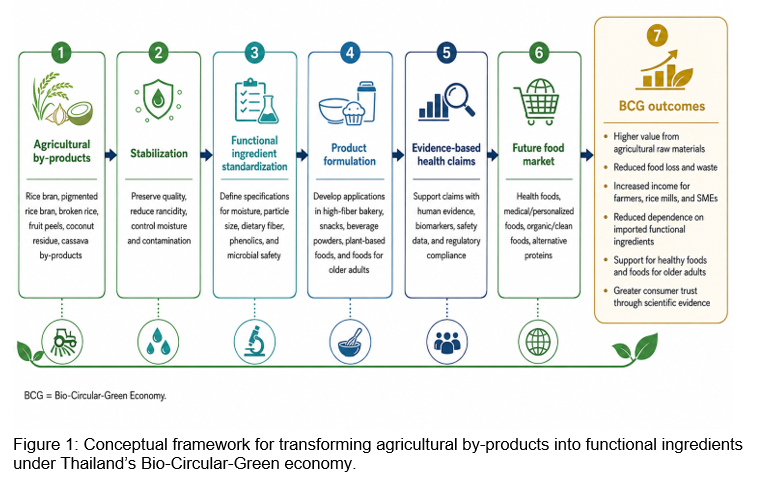
The framework links agricultural by-products with stabilization, ingredient standardization, product formulation, substantiated health claims, future food markets, and BCG outcomes.
REFERENCES
Angulo-López, J. E., Flores-Gallegos, A. C., Ascacio-Valdés, J. A., Contreras Esquivel, J. C., Torres-León, C., Rúelas-Chácon, X., & Aguilar, C. N. (2023). Antioxidant dietary fiber sourced from agroindustrial byproducts and its applications. Foods, 12(1), Article 159. https://doi.org/10.3390/foods12010159
BCG Economy Model. (n.d.). Strategies. Retrieved June 10, 2026, from https://www.bcg.in.th/eng/strategies/
Bodie, A. R., Micciche, A. C., Atungulu, G. G., Rothrock, M. J., Jr., & Ricke, S. C. (2019). Current trends of rice milling byproducts for agricultural applications and alternative food production systems. Frontiers in Sustainable Food Systems, 3, Article 47. https://doi.org/10.3389/fsufs.2019.00047
Codex Alimentarius Commission. (1997). Guidelines for use of nutrition and health claims (CAC/GL 23-1997). FAO/WHO Codex Alimentarius. https://www.fao.org/ag/humannutrition/32443-04352e8311b857c57caf5ffc4c5c...
Codex Alimentarius Commission. (2020). General principles of food hygiene: Good hygiene practices and the Hazard Analysis and Critical Control Point system (CXC 1-1969). FAO/WHO Codex Alimentarius. https://openknowledge.fao.org/server/api/core/bitstreams/6866dc55-d2c0-4...
Earp, C. F., Bergman, C. J., & Bautista, R. C. (2003). Development of rice quality evaluation methods. Rice Technical Working Group Meeting Proceedings, 102. U.S. Department of Agriculture, Agricultural Research Service. https://www.ars.usda.gov/research/publications/publication/?seqNo115=147419
European Commission. (n.d.). Food use and waste hierarchy. Retrieved June 10, 2026, from https://food.ec.europa.eu/food-safety/food-waste/eu-food-waste-relevant-...
Food and Agriculture Organization. (n.d.). Food loss and food waste. Retrieved June 10, 2026, from https://www.fao.org/policy-support/policy-themes/food-loss-and-food-wast...
Food and Agriculture Organization Global Information and Early Warning System. (2026, January 23). Country brief: Thailand. https://www.fao.org/giews/countrybrief/country.jsp?code=THA
Food and Drug Administration, Ministry of Public Health. (2024a, July 2). The Thai FDA issues a notification to support health claims for functional foods to enhance the Thai economy. https://en.fda.moph.go.th/news/thai-fda-issues-notification-to-support-h...
Food and Drug Administration, Ministry of Public Health. (2025, February 18). อย. สนับสนุนอาหารแห่งอนาคต จัดทำ Positive List ส่งเสริมผู้ประกอบการอาหารสุขภาพไทย [Thai FDA supports future food by developing the Positive List to promote Thai health food entrepreneurs]. https://www.fda.moph.go.th/news/180268
Food Division, Food and Drug Administration, Ministry of Public Health. (2024, January 10). การกล่าวอ้างทางสุขภาพของอาหาร [Health claims made on food]. https://food.fda.moph.go.th/food-law/nutrition-claim/
Government Public Relations Department. (2024, July 22). Thailand aims to lead the future food industry. https://thailand.prd.go.th/en/content/category/detail/id/43/cid/2078/iid...
Government Public Relations Department. (2025, January 30). Thai rice exports hit a 6-year high in 2024, worth USD 6.69B. https://thailand.prd.go.th/en/content/category/detail/id/2078/iid/360215
Hasan, M. M., Islam, M. R., Haque, A. R., Kabir, M. R., Khushe, K. J., & Hasan, S. M. K. (2024). Trends and challenges of fruit by-products utilization: Insights into safety, sensory, and benefits of the use for the development of innovative healthy food: A review. Bioresources and Bioprocessing, 11, Article 10. https://doi.org/10.1186/s40643-023-00722-8
Huang, W., Liu, B., Shi, D., Cheng, A., Chen, G., Liu, F., Dong, J., Lan, J., Hong, B., & Ren, C. (2024). Research progress on the quality, extraction technology, food application, and physiological function of rice bran oil. Foods, 13(20), Article 3262. https://doi.org/10.3390/foods13203262
International Rice Research Institute. (n.d.). Milling and processing. Rice Knowledge Bank. Retrieved August 11, 2026, from https://www.knowledgebank.irri.org/step-by-step-production/postharvest/m...
Musika, S., Khampitoon, A., Bunsroem, K., Kupradit, C., Ranok, A., Mangkalanan, S., & Khongla, C. (2025). Development of cookies fortified with defatted rice bran flour derived from the dough grain stage: Nutritional, phytochemical, and antioxidant properties. International Journal of Agricultural Technology, 21(6), 2409-2428. https://doi.org/10.63369/ijat.2025.21.6.2409-2428
Nidhishree, A. S., Menezes, R. A., Venkatachalam, H., & Bhat, K. S. (2024). Rice bran as a sustainable source for value-added materials: An overview. Discover Materials, 4, Article 93. https://doi.org/10.1007/s43939-024-00159-6
Office of National Higher Education Science Research and Innovation Policy Council. (2025a, November 11). Policy recommendations for driving Thailand’s future food industry through science, research, and innovation. https://www.nxpo.or.th/th/en/40632/
Office of National Higher Education Science Research and Innovation Policy Council. (2025b, October 7). Positive List: Unlocking Thailand’s future food industry. https://www.nxpo.or.th/th/en/39708/
Rahim, F. N. A., Ibadullah, W. Z. W., Saari, N., Mustapha, N. A., Shukri, R., Zawawi, N., Karim, R., & Rashedi, I. F. (2022). Comparison of different protein extraction methods of rice bran protein concentrates. Asia-Pacific Journal of Science and Technology, 27(6), Article APST-27. https://doi.org/10.14456/apst.2022.101
Rao, M., Bast, A., & de Boer, A. (2021). Valorized food processing by-products in the EU: Finding the balance between safety, nutrition, and sustainability. Sustainability, 13(8), Article 4428. https://doi.org/10.3390/su13084428
Royal Thai Embassy, Washington, D.C. (2023, December 29). Bio-Circular-Green Economic Model (BCG). https://washingtondc.thaiembassy.org/en/page/bio-circular-green-economic...
Sapwarobol, S., Saphyakhajorn, W., & Astina, J. (2021). Biological functions and activities of rice bran as a functional ingredient: A review. Nutrition and Metabolic Insights, 14, 11786388211058559. https://doi.org/10.1177/11786388211058559
Sreenakhot, P., Kettawan, A., Wunjuntuk, K., Kringkasemsee Kettawan, A., Monboonpitak, N., & Saowongjan, B. (2024). Effect of particle size on physicochemical, functional, and antioxidant properties of defatted rice (Oryza sativa L.) bran. Journal of Nutrition Association of Thailand, 59(2), 55-66. https://he01.tci-thaijo.org/index.php/JNAT/article/view/274301
Tajasuwan, L., Kettawan, A., Rungruang, T., Wunjuntuk, K., Prombutara, P., Muangnoi, C., & Kettawan, A. K. (2022). Inhibitory effect of dietary defatted rice bran in an AOM/DSS-induced colitis-associated colorectal cancer experimental animal model. Foods, 11(21), Article 3488. https://doi.org/10.3390/foods11213488
Tajasuwan, L., Kettawan, A., Rungruang, T., Wunjuntuk, K., & Prombutara, P. (2023). Role of dietary defatted rice bran in the modulation of gut microbiota in AOM/DSS-induced colitis-associated colorectal cancer rat model. Nutrients, 15(6), Article 1528. https://doi.org/10.3390/nu15061528
Tridge. (n.d.). Rice bran price in Thailand. Retrieved August 11, 2026, from https://dir.tridge.com/prices/rice-bran/TH
United Nations Environment Programme. (2024). Food Waste Index Report 2024: Think Eat Save: Tracking progress to halve global food waste. https://www.unep.org/resources/publication/food-waste-index-report-2024
U.S. Department of Agriculture, Foreign Agricultural Service. (2026, March 31). Food processing ingredients annual: Thailand (GAIN Report No. TH2026-0007). https://apps.fas.usda.gov/newgainapi/api/Report/DownloadReportByFileName...
World Health Organization. (n.d.). Noncommunicable diseases. Retrieved June 10, 2026, from https://www.who.int/thailand/our-work/NCDs
World Health Organization Regional Office for South-East Asia. (2023, February 9). Thailand’s leadership and innovations towards healthy ageing. https://www.who.int/southeastasia/news/feature-stories/detail/thailands-...
Wunjuntuk, K., Tajasuwan, L., Kettawan, A., Rungruang, T., Prombutara, P., Prangthip, P., Chaisri, A., Nirmal, N., & Kettawan, A. K. (2025). Antioxidative effects of defatted rice bran in rats on AOM/DSS-induced colon oxidative stress and correlations between gut microbiota and antioxidant biomarkers. Food Science & Nutrition, 13(8), Article e70554. https://doi.org/10.1002/fsn3.70554
Yılmaz Tuncel, N. (2023). Stabilization of rice bran: A review. Foods, 12(9), Article 1924. https://doi.org/10.3390/foods12091924


Prospects for Thailand’s Future Food: Rice Bran under the Bio-Circular-Green Economy Policy
ABSTRACT
Thailand’s future food agenda offers an opportunity to move beyond commodity-based agricultural production toward value-added, science-based food innovation. Rice bran, a by-product of rice milling, is a relevant case for this transition. Although often used in low-value applications, rice bran contains dietary fiber, protein, lipids, vitamins, minerals, and bioactive compounds such as γ-oryzanol, tocopherols, tocotrienols, and phenolics. Its development as a functional ingredient, however, is constrained by rapid rancidity, variable quality, limited standardization, sensory challenges, and insufficient human evidence for health-related claims. This article discusses rice bran and defatted rice bran as strategic co-products within Thailand’s Bio-Circular-Green economy and future food policy. It emphasizes that credible development should be grounded in nutritional facts, ingredient specifications, safety data, reliable scientific evidence for health-related benefits, and responsible health claims. Policy priorities include regional stabilization hubs, university–industry consortia, clinical validation for local functional ingredients, ingredient standards, and Positive List pathways. If implemented systematically, rice bran-based ingredients could support circular nutrition, increase value in the rice sector, reduce underutilization of agricultural co-products, and strengthen consumer trust in Thailand’s future food industry.
Keywords: co-products; stabilization; standardization; nutritional facts; health claims; and consumer trust
INTRODUCTION
Thailand is a major agri-food economy in Asia, and rice remains central to the country’s agricultural identity, rural livelihoods, and export profile. In 2024, Thailand exported 9.95 million tons of rice valued at 225,656 million baht (approximately US$6.69 billion), the highest export volume in six years (Government Public Relations Department, 2025). However, this performance should not obscure the need to move beyond volume-based competitiveness toward value-added rice-based innovation. Climate variability, production costs, international competition, and changing consumer demand increasingly require Thailand to capture more value from the whole agricultural value chain.
This direction is consistent with Thailand’s Bio-Circular-Green (BCG) Economy Model, which promotes the use of science, technology, and innovation to increase value from biological resources while improving resource efficiency and sustainability (BCG Economy Model, n.d.). It also aligns with Thailand’s future food strategy, which identifies four key categories: health foods and functional ingredients, medical and personalized foods, organic and clean foods, and alternative proteins (Office of National Higher Education Science Research and Innovation Policy Council [NXPO], 2025a). These priorities suggest that Thailand’s future food opportunity may lie not only in novel or imported ingredients but also in rethinking familiar domestic resources.
Rice bran is one such resource. As a by-product of rice milling, it has often been used for animal feed or other lower-value purposes. Yet rice bran contains dietary fiber, protein, lipids, vitamins, minerals, and bioactive compounds, including γ-oryzanol, tocopherols, tocotrienols, and phenolic compounds (Bodie et al., 2019; Sapwarobol et al., 2021). For a rice-producing country such as Thailand, rice bran should therefore be reconsidered as a strategic co-product rather than a residual material.
Despite this potential, rice bran is difficult to convert into a market-ready food ingredient. Fresh rice bran deteriorates rapidly after milling because endogenous lipases promote hydrolytic rancidity, leading to off-flavors, reduced shelf life, and lower suitability for human consumption (Yılmaz Tuncel, 2023). Its composition also varies according to rice variety, milling degree, stabilization method, storage, and processing conditions. Therefore, rice bran valorization requires more than simple reuse. It requires a structured pathway from raw material control to stabilization, standardization, product formulation, safety assessment, and evidence-based communication.
This article uses rice bran as a case study to examine how Thailand can transform agricultural by-products into functional ingredients under the BCG and future food agendas. It focuses on three connected issues: the policy and market context for functional ingredients, the scientific and technological requirements for rice bran development, and the regulatory need for evidence-based health claims.
THAILAND’S FUTURE FOOD LANDSCAPE: POLICY MOMENTUM AND MARKET SIGNALS
Future food in Thailand should be understood as an economic and industrial strategy, not merely as a consumer trend. The BCG model emphasizes value creation from biological resources, product differentiation, food safety, traceability, and resource efficiency (BCG Economy Model, n.d.; Royal Thai Embassy, Washington, D.C., 2023). Within this framework, food innovation is expected to contribute not only to export competitiveness, but also to sustainability, health, and inclusive economic development.
Thailand’s future food policy identifies health foods and functional ingredients, medical and personalized foods, organic and clean foods, and alternative proteins as key categories. NXPO has proposed increasing the value of Thailand’s future food industry to 500 billion baht by 2027 (approximately US$15.4 billion, calculated at US$1 = 32.5 baht), while reducing greenhouse gas emissions by 0.3 million tons of CO₂ equivalent (NXPO, 2025a). This reflects a policy attempt to link economic upgrading with environmental performance.
Policy instruments are also becoming more specific. NXPO has proposed three measures to drive the future food industry: attracting investment in advanced extraction and formulation technologies, establishing R&D consortia for functional ingredients and protein production, and developing standards and certification systems, including the FFC Thailand Sandbox and positive lists to streamline health-related functional claims (NXPO, 2025a). In parallel, the Thai FDA and partner agencies are developing a Positive List of health claims to support functional foods and functional ingredients, with a target of 150 items by 2027 (Thai FDA, 2024a; NXPO, 2025b).
Market data supports the importance of this sector. In 2023, Thailand’s future food exports reached 143 billion baht (approximately US$4.4 billion), with functional foods and ingredients accounting for 89.7% of the total. During the first four months of 2024, exports reached 51.6 billion baht (approximately US$1.6 billion), with functional foods accounting for 90.8% of export value (Government Public Relations Department, 2024). These figures indicate that functional foods and functional ingredients are already central to Thailand’s future food economy.
Several structural factors reinforce this direction. Noncommunicable diseases are responsible for three out of every four deaths in Thailand, and the country is among the fastest-aging societies in the world (World Health Organization [WHO], n.d.). WHO reported that Thailand has approximately 12 million older persons and is expected to become a super-aged society in the next decade (WHO Regional Office for South-East Asia, 2023). These transitions create demand for foods that support healthy aging, digestive health, metabolic health, and personalized nutrition.
Food industry assessments point in the same direction. The U.S. Department of Agriculture, Foreign Agricultural Service (USDA FAS) reported growing demand in Thailand for health-focused foods, dietary supplements, plant-based products, and functional ingredients (USDA FAS, 2026). Functional ingredients are therefore a critical upstream component of future food development. They enable downstream products such as high-fiber foods, foods for older adults, nutraceuticals, plant-based products, and medical or personalized foods.
Thailand has a rich base of local raw materials, including rice, pigmented rice, herbs, coconut, cassava, tea, coffee, cocoa, mushrooms, and tropical fruits. The key challenge is not the absence of resources, but the limited ability to convert them into ingredient-grade materials with defined composition, safety parameters, functionality, and claim readiness. This is where rice bran becomes particularly relevant.
AGRICULTURAL BY-PRODUCTS AND CIRCULAR NUTRITION
Agricultural and food-processing by-products are often treated as waste management problems. From a nutrition and food-system perspective, however, many should be viewed as underutilized nutritional resources. Globally, 13.2% of food is lost after harvest and before retail, while an additional 19% of food available to consumers is wasted at the retail, food service, and household levels (Food and Agriculture Organization [FAO], n.d.; United Nations Environment Programme [UNEP], 2024). These figures should not be added directly, as they refer to different points in the supply chain, but together they show that food loss and waste represent substantial environmental, economic, and nutritional inefficiencies.
A more strategic approach is to classify suitable agricultural by-products as secondary raw materials or co-products. This framing is important. “Waste” implies disposal, whereas “co-product” implies potential value, design, and responsibility. When safe and nutritionally meaningful, by-products may be returned to the human food chain before being directed to lower-value uses such as animal feed, compost, or energy recovery. This principle is consistent with food use and waste hierarchy approaches, which prioritize higher-value uses of food-related materials (European Commission, n.d.).
Many agricultural by-products contain nutrients and bioactive compounds that may support the development of functional foods. Cereal brans, fruit peels, oilseed cakes, spent grains, and other side streams can contain dietary fiber, proteins, phenolic compounds, carotenoids, minerals, and antioxidant components (Angulo-López et al., 2023; Hasan et al., 2024). These materials may contribute not only to nutrient content but also to texture, hydration, antioxidant capacity, and consumer-perceived health value.
This perspective can be described as circular nutrition: the use of circular economy principles to retain nutritional and functional value within the human food system. It differs from conventional waste management because it asks not only how materials can be diverted from disposal, but also whether their nutritional value can be safely preserved and upgraded.
However, agricultural by-products should not be assumed to be automatically suitable for human food. Some may contain contaminants, pesticide residues, mycotoxins, heavy metals, undesirable flavors, high water activity, microbial risks, or unstable bioactive compounds (Rao et al., 2021; Hasan et al., 2024). By-product valorization, therefore, requires risk assessment, ingredient standardization, food safety controls, and consumer acceptance. Rice bran illustrates both the promise and the complexity of this transition.
RICE BRAN AS A STRATEGIC FUNCTIONAL INGREDIENT
Rice bran in Thailand’s rice-based food system
Rice milling produces several co-products, including husk, broken rice, and rice bran. Rice bran is generated from the outer layers of the rice kernel during milling and polishing and is commonly generated at approximately 8–12% of the paddy or rice milling mass, depending on the milling system, rice variety, and degree of polishing (Bodie et al., 2019; Earp et al., 2003; International Rice Research Institute [IRRI], n.d.; Sapwarobol et al., 2021; Yılmaz Tuncel, 2023). In Thailand, this represents a substantial biomass stream linked directly to one of the country’s most important agricultural sectors.
The scale of this stream is economically meaningful. FAO GIEWS forecast Thailand’s 2025/26 aggregate paddy production at 33.5 million tonnes. Using the 8–12% bran fraction commonly reported for rice milling, Thailand’s potential rice bran generation can be roughly approximated at 2.7–4.0 million tonnes per year (FAO GIEWS, 2026; IRRI, n.d.). At a recent wholesale price indication of 625 baht per 100 kg, or about US$0.18 per kg, this stream would represent an indicative gross transaction value of approximately 16.8–25.1 billion baht (US$0.48–0.72 billion), before accounting for grade, losses, stabilization, oil extraction, feed use, and suitability for food-grade processing (Tridge, n.d.). This estimate is not a formal market valuation, but it illustrates why quality upgrading, stabilization, and food-grade standardization could create economic value beyond conventional low-value utilization.
The strategic question is therefore not only how much rice Thailand can produce or export, but how much value can be created from each fraction of the rice grain. Rice bran should be positioned as a co-product for higher-value applications rather than as a low-value milling residue. This framing is consistent with Thailand’s BCG agenda, which emphasizes resource efficiency, product differentiation, and value-added innovation.
Nutritional and bioactive potential
Rice bran is nutritionally important because it contains both macronutrients and bioactive compounds. Reviews identify rice bran as a source of dietary fiber, protein, lipids, minerals, B vitamins, tocopherols, tocotrienols, phenolics, and γ-oryzanol (Bodie et al., 2019; Sapwarobol et al., 2021). This complex matrix makes rice bran relevant to several food applications, including high-fiber foods, cereal-based products, plant-based formulations, and nutraceutical ingredients.
Nevertheless, its composition is not uniform. It varies by cultivar, cultivation conditions, milling degree, stabilization, storage, and processing method (Bodie et al., 2019). This variability limits industrial use unless specifications are established. A rice bran ingredient intended for bakery applications, for example, may require defined values for moisture, particle size, total dietary fiber, soluble and insoluble fiber, and rancidity indicators. A phenolic-rich fraction would require different specifications, including bioactive markers and antioxidant stability. Thus, the goal should be to move rice bran from a nutrient-rich by-product to a standardized ingredient platform.
Defatted rice bran as a practical ingredient
Defatted rice bran is especially relevant because it remains after rice bran oil extraction and still contains dietary fiber, protein, and phenolic compounds. It can be developed into high-fiber powders, cereal ingredients, bakery ingredients, snack components, or other functional food inputs.
Recent Thai research shows that particle size can influence the functional properties of defatted rice bran. Sreenakhot et al. (2024) reported that smaller particle sizes increased soluble dietary fiber proportion, total phenolic content, antioxidant activity, lightness, and water solubility index, while reducing insoluble dietary fiber proportion. This finding is important because particle-size control is a practical processing tool for tailoring rice bran fractions to different product matrices.
Product application studies also highlight the need for formulation balance. Musika et al. (2025) found that cookies fortified with defatted Jasmine rice bran flour had higher phytochemical content and antioxidant activity, but higher substitution levels reduced sensory acceptability. A 15% substitution level provided the best balance between functionality and consumer acceptance. This suggests that product success depends not only on increasing functional ingredients but also on optimizing ingredient level, matrix compatibility, and sensory quality.
Gut health and prebiotic potential
Gut health is an emerging area of interest for rice bran-based functional ingredients, as rice bran contains dietary fiber and phytochemicals that may interact with the gut microbiota. Preclinical studies in Thailand provide promising evidence. Tajasuwan et al. (2023) reported that dietary defatted rice bran modulated gut microbiota, increased short-chain fatty acids, and improved mucus layer-related outcomes in a rat model of colitis-associated colorectal cancer. Related studies also suggest anti-inflammatory, antioxidant, and gut-related effects in experimental models (Tajasuwan et al., 2022; Wunjuntuk et al., 2025).
These preclinical findings support further investigation of defatted rice bran as a gut-health-related ingredient candidate, but they do not yet justify disease prevention or treatment claims in humans. Human studies are needed to determine effective intake levels, relevant biomarkers, safety, gastrointestinal tolerance, and practical food applications. Therefore, rice bran should be described as having emerging potential for gut health, rather than as an established therapeutic ingredient.
FROM SCIENCE TO MARKET-READY INGREDIENTS
The scientific potential of rice bran is well documented, but scientific potential alone does not create a market-ready ingredient. Commercial development requires a complete pathway from raw material control to consumer-ready products.
The first step is stabilization. Fresh rice bran deteriorates rapidly because milling disrupts cellular structures and allows lipases to hydrolyze lipids into free fatty acids (Yılmaz Tuncel, 2023). Stabilization methods such as extrusion, steaming, microwave treatment, infrared treatment, and hot-air drying can reduce enzymatic activity and delay rancidity. In Thailand, stabilization should be treated as a value chain issue. If stabilization occurs too late, much of the ingredient value may be lost before processing begins.
The second step is particle-size control. Particle size affects water absorption, water solubility, dispersibility, color, mouthfeel, and texture. Finer fractions may be suitable for beverage powders, smooth bakery products, texture-modified foods, or nutraceutical formulations. Coarser fractions may be suitable for cookies, cereal bars, or extruded products. This makes particle-size control an accessible way to improve functional performance and match the ingredient to the target food matrix (Sreenakhot et al., 2024).
The third step is extraction and fractionation. Rice bran can be processed into fiber-rich, protein-rich, phenolic-rich, or γ-oryzanol-rich fractions. Reviews have highlighted the potential of rice bran oil, protein, fiber, and bioactive compounds for food and nutraceutical applications (Huang et al., 2024; Nidhishree et al., 2024). However, laboratory extraction methods must be evaluated for cost, safety, scalability, solvent use, environmental impact, and suitability for small and medium-sized enterprises (SMEs). Rice bran protein extraction studies also suggest that extraction method, particle size, and processing conditions affect yield and protein quality (Rahim et al., 2022).
The fourth step is standardization. A functional ingredient requires clear specifications for moisture, water activity, particle-size distribution, dietary fiber (soluble and insoluble), protein, fat, phenolics, antioxidant activity, rancidity indicators, microbial load, pesticide residues, heavy metals, mycotoxins, shelf life, and storage conditions. Standardization is the bridge between food science, regulation, and market credibility. It is also consistent with the broader food safety principle that hazards should be managed across the food chain through appropriate hygiene and control systems (Codex Alimentarius Commission, 2020).
The fifth step is product formulation. Rice bran-based ingredients can be used in bakery products, snacks, breakfast cereals, beverage powders, meal replacements, plant-based foods, foods for older adults, and functional cereal products. However, higher inclusion levels do not always produce better products. Flavor, color, texture, mouthfeel, and consumer acceptance must be optimized for each matrix.
The final step is consumer acceptance. Rice bran may be associated with rough texture, dark color, off-flavor, or animal feed use. Communication should therefore avoid framing rice bran as “waste.” A more appropriate narrative is that rice bran is a traceable rice co-product, stabilized and standardized for food use, and supported by scientific evidence. This framing is essential for consumer trust.
Table 1. Key value-chain stages for developing rice bran as a functional ingredient.
Value-chain stage
Critical control points
Desired output
Rice milling
Freshness, hygienic handling, and contamination control
Good-quality rice bran
Stabilization
Heat, time, moisture, cooling, storage
Reduced rancidity and improved shelf life
Defatting / fractionation
Extraction method, solvent or non-solvent technology, fraction yield
Fiber-, protein-, or bioactive-rich fractions
Milling / particle-size control
Particle size, distribution, dispersibility, hydration properties
Application-specific rice bran ingredients
Standardization
Dietary fiber, phenolics, microbial safety, contaminants, rancidity markers
Ingredient specification and batch consistency
Product formulation
Flavor, color, texture, shelf life, and inclusion level
Consumer-acceptable functional foods
Evidence generation
In vitro, animal, human studies, biomarkers, safety data
Health-claim readiness
Note. Authors’ synthesis based on Yılmaz Tuncel (2023), Sreenakhot et al. (2024), Codex Alimentarius Commission (2020), and Food and Drug Administration, Ministry of Public Health (2024a).
NUTRITIONAL FACTS, HEALTH CLAIMS, AND CONSUMER TRUST
The growth of functional foods depends on credible health communication. Health claims can support product differentiation and consumer choice, but they can also mislead consumers if they are vague or unsupported. For Thailand’s future food industry, responsible communication should connect nutritional facts, reliable scientific evidence for health-related benefits, safety data, and legally appropriate health claims.
Codex classifies health claims into nutrient function claims, other function claims, and reduction of disease risk claims (Codex Alimentarius Commission, 1997). This distinction is important because different types of claims require different levels of evidence. A nutrient function claim may be supported by established nutrient roles and compositional criteria. Claims related to physiological function, microbiota modulation, cholesterol reduction, glycemic response, or disease risk reduction generally require stronger substantiation.
Thailand has strengthened this area through Ministry of Public Health Notification No. 447 B.E. 2566 (2023), which regulates health claims made on food labeling and came into force on July 2, 2024 (Food Division, Food and Drug Administration, Ministry of Public Health, 2024). The Thai Food and Drug Administration (Thai FDA) has also promoted a Positive List system to allow approved claims to be used under defined conditions without case-by-case approval (Food and Drug Administration, Ministry of Public Health [Thai FDA], 2024a, 2025; NXPO, 2025b). This system can reduce uncertainty for entrepreneurs and improve consumer confidence, provided that claims remain scientifically justified.
In this article, scientific substantiation does not imply that a raw ingredient automatically carries a health claim. Rather, it refers to the alignment of nutritional composition, validated analytical data, safety information, and, where required, human evidence with the wording and conditions of the proposed claim. This distinction is important for rice bran because its nutritional facts and potential health-related benefits depend on variety, stabilization, fractionation, particle size, formulation, and serving size.
For rice bran and defatted rice bran, this presents both opportunities and cautions. Products may be positioned around dietary fiber or nutrient contribution if the final food meets relevant criteria. However, claims related to gut microbiota, short-chain fatty acid production, antioxidant effects, cholesterol reduction, glycemic control, or disease risk reduction require more rigorous evidence. Preclinical findings on defatted rice bran are promising, but they should be described as potential, emerging evidence or as requiring human validation (Tajasuwan et al., 2023; Wunjuntuk et al., 2025).
Rice bran-based products should not use treatment, cure, or disease-prevention language. Claims related to gut microbiota, cholesterol, glycemic response, antioxidant effects, or disease risk reduction should be made only when the final product meets the relevant regulatory criteria and is supported by appropriate human evidence.
This framework has implications for research. Studies on local functional ingredients should be designed with regulatory endpoints in mind. Laboratory analyses of phenolics, antioxidant capacity, soluble fiber, or in vitro fermentability are useful but not sufficient for stronger claims. Thailand should invest in systematic reviews, human intervention studies, dose-response trials, biomarker validation, safety studies, and evidence dossiers that can support Positive List expansion.
Consumer trust should be treated as a policy outcome. If health claims are credible, consumers can better understand the value of local functional ingredients. If claims are exaggerated, the credibility of the entire future food sector may be damaged. Therefore, the most appropriate positioning for rice bran is not as a “superfood,” but as a standardized and traceable co-product supported by nutritional facts, safety data, and reliable scientific evidence.
POLICY RECOMMENDATIONS
Thailand needs an integrated pathway to transform rice bran and other agricultural by-products into credible functional ingredients supported by nutritional facts, safety data, and reliable scientific evidence.
First, the country should establish a national database of agricultural by-products with potential as functional ingredient candidates. This database should include nutritional composition, bioactive compounds, safety risks, seasonal availability, production areas, current utilization, processing needs, and market potential. Candidate materials could include rice bran, pigmented rice bran, broken rice, coconut residue, cassava by-products, fruit peels, oilseed cakes, and mushroom residues.
Second, Thailand should develop regional hubs for stabilization and primary processing, especially near rice mills or cooperatives. For rice bran, stabilization close to the milling site is essential to prevent quality deterioration. Shared facilities could provide drying, stabilization, milling, sieving, hygienic packaging, and initial quality testing. This would help SMEs and rice mills access food-grade processing infrastructure.
Third, university-industry consortia should be strengthened. These consortia should connect universities, rice mills, SMEs, analytical laboratories, food manufacturers, clinical researchers, and regulators. Priority projects could include rice bran fiber ingredients, phenolic-rich rice bran powder, rice bran protein fractions, and rice bran-based prebiotic candidates.
Fourth, public funding should support the generation of evidence for health claims. This includes systematic reviews, human intervention studies, biomarker validation, dose-response studies, safety assessment, and claim dossiers. Such investment would help local ingredients enter evidence-based regulatory pathways and reduce dependence on imported functional ingredients.
Fifth, Thailand should develop ingredient specifications for by-product-based ingredients. For rice bran, specifications should include moisture, water activity, particle size, dietary fiber, protein, phenolics, microbial safety, contaminants, rancidity markers, shelf life, and storage conditions. Ingredient specification is essential for scale-up, regulatory confidence, and market trust.
Sixth, public procurement could create early demand for safe, acceptable products made with local functional ingredients. Schools, hospitals, elderly care centers, public universities, and government canteens could pilot high-fiber bakery products, rice-bran-enriched snacks, fiber-enriched plant-based products, or foods for older adults. However, these products must meet nutritional, sensory, safety, and regulatory criteria.
Finally, Thailand should build a national brand for Thai functional ingredients supported by reliable scientific evidence. The brand should be based on four attributes: local origin, traceability, circular economy, and scientific substantiation. This positioning would differentiate Thai ingredients from generic imports and from poorly substantiated health products.
Table 2. Policy bottlenecks and proposed solutions for rice bran-based functional ingredient development in Thailand.
Bottleneck
Impact
Proposed solution
Rapid deterioration of rice bran
Limited use in human food
Regional stabilization hubs
Inconsistent raw material quality
Difficult scale-up
Ingredient specifications
Limited human evidence
Restricted health claims
Clinical validation grants
Limited SME access to technology
Weak competitiveness against imported ingredients
Pilot plants and shared processing facilities
Negative perception of by-products
Low consumer acceptance
Communication based on circular nutrition
Complex health-claim regulation
Risk of vague or non-compliant claims
Regulatory consultation and Positive List pathway
Limited early market demand
Commercialization risk
Public procurement for safe and acceptable products
Note. Authors’ synthesis based on NXPO (2025a, 2025b), Thai FDA (2024a, 2025), Royal Thai Embassy, Washington, D.C. (2023), and Yılmaz Tuncel (2023).
CONCLUSION
Rice bran is more than a rice-milling by-product. It is a strategic test case for Thailand’s ability to transform local agricultural co-products into standardized, traceable functional ingredients backed by nutritional facts and reliable scientific evidence. Its development requires more than technical processing. It requires coordinated action across agriculture, food science, nutrition research, regulation, industry, and consumer communication.
The broader lesson is that future food innovation does not always begin with unfamiliar novel ingredients. It can begin with familiar materials that are scientifically redefined and systematically upgraded. For rice bran, this means moving from low-value utilization toward stabilization, functional ingredient standardization, product formulation, substantiated health claims, and future food market development.
If Thailand can build this pathway, rice bran could contribute to several BCG outcomes: higher value from agricultural raw materials, reduced food loss and waste, increased income for farmers, rice mills, and SMEs, reduced dependence on imported functional ingredients, support for healthy foods and foods for older adults, and greater consumer trust through scientific evidence.
The framework links agricultural by-products with stabilization, ingredient standardization, product formulation, substantiated health claims, future food markets, and BCG outcomes.
REFERENCES
Angulo-López, J. E., Flores-Gallegos, A. C., Ascacio-Valdés, J. A., Contreras Esquivel, J. C., Torres-León, C., Rúelas-Chácon, X., & Aguilar, C. N. (2023). Antioxidant dietary fiber sourced from agroindustrial byproducts and its applications. Foods, 12(1), Article 159. https://doi.org/10.3390/foods12010159
BCG Economy Model. (n.d.). Strategies. Retrieved June 10, 2026, from https://www.bcg.in.th/eng/strategies/
Bodie, A. R., Micciche, A. C., Atungulu, G. G., Rothrock, M. J., Jr., & Ricke, S. C. (2019). Current trends of rice milling byproducts for agricultural applications and alternative food production systems. Frontiers in Sustainable Food Systems, 3, Article 47. https://doi.org/10.3389/fsufs.2019.00047
Codex Alimentarius Commission. (1997). Guidelines for use of nutrition and health claims (CAC/GL 23-1997). FAO/WHO Codex Alimentarius. https://www.fao.org/ag/humannutrition/32443-04352e8311b857c57caf5ffc4c5c...
Codex Alimentarius Commission. (2020). General principles of food hygiene: Good hygiene practices and the Hazard Analysis and Critical Control Point system (CXC 1-1969). FAO/WHO Codex Alimentarius. https://openknowledge.fao.org/server/api/core/bitstreams/6866dc55-d2c0-4...
Earp, C. F., Bergman, C. J., & Bautista, R. C. (2003). Development of rice quality evaluation methods. Rice Technical Working Group Meeting Proceedings, 102. U.S. Department of Agriculture, Agricultural Research Service. https://www.ars.usda.gov/research/publications/publication/?seqNo115=147419
European Commission. (n.d.). Food use and waste hierarchy. Retrieved June 10, 2026, from https://food.ec.europa.eu/food-safety/food-waste/eu-food-waste-relevant-...
Food and Agriculture Organization. (n.d.). Food loss and food waste. Retrieved June 10, 2026, from https://www.fao.org/policy-support/policy-themes/food-loss-and-food-wast...
Food and Agriculture Organization Global Information and Early Warning System. (2026, January 23). Country brief: Thailand. https://www.fao.org/giews/countrybrief/country.jsp?code=THA
Food and Drug Administration, Ministry of Public Health. (2024a, July 2). The Thai FDA issues a notification to support health claims for functional foods to enhance the Thai economy. https://en.fda.moph.go.th/news/thai-fda-issues-notification-to-support-h...
Food and Drug Administration, Ministry of Public Health. (2025, February 18). อย. สนับสนุนอาหารแห่งอนาคต จัดทำ Positive List ส่งเสริมผู้ประกอบการอาหารสุขภาพไทย [Thai FDA supports future food by developing the Positive List to promote Thai health food entrepreneurs]. https://www.fda.moph.go.th/news/180268
Food Division, Food and Drug Administration, Ministry of Public Health. (2024, January 10). การกล่าวอ้างทางสุขภาพของอาหาร [Health claims made on food]. https://food.fda.moph.go.th/food-law/nutrition-claim/
Government Public Relations Department. (2024, July 22). Thailand aims to lead the future food industry. https://thailand.prd.go.th/en/content/category/detail/id/43/cid/2078/iid...
Government Public Relations Department. (2025, January 30). Thai rice exports hit a 6-year high in 2024, worth USD 6.69B. https://thailand.prd.go.th/en/content/category/detail/id/2078/iid/360215
Hasan, M. M., Islam, M. R., Haque, A. R., Kabir, M. R., Khushe, K. J., & Hasan, S. M. K. (2024). Trends and challenges of fruit by-products utilization: Insights into safety, sensory, and benefits of the use for the development of innovative healthy food: A review. Bioresources and Bioprocessing, 11, Article 10. https://doi.org/10.1186/s40643-023-00722-8
Huang, W., Liu, B., Shi, D., Cheng, A., Chen, G., Liu, F., Dong, J., Lan, J., Hong, B., & Ren, C. (2024). Research progress on the quality, extraction technology, food application, and physiological function of rice bran oil. Foods, 13(20), Article 3262. https://doi.org/10.3390/foods13203262
International Rice Research Institute. (n.d.). Milling and processing. Rice Knowledge Bank. Retrieved August 11, 2026, from https://www.knowledgebank.irri.org/step-by-step-production/postharvest/m...
Musika, S., Khampitoon, A., Bunsroem, K., Kupradit, C., Ranok, A., Mangkalanan, S., & Khongla, C. (2025). Development of cookies fortified with defatted rice bran flour derived from the dough grain stage: Nutritional, phytochemical, and antioxidant properties. International Journal of Agricultural Technology, 21(6), 2409-2428. https://doi.org/10.63369/ijat.2025.21.6.2409-2428
Nidhishree, A. S., Menezes, R. A., Venkatachalam, H., & Bhat, K. S. (2024). Rice bran as a sustainable source for value-added materials: An overview. Discover Materials, 4, Article 93. https://doi.org/10.1007/s43939-024-00159-6
Office of National Higher Education Science Research and Innovation Policy Council. (2025a, November 11). Policy recommendations for driving Thailand’s future food industry through science, research, and innovation. https://www.nxpo.or.th/th/en/40632/
Office of National Higher Education Science Research and Innovation Policy Council. (2025b, October 7). Positive List: Unlocking Thailand’s future food industry. https://www.nxpo.or.th/th/en/39708/
Rahim, F. N. A., Ibadullah, W. Z. W., Saari, N., Mustapha, N. A., Shukri, R., Zawawi, N., Karim, R., & Rashedi, I. F. (2022). Comparison of different protein extraction methods of rice bran protein concentrates. Asia-Pacific Journal of Science and Technology, 27(6), Article APST-27. https://doi.org/10.14456/apst.2022.101
Rao, M., Bast, A., & de Boer, A. (2021). Valorized food processing by-products in the EU: Finding the balance between safety, nutrition, and sustainability. Sustainability, 13(8), Article 4428. https://doi.org/10.3390/su13084428
Royal Thai Embassy, Washington, D.C. (2023, December 29). Bio-Circular-Green Economic Model (BCG). https://washingtondc.thaiembassy.org/en/page/bio-circular-green-economic...
Sapwarobol, S., Saphyakhajorn, W., & Astina, J. (2021). Biological functions and activities of rice bran as a functional ingredient: A review. Nutrition and Metabolic Insights, 14, 11786388211058559. https://doi.org/10.1177/11786388211058559
Sreenakhot, P., Kettawan, A., Wunjuntuk, K., Kringkasemsee Kettawan, A., Monboonpitak, N., & Saowongjan, B. (2024). Effect of particle size on physicochemical, functional, and antioxidant properties of defatted rice (Oryza sativa L.) bran. Journal of Nutrition Association of Thailand, 59(2), 55-66. https://he01.tci-thaijo.org/index.php/JNAT/article/view/274301
Tajasuwan, L., Kettawan, A., Rungruang, T., Wunjuntuk, K., Prombutara, P., Muangnoi, C., & Kettawan, A. K. (2022). Inhibitory effect of dietary defatted rice bran in an AOM/DSS-induced colitis-associated colorectal cancer experimental animal model. Foods, 11(21), Article 3488. https://doi.org/10.3390/foods11213488
Tajasuwan, L., Kettawan, A., Rungruang, T., Wunjuntuk, K., & Prombutara, P. (2023). Role of dietary defatted rice bran in the modulation of gut microbiota in AOM/DSS-induced colitis-associated colorectal cancer rat model. Nutrients, 15(6), Article 1528. https://doi.org/10.3390/nu15061528
Tridge. (n.d.). Rice bran price in Thailand. Retrieved August 11, 2026, from https://dir.tridge.com/prices/rice-bran/TH
United Nations Environment Programme. (2024). Food Waste Index Report 2024: Think Eat Save: Tracking progress to halve global food waste. https://www.unep.org/resources/publication/food-waste-index-report-2024
U.S. Department of Agriculture, Foreign Agricultural Service. (2026, March 31). Food processing ingredients annual: Thailand (GAIN Report No. TH2026-0007). https://apps.fas.usda.gov/newgainapi/api/Report/DownloadReportByFileName...
World Health Organization. (n.d.). Noncommunicable diseases. Retrieved June 10, 2026, from https://www.who.int/thailand/our-work/NCDs
World Health Organization Regional Office for South-East Asia. (2023, February 9). Thailand’s leadership and innovations towards healthy ageing. https://www.who.int/southeastasia/news/feature-stories/detail/thailands-...
Wunjuntuk, K., Tajasuwan, L., Kettawan, A., Rungruang, T., Prombutara, P., Prangthip, P., Chaisri, A., Nirmal, N., & Kettawan, A. K. (2025). Antioxidative effects of defatted rice bran in rats on AOM/DSS-induced colon oxidative stress and correlations between gut microbiota and antioxidant biomarkers. Food Science & Nutrition, 13(8), Article e70554. https://doi.org/10.1002/fsn3.70554
Yılmaz Tuncel, N. (2023). Stabilization of rice bran: A review. Foods, 12(9), Article 1924. https://doi.org/10.3390/foods12091924