ABSTRACT
Climate-smart agriculture (CSA) has become a central pillar of the Philippines’ strategy to address agricultural risks arising from climate variability and intensifying extreme weather events. As one of the world’s most climate-vulnerable countries, the Philippines has embedded climate adaptation within national agricultural governance and development planning to strengthen resilience among farming communities exposed to typhoons, flooding, drought, and rainfall variability. Despite comprehensive policy frameworks and strong national commitment, the effectiveness of CSA implementation varies considerably across regions and localities. Spatial evidence from Camarines Sur Province indicates that areas facing high hazard exposure often exhibit low adaptive capacity, underscoring the institutional dimensions of climate vulnerability. This study examines the governance and institutional conditions shaping CSA implementation in the rice farming systems of Camarines Sur, Philippines. Through an analysis of institutional arrangements, extension services, irrigation infrastructure, and national–local planning linkages, the paper identifies structural bottlenecks that constrain effective policy translation. The findings demonstrate that national CSA policy continues to stem from uneven local capacity, infrastructure deficits, and coordination challenges. The study argues that strengthening extension systems, prioritizing climate-resilient irrigation investment, and institutionalizing national–local alignment is critical to advancing adaptation objectives and ensuring equitable delivery of climate resilience benefits.
Keywords: Agricultural extension, climate-smart agriculture, climate policy, irrigation, institutional capacity
INTRODUCTION
Climate change has become a major concern for agricultural systems worldwide, particularly in developing countries that rely heavily on climate-sensitive crops. The Philippines is consistently ranked among the most climate-vulnerable countries due to its exposure to typhoons, flooding, and rainfall variability (Eckstein et al., 2021). Rice production, which plays a central role in national food security, is especially vulnerable to these environmental risks (Wassmann et al., 2009). These climatic stresses threaten not only farm productivity but also rural livelihoods, and the stability of domestic food supply systems.
In response, climate-smart agriculture has been adopted as a national policy approach to strengthen agricultural resilience (FAO, 2017). National institutions such as the Philippine Climate Change Commission and the Department of Agriculture have developed programs to support farmer adaptation. However, the success of these policies depends heavily on local implementation, where institutional capacity, resource availability, and farmer engagement vary considerably across regions. Understanding how national strategies translate into local action is therefore critical for improving the effectiveness of climate-smart agriculture initiatives. This study examines lessons from Camarines Sur, Philippines, to understand the institutional challenges affecting national climate-smart agriculture policy.
NATIONAL POLICY CONTEXT AND IMPLEMENTATION GAPS
The Philippine government has developed an extensive policy framework to address climate change in agriculture, anchored in the Climate Change Act of 2009 and supported by subsequent instruments, including the National Climate Change Action Plan. These policies collectively seek to embed climate change adaptation and mitigation within national and local development processes, while positioning agriculture as a priority sector due to its high exposure to climate risks. In line with the principles of climate-smart agriculture, the framework emphasizes improving productivity, strengthening resilience, and supporting sustainable resource use.
Table 1 summarizes the key national policies that underpin climate-smart agriculture in the Philippines, including their implementing agencies, stated objectives, and intended policy implications. The table is compiled by the authors of the Climate Change Commission and the Department of Agriculture (Climate Change Commission, 2011; Department of Agriculture, various issuances). It highlights that while policy objectives are clearly articulated, their effectiveness depends on how these objectives are translated into actionable interventions at the local level.
Table 1. National policy framework supporting climate-smart agriculture in the Philippines
|
Policy
|
Implementing agency
|
Objective
(Policy intent)
|
Policy implication
|
|
Climate Change Act of 2009
|
Climate Change Commission
|
Institutionalize climate change adaptation and mainstream climate risks into national and local planning
|
Requires LGUs to integrate climate risk assessments into development plans and budgets, directing resources toward climate-resilient agriculture, disaster risk reduction, and adaptive infrastructure
|
|
National Climate Change Action Plan
|
Climate Change Commission
|
Promote climate-resilient agriculture and guide sectoral adaptation priorities
|
Provides a strategic framework for agencies and LGUs to implement location-specific CSA practices, including stress-tolerant crops, diversified farming systems, and risk management interventions
|
|
Agricultural Modernization Programs
|
Department of Agriculture
|
Increase agricultural productivity while enhancing resilience to climate variability
|
Channels public investment into mechanization, input support, and extension services to facilitate farmer adoption of adaptive technologies and improve production stability
|
|
Irrigation and infrastructure programs
|
Department of Agriculture
|
Strengthen agricultural systems through improved water management and physical infrastructure
|
Expands and rehabilitation of irrigation systems and farm infrastructure to reduce climate-related production risks, particularly drought and flooding in rice-based systems
|
Source: Compiled from official policy documents of the Philippine Climate Change Commission and the Department of Agriculture.
A closer examination of these policies shows that their intended impacts rely on specific institutional and operational pathways. The Climate Change Act of 2009, for instance, seeks to integrate climate adaptation into development planning by requiring local government units to mainstream climate risks into their plans, programs, and budgets. In practice, this means that local governments are expected to prioritize investments in climate-resilient infrastructure, disaster risk reduction systems, and adaptive agricultural support. The National Climate Change Action Plan further provides strategic direction by identifying climate-resilient agriculture as a key priority area, encouraging agencies to promote practices such as stress-tolerant crop varieties, diversified farming systems, and improved risk management strategies.
Similarly, agricultural modernization programs aim to enhance both productivity and resilience through mechanisms such as mechanization, input provision, and extension services. These interventions are designed to reduce farmers’ vulnerability to climate variability by improving efficiency and enabling the adoption of adaptive technologies. Irrigation and infrastructure programs complement these efforts by stabilizing water supply and reducing exposure to droughts and floods, which are critical concerns in rice-based production systems.
Despite this strong policy foundation, existing evidence suggests that the effectiveness of these initiatives is uneven across local contexts. The literature consistently points to a gap between national policy design and local implementation, often driven by institutional constraints such as limited technical capacity, fragmented governance structures, and weak interagency coordination (Brillantes and Moscare, 2002; CCAFS, 2015). In many cases, policies provide broad strategic direction but leave substantial discretion to local actors, whose ability to implement them varies considerably.
In Camarines Sur, these challenges are particularly evident. Although national policies promote integrated and climate-responsive agricultural systems, their outcomes depend heavily on the capacity of local institutions to deliver services and support farmer adoption. For example, while agricultural modernization programs are intended to improve productivity and resilience, their impact is shaped by the availability and effectiveness of local extension services. Climate-smart agriculture practices are knowledge-intensive and require sustained engagement with farmers, yet extension systems often face staffing and resource limitations. As a result, the adoption and scaling of these practices remain uneven.
Institutional fragmentation further complicates implementation. National agencies operate within sector-specific mandates, while local government units must balance multiple development priorities under constrained budgets. This can lead to misalignment between policy objectives and actual interventions on the ground. In climate-vulnerable rice-producing areas, such as those frequently affected by flooding and typhoons, these gaps become more pronounced, limiting farmers' ability to benefit from national programs.
Taken together, these dynamics suggest that the primary challenge lies not in the absence of policy but in the capacity to operationalize it effectively at the local level. Bridging this gap requires strengthening local institutions, investing in extension systems, and improving coordination across governance levels. In the case of rice systems in Camarines Sur, these institutional conditions are central to determining whether national climate-smart agriculture policies can translate into tangible improvements in productivity, resilience, and farmer welfare.
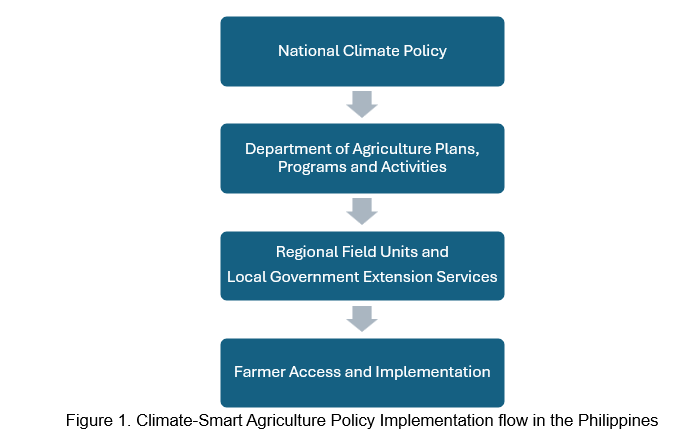
To clarify how these policies are expected to function in practice, Figure 1 illustrates the flow of climate-smart agriculture interventions from national institutions to farmers. National agencies formulate policies and allocate resources, while the Department of Agriculture translates these into programs and activities. These are implemented through regional field units and local government extension services, which serve as the primary interface with farmers. At the final stage, farmers access and apply these interventions within their production systems.
While this structure appears coherent, breakdowns often occur along this chain. Weak coordination, delays in information flow, and uneven service delivery constrain farmers’ ability to adopt climate-smart practices. This underscores the importance of strengthening institutional linkages across governance levels to ensure that national policy objectives result in tangible outcomes at the farm level.
INSTITUTIONAL LESSONS FROM CAMARINES SUR PROVINCE
The experience of Camarines Sur highlights the critical role of institutional capacity in climate adaptation. Farmers depend heavily on extension services, irrigation systems, and government programs to cope with increasing climate risks. Empirical evidence shows that climate adaptation outcomes are strongly shaped by institutional conditions (Table 2). Extension services are central to enabling farmers’ access to climate information and public support (Anderson & Feder, 2007); however, serious staffing gaps persist. The Department of Agriculture has set a benchmark of roughly one licensed agriculturist for every 50 farmers to ensure adequate field-level support, yet assessments by the Philippine Institute for Development Studies (PIDS) report ratios as high as one extension worker per 900 or more farmers in some municipal agricultural offices (PIDS, 2007; DA, 2025). Such heavy workloads constrain the frequency and quality of farmer engagement and limit effective dissemination of climate-smart practices.
Irrigation systems likewise play a crucial role in reducing vulnerability to rainfall variability (Rosegrant & Cline, 2003). However, national data reveal substantial infrastructure gaps. The National Irrigation Administration (NIA) estimates that only about 60–65% of potentially irrigable agricultural land is currently served by functional irrigation systems, with many facilities suffering from aging infrastructure and insufficient maintenance (NIA, 2022). These deficiencies weaken farmers’ adaptive capacity, particularly during droughts and delayed monsoon periods. Unequal access to irrigation and government programs further exacerbates disparities in resilience across communities, as smallholders and remote farmers are less likely to be included in program targeting and service delivery (World Bank, 2019; PIDS, 2018).
Institutional fragmentation also undermines implementation effectiveness. Studies on local agricultural governance identify problems related to delayed budget releases, lengthy procurement procedures, and underutilization of allocated funds, which prevent programs from being implemented in time to match farmers’ seasonal needs (DBM, 2021; PIDS, 2019). These coordination failures between national agencies and local government units contribute to gaps between policy design and field-level outcomes. Together, these challenges indicate that strengthening both physical infrastructure and institutional capacity is essential for translating national climate objectives into tangible adaptation benefits for farmers.
Table 2. National policy framework supporting climate-smart agriculture in the Philippines
|
Institutional area
|
Observed condition
|
Policy lesson
|
|
Extension service
|
Severe personnel shortages: benchmark of 1 Agri-Extension worker (AEW) per 50 farmers versus actual ratios of up to 1 AEW per 900 farmers in some LGUs. Heavy workloads limit regular farm visits and technical assistance.
|
Increase extension staffing and monitoring capacity; invest in training and retention of extension workers.
|
|
Irrigation systems
|
Infrastructure gaps: Only 60–65% of potentially irrigable land is covered by functional irrigation systems; many facilities are aging and poorly maintained
|
Expand irrigation investment and prioritize the rehabilitation and construction of climate-resilient infrastructure.
|
|
Government programs
|
Uneven and inequitable access: Smallholders and remote farmers face lower participation rates in subsidy, insurance, and adaptation programs. Targeting inefficiencies contribute to unequal resilience outcomes.
|
Strengthen beneficiary selection, improve outreach mechanisms, and ensure inclusive implementation.
|
|
Institutional coordination
|
Fragmentation due to delayed budget releases, long procurement processes, and underutilized funds that do not align with cropping calendars. Weak national–local coordination affects program timing and effectiveness.
|
Improve inter-agency coordination and synchronize budgeting and procurement with agricultural cycles.
|
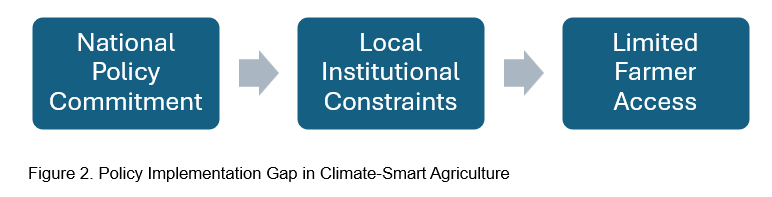
The gap between national climate-smart agriculture (CSA) policy and farm-level outcomes in Camarines Sur is shaped by several local institutional constraints that limit effective implementation. First, fragmented coordination among local government units and agricultural agencies often , short-term program delivery. Second, limited extension services reduce farmers’ access to timely, practical knowledge of CSA practices, particularly for smallholders managing diverse rice systems. Third, financial constraints remain a major barrier, as many farmers lack access to affordable credit and cannot shoulder the upfront costs of climate-resilient technologies. Fourth, weak market incentives—such as unstable rice prices and the absence of premiums for sustainable production—discourage investment in CSA. In addition, infrastructure gaps, including unreliable irrigation and delays in input distribution, further constrain adoption. Finally, local social and political dynamics, such as patronage and unequal access to programs, influence who benefits from government support.
Taken together, these constraints illustrate that the challenge is not only about policy design but also about aligning national initiatives with local realities. As observed in broader CSA literature, adoption is highly context-specific and depends on the presence of enabling institutions that support farmers beyond policy intent (Lipper et al., 2014; Arslan et al., 2015). In the case of Camarines Sur, these institutional limitations help explain why CSA outcomes remain uneven across rice-based farming systems.
POLICY IMPLICATIONS FOR NATIONAL CLIMATE-SMART AGRICULTURE STRATEGY
A comparison of the Hazard Index and Adaptive Capacity maps (Figures 3-4) shows that several municipalities facing high to very high hazard exposure also have low adaptive capacity. This means that climate risk in Camarines Sur is shaped not only by its geography, being prone to typhoons, floods, and landslides, but also by local limitations in governance, resources, and basic support systems. When adaptive capacity is weak, even less severe weather events can result in serious agricultural losses and longer recovery periods for communities.
The pattern suggests that vulnerability is closely tied to institutional strength. Municipalities exposed to similar hazards experience different outcomes depending on their financial capacity, planning systems, and coordination mechanisms. Addressing climate risk, therefore, requires more than infrastructure projects; it also demands stronger local institutions, better resource allocation, and improved preparedness systems to ensure communities can respond to and recover from shocks effectively.
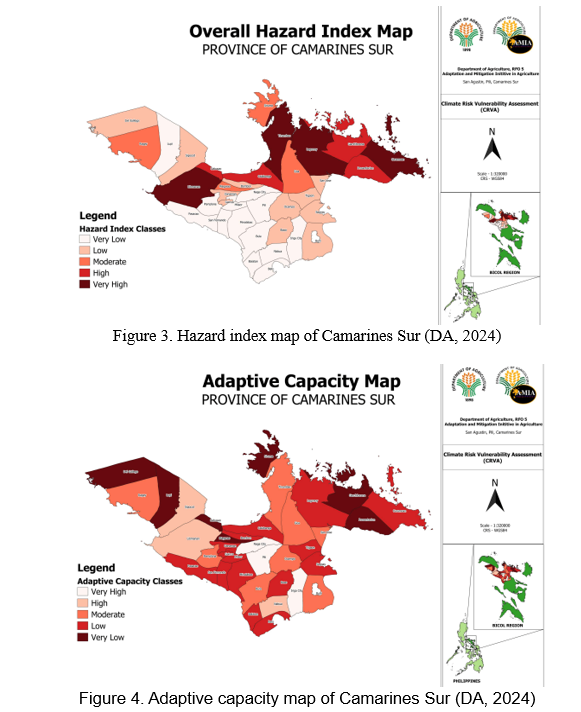
Building on these findings, policy responses must directly address the institutional gaps revealed by the spatial analysis. First, institutional strengthening should be elevated as a core pillar of CSA policy. The adaptive capacity map indicates that municipalities facing the greatest climate risks often have limited technical and operational capacity. Strengthening local agricultural offices, extension personnel, and planning units is essential to ensure that climate-responsive technologies and practices are properly implemented and sustained.
Second, extension systems need to be expanded and systematically climate-informed. Evidence from Bicol shows that farmer field schools and localized agro-climatic advisories improve farm-level decisions under rainfall variability and temperature stress. Embedding climate information into routine extension work can help translate risk assessments into concrete farmer action, particularly in high-risk areas. Third, irrigation and water management investments remain fundamental, especially where drought and flooding risks are both present. Prioritizing municipalities where water insecurity coincides with weak adaptive capacity can make other CSA interventions more effective.
Finally, stronger national–local coordination is necessary to align planning, financing, and data sharing across levels of government. At the same time, climate-smart agriculture (CSA) must be systematically integrated into local development planning processes within LGUs, including agricultural investment plans and land-use frameworks. Embedding CSA into formal planning instruments ensures that climate risk reduction is not treated as a stand-alone program but as a sustained development priority supported by local budgets and institutional mandates. Together, these measures ground the national CSA framework in spatial risk realities and shift climate policy toward more targeted, implementation-focused resilience building.
CONCLUSION
Climate change poses a systemic threat to agriculture worldwide, with disproportionate consequences for developing countries that depend on climate-sensitive crops. The Philippines, consistently ranked among the most climate-vulnerable nations, faces recurrent typhoons, flooding, and rainfall variability that directly threaten rice production, rural livelihoods, and national food security. While climate-smart agriculture (CSA) has been institutionalized through the Climate Change Act of 2009, the National Climate Change Action Plan, and Department of Agriculture modernization and irrigation programs, the effectiveness of this policy architecture ultimately hinges on local implementation capacity.
The case of Camarines Sur demonstrates that climate vulnerability is shaped not only by exposure to extreme events but also by institutional conditions that determine adaptive response. Recent severe storms in the Bicol Region illustrate how repeated climatic shocks compound risks to crop systems and household incomes. Yet spatial analysis of hazard exposure and adaptive capacity shows that municipalities facing the highest climate risks often exhibit the weakest institutional support structures. This misalignment between risk intensity and delivery capacity explains persistent gaps between national CSA intent and field-level outcomes.
Empirical evidence further indicates that extension staffing shortages, irrigation infrastructure deficits, uneven access to government programs, and fragmented coordination across governance levels constrain the translation of policy into practice. In a decentralized agricultural system, frontline service delivery—particularly extension services and water management—remains the decisive interface between national strategy and farmer adaptation. Without adequate human resources, synchronized budgeting, and functional infrastructure, even well-designed policies struggle to generate sustained gains in resilience.
The findings suggest that the next phase of CSA policy refinement in the Philippines must move beyond framework development toward institutional deepening. Targeted investments in extension manpower and climate information services, rehabilitation and expansion of climate-resilient irrigation systems, and institutionalized national–local coordination mechanisms are critical to aligning policy ambition with implementation realities.
More broadly, the Camarines Sur experience reinforces an important lesson for climate adaptation governance: resilience is co-produced by environmental conditions and institutional capacity. Embedding sustained capacity-building within national CSA strategies offers a pragmatic pathway for converting policy commitments into measurable improvements in productivity stability, livelihood security, and long-term agricultural resilience.
REFERENCES
Anderson, J. R., & G. Feder. 2007. Agricultural extension: Good intentions and hard realities. The World Bank Research Observer, 22(1), 41–60.
A. B., Jr., & D. Moscare. 2002. Decentralization and devolution in the Philippines: Lessons from provincial and local governments. University of the Philippines National College of Public Administration and Governance.
Arslan, A. et al. 2015. Adoption and impacts of CSA practices. World Development.
Brillantes, A. B., & D. Moscare. 2002. Decentralization and federalism in the Philippines: Lessons from global community. University of the Philippines National College of Public Administration and Governance.
Climate Change Commission. 2011. Climate Change Act of 2009 (Republic Act No. 9729): Implementing rules and regulations. Government of the Philippines.
Department of Agriculture. n.d. Region V – Bicol Region – Adaptation and Mitigation Initiative in Agriculture (AMIA) program. Adaptation and Mitigation Initiative in Agriculture Program. https://amia.da.gov.ph/region-v-bicol-region-crva/
Department of Agriculture. 2025. Statement on extension staffing targets and workforce needs. Government of the Philippines.
Department of Agriculture. n.d. Agricultural modernization programs and policy issuances. Department of Agriculture, Republic of the Philippines.
Department of Budget and Management. 2021. Budget execution and utilization reports. Government of the Philippines.
Eckstein, D., Künzel, V., & L. Schäfer. 2021. Global Climate Risk Index 2021: Who suffers most from extreme weather events? Weather-related loss events in 2019 and 2000–2019. Germanwatch.
Food and Agriculture Organization of the United Nations. 2017. Climate-smart agriculture sourcebook. FAO.
Lipper, L. et al. 2014. Climate-smart agriculture for food security. Nature Climate Change.
National Irrigation Administration. 2022. Annual report on irrigation coverage. Government of the Philippines.
Philippine Institute for Development Studies. 2007. Profile of municipal agricultural offices. PIDS.
Philippine Institute for Development Studies. 2018. Studies on agricultural governance and local implementation. PIDS.
Philippine Institute for Development Studies. 2019. Studies on agricultural governance and local implementation. PIDS.
Rola, A. C., Elazegui, D. D., & J.M. Pulhin. 2015. Strategic policy response to climate change in the Philippines (Volume 2): Exploring adaptation pathways. CGIAR Research Program on Climate Change, Agriculture and Food Security (CCAFS).
Rosegrant, M. W., & S.A. Cline. 2003. Global food security: Challenges and policies. Science, 302(5652), 1917–1919.
Sajise, A. J. U., & A. Torre. 2017. Climate-resiliency field schools: Building adaptive capacity of smallholder farmers in the Philippines. World Development, 98, 214–225. https://doi.org/10.1016/j.worlddev.2017.04.006
Scherr, S. J., Shames, S., & R. Friedman, R. 2012. From climate-smart agriculture to climate-smart landscapes. Agriculture & Food Security, 1(1), 12. https://doi.org/10.1186/2048-7010-1-12
United Nations Framework Convention on Climate Change. (2015). Adoption of the Paris Agreement. UNFCCC.
Wassmann, R., & A. Dobermann. 2009. Climate change adaptation in rice systems: Institutional and farmer responses. In R. S. D. Singh, R. K. Srivastava, & J. She (Eds.), Climate risk management in Asia: Uncertainties and adaptation (pp. 91–133). Elsevier.
World Bank. 2019. Transforming Philippine agriculture. World Bank.
[MC1]Please further elaborate on the objectives and policy implications. For example, for the agri modernization policy, the objective states that it aims to improve productivity and resilience. You may expand on this by explaining briefly how it will achieve these goals or by highlighting the key provision of the law.
[DJR2]Done elaborating the main table 1 and its supporting discussions


Why National Climate-Smart Agriculture Policy Struggles at the Local Level: Institutional and Policy Lessons from Rice Systems in Camarines Sur, Philippines
ABSTRACT
Climate-smart agriculture (CSA) has become a central pillar of the Philippines’ strategy to address agricultural risks arising from climate variability and intensifying extreme weather events. As one of the world’s most climate-vulnerable countries, the Philippines has embedded climate adaptation within national agricultural governance and development planning to strengthen resilience among farming communities exposed to typhoons, flooding, drought, and rainfall variability. Despite comprehensive policy frameworks and strong national commitment, the effectiveness of CSA implementation varies considerably across regions and localities. Spatial evidence from Camarines Sur Province indicates that areas facing high hazard exposure often exhibit low adaptive capacity, underscoring the institutional dimensions of climate vulnerability. This study examines the governance and institutional conditions shaping CSA implementation in the rice farming systems of Camarines Sur, Philippines. Through an analysis of institutional arrangements, extension services, irrigation infrastructure, and national–local planning linkages, the paper identifies structural bottlenecks that constrain effective policy translation. The findings demonstrate that national CSA policy continues to stem from uneven local capacity, infrastructure deficits, and coordination challenges. The study argues that strengthening extension systems, prioritizing climate-resilient irrigation investment, and institutionalizing national–local alignment is critical to advancing adaptation objectives and ensuring equitable delivery of climate resilience benefits.
Keywords: Agricultural extension, climate-smart agriculture, climate policy, irrigation, institutional capacity
INTRODUCTION
Climate change has become a major concern for agricultural systems worldwide, particularly in developing countries that rely heavily on climate-sensitive crops. The Philippines is consistently ranked among the most climate-vulnerable countries due to its exposure to typhoons, flooding, and rainfall variability (Eckstein et al., 2021). Rice production, which plays a central role in national food security, is especially vulnerable to these environmental risks (Wassmann et al., 2009). These climatic stresses threaten not only farm productivity but also rural livelihoods, and the stability of domestic food supply systems.
In response, climate-smart agriculture has been adopted as a national policy approach to strengthen agricultural resilience (FAO, 2017). National institutions such as the Philippine Climate Change Commission and the Department of Agriculture have developed programs to support farmer adaptation. However, the success of these policies depends heavily on local implementation, where institutional capacity, resource availability, and farmer engagement vary considerably across regions. Understanding how national strategies translate into local action is therefore critical for improving the effectiveness of climate-smart agriculture initiatives. This study examines lessons from Camarines Sur, Philippines, to understand the institutional challenges affecting national climate-smart agriculture policy.
NATIONAL POLICY CONTEXT AND IMPLEMENTATION GAPS
The Philippine government has developed an extensive policy framework to address climate change in agriculture, anchored in the Climate Change Act of 2009 and supported by subsequent instruments, including the National Climate Change Action Plan. These policies collectively seek to embed climate change adaptation and mitigation within national and local development processes, while positioning agriculture as a priority sector due to its high exposure to climate risks. In line with the principles of climate-smart agriculture, the framework emphasizes improving productivity, strengthening resilience, and supporting sustainable resource use.
Table 1 summarizes the key national policies that underpin climate-smart agriculture in the Philippines, including their implementing agencies, stated objectives, and intended policy implications. The table is compiled by the authors of the Climate Change Commission and the Department of Agriculture (Climate Change Commission, 2011; Department of Agriculture, various issuances). It highlights that while policy objectives are clearly articulated, their effectiveness depends on how these objectives are translated into actionable interventions at the local level.
Table 1. National policy framework supporting climate-smart agriculture in the Philippines
Policy
Implementing agency
Objective
(Policy intent)
Policy implication
Climate Change Act of 2009
Climate Change Commission
Institutionalize climate change adaptation and mainstream climate risks into national and local planning
Requires LGUs to integrate climate risk assessments into development plans and budgets, directing resources toward climate-resilient agriculture, disaster risk reduction, and adaptive infrastructure
National Climate Change Action Plan
Climate Change Commission
Promote climate-resilient agriculture and guide sectoral adaptation priorities
Provides a strategic framework for agencies and LGUs to implement location-specific CSA practices, including stress-tolerant crops, diversified farming systems, and risk management interventions
Agricultural Modernization Programs
Department of Agriculture
Increase agricultural productivity while enhancing resilience to climate variability
Channels public investment into mechanization, input support, and extension services to facilitate farmer adoption of adaptive technologies and improve production stability
Irrigation and infrastructure programs
Department of Agriculture
Strengthen agricultural systems through improved water management and physical infrastructure
Expands and rehabilitation of irrigation systems and farm infrastructure to reduce climate-related production risks, particularly drought and flooding in rice-based systems
Source: Compiled from official policy documents of the Philippine Climate Change Commission and the Department of Agriculture.
A closer examination of these policies shows that their intended impacts rely on specific institutional and operational pathways. The Climate Change Act of 2009, for instance, seeks to integrate climate adaptation into development planning by requiring local government units to mainstream climate risks into their plans, programs, and budgets. In practice, this means that local governments are expected to prioritize investments in climate-resilient infrastructure, disaster risk reduction systems, and adaptive agricultural support. The National Climate Change Action Plan further provides strategic direction by identifying climate-resilient agriculture as a key priority area, encouraging agencies to promote practices such as stress-tolerant crop varieties, diversified farming systems, and improved risk management strategies.
Similarly, agricultural modernization programs aim to enhance both productivity and resilience through mechanisms such as mechanization, input provision, and extension services. These interventions are designed to reduce farmers’ vulnerability to climate variability by improving efficiency and enabling the adoption of adaptive technologies. Irrigation and infrastructure programs complement these efforts by stabilizing water supply and reducing exposure to droughts and floods, which are critical concerns in rice-based production systems.
Despite this strong policy foundation, existing evidence suggests that the effectiveness of these initiatives is uneven across local contexts. The literature consistently points to a gap between national policy design and local implementation, often driven by institutional constraints such as limited technical capacity, fragmented governance structures, and weak interagency coordination (Brillantes and Moscare, 2002; CCAFS, 2015). In many cases, policies provide broad strategic direction but leave substantial discretion to local actors, whose ability to implement them varies considerably.
In Camarines Sur, these challenges are particularly evident. Although national policies promote integrated and climate-responsive agricultural systems, their outcomes depend heavily on the capacity of local institutions to deliver services and support farmer adoption. For example, while agricultural modernization programs are intended to improve productivity and resilience, their impact is shaped by the availability and effectiveness of local extension services. Climate-smart agriculture practices are knowledge-intensive and require sustained engagement with farmers, yet extension systems often face staffing and resource limitations. As a result, the adoption and scaling of these practices remain uneven.
Institutional fragmentation further complicates implementation. National agencies operate within sector-specific mandates, while local government units must balance multiple development priorities under constrained budgets. This can lead to misalignment between policy objectives and actual interventions on the ground. In climate-vulnerable rice-producing areas, such as those frequently affected by flooding and typhoons, these gaps become more pronounced, limiting farmers' ability to benefit from national programs.
Taken together, these dynamics suggest that the primary challenge lies not in the absence of policy but in the capacity to operationalize it effectively at the local level. Bridging this gap requires strengthening local institutions, investing in extension systems, and improving coordination across governance levels. In the case of rice systems in Camarines Sur, these institutional conditions are central to determining whether national climate-smart agriculture policies can translate into tangible improvements in productivity, resilience, and farmer welfare.
To clarify how these policies are expected to function in practice, Figure 1 illustrates the flow of climate-smart agriculture interventions from national institutions to farmers. National agencies formulate policies and allocate resources, while the Department of Agriculture translates these into programs and activities. These are implemented through regional field units and local government extension services, which serve as the primary interface with farmers. At the final stage, farmers access and apply these interventions within their production systems.
While this structure appears coherent, breakdowns often occur along this chain. Weak coordination, delays in information flow, and uneven service delivery constrain farmers’ ability to adopt climate-smart practices. This underscores the importance of strengthening institutional linkages across governance levels to ensure that national policy objectives result in tangible outcomes at the farm level.
INSTITUTIONAL LESSONS FROM CAMARINES SUR PROVINCE
The experience of Camarines Sur highlights the critical role of institutional capacity in climate adaptation. Farmers depend heavily on extension services, irrigation systems, and government programs to cope with increasing climate risks. Empirical evidence shows that climate adaptation outcomes are strongly shaped by institutional conditions (Table 2). Extension services are central to enabling farmers’ access to climate information and public support (Anderson & Feder, 2007); however, serious staffing gaps persist. The Department of Agriculture has set a benchmark of roughly one licensed agriculturist for every 50 farmers to ensure adequate field-level support, yet assessments by the Philippine Institute for Development Studies (PIDS) report ratios as high as one extension worker per 900 or more farmers in some municipal agricultural offices (PIDS, 2007; DA, 2025). Such heavy workloads constrain the frequency and quality of farmer engagement and limit effective dissemination of climate-smart practices.
Irrigation systems likewise play a crucial role in reducing vulnerability to rainfall variability (Rosegrant & Cline, 2003). However, national data reveal substantial infrastructure gaps. The National Irrigation Administration (NIA) estimates that only about 60–65% of potentially irrigable agricultural land is currently served by functional irrigation systems, with many facilities suffering from aging infrastructure and insufficient maintenance (NIA, 2022). These deficiencies weaken farmers’ adaptive capacity, particularly during droughts and delayed monsoon periods. Unequal access to irrigation and government programs further exacerbates disparities in resilience across communities, as smallholders and remote farmers are less likely to be included in program targeting and service delivery (World Bank, 2019; PIDS, 2018).
Institutional fragmentation also undermines implementation effectiveness. Studies on local agricultural governance identify problems related to delayed budget releases, lengthy procurement procedures, and underutilization of allocated funds, which prevent programs from being implemented in time to match farmers’ seasonal needs (DBM, 2021; PIDS, 2019). These coordination failures between national agencies and local government units contribute to gaps between policy design and field-level outcomes. Together, these challenges indicate that strengthening both physical infrastructure and institutional capacity is essential for translating national climate objectives into tangible adaptation benefits for farmers.
Table 2. National policy framework supporting climate-smart agriculture in the Philippines
Institutional area
Observed condition
Policy lesson
Extension service
Severe personnel shortages: benchmark of 1 Agri-Extension worker (AEW) per 50 farmers versus actual ratios of up to 1 AEW per 900 farmers in some LGUs. Heavy workloads limit regular farm visits and technical assistance.
Increase extension staffing and monitoring capacity; invest in training and retention of extension workers.
Irrigation systems
Infrastructure gaps: Only 60–65% of potentially irrigable land is covered by functional irrigation systems; many facilities are aging and poorly maintained
Expand irrigation investment and prioritize the rehabilitation and construction of climate-resilient infrastructure.
Government programs
Uneven and inequitable access: Smallholders and remote farmers face lower participation rates in subsidy, insurance, and adaptation programs. Targeting inefficiencies contribute to unequal resilience outcomes.
Strengthen beneficiary selection, improve outreach mechanisms, and ensure inclusive implementation.
Institutional coordination
Fragmentation due to delayed budget releases, long procurement processes, and underutilized funds that do not align with cropping calendars. Weak national–local coordination affects program timing and effectiveness.
Improve inter-agency coordination and synchronize budgeting and procurement with agricultural cycles.
The gap between national climate-smart agriculture (CSA) policy and farm-level outcomes in Camarines Sur is shaped by several local institutional constraints that limit effective implementation. First, fragmented coordination among local government units and agricultural agencies often , short-term program delivery. Second, limited extension services reduce farmers’ access to timely, practical knowledge of CSA practices, particularly for smallholders managing diverse rice systems. Third, financial constraints remain a major barrier, as many farmers lack access to affordable credit and cannot shoulder the upfront costs of climate-resilient technologies. Fourth, weak market incentives—such as unstable rice prices and the absence of premiums for sustainable production—discourage investment in CSA. In addition, infrastructure gaps, including unreliable irrigation and delays in input distribution, further constrain adoption. Finally, local social and political dynamics, such as patronage and unequal access to programs, influence who benefits from government support.
Taken together, these constraints illustrate that the challenge is not only about policy design but also about aligning national initiatives with local realities. As observed in broader CSA literature, adoption is highly context-specific and depends on the presence of enabling institutions that support farmers beyond policy intent (Lipper et al., 2014; Arslan et al., 2015). In the case of Camarines Sur, these institutional limitations help explain why CSA outcomes remain uneven across rice-based farming systems.
POLICY IMPLICATIONS FOR NATIONAL CLIMATE-SMART AGRICULTURE STRATEGY
A comparison of the Hazard Index and Adaptive Capacity maps (Figures 3-4) shows that several municipalities facing high to very high hazard exposure also have low adaptive capacity. This means that climate risk in Camarines Sur is shaped not only by its geography, being prone to typhoons, floods, and landslides, but also by local limitations in governance, resources, and basic support systems. When adaptive capacity is weak, even less severe weather events can result in serious agricultural losses and longer recovery periods for communities.
The pattern suggests that vulnerability is closely tied to institutional strength. Municipalities exposed to similar hazards experience different outcomes depending on their financial capacity, planning systems, and coordination mechanisms. Addressing climate risk, therefore, requires more than infrastructure projects; it also demands stronger local institutions, better resource allocation, and improved preparedness systems to ensure communities can respond to and recover from shocks effectively.
Building on these findings, policy responses must directly address the institutional gaps revealed by the spatial analysis. First, institutional strengthening should be elevated as a core pillar of CSA policy. The adaptive capacity map indicates that municipalities facing the greatest climate risks often have limited technical and operational capacity. Strengthening local agricultural offices, extension personnel, and planning units is essential to ensure that climate-responsive technologies and practices are properly implemented and sustained.
Second, extension systems need to be expanded and systematically climate-informed. Evidence from Bicol shows that farmer field schools and localized agro-climatic advisories improve farm-level decisions under rainfall variability and temperature stress. Embedding climate information into routine extension work can help translate risk assessments into concrete farmer action, particularly in high-risk areas. Third, irrigation and water management investments remain fundamental, especially where drought and flooding risks are both present. Prioritizing municipalities where water insecurity coincides with weak adaptive capacity can make other CSA interventions more effective.
Finally, stronger national–local coordination is necessary to align planning, financing, and data sharing across levels of government. At the same time, climate-smart agriculture (CSA) must be systematically integrated into local development planning processes within LGUs, including agricultural investment plans and land-use frameworks. Embedding CSA into formal planning instruments ensures that climate risk reduction is not treated as a stand-alone program but as a sustained development priority supported by local budgets and institutional mandates. Together, these measures ground the national CSA framework in spatial risk realities and shift climate policy toward more targeted, implementation-focused resilience building.
CONCLUSION
Climate change poses a systemic threat to agriculture worldwide, with disproportionate consequences for developing countries that depend on climate-sensitive crops. The Philippines, consistently ranked among the most climate-vulnerable nations, faces recurrent typhoons, flooding, and rainfall variability that directly threaten rice production, rural livelihoods, and national food security. While climate-smart agriculture (CSA) has been institutionalized through the Climate Change Act of 2009, the National Climate Change Action Plan, and Department of Agriculture modernization and irrigation programs, the effectiveness of this policy architecture ultimately hinges on local implementation capacity.
The case of Camarines Sur demonstrates that climate vulnerability is shaped not only by exposure to extreme events but also by institutional conditions that determine adaptive response. Recent severe storms in the Bicol Region illustrate how repeated climatic shocks compound risks to crop systems and household incomes. Yet spatial analysis of hazard exposure and adaptive capacity shows that municipalities facing the highest climate risks often exhibit the weakest institutional support structures. This misalignment between risk intensity and delivery capacity explains persistent gaps between national CSA intent and field-level outcomes.
Empirical evidence further indicates that extension staffing shortages, irrigation infrastructure deficits, uneven access to government programs, and fragmented coordination across governance levels constrain the translation of policy into practice. In a decentralized agricultural system, frontline service delivery—particularly extension services and water management—remains the decisive interface between national strategy and farmer adaptation. Without adequate human resources, synchronized budgeting, and functional infrastructure, even well-designed policies struggle to generate sustained gains in resilience.
The findings suggest that the next phase of CSA policy refinement in the Philippines must move beyond framework development toward institutional deepening. Targeted investments in extension manpower and climate information services, rehabilitation and expansion of climate-resilient irrigation systems, and institutionalized national–local coordination mechanisms are critical to aligning policy ambition with implementation realities.
More broadly, the Camarines Sur experience reinforces an important lesson for climate adaptation governance: resilience is co-produced by environmental conditions and institutional capacity. Embedding sustained capacity-building within national CSA strategies offers a pragmatic pathway for converting policy commitments into measurable improvements in productivity stability, livelihood security, and long-term agricultural resilience.
REFERENCES
Anderson, J. R., & G. Feder. 2007. Agricultural extension: Good intentions and hard realities. The World Bank Research Observer, 22(1), 41–60.
A. B., Jr., & D. Moscare. 2002. Decentralization and devolution in the Philippines: Lessons from provincial and local governments. University of the Philippines National College of Public Administration and Governance.
Arslan, A. et al. 2015. Adoption and impacts of CSA practices. World Development.
Brillantes, A. B., & D. Moscare. 2002. Decentralization and federalism in the Philippines: Lessons from global community. University of the Philippines National College of Public Administration and Governance.
Climate Change Commission. 2011. Climate Change Act of 2009 (Republic Act No. 9729): Implementing rules and regulations. Government of the Philippines.
Department of Agriculture. n.d. Region V – Bicol Region – Adaptation and Mitigation Initiative in Agriculture (AMIA) program. Adaptation and Mitigation Initiative in Agriculture Program. https://amia.da.gov.ph/region-v-bicol-region-crva/
Department of Agriculture. 2025. Statement on extension staffing targets and workforce needs. Government of the Philippines.
Department of Agriculture. n.d. Agricultural modernization programs and policy issuances. Department of Agriculture, Republic of the Philippines.
Department of Budget and Management. 2021. Budget execution and utilization reports. Government of the Philippines.
Eckstein, D., Künzel, V., & L. Schäfer. 2021. Global Climate Risk Index 2021: Who suffers most from extreme weather events? Weather-related loss events in 2019 and 2000–2019. Germanwatch.
Food and Agriculture Organization of the United Nations. 2017. Climate-smart agriculture sourcebook. FAO.
Lipper, L. et al. 2014. Climate-smart agriculture for food security. Nature Climate Change.
National Irrigation Administration. 2022. Annual report on irrigation coverage. Government of the Philippines.
Philippine Institute for Development Studies. 2007. Profile of municipal agricultural offices. PIDS.
Philippine Institute for Development Studies. 2018. Studies on agricultural governance and local implementation. PIDS.
Philippine Institute for Development Studies. 2019. Studies on agricultural governance and local implementation. PIDS.
Rola, A. C., Elazegui, D. D., & J.M. Pulhin. 2015. Strategic policy response to climate change in the Philippines (Volume 2): Exploring adaptation pathways. CGIAR Research Program on Climate Change, Agriculture and Food Security (CCAFS).
Rosegrant, M. W., & S.A. Cline. 2003. Global food security: Challenges and policies. Science, 302(5652), 1917–1919.
Sajise, A. J. U., & A. Torre. 2017. Climate-resiliency field schools: Building adaptive capacity of smallholder farmers in the Philippines. World Development, 98, 214–225. https://doi.org/10.1016/j.worlddev.2017.04.006
Scherr, S. J., Shames, S., & R. Friedman, R. 2012. From climate-smart agriculture to climate-smart landscapes. Agriculture & Food Security, 1(1), 12. https://doi.org/10.1186/2048-7010-1-12
United Nations Framework Convention on Climate Change. (2015). Adoption of the Paris Agreement. UNFCCC.
Wassmann, R., & A. Dobermann. 2009. Climate change adaptation in rice systems: Institutional and farmer responses. In R. S. D. Singh, R. K. Srivastava, & J. She (Eds.), Climate risk management in Asia: Uncertainties and adaptation (pp. 91–133). Elsevier.
World Bank. 2019. Transforming Philippine agriculture. World Bank.
[MC1]Please further elaborate on the objectives and policy implications. For example, for the agri modernization policy, the objective states that it aims to improve productivity and resilience. You may expand on this by explaining briefly how it will achieve these goals or by highlighting the key provision of the law.
[DJR2]Done elaborating the main table 1 and its supporting discussions