ABSTRACT
Malaysia’s broiler industry plays a critical role in ensuring national food security and providing affordable animal protein, yet the sector faces persistent cost pressures that undermine long-term economic sustainability. Based on empirical estimates from broiler farms in Peninsular Malaysia, both technical and cost efficiency levels exceed 0.90 on average. Nevertheless, profitability remains constrained due to structural cost conditions rather than farm-level inefficiencies. These structural pressures include heavy dependence on imported feed ingredients, exposure to input price volatility, and asymmetric cost transmission within vertically coordinated production systems. This paper examines policy strategies to enhance cost sustainability in Malaysia’s broiler industry by shifting the focus from farm-level efficiency improvements towards system-level cost management and resilience. Drawing on empirical efficiency evidence and national policy frameworks, including the National Agrofood Policy 2.0 (NAP 2.0) and the National Food Security Policy (DSMN) Action Plan 2021–2025, the paper identifies key policy priorities centred on strengthening feed security, improving cost transparency and risk sharing in contract farming arrangements, and embedding cost resilience as a core objective of broiler sector development. This study highlights that strengthening cost resilience across the broiler value chain is essential to sustain competitiveness and support inclusive growth, particularly amid rising exposure to global market uncertainty and external cost shocks.
Keywords: Broiler Industry, Cost Sustainability, Cost Efficiency
INTRODUCTION
The broiler industry is a cornerstone of Malaysia’s agri-food sector, supplying affordable animal protein and supporting employment and income generation across the broiler production and agribusiness value chain. Broiler meat contributes nearly half of national meat consumption in Malaysia, making it a vital contributor to the country's food security (Department of Veterinary Services Malaysia [DVS], 2024). The sector’s development has been supported by strong domestic demand, the prevalence of vertically coordinated production systems such as contract farming, and gradual improvements in farm management practices and biosecurity standards (Kaur et al., 2010; Kasron & Buda, 2024).
Despite its economic importance, the broiler industry continues to face sustained financial pressure as production costs rise steadily. Increases in major inputs, particularly feed, day-old chicks, utilities, and labor, have significantly elevated total production costs, with feed alone accounting for approximately 65-70% of overall expenditure (Department of Statistics Malaysia [DOSM], 2023; Md Isa et al., 2019). Notwithstanding relatively strong technical performance, as reflected by feed conversion ratios ranging from 1.29 to 1.57 (Abdurofi et al., 2018), profitability at the farm level remains persistently constrained.
Previous empirical studies indicate that Malaysian broiler farms generally operate at relatively high levels of technical efficiency (Gabdo et al., 2017; Yunus, 2012) and cost efficiency (Mohammad Nor et al., 2024a) under prevailing production technologies. As such, escalating production costs are unlikely to be driven primarily by farm-level inefficiency. Instead, cost pressures appear to stem from broader structural factors beyond farmers’ control, including heavy reliance on imported feed ingredients, exposure to exchange rate volatility, rising input prices, and concentration in upstream input markets (Mohammad Nor et al., 2024a; Md Isa et al., 2019; Malaysia Competition Commission [MyCC], 2014).
Therefore, addressing these challenges requires analytical and policy perspectives that extend beyond farm-level efficiency improvements. Enhancing the economic resilience of Malaysia’s broiler industry requires system-level cost-management strategies that mitigate external cost shocks and improve cost stability throughout the production chain.
OVERVIEW OF MALAYSIA’S BROILER INDUSTRY
Malaysia’s broiler industry is characterized by a highly integrated production and marketing structure, where a relatively small number of vertically integrated firms play a central role across most stages of the supply chain, including feed milling, breeder farms, hatcheries, processing, and wholesale distribution (Kaur et al., 2010; MyCC, 2014). Although a substantial share of broiler output is produced by contract and independent farmers, many of these producers remain heavily dependent on integrators for key inputs such as feed, day-old chicks (DOCs), and veterinary services. This reliance reflects a concentrated upstream input market in which dominant firms exert considerable influence over input prices and production conditions.
Empirical studies provide clear evidence of structural concentration within Malaysia’s broiler industry. Kaur et al. (2010) show that the broiler market in Peninsular Malaysia exhibits features of imperfect competition, driven by increasing vertical integration and a limited number of wholesalers operating at the central market level. In simple terms, a small group of firms plays a central role in coordinating the production, marketing, and pricing of broilers. Wholesale markets, particularly the central market, serve as key reference points for price formation, and price movements at this level are transmitted downstream to farm-gate prices, while producers have limited influence over pricing outcomes.
In practice, this structure shapes the economic position of broiler producers. Many growers, whether operating independently or under contract arrangements, depend on integrators for essential inputs such as feed, day-old chicks (DOCs), veterinary services, and access to marketing channels (Tapsir et al., 2011; MyCC, 2014). Input prices are largely determined outside the farm, while marketing is commonly organized through established wholesale or contractual networks (Tapsir et al., 2011). Consequently, individual producers have limited ability to negotiate either input prices or selling prices (Kaur et al., 2010; Tapsir et al., 2011).
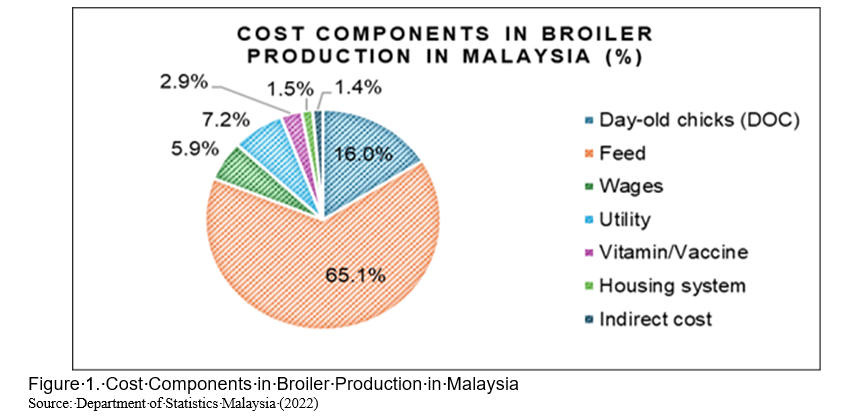
Such structural characteristics place producers in a weaker bargaining position and limit their ability to respond effectively to rising production costs. These structural constraints have important implications for production costs. Data from the Department of Statistics Malaysia indicate that feed accounts for approximately two-thirds of total broiler production costs, making it the most dominant cost component in the industry (DOSM, 2022; MyCC, 2014; Shaban & Alabboodi, 2019). Feed formulations rely heavily on imported grain corn and soybean meals, which expose producers to exchange rate movements, global supply disruptions, and international commodity price volatility (MyCC, 2014; DOSM, 2022; Mohammad Nor et al., 2024). When feed prices increase, these higher costs are reflected directly in farm-level production costs (DOSM, 2022). However, when feed prices decline, or when farms improve production efficiency, the benefits are not always transmitted proportionately to farm-gate prices (Kaur et al., 2010; MyCC, 2014).
As a result, production costs in Malaysia’s broiler industry remain high despite strong technical performance at the farm level. Structural concentration in upstream input supply and wholesale marketing limits producers’ bargaining power and constrains their ability to respond effectively to changing market conditions (Kaur et al., 2010; Tapsir et al., 2011). Producers that are more exposed to market fluctuations, particularly smaller and independent farms, face greater difficulty absorbing cost shocks, contributing to persistent cost pressures across the broiler value chain (MyCC, 2014).
Overall, these structural characteristics indicate that rising production costs in Malaysia’s broiler industry stem less from farm-level inefficiencies and more from constraints embedded within the organization of the industry itself (Kaur et al., 2010; DOSM, 2022). This helps explain why, despite achieving close to 100% self-sufficiency and producing over 1.8 billion broilers annually (DVS, 2024), the industry continues to face significant challenges in cost sustainability. The dominance of feed costs in the cost structure highlights the sector's vulnerability to external price shocks and underscores the importance of system-level approaches to cost management. This is reflected in the cost structure of broiler production in Malaysia, where feed expenditure overwhelmingly dominates total production costs, followed by DOC and utility costs (see Figure 1).
EFFICIENCY AND COST PERFORMANCE
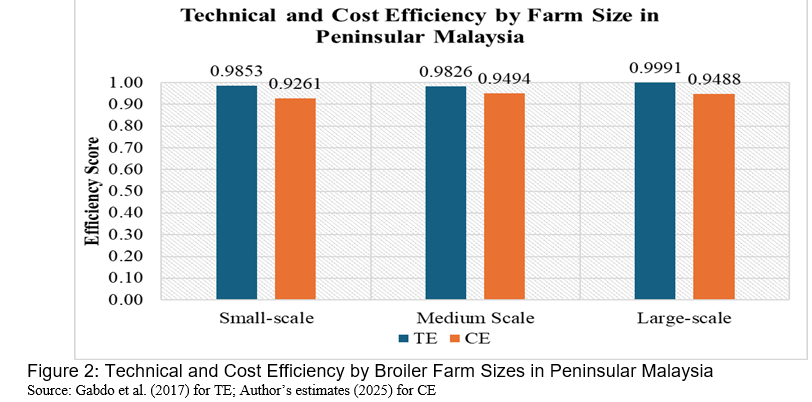
Technical performance indicators, particularly feed conversion ratio (FCR), suggest that Malaysia’s broiler farms achieve high production efficiency. FCRs ranging from 1.29 to 1.57 reflect strong feed utilization efficiency (Abdurofi et al., 2018). This technical performance is complemented by evidence from earlier efficiency studies, which show that Malaysian broiler farms generally operate at very high levels of efficiency. Gabdo et al. (2017) reported very high mean technical efficiency (TE) across all farm sizes in Peninsular Malaysia. Their results show a mean TE of 0.9853 for small-scale farms, 0.9826 for medium-scale farms, and 0.9991 for large-scale farms. These indicate that farmers utilize their input efficiently and operate close to the maximum attainable output under existing production technologies.
The cost efficiency (CE) results from this study further indicate that broiler farms operate efficiently from a cost perspective. The mean CE values estimated using the stochastic cost frontier model are high: 0.9261 for small-scale farms, 0.9494 for medium-scale farms, and 0.9488 for large-scale farms, with an overall average of 0.9482. Although CE is slightly lower than TE across all categories, as illustrated in Figure 2, both indicators exceed 0.90, demonstrating that Malaysian broiler farms are not only technically efficient but also cost-efficient.
The slightly lower CE values suggest that external cost pressures constrain the ability of technically efficient farms to achieve minimum observed production costs. In other words, high technical performance does not automatically translate into lower cost outcomes when major cost components are externally determined. Consistent with this view, Etuah et al., (2020) show that cost efficiency is shaped not only by managerial performance but also by input cost structures, while Aji et al., (2023) highlight that feed and day-old chick (DOC) prices dominate the broiler cost structure and strongly influence cost efficiency regardless of farm-level production performance. Likewise, Musaba (2014) demonstrates that feed accounts for a substantial share of total production costs, rendering cost efficiency highly sensitive to market-driven input prices rather than solely to management practices.
Taken together, these findings support the argument that the slightly lower CE values observed in this study largely reflect structural and market-related cost pressures, rather than inefficiencies in farm management. They underline that improving technical efficiency alone is insufficient to substantially reduce production costs unless broader issues such as feed price volatility, dependence on imported inputs, and concentrated input markets are also addressed.
Despite the relatively high levels of TE and CE observed among broiler farms, profitability margins remain persistently narrow, particularly for small and medium-sized producers. This mismatch between efficiency and financial performance indicates that the key constraints facing the broiler industry are structural rather than managerial, as discussed earlier in relation to vertical integration, concentration in upstream input markets, and asymmetric price transmission along the value chain, which shape cost and price formation beyond farmers’ control. Evidence from stochastic cost frontier analysis supports this interpretation, showing that only a small proportion of the variation in production costs is attributable to cost inefficiency, while the majority is driven by random shocks and external factors beyond farmers’ control, such as feed price volatility, exchange rate fluctuations, and market-driven input prices (Mohammad Nor et al., 2024a).
Comparative cross-country evidence further reinforces this finding, showing that production systems with strong feed-use efficiency often remain exposed to high and volatile production costs when input prices are externally driven, underscoring the structural nature of cost sustainability challenges in broiler production (Thobe et al., 2025). These structural pressures are closely linked to industry’s heavy dependence on imported feed ingredients. Feed constitutes the largest share of broiler production costs in Malaysia, and its price is largely determined by international market conditions, exposing producers to global commodity price volatility and exchange rate movements (MyCC, 2014; Nurshuhada et al., 2021). As major feed components such as grain corn and soybean meal are imported, any increase in world prices or depreciation of the Malaysian Ringgit is transmitted directly into higher production costs at the farm level.
At the same time, the increasing adoption of closed-house systems has raised reliance on continuous electricity and fuel use for ventilation, cooling, and environmental control. Although energy does not constitute the largest cost component, it represents a quasi-fixed operating expense that reduces cost flexibility and increases the rigidity of the production cost structure (Kasron & Buda, 2024; Nurshuhada et al., 2021). Together, these factors generate a persistent cost-price squeeze, in which farms operate efficiently but remain unable to lower per-unit costs amid escalating upstream input prices. Table 1 reinforces this observation by showing that production costs exceed selling prices in most states in Malaysia. With negative price-cost margins recorded across nearly all major producing regions, the industry’s profitability is clearly hindered by systemic cost burdens rather than weaknesses in farm management. These cost pressures are further reinforced by limited flexibility in farm-gate prices under prevailing market arrangements and policy-based price stabilization mechanisms, which restrict producers’ ability to adjust output prices in response to rising production costs.
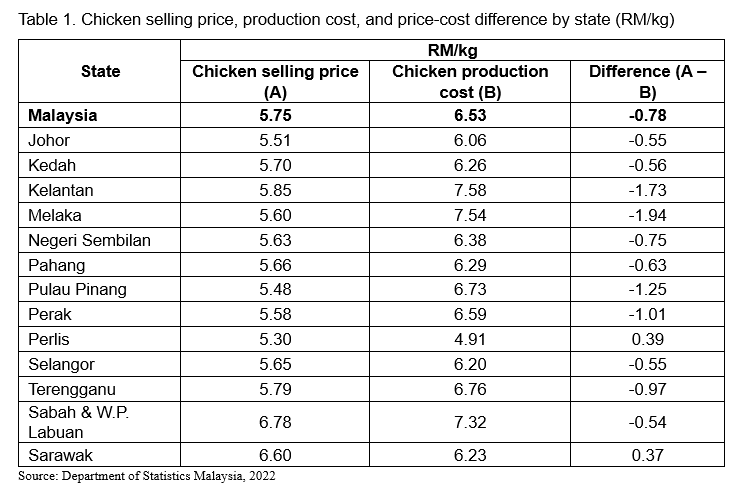
Although Table 1 indicates negative price-cost margins across most states, these figures represent industry-level average accounting production costs and do not necessarily imply uniform financial losses at the farm level. From a microeconomic perspective, firms may continue operating in the short run if output prices cover average variable costs, even if average total costs are not fully recovered. Thus, negative accounting margins do not automatically result in immediate shutdown, particularly in capital-intensive broiler systems where fixed costs are largely sunk, and debt servicing obligations persist. A substantial proportion of broiler growers in Malaysia operate within vertically coordinated contract farming arrangements. Under these systems, integrators supply feed, day-old chicks (DOCs), veterinary inputs, and market access, while growers receive performance-based growing fees. Such arrangements redistribute price and input risks along the value chain, thereby reducing growers’ direct exposure to farm-gate price volatility and feeding cost fluctuations. Consequently, negative aggregate margins at the industry level may not translate uniformly into immediate financial exit at the farm level.
Economies of scale further moderate the impact of cost-price compression. Larger, more integrated operations can spread fixed capital expenditures, particularly those associated with closed-house systems, across higher output volumes, thereby lowering average unit costs relative to smaller, independent farms. The high asset specificity and sunk investment embedded in environmentally controlled housing also raise exit barriers, encouraging continued production even under weakened profitability. Institutional factors additionally shape the cost-price transmission process. Government intervention through price ceiling mechanisms and periodic stabilization measures, introduced to safeguard consumer welfare and food security objectives, can limit producers’ ability to adjust output prices in response to escalating input costs. While such policies may stabilize markets and ease short-term liquidity pressures, incomplete transmission of upstream cost increases may compress producer margins.
Moreover, asymmetries in market power between integrators and independent growers influence how risks and returns are distributed within the production system. Price transmission may be asymmetric, whereby increases in input costs are passed downstream more rapidly than cost reductions or efficiency gains are transmitted back to growers (Kaur et al., 2010). As a result, even where farms achieve improvements in technical or cost efficiency, structural constraints within vertically coordinated value chains may limit the extent to which such gains translate into sustained profitability. Collectively, these structural, contractual, and institutional features help explain why production levels remain relatively stable despite reported negative aggregate margins. Nevertheless, a prolonged cost–price imbalance would gradually erode financial resilience, accelerate structural consolidation, and disproportionately affect smaller independent producers with limited economies of scale.
COST BURDENS AND MARKET PRESSURES
As mentioned earlier, feed is the most significant component of broiler production costs. This pattern is not unique to Malaysia. Comparative global evidence shows that feed and day-old chick costs consistently constitute the dominant cost components across broiler production systems worldwide, making cost competitiveness highly sensitive to upstream input structures rather than farm-level efficiency alone (Thobe et al., 2025).
In Malaysia, heavy dependence on imported grain corn and soybean meal heightens the industry’s exposure to international commodity price cycles (Mohammad Nor et al., 2024a). This dependency creates a strong exchange-rate pass-through effect, whereby movements in the Malaysian Ringgit against the U.S. dollar are transmitted with limited buffering into domestic feed prices. Given the limited availability of economically viable local substitutes, the elasticity of substitution between imported and domestic feed ingredients remains low, thereby constraining producers’ flexibility to adjust input mixes during periods of price escalation.
Global market disturbances, including logistical bottlenecks, geopolitical tensions, and fluctuations in freight rates, further amplify cost variability. Because feed ingredients are essential and relatively price-inelastic inputs in broiler production, increases in their prices lead to disproportionate increases in total production costs. These dynamics reflect a systemic vulnerability in which external shocks are transmitted into the cost structure with minimal buffering capacity at the farm level.
Energy and fuel expenditures introduce an additional layer of cost rigidity within the broiler production system. The increasing adoption of closed-house systems (CHS), while improving productivity and biosecurity, heightens producers’ reliance on electricity-intensive ventilation and cooling systems. As a result, a larger share of total costs becomes fixed or quasi-fixed, reducing cost flexibility and increasing overall sensitivity to energy and upstream input price shocks. In economic terms, this shifts the industry toward a structurally high-input production environment in which costs become increasingly responsive to external price volatility.
Market structure characteristics further reinforce cost pressures. The upstream segment exhibits a high degree of market concentration at the wholesale level, as evidenced by elevated concentration indices reported in prior studies (Kaur & Mohamed Arshad, 2008). In such concentrated market structures, price transmission may be asymmetric, whereby cost increases are passed downstream more rapidly than cost reductions are transmitted back to producers (Kaur et al., 2010). This asymmetry weakens the ability of technically efficient farms to convert efficiency gains into meaningful cost savings or higher profit margins. Consequently, the link between technical efficiency and economic performance becomes attenuated, not because of inefficiency at the farm level, but because of the distribution of bargaining power along the value chain.
Together, these dynamics demonstrate that Malaysia’s broiler industry operates within a structurally constrained cost environment. High production efficiency coexists with elevated and volatile production costs because external shocks, upstream market concentration, and rigid input structures limit farms’ ability to adjust their cost structures. This structurally high-input, high-efficiency environment leaves producers economically exposed, even when operating at near-optimal technical performance.
POLICY CONTEXT IN MALAYSIA
The Malaysian government recognizes the broiler sector as a strategic component of national food security due to its high self-sufficiency level, relatively stable domestic supply, and role as an affordable source of animal protein. Under the National Agrofood Policy 2.0 (NAP 2.0, 2021–2030), broiler production is positioned as a key pillar of the agri-food system, with policy emphasis placed on productivity enhancement, value-chain integration, and sectoral modernization through technology adoption (KPKM, 2021a). These priorities reflect the government’s objective of sustaining domestic supply while strengthening the competitiveness of the broiler industry amid increasing global market uncertainty.
Complementing NAP 2.0, the National Food Security Policy Action Plan (DSMN) 2021–2025 serves as the operational framework for advancing food security objectives across four interrelated pillars: availability, accessibility, utilization, and stability and sustainability (KPKM, 2021b). Within this framework, the broiler industry is explicitly targeted for interventions to improve production efficiency, reduce feed-related cost pressures, and enhance resilience to external shocks. In particular, the policy framework recognizes heavy dependence on imported feed ingredients and exposure to global price volatility as key structural risks affecting cost stability and long-term sector sustainability.
Recent policy initiatives in Malaysia have focused on strengthening domestic feed development, supporting production modernization through the adoption of closed-house systems, and enhancing institutional support for research and innovation. These initiatives are primarily designed to reduce long-term dependence on imported feed ingredients and improve productivity, biosecurity, and production efficiency. However, they address feed cost pressures mainly in the medium to long term and do not provide immediate solutions to short-term price volatility driven by global commodity markets and exchange rate movements.
In the short run, government interventions have largely taken the form of temporary price controls and targeted subsidy schemes aimed at stabilizing production and protecting market supply during periods of sharp cost escalation. This includes the broiler and egg subsidy programs implemented during 2022–2023, which were introduced in response to surging feed costs and inflationary pressures, with total government support amounting to several billion ringgit before the gradual removal of chicken subsidies and price controls in November 2023, while egg subsidy support continued under programs administered by the Department of Veterinary Services Malaysia (DVS, n.d.). These measures functioned primarily as short-term stabilization tools rather than as permanent solutions to structural feed cost dependence.
While these policies have contributed to productivity gains and improvements in technical and cost efficiency, they have also introduced important policy trade-offs. The promotion of closed-house systems and modern production technologies involves significant capital investment and greater reliance on electricity and fuel inputs, thereby increasing operating costs. These cost burdens are particularly significant for small-scale and contract farmers with limited financial capacity. This creates a tension between productivity-oriented policies and cost-resilience objectives, where efforts to modernize production may unintentionally intensify financial pressures on more vulnerable producers, highlighting the need for complementary policy measures that strengthen cost stability alongside productivity improvements. International evidence suggests that differences in cost competitiveness across broiler production systems are often shaped more by institutional settings, market structures, and policy instruments than by technological performance alone (Thobe et al., 2025).
POLICY IMPLICATIONS AND STRATEGIC OPTIONS
This study highlights that Malaysia’s broiler industry faces a structural cost sustainability challenge rather than a farm-level efficiency problem. With both technical efficiency (TE) and cost efficiency (CE) consistently exceeding 0.90, further productivity gains alone are unlikely to resolve the persistent financial pressures producers face. Policy responses must therefore extend beyond farm-level efficiency enhancement and focus on system-level cost-management strategies that address the structural vulnerabilities embedded in the broiler production system.
In this context, policy interventions should be designed to strengthen cost resilience across the value chain while preserving the efficiency gains already achieved. The following strategic policy options are proposed, in line with Malaysia’s agri-food policy framework and broader regional policy emphasis on sustainable, inclusive, and resilient food systems.
Strengthening feed security to reduce structural cost exposure
Feed dependency remains the most significant structural risk facing Malaysia’s broiler industry. Given that feed accounts for approximately two-thirds of total production costs and relies heavily on imported grain corn and soybean meals, the sector is highly exposed to exchange rate volatility and global commodity price fluctuations. Reducing this vulnerability requires a medium to long-term feed security strategy that prioritizes diversification rather than complete import substitution.
Policy efforts should focus on expanding research, pilot testing, and the gradual commercialization of alternative feed ingredients derived from locally available resources, including grain corn, legume-based protein sources, agro-industrial by-products, and other novel feed inputs. A phased approach that integrates feed innovation into existing contract farming arrangements between integrators and growers, as well as feed manufacturing systems, would help minimize transition risks while ensuring technical and economic feasibility. Strengthening coordination among research institutions, feed manufacturers, and integrators is essential for translating experimental feed solutions into commercially adoptable formulations that can reduce exposure to external price shocks without compromising feed quality or production performance.
However, experiences from other agricultural by-products suggest that diversification alone does not guarantee long-term cost stability. The case of rice straw bales in Malaysia illustrates how materials previously considered low-value or waste products can experience significant price increases as commercial demand develops and dedicated markets emerge. As agro-based inputs become monetized and integrated into formal supply chains, they are subject to market forces, competition, and speculative pricing.
Therefore, feed diversification policies must be accompanied by mechanisms to prevent excessive price escalation of alternative feed resources. This includes developing transparent pricing frameworks, strengthening producer–buyer coordination, encouraging contract-based supply arrangements, and supporting efficient logistics and processing systems. Without such safeguards, locally sourced feed inputs may eventually replicate the same price volatility currently associated with imported feed ingredients, thereby limiting their effectiveness in enhancing long-term cost resilience.
Enhancing cost transparency and risk sharing in contract farming systems
Vertically coordinated production systems have played a critical role in improving efficiency and supply stability in Malaysia’s broiler industry. However, prevailing contract arrangements often concentrate cost risks at the farm level, particularly during periods of sharp increases in feed and input prices. While cost increases are transmitted rapidly to growers, reductions in input prices or efficiency gains are not always shared proportionately across the value chain.
Policy interventions should therefore prioritize improving transparency and risk-sharing mechanisms within contract farming systems. Establishing a feed cost monitoring and information-sharing framework, coordinated by relevant authorities or an independent industry body, could reduce information asymmetry and improve trust between integrators and growers. Greater transparency in feed pricing and cost structures would strengthen farmers’ ability to understand and manage production risks.
In addition, encouraging the inclusion of flexible cost-adjustment clauses in production contracts would allow partial sharing of extreme input price shocks between integrators and growers. Such arrangements could enhance producers' income stability without undermining the coordination and efficiency benefits of vertically integrated systems. Strengthening risk-sharing mechanisms would help ensure that the efficiency gains achieved at the farm level are more fairly translated into financial sustainability.
Reorienting policy focus from productivity targets to cost resilience
The empirical findings show that Malaysia’s broiler industry is already operating close to its technical and cost frontiers. This indicates that the key policy challenge has shifted from raising productivity to managing cost volatility and stabilizing production costs in the presence of structural risks such as feed import dependence and asymmetric price transmission.
Future agri-food policies should therefore embed cost resilience as a core policy objective alongside productivity and self-sufficiency. This would require greater emphasis on systematic monitoring of production costs, early warning mechanisms for feed price surges, and closer integration of cost sustainability indicators into livestock development planning. Strengthening data systems on feed prices, input costs, and farm-level margins would enable policymakers to respond more rapidly and effectively during periods of extreme cost pressure.
In this context, establishing a national livestock cost observatory or strengthening existing cost-monitoring platforms could provide an institutional mechanism to track structural cost trends, evaluate policy impacts, and support evidence-based intervention. By shifting the policy narrative from producing more efficiently to producing efficiently at manageable and stable costs, Malaysia can enhance the long-term competitiveness, inclusiveness, and resilience of its broiler industry.
CONCLUSION
This study demonstrates that Malaysia’s broiler industry operates at a high level of technical and cost efficiency yet continues to face persistent financial pressure due to structural cost vulnerabilities. High efficiency at the farm level does not automatically translate into economic sustainability when production costs are driven by external factors, such as imported feed prices, rising energy costs, market power asymmetries, and price transmission mechanisms along the value chain.
The findings indicate that future improvements in sector performance will depend less on further productivity gains and more on the ability to manage cost volatility and strengthen system-level cost resilience. Policies that focus solely on technical upgrading risk overlooking the structural nature of cost pressures that constrain profitability, particularly for small and medium-scale producers.
By shifting policy attention from efficiency enhancement towards cost stabilization, risk sharing, feed security, and energy cost management, Malaysia can strengthen the long-term competitiveness, inclusiveness, and sustainability of its broiler industry. These insights are also relevant to other developing economies where high-efficiency livestock systems coexist with persistent cost instability, highlighting the broader importance of structural approaches to agricultural cost sustainability.
REFERENCES
Abdurofi, I., Ismail, M. M., & Md Isa, A. H. (2018). A comparative study between returns to technology and scale of broiler production in Peninsular Malaysia. Journal of Applied Sciences, 18(3), 109–115. https://doi.org/10.3923/jas.2018.109.115
Aji, J. M. M., Rondhi, M., Suwandari, A., Hapsari, T. D., Januar, J., Yanuarti, R., & Rokhani. (2023). Determinants of cost inefficiency and farmer performance in broiler contract farming. Tropical Animal Science Journal, 46(3), 382–388. https://doi.org/10.5398/tasj.2023.46.3.382
Department of Statistics Malaysia (DOSM). (2022). Special study report on the cost of production of chicken and eggs, 2022. https://www.dosm.gov.my
Department of Veterinary Services Malaysia. (n.d.). Maklumat subsidi ayam dan telur. Retrieved January 15, 2026, from https://www.dvs.gov.my/index.php/pages/view/4450
Department of Veterinary Services Malaysia. (2024). Livestock statistics of Malaysia 2023/2024. https://www.dvs.gov.my/index.php/pages/view/5008
Etuah, S., Ohene-Yankyera, K., Liu, Z., Mensah, J. O., & Lan, J. (2020). Determinants of cost inefficiency in poultry production: Evidence from small-scale broiler farms in the Ashanti Region of Ghana. Tropical Animal Health and Production, 52, 1149–1159. https://doi.org/10.1007/s11250-019-02115-6
Gabdo, B. H., Mansor, M. I., Kamal, H. A. W., & Ilmas, A. M. (2017). Robust efficiency and output elasticity of broiler production in Peninsular Malaysia. Journal of Agricultural Science and Technology, 19, 525–539.
Kasron, N., & Buda, M. (2024). Viability study of broiler chicken production under closed house system. Economic and Technology Management Review, 23, 77–84.
Kaur, B., & Mohamed Arshad, F. (2008). The broiler chicken industry in Malaysia: Some evidences on the structure, conduct and performance. Journal of Agribusiness Marketing, 1, 37–62.
Kaur, B., Mohamed Arshad, F., & Tan, H.-B. (2010). Spatial integration in the broiler market in Peninsular Malaysia. Journal of International Food & Agribusiness Marketing, 22(1–2), 94–107. https://doi.org/10.1080/08974430903372856
Malaysia Competition Commission (MyCC). (2014). Review of domestic broiler market: Final report. Malaysia Competition Commission.
Md Isa, A. H., Ismail, M. M., Samsuddin, N. S., & Abdurofi, I. (2019). Profitability of broiler contract farming: A case study in Johor and Sabah. International Journal of Business and Society, 20(2), 521–532.
Ministry of Agriculture and Food Security (KPKM). (2021a). National Agrofood Policy 2.0 (2021–2030). Ministry of Agriculture and Food Security. https://www.kpkm.gov.my/en/agro-food-policy/national-agrofood-policy
Ministry of Agriculture and Food Security (KPKM). (2021b). National Food Security Policy Action Plan 2021–2025. Ministry of Agriculture and Food Security. https://www.kpkm.gov.my/en/agro-food-policy/national-food-security-policy-action-plan-2021-2025
Mohammad Nor, N. A. A., Buda, M., Mohd Nor, N., Wong, K. S. K., Sharifuddin, J., & Suhaimee, S. (2024a). Cost efficiency analysis of broiler production in Peninsular Malaysia. Tropical Animal Science Journal, 47(3), 402–408. https://doi.org/10.5398/tasj.2024.47.3.402
Mohammad Nor, N. A. A., Buda, M., Mohd Nor, N., Wong, K. S. K., Sharifuddin, J., & Suhaimee, S. (2024b). Profitability assessment of broiler farming in Peninsular Malaysia. Economic and Technology Management Review, 23, 1–12.
Mohammad Nor, N. A. A., Buda, M., Mohd Nor, N., Wong, K. S. K., & Sharifuddin, J. (2024). Cost-efficiency of small and semi-commercial broiler farms in Peninsular Malaysia. In Proceedings of the 1st ASEAN University Symposium for Sustainable Food System (18–19 April 2024). Kasetsart University, Bangkok, Thailand.
Musaba, E. C., & Mseteka, M. (2014). Cost efficiency of small-scale commercial broiler production in Zambia: A stochastic cost frontier approach. Developing Country Studies, 4(5), 98–105.
Nurshuhada, S., Nurul Aini, M. Y., Mohd Hishammfariz, M. A., Ahmad Daud, R., & Shamizah, O. H. (2021). Economic production of broiler industry in Malaysia. Malaysian Journal of Veterinary Research, 12(2), 52–60.
Shaban, N. S., & Alabboodi, A. S. (2019). Explain why Malaysian broiler industry facing production problem. Indian Journal of Applied Research, 5, 301–308.
Tapsir, S., Mokhdzir, H. L., Sharif, N. R., & Nazir, J. (2011). Issue and impact in broiler contract farming in Peninsular Malaysia. Economic and Technology Management Review, 6, 33–57.
Thobe, P., Chibanda, C., Almadani, M. I., & Koch, S. (2025). Chicken meat production in global comparison: Production systems and economics. Studies in Agricultural Economics, 127, 220–227. https://doi.org/10.7896/j.3313
Yunus, I. (2012). Estimation of technical efficiency of broiler production in Peninsular Malaysia: A stochastic frontier analysis. Journal of Business Management and Accounting, 2(1), 77–96.


Efficient but Cost-Burdened: Policy Strategies to Enhance Cost Sustainability in Malaysia’s Broiler Industry
ABSTRACT
Malaysia’s broiler industry plays a critical role in ensuring national food security and providing affordable animal protein, yet the sector faces persistent cost pressures that undermine long-term economic sustainability. Based on empirical estimates from broiler farms in Peninsular Malaysia, both technical and cost efficiency levels exceed 0.90 on average. Nevertheless, profitability remains constrained due to structural cost conditions rather than farm-level inefficiencies. These structural pressures include heavy dependence on imported feed ingredients, exposure to input price volatility, and asymmetric cost transmission within vertically coordinated production systems. This paper examines policy strategies to enhance cost sustainability in Malaysia’s broiler industry by shifting the focus from farm-level efficiency improvements towards system-level cost management and resilience. Drawing on empirical efficiency evidence and national policy frameworks, including the National Agrofood Policy 2.0 (NAP 2.0) and the National Food Security Policy (DSMN) Action Plan 2021–2025, the paper identifies key policy priorities centred on strengthening feed security, improving cost transparency and risk sharing in contract farming arrangements, and embedding cost resilience as a core objective of broiler sector development. This study highlights that strengthening cost resilience across the broiler value chain is essential to sustain competitiveness and support inclusive growth, particularly amid rising exposure to global market uncertainty and external cost shocks.
Keywords: Broiler Industry, Cost Sustainability, Cost Efficiency
INTRODUCTION
The broiler industry is a cornerstone of Malaysia’s agri-food sector, supplying affordable animal protein and supporting employment and income generation across the broiler production and agribusiness value chain. Broiler meat contributes nearly half of national meat consumption in Malaysia, making it a vital contributor to the country's food security (Department of Veterinary Services Malaysia [DVS], 2024). The sector’s development has been supported by strong domestic demand, the prevalence of vertically coordinated production systems such as contract farming, and gradual improvements in farm management practices and biosecurity standards (Kaur et al., 2010; Kasron & Buda, 2024).
Despite its economic importance, the broiler industry continues to face sustained financial pressure as production costs rise steadily. Increases in major inputs, particularly feed, day-old chicks, utilities, and labor, have significantly elevated total production costs, with feed alone accounting for approximately 65-70% of overall expenditure (Department of Statistics Malaysia [DOSM], 2023; Md Isa et al., 2019). Notwithstanding relatively strong technical performance, as reflected by feed conversion ratios ranging from 1.29 to 1.57 (Abdurofi et al., 2018), profitability at the farm level remains persistently constrained.
Previous empirical studies indicate that Malaysian broiler farms generally operate at relatively high levels of technical efficiency (Gabdo et al., 2017; Yunus, 2012) and cost efficiency (Mohammad Nor et al., 2024a) under prevailing production technologies. As such, escalating production costs are unlikely to be driven primarily by farm-level inefficiency. Instead, cost pressures appear to stem from broader structural factors beyond farmers’ control, including heavy reliance on imported feed ingredients, exposure to exchange rate volatility, rising input prices, and concentration in upstream input markets (Mohammad Nor et al., 2024a; Md Isa et al., 2019; Malaysia Competition Commission [MyCC], 2014).
Therefore, addressing these challenges requires analytical and policy perspectives that extend beyond farm-level efficiency improvements. Enhancing the economic resilience of Malaysia’s broiler industry requires system-level cost-management strategies that mitigate external cost shocks and improve cost stability throughout the production chain.
OVERVIEW OF MALAYSIA’S BROILER INDUSTRY
Malaysia’s broiler industry is characterized by a highly integrated production and marketing structure, where a relatively small number of vertically integrated firms play a central role across most stages of the supply chain, including feed milling, breeder farms, hatcheries, processing, and wholesale distribution (Kaur et al., 2010; MyCC, 2014). Although a substantial share of broiler output is produced by contract and independent farmers, many of these producers remain heavily dependent on integrators for key inputs such as feed, day-old chicks (DOCs), and veterinary services. This reliance reflects a concentrated upstream input market in which dominant firms exert considerable influence over input prices and production conditions.
Empirical studies provide clear evidence of structural concentration within Malaysia’s broiler industry. Kaur et al. (2010) show that the broiler market in Peninsular Malaysia exhibits features of imperfect competition, driven by increasing vertical integration and a limited number of wholesalers operating at the central market level. In simple terms, a small group of firms plays a central role in coordinating the production, marketing, and pricing of broilers. Wholesale markets, particularly the central market, serve as key reference points for price formation, and price movements at this level are transmitted downstream to farm-gate prices, while producers have limited influence over pricing outcomes.
In practice, this structure shapes the economic position of broiler producers. Many growers, whether operating independently or under contract arrangements, depend on integrators for essential inputs such as feed, day-old chicks (DOCs), veterinary services, and access to marketing channels (Tapsir et al., 2011; MyCC, 2014). Input prices are largely determined outside the farm, while marketing is commonly organized through established wholesale or contractual networks (Tapsir et al., 2011). Consequently, individual producers have limited ability to negotiate either input prices or selling prices (Kaur et al., 2010; Tapsir et al., 2011).
Such structural characteristics place producers in a weaker bargaining position and limit their ability to respond effectively to rising production costs. These structural constraints have important implications for production costs. Data from the Department of Statistics Malaysia indicate that feed accounts for approximately two-thirds of total broiler production costs, making it the most dominant cost component in the industry (DOSM, 2022; MyCC, 2014; Shaban & Alabboodi, 2019). Feed formulations rely heavily on imported grain corn and soybean meals, which expose producers to exchange rate movements, global supply disruptions, and international commodity price volatility (MyCC, 2014; DOSM, 2022; Mohammad Nor et al., 2024). When feed prices increase, these higher costs are reflected directly in farm-level production costs (DOSM, 2022). However, when feed prices decline, or when farms improve production efficiency, the benefits are not always transmitted proportionately to farm-gate prices (Kaur et al., 2010; MyCC, 2014).
As a result, production costs in Malaysia’s broiler industry remain high despite strong technical performance at the farm level. Structural concentration in upstream input supply and wholesale marketing limits producers’ bargaining power and constrains their ability to respond effectively to changing market conditions (Kaur et al., 2010; Tapsir et al., 2011). Producers that are more exposed to market fluctuations, particularly smaller and independent farms, face greater difficulty absorbing cost shocks, contributing to persistent cost pressures across the broiler value chain (MyCC, 2014).
Overall, these structural characteristics indicate that rising production costs in Malaysia’s broiler industry stem less from farm-level inefficiencies and more from constraints embedded within the organization of the industry itself (Kaur et al., 2010; DOSM, 2022). This helps explain why, despite achieving close to 100% self-sufficiency and producing over 1.8 billion broilers annually (DVS, 2024), the industry continues to face significant challenges in cost sustainability. The dominance of feed costs in the cost structure highlights the sector's vulnerability to external price shocks and underscores the importance of system-level approaches to cost management. This is reflected in the cost structure of broiler production in Malaysia, where feed expenditure overwhelmingly dominates total production costs, followed by DOC and utility costs (see Figure 1).
EFFICIENCY AND COST PERFORMANCE
Technical performance indicators, particularly feed conversion ratio (FCR), suggest that Malaysia’s broiler farms achieve high production efficiency. FCRs ranging from 1.29 to 1.57 reflect strong feed utilization efficiency (Abdurofi et al., 2018). This technical performance is complemented by evidence from earlier efficiency studies, which show that Malaysian broiler farms generally operate at very high levels of efficiency. Gabdo et al. (2017) reported very high mean technical efficiency (TE) across all farm sizes in Peninsular Malaysia. Their results show a mean TE of 0.9853 for small-scale farms, 0.9826 for medium-scale farms, and 0.9991 for large-scale farms. These indicate that farmers utilize their input efficiently and operate close to the maximum attainable output under existing production technologies.
The cost efficiency (CE) results from this study further indicate that broiler farms operate efficiently from a cost perspective. The mean CE values estimated using the stochastic cost frontier model are high: 0.9261 for small-scale farms, 0.9494 for medium-scale farms, and 0.9488 for large-scale farms, with an overall average of 0.9482. Although CE is slightly lower than TE across all categories, as illustrated in Figure 2, both indicators exceed 0.90, demonstrating that Malaysian broiler farms are not only technically efficient but also cost-efficient.
The slightly lower CE values suggest that external cost pressures constrain the ability of technically efficient farms to achieve minimum observed production costs. In other words, high technical performance does not automatically translate into lower cost outcomes when major cost components are externally determined. Consistent with this view, Etuah et al., (2020) show that cost efficiency is shaped not only by managerial performance but also by input cost structures, while Aji et al., (2023) highlight that feed and day-old chick (DOC) prices dominate the broiler cost structure and strongly influence cost efficiency regardless of farm-level production performance. Likewise, Musaba (2014) demonstrates that feed accounts for a substantial share of total production costs, rendering cost efficiency highly sensitive to market-driven input prices rather than solely to management practices.
Taken together, these findings support the argument that the slightly lower CE values observed in this study largely reflect structural and market-related cost pressures, rather than inefficiencies in farm management. They underline that improving technical efficiency alone is insufficient to substantially reduce production costs unless broader issues such as feed price volatility, dependence on imported inputs, and concentrated input markets are also addressed.
Despite the relatively high levels of TE and CE observed among broiler farms, profitability margins remain persistently narrow, particularly for small and medium-sized producers. This mismatch between efficiency and financial performance indicates that the key constraints facing the broiler industry are structural rather than managerial, as discussed earlier in relation to vertical integration, concentration in upstream input markets, and asymmetric price transmission along the value chain, which shape cost and price formation beyond farmers’ control. Evidence from stochastic cost frontier analysis supports this interpretation, showing that only a small proportion of the variation in production costs is attributable to cost inefficiency, while the majority is driven by random shocks and external factors beyond farmers’ control, such as feed price volatility, exchange rate fluctuations, and market-driven input prices (Mohammad Nor et al., 2024a).
Comparative cross-country evidence further reinforces this finding, showing that production systems with strong feed-use efficiency often remain exposed to high and volatile production costs when input prices are externally driven, underscoring the structural nature of cost sustainability challenges in broiler production (Thobe et al., 2025). These structural pressures are closely linked to industry’s heavy dependence on imported feed ingredients. Feed constitutes the largest share of broiler production costs in Malaysia, and its price is largely determined by international market conditions, exposing producers to global commodity price volatility and exchange rate movements (MyCC, 2014; Nurshuhada et al., 2021). As major feed components such as grain corn and soybean meal are imported, any increase in world prices or depreciation of the Malaysian Ringgit is transmitted directly into higher production costs at the farm level.
At the same time, the increasing adoption of closed-house systems has raised reliance on continuous electricity and fuel use for ventilation, cooling, and environmental control. Although energy does not constitute the largest cost component, it represents a quasi-fixed operating expense that reduces cost flexibility and increases the rigidity of the production cost structure (Kasron & Buda, 2024; Nurshuhada et al., 2021). Together, these factors generate a persistent cost-price squeeze, in which farms operate efficiently but remain unable to lower per-unit costs amid escalating upstream input prices. Table 1 reinforces this observation by showing that production costs exceed selling prices in most states in Malaysia. With negative price-cost margins recorded across nearly all major producing regions, the industry’s profitability is clearly hindered by systemic cost burdens rather than weaknesses in farm management. These cost pressures are further reinforced by limited flexibility in farm-gate prices under prevailing market arrangements and policy-based price stabilization mechanisms, which restrict producers’ ability to adjust output prices in response to rising production costs.
Although Table 1 indicates negative price-cost margins across most states, these figures represent industry-level average accounting production costs and do not necessarily imply uniform financial losses at the farm level. From a microeconomic perspective, firms may continue operating in the short run if output prices cover average variable costs, even if average total costs are not fully recovered. Thus, negative accounting margins do not automatically result in immediate shutdown, particularly in capital-intensive broiler systems where fixed costs are largely sunk, and debt servicing obligations persist. A substantial proportion of broiler growers in Malaysia operate within vertically coordinated contract farming arrangements. Under these systems, integrators supply feed, day-old chicks (DOCs), veterinary inputs, and market access, while growers receive performance-based growing fees. Such arrangements redistribute price and input risks along the value chain, thereby reducing growers’ direct exposure to farm-gate price volatility and feeding cost fluctuations. Consequently, negative aggregate margins at the industry level may not translate uniformly into immediate financial exit at the farm level.
Economies of scale further moderate the impact of cost-price compression. Larger, more integrated operations can spread fixed capital expenditures, particularly those associated with closed-house systems, across higher output volumes, thereby lowering average unit costs relative to smaller, independent farms. The high asset specificity and sunk investment embedded in environmentally controlled housing also raise exit barriers, encouraging continued production even under weakened profitability. Institutional factors additionally shape the cost-price transmission process. Government intervention through price ceiling mechanisms and periodic stabilization measures, introduced to safeguard consumer welfare and food security objectives, can limit producers’ ability to adjust output prices in response to escalating input costs. While such policies may stabilize markets and ease short-term liquidity pressures, incomplete transmission of upstream cost increases may compress producer margins.
Moreover, asymmetries in market power between integrators and independent growers influence how risks and returns are distributed within the production system. Price transmission may be asymmetric, whereby increases in input costs are passed downstream more rapidly than cost reductions or efficiency gains are transmitted back to growers (Kaur et al., 2010). As a result, even where farms achieve improvements in technical or cost efficiency, structural constraints within vertically coordinated value chains may limit the extent to which such gains translate into sustained profitability. Collectively, these structural, contractual, and institutional features help explain why production levels remain relatively stable despite reported negative aggregate margins. Nevertheless, a prolonged cost–price imbalance would gradually erode financial resilience, accelerate structural consolidation, and disproportionately affect smaller independent producers with limited economies of scale.
COST BURDENS AND MARKET PRESSURES
As mentioned earlier, feed is the most significant component of broiler production costs. This pattern is not unique to Malaysia. Comparative global evidence shows that feed and day-old chick costs consistently constitute the dominant cost components across broiler production systems worldwide, making cost competitiveness highly sensitive to upstream input structures rather than farm-level efficiency alone (Thobe et al., 2025).
In Malaysia, heavy dependence on imported grain corn and soybean meal heightens the industry’s exposure to international commodity price cycles (Mohammad Nor et al., 2024a). This dependency creates a strong exchange-rate pass-through effect, whereby movements in the Malaysian Ringgit against the U.S. dollar are transmitted with limited buffering into domestic feed prices. Given the limited availability of economically viable local substitutes, the elasticity of substitution between imported and domestic feed ingredients remains low, thereby constraining producers’ flexibility to adjust input mixes during periods of price escalation.
Global market disturbances, including logistical bottlenecks, geopolitical tensions, and fluctuations in freight rates, further amplify cost variability. Because feed ingredients are essential and relatively price-inelastic inputs in broiler production, increases in their prices lead to disproportionate increases in total production costs. These dynamics reflect a systemic vulnerability in which external shocks are transmitted into the cost structure with minimal buffering capacity at the farm level.
Energy and fuel expenditures introduce an additional layer of cost rigidity within the broiler production system. The increasing adoption of closed-house systems (CHS), while improving productivity and biosecurity, heightens producers’ reliance on electricity-intensive ventilation and cooling systems. As a result, a larger share of total costs becomes fixed or quasi-fixed, reducing cost flexibility and increasing overall sensitivity to energy and upstream input price shocks. In economic terms, this shifts the industry toward a structurally high-input production environment in which costs become increasingly responsive to external price volatility.
Market structure characteristics further reinforce cost pressures. The upstream segment exhibits a high degree of market concentration at the wholesale level, as evidenced by elevated concentration indices reported in prior studies (Kaur & Mohamed Arshad, 2008). In such concentrated market structures, price transmission may be asymmetric, whereby cost increases are passed downstream more rapidly than cost reductions are transmitted back to producers (Kaur et al., 2010). This asymmetry weakens the ability of technically efficient farms to convert efficiency gains into meaningful cost savings or higher profit margins. Consequently, the link between technical efficiency and economic performance becomes attenuated, not because of inefficiency at the farm level, but because of the distribution of bargaining power along the value chain.
Together, these dynamics demonstrate that Malaysia’s broiler industry operates within a structurally constrained cost environment. High production efficiency coexists with elevated and volatile production costs because external shocks, upstream market concentration, and rigid input structures limit farms’ ability to adjust their cost structures. This structurally high-input, high-efficiency environment leaves producers economically exposed, even when operating at near-optimal technical performance.
POLICY CONTEXT IN MALAYSIA
The Malaysian government recognizes the broiler sector as a strategic component of national food security due to its high self-sufficiency level, relatively stable domestic supply, and role as an affordable source of animal protein. Under the National Agrofood Policy 2.0 (NAP 2.0, 2021–2030), broiler production is positioned as a key pillar of the agri-food system, with policy emphasis placed on productivity enhancement, value-chain integration, and sectoral modernization through technology adoption (KPKM, 2021a). These priorities reflect the government’s objective of sustaining domestic supply while strengthening the competitiveness of the broiler industry amid increasing global market uncertainty.
Complementing NAP 2.0, the National Food Security Policy Action Plan (DSMN) 2021–2025 serves as the operational framework for advancing food security objectives across four interrelated pillars: availability, accessibility, utilization, and stability and sustainability (KPKM, 2021b). Within this framework, the broiler industry is explicitly targeted for interventions to improve production efficiency, reduce feed-related cost pressures, and enhance resilience to external shocks. In particular, the policy framework recognizes heavy dependence on imported feed ingredients and exposure to global price volatility as key structural risks affecting cost stability and long-term sector sustainability.
Recent policy initiatives in Malaysia have focused on strengthening domestic feed development, supporting production modernization through the adoption of closed-house systems, and enhancing institutional support for research and innovation. These initiatives are primarily designed to reduce long-term dependence on imported feed ingredients and improve productivity, biosecurity, and production efficiency. However, they address feed cost pressures mainly in the medium to long term and do not provide immediate solutions to short-term price volatility driven by global commodity markets and exchange rate movements.
In the short run, government interventions have largely taken the form of temporary price controls and targeted subsidy schemes aimed at stabilizing production and protecting market supply during periods of sharp cost escalation. This includes the broiler and egg subsidy programs implemented during 2022–2023, which were introduced in response to surging feed costs and inflationary pressures, with total government support amounting to several billion ringgit before the gradual removal of chicken subsidies and price controls in November 2023, while egg subsidy support continued under programs administered by the Department of Veterinary Services Malaysia (DVS, n.d.). These measures functioned primarily as short-term stabilization tools rather than as permanent solutions to structural feed cost dependence.
While these policies have contributed to productivity gains and improvements in technical and cost efficiency, they have also introduced important policy trade-offs. The promotion of closed-house systems and modern production technologies involves significant capital investment and greater reliance on electricity and fuel inputs, thereby increasing operating costs. These cost burdens are particularly significant for small-scale and contract farmers with limited financial capacity. This creates a tension between productivity-oriented policies and cost-resilience objectives, where efforts to modernize production may unintentionally intensify financial pressures on more vulnerable producers, highlighting the need for complementary policy measures that strengthen cost stability alongside productivity improvements. International evidence suggests that differences in cost competitiveness across broiler production systems are often shaped more by institutional settings, market structures, and policy instruments than by technological performance alone (Thobe et al., 2025).
POLICY IMPLICATIONS AND STRATEGIC OPTIONS
This study highlights that Malaysia’s broiler industry faces a structural cost sustainability challenge rather than a farm-level efficiency problem. With both technical efficiency (TE) and cost efficiency (CE) consistently exceeding 0.90, further productivity gains alone are unlikely to resolve the persistent financial pressures producers face. Policy responses must therefore extend beyond farm-level efficiency enhancement and focus on system-level cost-management strategies that address the structural vulnerabilities embedded in the broiler production system.
In this context, policy interventions should be designed to strengthen cost resilience across the value chain while preserving the efficiency gains already achieved. The following strategic policy options are proposed, in line with Malaysia’s agri-food policy framework and broader regional policy emphasis on sustainable, inclusive, and resilient food systems.
Strengthening feed security to reduce structural cost exposure
Feed dependency remains the most significant structural risk facing Malaysia’s broiler industry. Given that feed accounts for approximately two-thirds of total production costs and relies heavily on imported grain corn and soybean meals, the sector is highly exposed to exchange rate volatility and global commodity price fluctuations. Reducing this vulnerability requires a medium to long-term feed security strategy that prioritizes diversification rather than complete import substitution.
Policy efforts should focus on expanding research, pilot testing, and the gradual commercialization of alternative feed ingredients derived from locally available resources, including grain corn, legume-based protein sources, agro-industrial by-products, and other novel feed inputs. A phased approach that integrates feed innovation into existing contract farming arrangements between integrators and growers, as well as feed manufacturing systems, would help minimize transition risks while ensuring technical and economic feasibility. Strengthening coordination among research institutions, feed manufacturers, and integrators is essential for translating experimental feed solutions into commercially adoptable formulations that can reduce exposure to external price shocks without compromising feed quality or production performance.
However, experiences from other agricultural by-products suggest that diversification alone does not guarantee long-term cost stability. The case of rice straw bales in Malaysia illustrates how materials previously considered low-value or waste products can experience significant price increases as commercial demand develops and dedicated markets emerge. As agro-based inputs become monetized and integrated into formal supply chains, they are subject to market forces, competition, and speculative pricing.
Therefore, feed diversification policies must be accompanied by mechanisms to prevent excessive price escalation of alternative feed resources. This includes developing transparent pricing frameworks, strengthening producer–buyer coordination, encouraging contract-based supply arrangements, and supporting efficient logistics and processing systems. Without such safeguards, locally sourced feed inputs may eventually replicate the same price volatility currently associated with imported feed ingredients, thereby limiting their effectiveness in enhancing long-term cost resilience.
Enhancing cost transparency and risk sharing in contract farming systems
Vertically coordinated production systems have played a critical role in improving efficiency and supply stability in Malaysia’s broiler industry. However, prevailing contract arrangements often concentrate cost risks at the farm level, particularly during periods of sharp increases in feed and input prices. While cost increases are transmitted rapidly to growers, reductions in input prices or efficiency gains are not always shared proportionately across the value chain.
Policy interventions should therefore prioritize improving transparency and risk-sharing mechanisms within contract farming systems. Establishing a feed cost monitoring and information-sharing framework, coordinated by relevant authorities or an independent industry body, could reduce information asymmetry and improve trust between integrators and growers. Greater transparency in feed pricing and cost structures would strengthen farmers’ ability to understand and manage production risks.
In addition, encouraging the inclusion of flexible cost-adjustment clauses in production contracts would allow partial sharing of extreme input price shocks between integrators and growers. Such arrangements could enhance producers' income stability without undermining the coordination and efficiency benefits of vertically integrated systems. Strengthening risk-sharing mechanisms would help ensure that the efficiency gains achieved at the farm level are more fairly translated into financial sustainability.
Reorienting policy focus from productivity targets to cost resilience
The empirical findings show that Malaysia’s broiler industry is already operating close to its technical and cost frontiers. This indicates that the key policy challenge has shifted from raising productivity to managing cost volatility and stabilizing production costs in the presence of structural risks such as feed import dependence and asymmetric price transmission.
Future agri-food policies should therefore embed cost resilience as a core policy objective alongside productivity and self-sufficiency. This would require greater emphasis on systematic monitoring of production costs, early warning mechanisms for feed price surges, and closer integration of cost sustainability indicators into livestock development planning. Strengthening data systems on feed prices, input costs, and farm-level margins would enable policymakers to respond more rapidly and effectively during periods of extreme cost pressure.
In this context, establishing a national livestock cost observatory or strengthening existing cost-monitoring platforms could provide an institutional mechanism to track structural cost trends, evaluate policy impacts, and support evidence-based intervention. By shifting the policy narrative from producing more efficiently to producing efficiently at manageable and stable costs, Malaysia can enhance the long-term competitiveness, inclusiveness, and resilience of its broiler industry.
CONCLUSION
This study demonstrates that Malaysia’s broiler industry operates at a high level of technical and cost efficiency yet continues to face persistent financial pressure due to structural cost vulnerabilities. High efficiency at the farm level does not automatically translate into economic sustainability when production costs are driven by external factors, such as imported feed prices, rising energy costs, market power asymmetries, and price transmission mechanisms along the value chain.
The findings indicate that future improvements in sector performance will depend less on further productivity gains and more on the ability to manage cost volatility and strengthen system-level cost resilience. Policies that focus solely on technical upgrading risk overlooking the structural nature of cost pressures that constrain profitability, particularly for small and medium-scale producers.
By shifting policy attention from efficiency enhancement towards cost stabilization, risk sharing, feed security, and energy cost management, Malaysia can strengthen the long-term competitiveness, inclusiveness, and sustainability of its broiler industry. These insights are also relevant to other developing economies where high-efficiency livestock systems coexist with persistent cost instability, highlighting the broader importance of structural approaches to agricultural cost sustainability.
REFERENCES
Abdurofi, I., Ismail, M. M., & Md Isa, A. H. (2018). A comparative study between returns to technology and scale of broiler production in Peninsular Malaysia. Journal of Applied Sciences, 18(3), 109–115. https://doi.org/10.3923/jas.2018.109.115
Aji, J. M. M., Rondhi, M., Suwandari, A., Hapsari, T. D., Januar, J., Yanuarti, R., & Rokhani. (2023). Determinants of cost inefficiency and farmer performance in broiler contract farming. Tropical Animal Science Journal, 46(3), 382–388. https://doi.org/10.5398/tasj.2023.46.3.382
Department of Statistics Malaysia (DOSM). (2022). Special study report on the cost of production of chicken and eggs, 2022. https://www.dosm.gov.my
Department of Veterinary Services Malaysia. (n.d.). Maklumat subsidi ayam dan telur. Retrieved January 15, 2026, from https://www.dvs.gov.my/index.php/pages/view/4450
Department of Veterinary Services Malaysia. (2024). Livestock statistics of Malaysia 2023/2024. https://www.dvs.gov.my/index.php/pages/view/5008
Etuah, S., Ohene-Yankyera, K., Liu, Z., Mensah, J. O., & Lan, J. (2020). Determinants of cost inefficiency in poultry production: Evidence from small-scale broiler farms in the Ashanti Region of Ghana. Tropical Animal Health and Production, 52, 1149–1159. https://doi.org/10.1007/s11250-019-02115-6
Gabdo, B. H., Mansor, M. I., Kamal, H. A. W., & Ilmas, A. M. (2017). Robust efficiency and output elasticity of broiler production in Peninsular Malaysia. Journal of Agricultural Science and Technology, 19, 525–539.
Kasron, N., & Buda, M. (2024). Viability study of broiler chicken production under closed house system. Economic and Technology Management Review, 23, 77–84.
Kaur, B., & Mohamed Arshad, F. (2008). The broiler chicken industry in Malaysia: Some evidences on the structure, conduct and performance. Journal of Agribusiness Marketing, 1, 37–62.
Kaur, B., Mohamed Arshad, F., & Tan, H.-B. (2010). Spatial integration in the broiler market in Peninsular Malaysia. Journal of International Food & Agribusiness Marketing, 22(1–2), 94–107. https://doi.org/10.1080/08974430903372856
Malaysia Competition Commission (MyCC). (2014). Review of domestic broiler market: Final report. Malaysia Competition Commission.
Md Isa, A. H., Ismail, M. M., Samsuddin, N. S., & Abdurofi, I. (2019). Profitability of broiler contract farming: A case study in Johor and Sabah. International Journal of Business and Society, 20(2), 521–532.
Ministry of Agriculture and Food Security (KPKM). (2021a). National Agrofood Policy 2.0 (2021–2030). Ministry of Agriculture and Food Security. https://www.kpkm.gov.my/en/agro-food-policy/national-agrofood-policy
Ministry of Agriculture and Food Security (KPKM). (2021b). National Food Security Policy Action Plan 2021–2025. Ministry of Agriculture and Food Security. https://www.kpkm.gov.my/en/agro-food-policy/national-food-security-policy-action-plan-2021-2025
Mohammad Nor, N. A. A., Buda, M., Mohd Nor, N., Wong, K. S. K., Sharifuddin, J., & Suhaimee, S. (2024a). Cost efficiency analysis of broiler production in Peninsular Malaysia. Tropical Animal Science Journal, 47(3), 402–408. https://doi.org/10.5398/tasj.2024.47.3.402
Mohammad Nor, N. A. A., Buda, M., Mohd Nor, N., Wong, K. S. K., Sharifuddin, J., & Suhaimee, S. (2024b). Profitability assessment of broiler farming in Peninsular Malaysia. Economic and Technology Management Review, 23, 1–12.
Mohammad Nor, N. A. A., Buda, M., Mohd Nor, N., Wong, K. S. K., & Sharifuddin, J. (2024). Cost-efficiency of small and semi-commercial broiler farms in Peninsular Malaysia. In Proceedings of the 1st ASEAN University Symposium for Sustainable Food System (18–19 April 2024). Kasetsart University, Bangkok, Thailand.
Musaba, E. C., & Mseteka, M. (2014). Cost efficiency of small-scale commercial broiler production in Zambia: A stochastic cost frontier approach. Developing Country Studies, 4(5), 98–105.
Nurshuhada, S., Nurul Aini, M. Y., Mohd Hishammfariz, M. A., Ahmad Daud, R., & Shamizah, O. H. (2021). Economic production of broiler industry in Malaysia. Malaysian Journal of Veterinary Research, 12(2), 52–60.
Shaban, N. S., & Alabboodi, A. S. (2019). Explain why Malaysian broiler industry facing production problem. Indian Journal of Applied Research, 5, 301–308.
Tapsir, S., Mokhdzir, H. L., Sharif, N. R., & Nazir, J. (2011). Issue and impact in broiler contract farming in Peninsular Malaysia. Economic and Technology Management Review, 6, 33–57.
Thobe, P., Chibanda, C., Almadani, M. I., & Koch, S. (2025). Chicken meat production in global comparison: Production systems and economics. Studies in Agricultural Economics, 127, 220–227. https://doi.org/10.7896/j.3313
Yunus, I. (2012). Estimation of technical efficiency of broiler production in Peninsular Malaysia: A stochastic frontier analysis. Journal of Business Management and Accounting, 2(1), 77–96.