ABSTRACT
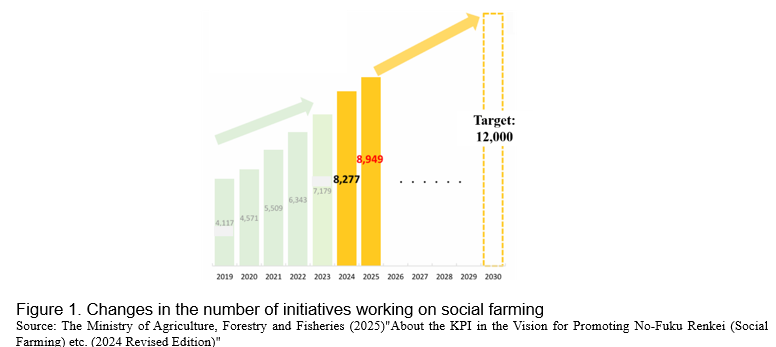
It's been 16 years since the term 'social farming' came about in Japan, and now the number of initiatives has grown to 8,949 as of fiscal year 2025. The Japanese government has set a goal to increase is to 12,000 by fiscal 2030. This article will begin by explaining how social farming in Japan started as an initiative for people with disabilities to work, then expanded to provide care and therapeutic activities for those who face working challenges through farming and gardening. This article will also show how this has led to the spread and growth of universal farms, where a variety of people come together to address social issues. On top of that, this article organizes the current state of the newly launched Universal Farms and introduces representative advanced examples from three types: i) farms that support people with mental disabilities or people experiencing hikikomori in getting regular employment, ii) farms aimed at creating a place for elderly people and aimed at developing skills or creating a place for people with disabilities, and iii) farms that promote interaction among diverse local residents, including those facing social difficulties. Finally, this article considers the potential of a future 'Universal Farm' in the future considering these trends as well as the current situations of people with disabilities who have trouble working, people experiencing hikikomori, and elderly people with dementia.
Keywords: social farming, universal farm, people with disabilities, hikikomori, dementia
INTRODUCTION
It's been 16 years since the term 'No-Fuku Renkei (Social Farming)' started being used in Japan, and the approach has become more diverse, expanding from social farming for people with disabilities who can work to social farming for those with severe disabilities, people experiencing hikikomori (prolonged social withdrawal), and elderly people with dementia.
In May 2024, the Ministry of Agriculture, Forestry and Fisheries added an article on social farming to the "Basic Act on Food, Agriculture and Rural Areas," which sets out the policies the ministry should implement. Article 46 includes "creating an environment for agricultural activities for people with disabilities and others." Then, in June 2024, the "Vision for Promoting No-Fuku Renkei (Social Farming) etc." (originally formulated in 2019) was revised, and the updated version was decided. It includes plans to expand and spread universal farms across four government ministries, so social farming in Japan continues to have favorable momentum.
This article looks back at the history of social farming in Japan and how it has spread. On top of that, it considers the potential of 'Universal Farms' in the future, based on the actual examples of the newly launched advanced cases.
THE HISTORY LEADING UP TO UNIVERSAL FARM
Looking back at the historical development of social farming in Japan, it’s clear that it began with agriculture as an independent activity in large residential facilities for people with disabilities, then expanded into opportunities for people with disabilities to work in agriculture at day-service welfare facilities.
From there, collaborations spread across Japan, with disability welfare service offices supporting farms and agricultural corporations through off-site work. In addition, agricultural corporations have begun recognizing people with disabilities as valuable workers, and opportunities for them to thrive in these companies are expanding. In this way, a trend of efforts to create opportunities for people with disabilities who can work in agriculture can be seen. Also, along the way, in parallel with this trend, there has been an expansion of care and therapeutic activities for people with disabilities and others who have difficulties finding work through farming and gardening activities, and this is creating another trend that leads to universal farms where more diverse people gather and help solve social issues.
First of all, this article introduces the background of efforts to expand opportunities for people with disabilities who can work, specifically through agriculture. Even 50 or 60 years ago, before the term 'No-Fukurenkei (Social Farming)' existed, efforts across the country already existed to help people with disabilities engage in farming work, mainly in large residential facilities for the disabled, but those efforts were scattered.
As a result of the 2008 Lehman Shock and factories moving overseas, the subcontracting work that disability welfare service centers could take on decreased. At the same time, the agricultural sector faced labor shortages and increased abandoned farmland due to declining and aging farmers and depopulation in rural areas. In response, in the 2010s, cases across the country of people with disabilities who could work getting involved in agriculture increased, mainly through welfare service centers that provide opportunities to work for people with disabilities, and successful initiatives began to be copied and spread.
In this situation, support for social farming from local governments and organizations like JA has gradually expanded. In particular, efforts to help match farmers and agricultural corporations facing labor shortages with disability welfare service centers that want to help with farm work have noticeably increased.
In response to this trend, the Japanese government also held the "Council for the Promotion of Agriculture-Welfare Collaboration" at the Prime Minister's Office in 2019, where the first "Vision for Promoting No-Fuku Renkei (Social Farming) etc" was decided. Based on this, at the national level, four ministries—the Ministry of Agriculture, Forestry and Fisheries, the Ministry of Health, Labor and Welfare, the Ministry of Justice, and the Ministry of Education, Culture, Sports, Science and Technology—are promoting social farming. As mentioned earlier, in 2024, the revision of the "Basic Act on Food, Agriculture, and Rural Areas" was enacted, including provisions on social farming and legally establishing its promotion.
Thanks to support at both the national and prefectural levels, the number of organizations involved in social farming is increasing. According to the Ministry of Agriculture, Forestry and Fisheries, by the end of fiscal year 2025, 8,949 initiatives will be working on social farming, and the Japanese government aims to increase this to 12,000 by fiscal 2030 (Table 1, Figure 1).
On the other hand, there's another trend toward spreading and expanding universal farms, driven by more care and therapeutic activities for people with disabilities who struggle to work. This actually started back in the Meiji era, when gardening and horticulture activities were used for people with mental illnesses, tuberculosis, and intellectual disabilities.
After that, 'Horticultural Therapy,' which had developed in the United States, was introduced to Japan in the 1990s through the media. In Japan, 'Horticultural Therapy' came to be recognized and spread as an approach aimed at helping people recover or maintain mental, physical, and social functions through a lifestyle that continuously engages with nature and plants.
Also, as gardening booms and activities like community gardens become more active, initiatives called 'horticultural welfare,' proposed as measures to broadly improve citizens' well-being, have been expanding around the same time.
Until now, initiatives connected to these universal farms have only been supported by the Ministry of Agriculture, Forestry and Fisheries, but as mentioned earlier, in the 2024 "Vision for Promoting No-Fuku Renkei (Social Farming) etc., Revised Edition,” it was decided that not just the Ministry of Agriculture, Forestry and Fisheries, but also the Ministries of Health, Labor and Welfare, Education, Culture, Sports, Science and Technology, and Justice will work together to promote and expand universal farms. As a result, we can expect universal farms to spread and grow while serving various functions.
According to the Ministry of Agriculture, Forestry and Fisheries, by the end of fiscal 2025, 399 entities will be involved in initiatives like Universal Farms, up 59 from the previous year.
Table 1. Number and breakdown of initiatives working on social farming (2025)
|
①Number of operators in agriculture, forestry, and fisheries, etc.
|
4,140
|
|
②Number of organizations running work facilities for people with disabilities, etc.
|
4,410
|
|
③Number of entities involved in Universal Farms, etc.
|
399
|
|
Total(①+②+③)
|
8,949
|
Source: The Ministry of Agriculture, Forestry and Fisheries (2025)"About the KPI in the Vision for Promoting No-Fuku Renkei (Social Farming) etc. (2024 Revised Edition)"
THE CURRENT STATE OF UNIVERSAL FARMS ACCORDING TO PREVIOUS STUDIES
Before the term 'Universal Farm' emerged, the Japanese version of 'care farm' was also used, and Dutch care farms have become a model for Universal Farms.
According to Nakamoto et al. (2025), care farms in the Netherlands have been introduced since the early 2000s as a survival strategy for small and medium-sized farms. They are defined as initiatives that use rural landscapes to promote both commercial farm use and physical and mental health, contributing to people's health through social or educational activities. With generous public support, there are now over 1,400 of them, serving more than 20,000 users.
Even in Japan, similar farms have been increasing before the term 'universal farm' came into use, and although we don’t yet have enough data to see the whole picture, past studies have begun to summarize them, and some patterns are emerging.
Sakakibara and Yoshida (2025) looked at 10 farms that provide support for people with mental disorders or people experiencing hikikomori in getting regular employment. Then, Kubota and Yoshida (2025) analyzed 7 farms, including those aimed at creating spaces for the elderly, those focused on developing functions and creating spaces for people with disabilities, and those that promote interaction among diverse community members, including those facing social difficulties.
Also, the range of people being supported has become more diverse, from people with disabilities who can work to those who have difficulty working, elderly people with dementia, and people experiencing hikikomori. Support approaches have also diversified, and the people providing support are no longer limited to those in agriculture or disability welfare. It has expanded to include occupational therapists, horticultural therapists, and others who use farm work as a form of care.
Also, from the perspective of community connections, there are efforts emerging that position urban agriculture as having multiple functions in cities where the number of elderly people with dementia or people experiencing hikikomori is rapidly increasing. Similarly, in rural areas facing depopulation and aging, initiatives are emerging across the country to revitalize rural communities through farm-centered activities.
In December 2025, the Social Farming Academic Society of Japan was established, so we can look forward to analyzing overall trends and future directions for Universal Farms once the data has been organized.
INTRODUCTION TO EXAMPLES OF UNIVERSAL FARM INITIATIVES
As mentioned above, Universal Farms include, at minimum, ⅰ)farms that support people with mental disabilities or people experiencing hikikomori in moving toward regular employment, ⅱ)farms aimed at creating places for the elderly to gather, ⅲ)farms aimed at developing functions and creating spaces for people with disabilities, and ⅳ)farms that facilitate interaction among diverse community residents, including those facing social difficulties. In this article, as representative examples of ⅰ), ⅱ) & ⅲ), and ⅳ), we will specifically introduce the initiatives of Nou School, Yume Sodate Farm, and Kogane Wakuwaku Farm, respectively, citing previous literature that the author was also involved in.
- Know school
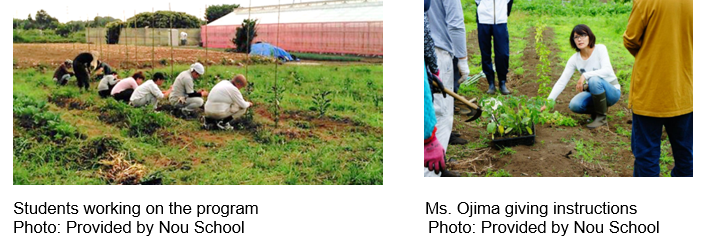
Know School (meaning 'farm school' in Japanese) is an NPO that offers farming support programs for people experiencing hikikomori. Ms. Ojima, the representative, established Eto Farm Co., Ltd. in 2009to address social issues like homelessness and labor shortages in agriculture by providing employment support for the homeless. After completing that support, in 2013 she opened a farming school and began full-scale activities to support employment by offering agricultural work opportunities to people experiencing hikikomori and others.
According to Ojima (2021), the farming support program has two stages. The first stage is an introductory course meant to boost students' confidence and communication skills, while the second stage is a basic course aimed at preparing them to work in agriculture. Both courses run once a week for about two hours over roughly three months. In the intro course, class size is capped at around six people. Each student works individually on the program’s own farm (20 a), focusing on picking up basic farming skills and knowledge. In the next step, the basic course, students use their intro course experience to figure out their own fit and interest in farming, and those eager to work in agriculture continue. Unlike the intro course, the basic course involves hands-on training at nearby farms. With training spots changing each time, students get a range of practical experiences and chances to meet various producers. The program has lined up about 20 farms and agricultural companies as potential workplaces.
In terms of outcomes, about five people find work each year. By 2025, of the 127 people who participated in the program, 63 were employed, with 30 securing jobs in agriculture.
- Yumesodate farm
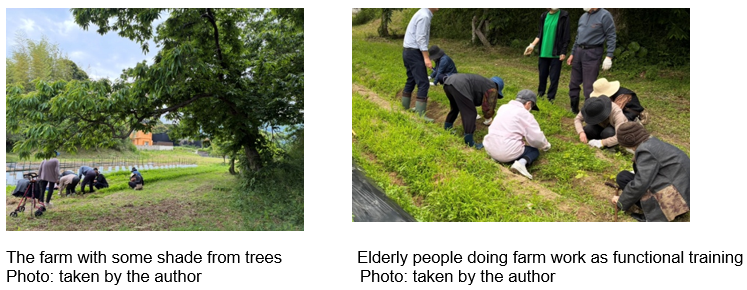
Yumesodate Farm (meaning 'a farm that grows dreams' in Japanese) is a universal farm run by the social welfare corporation Houwa-kai, and it opened in 2024. The farm area is made up of the first farm at 30 a, the second farm at 50 a, and an area at 43 a including a renovated old house used as a rest spot along with its surrounding forest. There are also plans to lease an additional 1.5ha of rice paddies. All farmland is leased from landowners by the social welfare corporation.
To address future management challenges such as the declining elderly population, the need for large funds to rebuild aging facilities, and difficulties hiring staff, they launched new projects: 'Yumesodate Farm' for agricultural production and 'Yumesodate,' a facility offering life care services for people with disabilities. Even as our welfare services become more diverse, they run Yumesodate Farm as a universal farm to keep a sense of unity, provide programs that help users’ cognitive abilities grow throughout their lives, and build trusting relationships with various people in the community.
People with disabilities using life care services grow vegetables for sale, doing whatever tasks they can handle—from sowing and harvesting to preparing shipments—while aiming to improve their cognitive skills and personal development. Seniors who use day services do farm work as functional exercise, usually helping with sowing, thinning, weeding, and preparing items for shipment. The farm manager, Mr. B (part-time farm staff), manages the farm with the other staff in the organization. Since Houwa-kai started the Universal Farm, more people have started using new services like life care and day services, and the number of users is expected to grow enough to make operations profitable.
- Kogane Wakuwaku farm
Kogane Wakuwaku Farm, an exciting farm (In Japanese, 'wakuwaku' is the feeling when your heart is thrilled), is a universal farm where people from the community, including those facing social challenges, can interact, and it's located in the Kogane area of Matsudo City, Chiba Prefecture. In Matsudo City, as part of efforts to create a community where no one is left behind, the Kogane area, which is rich in agriculture, focuses its activities on farming. With cooperation from neighborhood associations, district councils, local social welfare councils, and child welfare committees, a layered structure called the 'Kogane District Safe Space Creation Executive Committee' has been set up to carry out these initiatives.
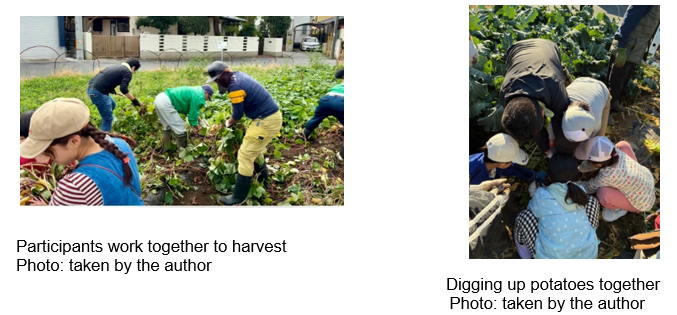
The farm is about 2 ha, and they are using land borrowed from Mr. I, who’s also on the organizing committee. They usually get together about once a month for planting, harvesting, and other farm work, and sometimes they have a get-together to eat what they have harvested.
At Kogane Wakuwaku Farm, a variety of local residents — from preschool kids to people in their 80s (about 30 to 140 people) — take part. In good weather, elderly people from nearby nursing homes, including those with dementia, also join as part of a place-making project. Also, young people experiencing hikikomori receive support from Workers' Coop. The main organizing group, the Place-Making Committee, includes diverse local residents, including seniors, who volunteer and take on hands-on roles.
CONCLUSION
In Japan, the number of people with disabilities (only physical, intellectual, and mental disabilities) is about 11.7 million, making up 9% of the total population. However, only about 1.21 million of them (109% of all people with disabilities) have work. Among the remaining 90% who aren’t working, some can’t work right away but could if they receive training, while others may not be able to work but can still find a place for themselves through farm work.
On the other hand, a 2022 Cabinet Office survey found that about 1.46 million people aged 15 to 64 are experiencing hikikomori. A common trigger for becoming hikikomori is retirement, and about 75% of them actually want to work. So, supporting these people in finding employment is an important social issue.
Furthermore, according to the Ministry of Health, Labor and Welfare's survey on dementia prevalence, out of 36.03 million people aged 65 and older in 2022, 4.43 million had dementia and 5.59 million had mild cognitive impairment, making up 28% of the total. The same survey estimates that by 2060, this will grow to 35%, making it an urgent social issue not only to prevent dementia but also to ensure places where people with dementia can live happily is an urgent social issue.
In this situation, as mentioned earlier, the "Vision for Promoting No-Fuku Renkei (Social Farming) etc." has been revised. By putting into practice, the initiatives outlined in the vision with cooperation from both the public and private sectors, it aims to promote the development of agriculture that supports Japan's food and communities, further social participation of people with disabilities, and ultimately the realization of a community-based society. Meanwhile, the Basic Act for Persons with Disabilities (2011) and the Basic Act on Dementia (2024) have repeatedly emphasized the realization of a symbiotic society. With strong demand for concrete ways to build a community-based society, movements in which diverse people engage in farming activities to help build such a community are also expanding.
Based on the above, the demand for universal farms for people with disabilities who have difficulty working, people in a state of social withdrawal, elderly people with dementia, and the like, as well as universal farms where a variety of people gather to solve social problems, is expected to steadily increase in the future. As mentioned earlier, the Netherlands already has over 1,400 care farms, used by more than 20,000 people. Considering that the total population of the Netherlands is 17 million, it would mean that in Japan, with a population of 123 million, we would need to establish 10,000 universal farms for over 150,000 people to provide support at the same level as in the Netherlands. With this in mind, we need to work to spread and establish universal farms in Japan.
Going forward, we hope the Japan Agricultural and Welfare Collaboration Society, established in 2025, will conduct research and feed the results back to the field, clarifying the future direction of Universal Farms' development and the challenges that need to be tackled.
ACKNOWLEDGEMENTS
We would like to thank all the practitioners at Universal Farm who helped with the survey.
FUNDING
This study was supported by the Agriculture, Forestry and Fisheries Policy Research Institute (ID:
23837277).
CONFLICT OF INTEREST
The authors declare no conflict of interest.
ROLE OF THE FUNDING SOURCE
The funders had no role in the design of the study, analysis or interpretation of the literature, or writing of the manuscript.
ETHICAL APPROVAL
Not applicable. This article presents a narrative review of the previously published studies and publicly available data.
DATA AVAILABILITY
No new data was generated or analyzed in this study.
REFERENCES
Eri Nakamoto, Hiroyuki Kikukawa, Masahiro Toyota & Yukisato Yoshida (2025) "Two Directions of Care Farms in the Netherlands and the Future Development of Universal Farms in Japan" Vocational Rehabilitation, 38(2), 25-32.
Keiya Sakakibara & Yukisato Yoshida (2025) "Current Status and Challenges of Support for Employment of Disabled People and the Socially Withdrawn through Social Farming" Agricultural Economics Research, 97(1), 73-78.
Kiyoko Kojima (2021) "Employment Support for People with Employment Difficulties Using Farm Work" Regional Welfare Research, 49, 47-60.
Sawako Kubota & Yukisato Yoshida (2025) "Advancing Social Farming through Farm-Based Experiential Activities: Community-Building Potential of Universal Farms" in Abstracts of Oral Presentations, 2025 Fall Conference of the Japan Society of Social Welfare, 275-276.
Yukisato Yoshida (2026) "Chairman’s Introduction: The Current State and Future Research Directions of Universal Farms in Urban and Suburban Areas- The Potential that Expands When Agriculture, Medicine, and Social Welfare Collaborate at Universal Farms -" Journal of The Social Farming Academic Society of Japan, 1(1), 5-27.

The Future of Social Farming – Expanding the Potential of Universal Farms
ABSTRACT
It's been 16 years since the term 'social farming' came about in Japan, and now the number of initiatives has grown to 8,949 as of fiscal year 2025. The Japanese government has set a goal to increase is to 12,000 by fiscal 2030. This article will begin by explaining how social farming in Japan started as an initiative for people with disabilities to work, then expanded to provide care and therapeutic activities for those who face working challenges through farming and gardening. This article will also show how this has led to the spread and growth of universal farms, where a variety of people come together to address social issues. On top of that, this article organizes the current state of the newly launched Universal Farms and introduces representative advanced examples from three types: i) farms that support people with mental disabilities or people experiencing hikikomori in getting regular employment, ii) farms aimed at creating a place for elderly people and aimed at developing skills or creating a place for people with disabilities, and iii) farms that promote interaction among diverse local residents, including those facing social difficulties. Finally, this article considers the potential of a future 'Universal Farm' in the future considering these trends as well as the current situations of people with disabilities who have trouble working, people experiencing hikikomori, and elderly people with dementia.
Keywords: social farming, universal farm, people with disabilities, hikikomori, dementia
INTRODUCTION
It's been 16 years since the term 'No-Fuku Renkei (Social Farming)' started being used in Japan, and the approach has become more diverse, expanding from social farming for people with disabilities who can work to social farming for those with severe disabilities, people experiencing hikikomori (prolonged social withdrawal), and elderly people with dementia.
In May 2024, the Ministry of Agriculture, Forestry and Fisheries added an article on social farming to the "Basic Act on Food, Agriculture and Rural Areas," which sets out the policies the ministry should implement. Article 46 includes "creating an environment for agricultural activities for people with disabilities and others." Then, in June 2024, the "Vision for Promoting No-Fuku Renkei (Social Farming) etc." (originally formulated in 2019) was revised, and the updated version was decided. It includes plans to expand and spread universal farms across four government ministries, so social farming in Japan continues to have favorable momentum.
This article looks back at the history of social farming in Japan and how it has spread. On top of that, it considers the potential of 'Universal Farms' in the future, based on the actual examples of the newly launched advanced cases.
THE HISTORY LEADING UP TO UNIVERSAL FARM
Looking back at the historical development of social farming in Japan, it’s clear that it began with agriculture as an independent activity in large residential facilities for people with disabilities, then expanded into opportunities for people with disabilities to work in agriculture at day-service welfare facilities.
From there, collaborations spread across Japan, with disability welfare service offices supporting farms and agricultural corporations through off-site work. In addition, agricultural corporations have begun recognizing people with disabilities as valuable workers, and opportunities for them to thrive in these companies are expanding. In this way, a trend of efforts to create opportunities for people with disabilities who can work in agriculture can be seen. Also, along the way, in parallel with this trend, there has been an expansion of care and therapeutic activities for people with disabilities and others who have difficulties finding work through farming and gardening activities, and this is creating another trend that leads to universal farms where more diverse people gather and help solve social issues.
First of all, this article introduces the background of efforts to expand opportunities for people with disabilities who can work, specifically through agriculture. Even 50 or 60 years ago, before the term 'No-Fukurenkei (Social Farming)' existed, efforts across the country already existed to help people with disabilities engage in farming work, mainly in large residential facilities for the disabled, but those efforts were scattered.
As a result of the 2008 Lehman Shock and factories moving overseas, the subcontracting work that disability welfare service centers could take on decreased. At the same time, the agricultural sector faced labor shortages and increased abandoned farmland due to declining and aging farmers and depopulation in rural areas. In response, in the 2010s, cases across the country of people with disabilities who could work getting involved in agriculture increased, mainly through welfare service centers that provide opportunities to work for people with disabilities, and successful initiatives began to be copied and spread.
In this situation, support for social farming from local governments and organizations like JA has gradually expanded. In particular, efforts to help match farmers and agricultural corporations facing labor shortages with disability welfare service centers that want to help with farm work have noticeably increased.
In response to this trend, the Japanese government also held the "Council for the Promotion of Agriculture-Welfare Collaboration" at the Prime Minister's Office in 2019, where the first "Vision for Promoting No-Fuku Renkei (Social Farming) etc" was decided. Based on this, at the national level, four ministries—the Ministry of Agriculture, Forestry and Fisheries, the Ministry of Health, Labor and Welfare, the Ministry of Justice, and the Ministry of Education, Culture, Sports, Science and Technology—are promoting social farming. As mentioned earlier, in 2024, the revision of the "Basic Act on Food, Agriculture, and Rural Areas" was enacted, including provisions on social farming and legally establishing its promotion.
Thanks to support at both the national and prefectural levels, the number of organizations involved in social farming is increasing. According to the Ministry of Agriculture, Forestry and Fisheries, by the end of fiscal year 2025, 8,949 initiatives will be working on social farming, and the Japanese government aims to increase this to 12,000 by fiscal 2030 (Table 1, Figure 1).
On the other hand, there's another trend toward spreading and expanding universal farms, driven by more care and therapeutic activities for people with disabilities who struggle to work. This actually started back in the Meiji era, when gardening and horticulture activities were used for people with mental illnesses, tuberculosis, and intellectual disabilities.
After that, 'Horticultural Therapy,' which had developed in the United States, was introduced to Japan in the 1990s through the media. In Japan, 'Horticultural Therapy' came to be recognized and spread as an approach aimed at helping people recover or maintain mental, physical, and social functions through a lifestyle that continuously engages with nature and plants.
Also, as gardening booms and activities like community gardens become more active, initiatives called 'horticultural welfare,' proposed as measures to broadly improve citizens' well-being, have been expanding around the same time.
Until now, initiatives connected to these universal farms have only been supported by the Ministry of Agriculture, Forestry and Fisheries, but as mentioned earlier, in the 2024 "Vision for Promoting No-Fuku Renkei (Social Farming) etc., Revised Edition,” it was decided that not just the Ministry of Agriculture, Forestry and Fisheries, but also the Ministries of Health, Labor and Welfare, Education, Culture, Sports, Science and Technology, and Justice will work together to promote and expand universal farms. As a result, we can expect universal farms to spread and grow while serving various functions.
According to the Ministry of Agriculture, Forestry and Fisheries, by the end of fiscal 2025, 399 entities will be involved in initiatives like Universal Farms, up 59 from the previous year.
Table 1. Number and breakdown of initiatives working on social farming (2025)
①Number of operators in agriculture, forestry, and fisheries, etc.
4,140
②Number of organizations running work facilities for people with disabilities, etc.
4,410
③Number of entities involved in Universal Farms, etc.
399
Total(①+②+③)
8,949
Source: The Ministry of Agriculture, Forestry and Fisheries (2025)"About the KPI in the Vision for Promoting No-Fuku Renkei (Social Farming) etc. (2024 Revised Edition)"
THE CURRENT STATE OF UNIVERSAL FARMS ACCORDING TO PREVIOUS STUDIES
Before the term 'Universal Farm' emerged, the Japanese version of 'care farm' was also used, and Dutch care farms have become a model for Universal Farms.
According to Nakamoto et al. (2025), care farms in the Netherlands have been introduced since the early 2000s as a survival strategy for small and medium-sized farms. They are defined as initiatives that use rural landscapes to promote both commercial farm use and physical and mental health, contributing to people's health through social or educational activities. With generous public support, there are now over 1,400 of them, serving more than 20,000 users.
Even in Japan, similar farms have been increasing before the term 'universal farm' came into use, and although we don’t yet have enough data to see the whole picture, past studies have begun to summarize them, and some patterns are emerging.
Sakakibara and Yoshida (2025) looked at 10 farms that provide support for people with mental disorders or people experiencing hikikomori in getting regular employment. Then, Kubota and Yoshida (2025) analyzed 7 farms, including those aimed at creating spaces for the elderly, those focused on developing functions and creating spaces for people with disabilities, and those that promote interaction among diverse community members, including those facing social difficulties.
Also, the range of people being supported has become more diverse, from people with disabilities who can work to those who have difficulty working, elderly people with dementia, and people experiencing hikikomori. Support approaches have also diversified, and the people providing support are no longer limited to those in agriculture or disability welfare. It has expanded to include occupational therapists, horticultural therapists, and others who use farm work as a form of care.
Also, from the perspective of community connections, there are efforts emerging that position urban agriculture as having multiple functions in cities where the number of elderly people with dementia or people experiencing hikikomori is rapidly increasing. Similarly, in rural areas facing depopulation and aging, initiatives are emerging across the country to revitalize rural communities through farm-centered activities.
In December 2025, the Social Farming Academic Society of Japan was established, so we can look forward to analyzing overall trends and future directions for Universal Farms once the data has been organized.
INTRODUCTION TO EXAMPLES OF UNIVERSAL FARM INITIATIVES
As mentioned above, Universal Farms include, at minimum, ⅰ)farms that support people with mental disabilities or people experiencing hikikomori in moving toward regular employment, ⅱ)farms aimed at creating places for the elderly to gather, ⅲ)farms aimed at developing functions and creating spaces for people with disabilities, and ⅳ)farms that facilitate interaction among diverse community residents, including those facing social difficulties. In this article, as representative examples of ⅰ), ⅱ) & ⅲ), and ⅳ), we will specifically introduce the initiatives of Nou School, Yume Sodate Farm, and Kogane Wakuwaku Farm, respectively, citing previous literature that the author was also involved in.
Know School (meaning 'farm school' in Japanese) is an NPO that offers farming support programs for people experiencing hikikomori. Ms. Ojima, the representative, established Eto Farm Co., Ltd. in 2009to address social issues like homelessness and labor shortages in agriculture by providing employment support for the homeless. After completing that support, in 2013 she opened a farming school and began full-scale activities to support employment by offering agricultural work opportunities to people experiencing hikikomori and others.
According to Ojima (2021), the farming support program has two stages. The first stage is an introductory course meant to boost students' confidence and communication skills, while the second stage is a basic course aimed at preparing them to work in agriculture. Both courses run once a week for about two hours over roughly three months. In the intro course, class size is capped at around six people. Each student works individually on the program’s own farm (20 a), focusing on picking up basic farming skills and knowledge. In the next step, the basic course, students use their intro course experience to figure out their own fit and interest in farming, and those eager to work in agriculture continue. Unlike the intro course, the basic course involves hands-on training at nearby farms. With training spots changing each time, students get a range of practical experiences and chances to meet various producers. The program has lined up about 20 farms and agricultural companies as potential workplaces.
In terms of outcomes, about five people find work each year. By 2025, of the 127 people who participated in the program, 63 were employed, with 30 securing jobs in agriculture.
Yumesodate Farm (meaning 'a farm that grows dreams' in Japanese) is a universal farm run by the social welfare corporation Houwa-kai, and it opened in 2024. The farm area is made up of the first farm at 30 a, the second farm at 50 a, and an area at 43 a including a renovated old house used as a rest spot along with its surrounding forest. There are also plans to lease an additional 1.5ha of rice paddies. All farmland is leased from landowners by the social welfare corporation.
To address future management challenges such as the declining elderly population, the need for large funds to rebuild aging facilities, and difficulties hiring staff, they launched new projects: 'Yumesodate Farm' for agricultural production and 'Yumesodate,' a facility offering life care services for people with disabilities. Even as our welfare services become more diverse, they run Yumesodate Farm as a universal farm to keep a sense of unity, provide programs that help users’ cognitive abilities grow throughout their lives, and build trusting relationships with various people in the community.
People with disabilities using life care services grow vegetables for sale, doing whatever tasks they can handle—from sowing and harvesting to preparing shipments—while aiming to improve their cognitive skills and personal development. Seniors who use day services do farm work as functional exercise, usually helping with sowing, thinning, weeding, and preparing items for shipment. The farm manager, Mr. B (part-time farm staff), manages the farm with the other staff in the organization. Since Houwa-kai started the Universal Farm, more people have started using new services like life care and day services, and the number of users is expected to grow enough to make operations profitable.
Kogane Wakuwaku Farm, an exciting farm (In Japanese, 'wakuwaku' is the feeling when your heart is thrilled), is a universal farm where people from the community, including those facing social challenges, can interact, and it's located in the Kogane area of Matsudo City, Chiba Prefecture. In Matsudo City, as part of efforts to create a community where no one is left behind, the Kogane area, which is rich in agriculture, focuses its activities on farming. With cooperation from neighborhood associations, district councils, local social welfare councils, and child welfare committees, a layered structure called the 'Kogane District Safe Space Creation Executive Committee' has been set up to carry out these initiatives.
The farm is about 2 ha, and they are using land borrowed from Mr. I, who’s also on the organizing committee. They usually get together about once a month for planting, harvesting, and other farm work, and sometimes they have a get-together to eat what they have harvested.
At Kogane Wakuwaku Farm, a variety of local residents — from preschool kids to people in their 80s (about 30 to 140 people) — take part. In good weather, elderly people from nearby nursing homes, including those with dementia, also join as part of a place-making project. Also, young people experiencing hikikomori receive support from Workers' Coop. The main organizing group, the Place-Making Committee, includes diverse local residents, including seniors, who volunteer and take on hands-on roles.
CONCLUSION
In Japan, the number of people with disabilities (only physical, intellectual, and mental disabilities) is about 11.7 million, making up 9% of the total population. However, only about 1.21 million of them (10
9% of all people with disabilities) have work. Among the remaining 90% who aren’t working, some can’t work right away but could if they receive training, while others may not be able to work but can still find a place for themselves through farm work.On the other hand, a 2022 Cabinet Office survey found that about 1.46 million people aged 15 to 64 are experiencing hikikomori. A common trigger for becoming hikikomori is retirement, and about 75% of them actually want to work. So, supporting these people in finding employment is an important social issue.
Furthermore, according to the Ministry of Health, Labor and Welfare's survey on dementia prevalence, out of 36.03 million people aged 65 and older in 2022, 4.43 million had dementia and 5.59 million had mild cognitive impairment, making up 28% of the total. The same survey estimates that by 2060, this will grow to 35%, making it an urgent social issue not only to prevent dementia but also to ensure places where people with dementia can live happily is an urgent social issue.
In this situation, as mentioned earlier, the "Vision for Promoting No-Fuku Renkei (Social Farming) etc." has been revised. By putting into practice, the initiatives outlined in the vision with cooperation from both the public and private sectors, it aims to promote the development of agriculture that supports Japan's food and communities, further social participation of people with disabilities, and ultimately the realization of a community-based society. Meanwhile, the Basic Act for Persons with Disabilities (2011) and the Basic Act on Dementia (2024) have repeatedly emphasized the realization of a symbiotic society. With strong demand for concrete ways to build a community-based society, movements in which diverse people engage in farming activities to help build such a community are also expanding.
Based on the above, the demand for universal farms for people with disabilities who have difficulty working, people in a state of social withdrawal, elderly people with dementia, and the like, as well as universal farms where a variety of people gather to solve social problems, is expected to steadily increase in the future. As mentioned earlier, the Netherlands already has over 1,400 care farms, used by more than 20,000 people. Considering that the total population of the Netherlands is 17 million, it would mean that in Japan, with a population of 123 million, we would need to establish 10,000 universal farms for over 150,000 people to provide support at the same level as in the Netherlands. With this in mind, we need to work to spread and establish universal farms in Japan.
Going forward, we hope the Japan Agricultural and Welfare Collaboration Society, established in 2025, will conduct research and feed the results back to the field, clarifying the future direction of Universal Farms' development and the challenges that need to be tackled.
ACKNOWLEDGEMENTS
We would like to thank all the practitioners at Universal Farm who helped with the survey.
FUNDING
This study was supported by the Agriculture, Forestry and Fisheries Policy Research Institute (ID:
23837277).
CONFLICT OF INTEREST
The authors declare no conflict of interest.
ROLE OF THE FUNDING SOURCE
The funders had no role in the design of the study, analysis or interpretation of the literature, or writing of the manuscript.
ETHICAL APPROVAL
Not applicable. This article presents a narrative review of the previously published studies and publicly available data.
DATA AVAILABILITY
No new data was generated or analyzed in this study.
REFERENCES
Eri Nakamoto, Hiroyuki Kikukawa, Masahiro Toyota & Yukisato Yoshida (2025) "Two Directions of Care Farms in the Netherlands and the Future Development of Universal Farms in Japan" Vocational Rehabilitation, 38(2), 25-32.
Keiya Sakakibara & Yukisato Yoshida (2025) "Current Status and Challenges of Support for Employment of Disabled People and the Socially Withdrawn through Social Farming" Agricultural Economics Research, 97(1), 73-78.
Kiyoko Kojima (2021) "Employment Support for People with Employment Difficulties Using Farm Work" Regional Welfare Research, 49, 47-60.
Sawako Kubota & Yukisato Yoshida (2025) "Advancing Social Farming through Farm-Based Experiential Activities: Community-Building Potential of Universal Farms" in Abstracts of Oral Presentations, 2025 Fall Conference of the Japan Society of Social Welfare, 275-276.
Yukisato Yoshida (2026) "Chairman’s Introduction: The Current State and Future Research Directions of Universal Farms in Urban and Suburban Areas- The Potential that Expands When Agriculture, Medicine, and Social Welfare Collaborate at Universal Farms -" Journal of The Social Farming Academic Society of Japan, 1(1), 5-27.