ABSTRACT
Agriculture occupies a central place in Lao PDR's economy, yet the sector remains held back by a persistent combination of climate vulnerability, financial exclusion, and weak institutional capacity. Smallholder farmers, who make up the great majority of rural households, face serious difficulties accessing affordable long-term credit, constrained by inadequate collateral, high perceived risk, and burdensome application requirements. Conventional instruments such as subsidized loans and microfinance have offered only partial relief, leaving a significant rural finance gap. Green finance, encompassing green bonds, climate-linked loans, and ESG-aligned credit facilities, offers a more systemic pathway to address this gap by directing capital toward sustainable agricultural practices while strengthening the sector's adaptive capacity. When combined with Responsible Agricultural Investment (RAI) principles, green finance provides an operational framework to ensure that capital flows translate into tangible social and environmental improvements on the ground. Drawing on desk research, policy analysis, and stakeholder interviews across the agricultural value chain, this paper examines Lao PDR's current financial landscape, reviews emerging green finance developments, and identifies the principal barriers to sustainable agricultural finance, including limited financial literacy, elevated borrowing costs, and weak ESG infrastructure. A set of practical policy recommendations is offered to strengthen the enabling environment for green and responsible investment.
Keywords: green finance, responsible agricultural investment, financial inclusion, sustainable agriculture, Lao PDR, ESG
INTRODUCTION
Access to formal finance in Lao PDR remains severely constrained, particularly for smallholder farmers and agricultural businesses. One of the most persistent structural barriers is the widespread lack of formal land titles: a large share of agricultural land is registered under customary land-use certificates, which commercial banks and microfinance institutions (MFIs) typically do not accept as collateral (Wongpit & Sisengnam, 2018). Without the ability to use their primary productive assets to secure loans, farmers are effectively locked out of formal credit markets. This problem is compounded by the sparse banking infrastructure in rural areas, which leaves most households reliant on informal financial arrangements that lack adequate consumer protection, regulatory oversight, and risk-sharing mechanisms.
The scale of financial exclusion is significant. World Bank Enterprise Survey data from 2018 indicate that around 80 percent of small enterprises and 55 percent of medium-sized enterprises in Lao PDR are unable to access formal financial services, with a large proportion operating in agriculture (World Bank, 2019). In 2019, total outstanding Small and Medium Enterprise (SME) loans stood at approximately LAK 14,104 billion, equivalent to around 8.5 percent of GDP, yet agriculture received only 3.8 percent of that lending. Microfinance institutions directed a proportionally higher share, around 13.0 percent of their LAK 1,294 billion portfolio, to agriculture, underscoring the sector's dependence on smaller and costlier financing channels (ADB, 2020).
Against this backdrop, green finance has emerged internationally as a policy instrument designed to channel capital toward environmentally and socially beneficial activities. It covers a broad range of tools, including green bonds, sustainability-linked loans, and climate risk insurance, structured to align financial flows with environmental outcomes and manage climate-related risks (Taneja & Reepu, 2024). Over the past two decades, green finance has evolved from a niche concept into a mainstream policy and market priority, driven by growing awareness of climate urgency and sustainability imperatives (Nsisong et al., 2024).
In Lao PDR, the policy conversation around green finance is gaining momentum. Integrating green finance with Responsible Agricultural Investment (RAI) principles, a framework designed to promote sustainable, equitable, and food-security-enhancing investment in agriculture (FAO, 2014), could offer a coherent strategy for simultaneously addressing financial exclusion, environmental vulnerability, and rural underdevelopment. FAO, with support from GIZ, implemented an RAI project in Lao PDR between 2019 and 2021 that laid important institutional groundwork for this integration.
This paper examines the potential to integrate green finance with RAI principles in the Lao PDR, with direct relevance to policymakers and financial sector actors. The analysis draws on a desk review of annual reports from the Bank of Lao PDR (BOL), commercial banks, and MFIs, academic literature, and policy documents. Qualitative interviews were conducted with representatives from BOL, the SME Promotion Fund, the Ministry of Agriculture and Environment, commercial banks, MFIs, and actors across the agricultural value chain, including farmers, processors, and exporters.
ACCESS TO FINANCE IN LAO PDR
A defining feature of private sector development in Lao PDR is the high cost of capital and limited access to affordable financing. Micro, small, and medium enterprises (MSMEs) account for approximately 99 percent of all domestic firms, yet their share of commercial bank lending has fallen sharply — from 31 percent in 2015 to around 12 percent in 2022 (World Bank, 2024). This contraction is largely driven by information asymmetry: many MSMEs operate informally, without business licenses or standardized financial records, making it difficult for lenders to assess creditworthiness reliably.
Agricultural lending faces particular challenges. Financial institutions typically view the sector as high-risk, pointing to market risks (price volatility and limited market access), production risks (exposure to imported input costs), and environmental risks (climate shocks, pests, and disease). Without robust risk-mitigation tools — such as crop insurance or functioning credit guarantee schemes — and with limited progress in financial literacy among agricultural entrepreneurs, the sector remains trapped in a cycle of chronic underinvestment.
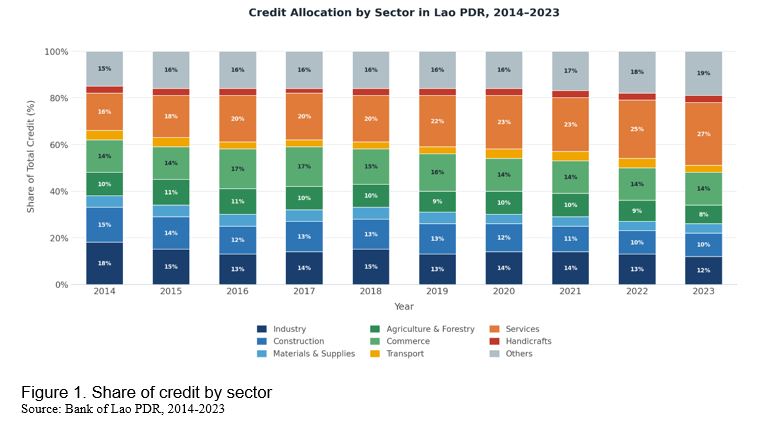
Figure 1 traces credit allocation by sector in Lao PDR from 2014 to 2023. Over the decade, the services sector emerged as the largest and fastest-growing recipient of credit, expanding from around 16% of the total in 2014 to approximately 27% by 2023, reflecting growing activities such as tourism, financial services, and real estate. The industrial sector maintained a consistently significant share, accounting for roughly 12 to 18 % of total credit, in line with the government's sustained emphasis on manufacturing and industrial expansion as a national development priority (Bank of Lao PDR, 2024).
Agriculture and forestry, despite being the foundation of rural livelihoods, held only an 8-11 percent share of credit throughout the period. This persistently low figure reflects deep-rooted structural barriers: collateral deficits, high lender risk perceptions, and the absence of green credit products tailored to smallholders’ needs. The gap is particularly striking given agriculture's centrality to Lao PDR's commitments under NDC 2021 on land use and forest cover. Materials and supplies, transport, and handicrafts each held smaller shares, with handicrafts consistently receiving less than 5% of total credit. The residual "others" category grew gradually from around 15 percent in 2014 to approximately 19% by 2023, likely reflecting the emergence of digital services and early-stage green economy activities not yet captured in BOL's formal sectoral taxonomy (Bank of Lao PDR, 2024).
Taken together, these patterns describe a credit system in slow structural transition that shifts from an agrarian and industry-led model toward one increasingly dominated by services. Yet the persistently marginal position of agriculture and forestry in credit allocation represents a serious misalignment between financial flows and national climate commitments. Closing this gap is precisely the challenge that green finance instruments and responsible investment frameworks are best placed to address if Lao PDR is to bring its financial system into alignment with the NDC 2021 and the National Strategy on Climate Change (NSCC) 2023.
In response to systemic credit gaps, the Lao PDR SME Development Plan (2016–2020) established a five-pillar strategic framework covering: institutional capacity strengthening of financial intermediaries; diversification of financial products tailored to SME needs; streamlining of credit access through regulatory reform; improvement of financial literacy and loan-readiness among SME owners; and mobilization of dedicated liquidity for small-scale lending. The SME Promotion Fund, operating under the Ministry of Industry and Commerce (MOIC), implemented targeted technical assistance programs to address the two most cited lending barriers: complicated loan application requirements and insufficient financial documentation. By 2023, these programs had supported over 223 SMEs, with 162 having adopted standardized accounting frameworks (DOSMEP, 2023).
The Lao Credit Guarantee Sole Company Limited (LCGC) was first approved by the government in July 2024, officially incorporated in December 2024, and formally launched operations in April 2026. Operating under the oversight of BOL, LCGC has the potential to play a transformative role in reducing lender risk by providing partial credit guarantees on bank loans, enabling financial institutions to assess borrowers based on their business potential and growth prospects rather than collateral alone. This enables lenders to move beyond purely collateral-based assessments toward a more comprehensive appraisal of business viability, thereby opening formal access to credit for MSMEs that would otherwise be excluded from the financial system.
Within the commercial banking landscape, most institutions focus primarily on clients in the industrial and service sectors. Two banks explicitly serve the agricultural sector: the Agriculture Promotion Bank (APB) and the Rural Development Bank (RDB). In 2022, APB transitioned from a state-mandated agricultural lender to a private commercial bank following a 70% private equity acquisition, with the predictable consequence that its agricultural loan portfolio fell sharply from 60% to 23.9% by 2024 (Agriculture Promotion Bank, 2025). APB nevertheless retains several agricultural credit products, including small-group loans for three to five farmers, with a maximum limit of LAK 30 million and no formal collateral requirement. However, rising non-performing loans have dampened uptake.
APB has also partnered with the Global Green Growth Institute and the Lao Securities Commission Office on a Green Bond Initiative supported by the Government of Luxembourg. This initiative aims to direct investment into hydropower, renewable energy, electric agricultural vehicles, and recycling infrastructure, signaling a meaningful commitment to ESG-aligned financing within Lao PDR's banking sector (Agriculture Promotion Bank, 2025).
RDB, by contrast, remains a fully state-owned policy bank, operating outside BOL prudential supervision and explicitly targeting the 68 officially designated poor districts. Modeled on Vietnam's Bank for Social Policies, RDB provides concessional lending at rates of 5 to 7 percent per annum, well below commercial rates that exceed 10 percent, using group loan structures that substitute mutual guarantees for individual collateral. Its principal constraints are limited geographic coverage and an annual cap on the credit budget, which together restrict its potential outreach (Rural Development Bank, 2026).
Village Savings and Credit Schemes and Village Banks are grassroots financial mechanisms that mobilize local savings and extend micro-credit for agricultural and trading activities. While these arrangements meaningfully improve access for underserved communities, their capitalization and outreach remain insufficient to support agricultural modernization on scale. A promising approach would be to formalize linkages between Village Banks and commercial lenders, supplemented by on-farm technical assistance delivered through farmer organizations. Capacity needs identified by farmers themselves include business planning, financial management, group governance, and monitoring and reporting skills (Wongpit & Sisengnam, 2022).
GREEN FINANCE AND RESPONSIBLE AGRICULTURAL INVESTMENT IN LAO PDR
Green finance has evolved into a multifaceted framework centered on the mobilization of capital toward activities that generate broad environmental benefits within the context of sustainable development (G20 Green Finance Study Group, 2016). Beyond any single instrument, green finance represents a systemic reorientation of capital allocation, repositioning financial institutions as active intermediaries that channel resources toward environmentally sustainable, socially equitable, and economically resilient activities (Berensmann et al., 2016; Weber & ElAlfy, 2019; Fu & Ng, 2020).
RAI provides a complementary operational framework at the sector level. While green finance furnishes the systemic architecture, liquidity channels, and regulatory mechanisms that enable climate neutrality and financial stability, RAI offers a practical guide for deploying capital ethically within food and agricultural systems (FAO, 2014). Both frameworks share a commitment to triple-performance outcomes: financial profitability, food security, and the protection of natural ecosystems.
The two frameworks are operationally linked through the alignment of green finance's ESG criteria with RAI's core pillars: smallholder empowerment, community tenure rights protection, and environmental stewardship. In this sense, green finance provides the capital to scale sustainable agriculture, while the RAI framework ensures that capital generates tangible socio-environmental improvements and lasting economic value (Clapp & Isakson, 2018; Reardon & Barrett, 2000).
Several major multilateral green finance mechanisms offer tangible opportunities for Lao PDR to access climate-linked capital. The Green Climate Fund (GCF), with a portfolio of approximately USD 19.3 billion spanning around 300 projects in 130 countries, has invested approximately USD 268 million in Lao PDR across 17 readiness activities, covering initiatives to strengthen climate resilience in the health system, improve early warning infrastructure, and enhance climate-adaptive public services (GCF, 2026). The Global Environment Facility (GEF), with cumulative funding of approximately USD 23.2 billion, and the Climate Investment Funds (CIF), which have mobilized around USD 12.5 billion in pledged resources and issued an inaugural USD 500 million climate bond, represent additional multilateral pathways.
For developing economies like Lao PDR, these developments open significant opportunities to finance RAI, land-based investments, and agri-food system transformation. Global climate investment opportunities in emerging markets are projected to reach USD 32 trillion by 2030, with the East Asia and Pacific region accounting for more than USD 16 trillion (Climate Investment Fund, 2025). Key international standards facilitating market access include the Climate Bond Taxonomy, the Green and Social Bond Principles, and the EU–China Common Ground Taxonomy on Climate Change Mitigation. At the regional level, the ASEAN Taxonomy for Sustainable Finance provides an important reference framework for Lao PDR's sustainable finance strategy (ASEAN Taxonomy Board, 2025).
Lao PDR formally initiated its green finance journey in 2022 through a Memorandum of Understanding between BOL and International Finance Corporation (IFC), with the partnership aimed at developing a national green finance policy framework, integrating environmental risk into credit allocation, and building capacity for green bond issuance. Key commitments include reducing greenhouse gas emissions by 60 percent by 2030 and achieving carbon neutrality in subsequent decades. Initial activities have encompassed market readiness assessments, the drafting of regulatory guidelines, and capacity-building programs for financial sector personnel (Bank of Lao PDR, 2022).
ADB survey conducted in 2022 found growing interest among institutional investors in Lao PDR in ESG-aligned opportunities, with approximately 60 percent of those surveyed indicating intentions to explore sustainable investments. This signals a meaningful shift in investment culture, even as structural constraints, limited technical expertise, insufficient policy guidance, and thin institutional capacity for developing green products continue to slow market development (ADB, 2022).
A noteworthy recent milestone is the issuance of a USD 2.5 million green bond by LOCA, a Lao-owned electric mobility start-up, facilitated by three securities companies. While modest in scale, this represents one of the first practical applications of green bond financing in the country and demonstrates that private sector-led green capital market activity is possible within the current institutional environment (LOCA, 2025).
Despite the momentum described above, significant structural barriers continue to impede the scaling of green finance for agriculture. The relatively small size of Lao PDR's domestic economy and financial markets tends to deter large-scale investment by international financial institutions, which face fixed transaction costs that are difficult to recover on small-ticket deals. Many existing agricultural investments do not yet meet the ESG or RAI compliance standards required by international funders, further limiting their eligibility for green financial products.
Awareness of green finance, ESG principles, and RAI remains limited among domestic investors, financial intermediaries, and farmers. Stronger institutional coordination is needed among the Ministry of Agriculture and Environment and BOL if green finance is to be embedded coherently within agricultural policy. The RAI framework, formally introduced by FAO in 2014, has seen slow practical uptake, partly because investors and financial institutions continue to prioritize short-term returns over long-term sustainability considerations (GIZ, 2021). A 2021 GIZ assessment identified an urgent need for practical RAI guidance and evaluation frameworks and subsequently developed supporting manuals covering environmental and social impact assessment and community grievance mechanisms.
DiscussionS
The findings broadly confirm the institutionalist argument advanced by Volz (2018, 2023) and the UNEP FI (2025) that green finance market development in emerging economies is primarily a problem of regulatory construction rather than capital scarcity per se. Lao PDR's experience shows that even where active multilateral finance pipelines exist GCF, FCPF, ADB blended finance, the absence of a national green taxonomy, and the fragility of domestic capital markets prevent international climate finance commitments from translating into scalable domestic instruments. The LOCA green bond, while symbolically important as the country's first labelled corporate issuance, illustrates the gap between policy aspiration and market depth that Mathews and Kidney (2012) identified as the critical bottleneck in early-stage green finance systems.
This finding extends the existing literature in an important direction. In a debt-distressed LDC facing imminent graduation, the taxonomy gap is compounded by a fiscal credibility gap. This dual constraint simultaneously reduces the sovereign's capacity to offer first-loss guarantees and undermines investor confidence in the rule-of-law framework underpinning green bond covenants, a dynamic that has not been adequately theorized in the existing LDC green finance literature.
The paper's central theoretical contribution, the Green Finance–Responsible Agricultural Investment nexus (GF-RAI nexus), builds on but departs from two adjacent bodies of scholarship. First, it extends the climate finance accountability literature (Buchner et al., 2021; Whitley et al., 2018) by proposing that structured, agriculture-investment-aligned MRV (Measure, Reporting, and Verification) systems function not simply as technical efficiency tools but as institutional trust-building mechanisms that can reduce the principal–agent problems endemic to results-based climate finance disbursements. This argument is particularly relevant in governance-constrained contexts such as Lao PDR, where formal accountability mechanisms and civil society oversight are limited.
Second, applying RAI principles to credit assessment and land use monitoring systems that carry significant distributive consequences for rural smallholders and indigenous communities requires particular care to ensure that financial models do not simply reflect and reinforce existing patterns of exclusion. The equitable deployment of these tools is therefore as important as their technical design.
A recurring tension in the findings is the gap between the sophistication of Lao PDR's macro-level policy architecture and the persistent under-delivery at the micro level, particularly in agricultural credit penetration and forest MRV data quality. This pattern is consistent with what Andrews, Pritchett, and Woolcock (2017) call "isomorphic mimicry" in development institutions: the adoption of internationally legitimate policy forms without the organizational capability needed to operationalize them.
The GF–RAI nexus offers a potential pathway out of this impasse, but only if investment deployment is preceded by the capability-building investments identified in this paper, including inter-ministerial coordination, financial sector capacity development, and the formalization of credit guarantee schemes for green agriculture. Without this sequencing, there is a real risk that new financial tools will entrench existing information asymmetries rather than resolve them, particularly where credit assessment models draw on historical data that reflects the agricultural sector's longstanding marginalization from formal finance.
Situating Lao PDR within its regional peer group reveals a structural divergence with important policy implications. Vietnam's legally binding Green Taxonomy (Decision 21/2025/QD-TTg, effective August 2025) and an outstanding green credit portfolio equivalent to 4.3 percent of total bank lending illustrates the trajectory the BOL–IFC roadmap aspires to follow, but from a considerably more constrained starting point (WATSON FARLEY & WILLIAMS, 2025). Cambodia's Sustainable Bond Accelerator, which catalyzed over USD 60 million in green bond issuances between 2023 and 2025 with GGGI and CGIF support, offers a more directly replicable model given the two countries' comparable capital market depths and institutional capacities (GGGI, 2025). Thailand's two-phase national taxonomy and the Bank of Thailand's mandatory climate risk disclosure framework provide a useful medium-term policy horizon (Bank of Thailand, 2025).
This comparison suggests that Lao PDR's green finance strategy should be benchmarked explicitly against Cambodia and Vietnam rather than more advanced ASEAN economies. Regional knowledge-transfer mechanisms potentially through the ASEAN Taxonomy Working Group represent an underutilized resource for accelerating the country's progress
CONCLUSION AND POLICY RECOMMENDATIONS
Lao PDR's agricultural sector faces a convergence of structural financial barriers, climate vulnerabilities, and institutional capacity constraints that limit its potential for sustainable development. Green finance aligned with RAI principles offers a coherent, scalable response: directing capital toward environmentally sound agricultural practices while improving financial inclusion and sector resilience.
This paper has traced the financial landscape facing Lao farmers, documented the emergence of green finance initiatives, and mapped the principal barriers to implementation, including limited ESG awareness, weak institutional coordination, and insufficient policy infrastructure. While early-stage developments the BOL–IFC MoU, APB's Green Bond Initiative, and the LOCA bond issuance demonstrate genuine momentum, the transition to a sustainable agricultural finance ecosystem will require sustained political commitment, deliberate capacity building, and coherent engagement with international finance mechanisms.
The following policy recommendations are proposed to advance the integration of green finance with responsible agricultural investment in Lao PDR:
- Strengthen financial sector capacity on RAI and ESG. BOL should mandate or incentivize structured capacity-building programs for commercial banks and MFIs covering ESG credit assessment, environmental risk evaluation, and RAI principles. GIZ, FAO, and IFC can provide technical assistance and co-financing to reduce the upfront cost burden on domestic institutions.
- Develop a national green finance taxonomy. Drawing on the ASEAN Taxonomy for Sustainable Finance, Lao PDR should develop a nationally tailored taxonomy that explicitly defines eligible green activities in the agricultural sector, facilitating both domestic and international green capital flows and reducing the risk of greenwashing.
- Expand credit guarantee mechanisms for sustainable agriculture. The LCGC's mandate should be extended to cover green agricultural investments, with blended finance structures incorporating GCF or GEF resources to de-risk lending to smallholders adopting sustainable practices.
- Simplify and digitalize loan application processes. Financial institutions should develop streamlined, mobile-accessible application processes for green agricultural loans, reducing complexity during the initial rollout phase to encourage uptake among smallholder borrowers unfamiliar with formal financial products.
- Promote financial literacy with a sustainability focus. Financial literacy programs targeting smallholder farmers should incorporate sustainability concepts — the benefits of green investment, ESG criteria, and the RAI framework — to build demand-side readiness for green financial products.
Future research should examine the effectiveness of specific green finance instruments in Lao PDR's agricultural context, assess the impact of RAI-aligned investments on smallholder outcomes, and track progress on ESG integration across the banking sector. Cross-country comparisons within ASEAN, particularly with Cambodia and Vietnam, would contribute valuable insights for regional policy learning and help establish credible
REFERENCES
ADB. (2020). Financial sector development in Lao PDR. Asian Development Bank.
ADB. (2022). Green Bond Market Survey for the Lao People's Democratic Republic: Insights on the Perspectives of Institutional Investors and Underwriters. Retrieved from https://www.adb.org/sites/default/files/publication/821746/green-bond-market-survey-lao-pdr.pdf
Agriculture Promotion Bank. (2025). Annual report 2024. APB, Vientiane, Lao PDR. Retrieved from https://www.apb.com.la/about/financial-report
Andrews, M., Pritchett, L., & Woolcock, M. (2017). Building state capability: Evidence, analysis, action. MIT Press.
ASEAN Taxonomy Board. (2025). ASEAN Taxonomy for Sustainable Finance. Retrieved from www.theacmf.org/images/downloads/pdf/ASEAN%20Taxonomy%20Sustainable%20Finance%20V4_06Nov25.pdf
Bank of Lao PDR. (2022). A new Partnership between the Bank of Lao PDR and International Finance Corporation to Boost Green Finance. Retrieved from https://www.bol.gov.la/en/fileupload/29-09-2022_1664436051.pdf
Bank of Lao PDR. (2024). Annual Economic Report 2024. Retrieved from https://www.bol.gov.la/en/fileupload/20-06-2025_1750414260.pdf
Bank of Thailand. (2025). Thailand Taxonomy Driving the Thai Economy Towards Sustainability. Retrieved from https://www.bot.or.th/content/dam/bot/financial-innovation/sustainable-finance/green/taxonomy/01_EN_Thailand_Taxonomy-Introduction.pdf
Berensmann, K., Dafe, F., & Lindenberg, N. (2016). Demystifying green finance. Briefing Paper 3/2016, German Development Institute.
Buchner, B., Clark, A., Falconer, A., Macquarie, R., Meattle, C., Tolentino, R., & Wetherbee, C. (2021). Global landscape of climate finance 2021. Climate Policy Initiative. Retrieved from https://www.climatepolicyinitiative.org/wp-content/uploads/2021/10/Full-report-Global-Landscape-of-Climate-Finance-2021.pdf
Clapp, J., & Isakson, S. R. (2018). Speculative harvests: Financialization, food, and agriculture. United Kingdom: Fernwood Publishing.
Climate Investment Fund. (2025). Annual Report 2024: Shifting Gears. Retrieved from https://www.cif.org/sites/cif_enc/files/knowledge-documents/cif-annual-report-2024.pdf
DOSMEP. (2023). SME capacity building report 2023. Department of SME Promotion, Ministry of Industry and Commerce, Lao PDR.
FAO. (2014). Enabling Legal Environment for Responsible Investment in Agriculture and Food Systems. Retrieved from https://openknowledge.fao.org/server/api/core/bitstreams/277ebdd1-d249-4445-9214-3ec0b219ea74/content
Floridi, L., Cowls, J., Beltrametti, M., Chatila, R., Chazerand, P., Dignum, V., ... & Vayena, E. (2018). AI4People — An ethical framework for a good AI society. Minds and Machines, 28(4), 689–707.
Fu, J., & Ng, A. W. (2020). Greening the financial system in China, Europe, and beyond: Towards a common taxonomy. Journal of Sustainable Finance & Investment, 11(2), 131–152.
G20 Green Finance Study Group. (2016). G20 Green Finance Sythesis Report. Retreived from https://g20sfwg.org/wp-content/uploads/2021/07/2016_Synthesis_Report_Full_EN.pdf.
GCF. (2026). GCF.10: 10 years of climate impact. Green Climate Fund. https://www.greenclimate.fund/gcf10
GGGI. (2025). Cambodia Sustainable Bond Accelerator Program Launches Phase III: Call for Applications Now Open to Empower Green and Sustainable Bond Issuers. Retrieved from https://gggi.org/cambodia-sustainable-bond-accelerator-program-launches-phase-iii-call-for-applications-now-open-to-empower-green-and-sustainable-bond-issuers/
GIZ. (2021). Responsible agricultural investment guidelines for Lao PDR. Deutsche Gesellschaft für Internationale Zusammenarbeit, Vientiane.
Jobin, A., Ienca, M., & Vayena, E. (2019). The global landscape of AI ethics guidelines. Nature Machine Intelligence, 1(9), 389–399.
Lindenberg, N. (2014). Definition of green finance. German Development Institute. Retrieved from https://www.idos-research.de/fileadmin/migratedNewsAssets/Files/Lindenberg_Definition_green_finance.pdf
LOCA. (2025). Blog/ LOCA Extends Fundraising Round with $2.5M Green Bond to Accelerate EV Adoption and Green Mobility in Laos. Retrieved from https://loca.la/blog/loca-extends-fundraising-round-with-2-5m-green-bond-to-accelerate-ev-adoption-and-green-mobility-in-laos/
Mathews, J. A., & Kidney, S. (2012). Financing climate-friendly energy development through bonds. Development Southern Africa, 29(2), 337–349.
Government of Lao PDR. (2021). Nationally Determined Contribution. Retrieved from https://unfccc.int/sites/default/files/NDC/2022-06/NDC%202020%20of%20Lao%20PDR%20%28English%29%2C%2009%20April%202021%20%281%29.pdf
Government of Lao PDR. (2023). National Strategy on Climate Change. Retrieved from https://lpr.adb.org/sites/default/files/2024-06/NCCS_Eng_Final.pdf
Nsisong, L. E. U., Mercy, O. A., Ekene, C. O., Aumbur, K. S., & Chima, A. (2024). Advances in green finance solutions for combating climate change and ensuring sustainability. Gulf Journal of Advance Business Research, 2(6), 338-375.
Reardon, T., & Barrett, C. B. (2000). Agroindustrialization, globalization, and international development. Agricultural Economics, 23(3), 195–205.
Rural Development Bank. (2026). Loan service. Retrieved from https://rdb.com.la/web-page-menu/28
Taneja, S., & Reepu. (2024). Sustainability-Driven Finance: Reshaping the Financial World. In: A. Singh, S. Taneja, & P. Kumar (Eds.), Algorithmic Approaches to Financial Technology: Forecasting, Trading, and Optimization, 74–92. IGI Global Scientific Publishing. doi: 10.4018/979-8-3693-1746-4.ch005.
Volz, U. (2018). Fostering green finance for sustainable development in Asia. ADBI Working Paper 814. Asian Development Bank Institute.
Volz, U. (2023). The role of central banks and financial regulators in addressing climate-related financial risks. Journal of Economics and Business, 125, 106107.
WATSON FARLEY & WILLIAMS. (2025). Vietnam’s Green Taxonomy: A New Legal Framework for Green Credit and Green Bonds. Retrieved from https://www.wfw.com/articles/vietnams-green-taxonomy-new-legal-framework-green-credit-green-bonds/
Weber, O., & ElAlfy, A. (2019). The development of green finance by sector. In The rise of green finance in Europe: opportunities and challenges for issuers, investors and marketplaces (pp. 53-78). Cham: Springer International Publishing.
Whitley, S., Thwaites, J., Wright, H., & Ott, C. (2018). Making finance consistent with climate goals. Overseas Development Institute. Retrieved from https://www.wri.org/research/making-finance-consistent-climate-goals
Wongpit, P., & Sisengnam, K. (2022). Determinants of farmers’ access to credit in the Lao People’s Democratic Republic. Applied Economics Journal, 29(2), 124-138.
World Bank. (2019). Enterprise survey: Lao PDR. World Bank Group. Retrieved from https://microdata.worldbank.org/index.php/catalog/3573
World Bank. (2024). Lao PDR economic monitor. World Bank, Washington DC. Retrieved from https://thedocs.worldbank.org/en/doc/5c2594a0cc6846465fe3bafda50ad993-0070062024/related/LEM-October-2024-Final.pd

Green Finance for Sustainable Agricultural Development in Lao PDR
ABSTRACT
Agriculture occupies a central place in Lao PDR's economy, yet the sector remains held back by a persistent combination of climate vulnerability, financial exclusion, and weak institutional capacity. Smallholder farmers, who make up the great majority of rural households, face serious difficulties accessing affordable long-term credit, constrained by inadequate collateral, high perceived risk, and burdensome application requirements. Conventional instruments such as subsidized loans and microfinance have offered only partial relief, leaving a significant rural finance gap. Green finance, encompassing green bonds, climate-linked loans, and ESG-aligned credit facilities, offers a more systemic pathway to address this gap by directing capital toward sustainable agricultural practices while strengthening the sector's adaptive capacity. When combined with Responsible Agricultural Investment (RAI) principles, green finance provides an operational framework to ensure that capital flows translate into tangible social and environmental improvements on the ground. Drawing on desk research, policy analysis, and stakeholder interviews across the agricultural value chain, this paper examines Lao PDR's current financial landscape, reviews emerging green finance developments, and identifies the principal barriers to sustainable agricultural finance, including limited financial literacy, elevated borrowing costs, and weak ESG infrastructure. A set of practical policy recommendations is offered to strengthen the enabling environment for green and responsible investment.
Keywords: green finance, responsible agricultural investment, financial inclusion, sustainable agriculture, Lao PDR, ESG
INTRODUCTION
Access to formal finance in Lao PDR remains severely constrained, particularly for smallholder farmers and agricultural businesses. One of the most persistent structural barriers is the widespread lack of formal land titles: a large share of agricultural land is registered under customary land-use certificates, which commercial banks and microfinance institutions (MFIs) typically do not accept as collateral (Wongpit & Sisengnam, 2018). Without the ability to use their primary productive assets to secure loans, farmers are effectively locked out of formal credit markets. This problem is compounded by the sparse banking infrastructure in rural areas, which leaves most households reliant on informal financial arrangements that lack adequate consumer protection, regulatory oversight, and risk-sharing mechanisms.
The scale of financial exclusion is significant. World Bank Enterprise Survey data from 2018 indicate that around 80 percent of small enterprises and 55 percent of medium-sized enterprises in Lao PDR are unable to access formal financial services, with a large proportion operating in agriculture (World Bank, 2019). In 2019, total outstanding Small and Medium Enterprise (SME) loans stood at approximately LAK 14,104 billion, equivalent to around 8.5 percent of GDP, yet agriculture received only 3.8 percent of that lending. Microfinance institutions directed a proportionally higher share, around 13.0 percent of their LAK 1,294 billion portfolio, to agriculture, underscoring the sector's dependence on smaller and costlier financing channels (ADB, 2020).
Against this backdrop, green finance has emerged internationally as a policy instrument designed to channel capital toward environmentally and socially beneficial activities. It covers a broad range of tools, including green bonds, sustainability-linked loans, and climate risk insurance, structured to align financial flows with environmental outcomes and manage climate-related risks (Taneja & Reepu, 2024). Over the past two decades, green finance has evolved from a niche concept into a mainstream policy and market priority, driven by growing awareness of climate urgency and sustainability imperatives (Nsisong et al., 2024).
In Lao PDR, the policy conversation around green finance is gaining momentum. Integrating green finance with Responsible Agricultural Investment (RAI) principles, a framework designed to promote sustainable, equitable, and food-security-enhancing investment in agriculture (FAO, 2014), could offer a coherent strategy for simultaneously addressing financial exclusion, environmental vulnerability, and rural underdevelopment. FAO, with support from GIZ, implemented an RAI project in Lao PDR between 2019 and 2021 that laid important institutional groundwork for this integration.
This paper examines the potential to integrate green finance with RAI principles in the Lao PDR, with direct relevance to policymakers and financial sector actors. The analysis draws on a desk review of annual reports from the Bank of Lao PDR (BOL), commercial banks, and MFIs, academic literature, and policy documents. Qualitative interviews were conducted with representatives from BOL, the SME Promotion Fund, the Ministry of Agriculture and Environment, commercial banks, MFIs, and actors across the agricultural value chain, including farmers, processors, and exporters.
ACCESS TO FINANCE IN LAO PDR
A defining feature of private sector development in Lao PDR is the high cost of capital and limited access to affordable financing. Micro, small, and medium enterprises (MSMEs) account for approximately 99 percent of all domestic firms, yet their share of commercial bank lending has fallen sharply — from 31 percent in 2015 to around 12 percent in 2022 (World Bank, 2024). This contraction is largely driven by information asymmetry: many MSMEs operate informally, without business licenses or standardized financial records, making it difficult for lenders to assess creditworthiness reliably.
Agricultural lending faces particular challenges. Financial institutions typically view the sector as high-risk, pointing to market risks (price volatility and limited market access), production risks (exposure to imported input costs), and environmental risks (climate shocks, pests, and disease). Without robust risk-mitigation tools — such as crop insurance or functioning credit guarantee schemes — and with limited progress in financial literacy among agricultural entrepreneurs, the sector remains trapped in a cycle of chronic underinvestment.
Figure 1 traces credit allocation by sector in Lao PDR from 2014 to 2023. Over the decade, the services sector emerged as the largest and fastest-growing recipient of credit, expanding from around 16% of the total in 2014 to approximately 27% by 2023, reflecting growing activities such as tourism, financial services, and real estate. The industrial sector maintained a consistently significant share, accounting for roughly 12 to 18 % of total credit, in line with the government's sustained emphasis on manufacturing and industrial expansion as a national development priority (Bank of Lao PDR, 2024).
Agriculture and forestry, despite being the foundation of rural livelihoods, held only an 8-11 percent share of credit throughout the period. This persistently low figure reflects deep-rooted structural barriers: collateral deficits, high lender risk perceptions, and the absence of green credit products tailored to smallholders’ needs. The gap is particularly striking given agriculture's centrality to Lao PDR's commitments under NDC 2021 on land use and forest cover. Materials and supplies, transport, and handicrafts each held smaller shares, with handicrafts consistently receiving less than 5% of total credit. The residual "others" category grew gradually from around 15 percent in 2014 to approximately 19% by 2023, likely reflecting the emergence of digital services and early-stage green economy activities not yet captured in BOL's formal sectoral taxonomy (Bank of Lao PDR, 2024).
Taken together, these patterns describe a credit system in slow structural transition that shifts from an agrarian and industry-led model toward one increasingly dominated by services. Yet the persistently marginal position of agriculture and forestry in credit allocation represents a serious misalignment between financial flows and national climate commitments. Closing this gap is precisely the challenge that green finance instruments and responsible investment frameworks are best placed to address if Lao PDR is to bring its financial system into alignment with the NDC 2021 and the National Strategy on Climate Change (NSCC) 2023.
In response to systemic credit gaps, the Lao PDR SME Development Plan (2016–2020) established a five-pillar strategic framework covering: institutional capacity strengthening of financial intermediaries; diversification of financial products tailored to SME needs; streamlining of credit access through regulatory reform; improvement of financial literacy and loan-readiness among SME owners; and mobilization of dedicated liquidity for small-scale lending. The SME Promotion Fund, operating under the Ministry of Industry and Commerce (MOIC), implemented targeted technical assistance programs to address the two most cited lending barriers: complicated loan application requirements and insufficient financial documentation. By 2023, these programs had supported over 223 SMEs, with 162 having adopted standardized accounting frameworks (DOSMEP, 2023).
The Lao Credit Guarantee Sole Company Limited (LCGC) was first approved by the government in July 2024, officially incorporated in December 2024, and formally launched operations in April 2026. Operating under the oversight of BOL, LCGC has the potential to play a transformative role in reducing lender risk by providing partial credit guarantees on bank loans, enabling financial institutions to assess borrowers based on their business potential and growth prospects rather than collateral alone. This enables lenders to move beyond purely collateral-based assessments toward a more comprehensive appraisal of business viability, thereby opening formal access to credit for MSMEs that would otherwise be excluded from the financial system.
Within the commercial banking landscape, most institutions focus primarily on clients in the industrial and service sectors. Two banks explicitly serve the agricultural sector: the Agriculture Promotion Bank (APB) and the Rural Development Bank (RDB). In 2022, APB transitioned from a state-mandated agricultural lender to a private commercial bank following a 70% private equity acquisition, with the predictable consequence that its agricultural loan portfolio fell sharply from 60% to 23.9% by 2024 (Agriculture Promotion Bank, 2025). APB nevertheless retains several agricultural credit products, including small-group loans for three to five farmers, with a maximum limit of LAK 30 million and no formal collateral requirement. However, rising non-performing loans have dampened uptake.
APB has also partnered with the Global Green Growth Institute and the Lao Securities Commission Office on a Green Bond Initiative supported by the Government of Luxembourg. This initiative aims to direct investment into hydropower, renewable energy, electric agricultural vehicles, and recycling infrastructure, signaling a meaningful commitment to ESG-aligned financing within Lao PDR's banking sector (Agriculture Promotion Bank, 2025).
RDB, by contrast, remains a fully state-owned policy bank, operating outside BOL prudential supervision and explicitly targeting the 68 officially designated poor districts. Modeled on Vietnam's Bank for Social Policies, RDB provides concessional lending at rates of 5 to 7 percent per annum, well below commercial rates that exceed 10 percent, using group loan structures that substitute mutual guarantees for individual collateral. Its principal constraints are limited geographic coverage and an annual cap on the credit budget, which together restrict its potential outreach (Rural Development Bank, 2026).
Village Savings and Credit Schemes and Village Banks are grassroots financial mechanisms that mobilize local savings and extend micro-credit for agricultural and trading activities. While these arrangements meaningfully improve access for underserved communities, their capitalization and outreach remain insufficient to support agricultural modernization on scale. A promising approach would be to formalize linkages between Village Banks and commercial lenders, supplemented by on-farm technical assistance delivered through farmer organizations. Capacity needs identified by farmers themselves include business planning, financial management, group governance, and monitoring and reporting skills (Wongpit & Sisengnam, 2022).
GREEN FINANCE AND RESPONSIBLE AGRICULTURAL INVESTMENT IN LAO PDR
Green finance has evolved into a multifaceted framework centered on the mobilization of capital toward activities that generate broad environmental benefits within the context of sustainable development (G20 Green Finance Study Group, 2016). Beyond any single instrument, green finance represents a systemic reorientation of capital allocation, repositioning financial institutions as active intermediaries that channel resources toward environmentally sustainable, socially equitable, and economically resilient activities (Berensmann et al., 2016; Weber & ElAlfy, 2019; Fu & Ng, 2020).
RAI provides a complementary operational framework at the sector level. While green finance furnishes the systemic architecture, liquidity channels, and regulatory mechanisms that enable climate neutrality and financial stability, RAI offers a practical guide for deploying capital ethically within food and agricultural systems (FAO, 2014). Both frameworks share a commitment to triple-performance outcomes: financial profitability, food security, and the protection of natural ecosystems.
The two frameworks are operationally linked through the alignment of green finance's ESG criteria with RAI's core pillars: smallholder empowerment, community tenure rights protection, and environmental stewardship. In this sense, green finance provides the capital to scale sustainable agriculture, while the RAI framework ensures that capital generates tangible socio-environmental improvements and lasting economic value (Clapp & Isakson, 2018; Reardon & Barrett, 2000).
Several major multilateral green finance mechanisms offer tangible opportunities for Lao PDR to access climate-linked capital. The Green Climate Fund (GCF), with a portfolio of approximately USD 19.3 billion spanning around 300 projects in 130 countries, has invested approximately USD 268 million in Lao PDR across 17 readiness activities, covering initiatives to strengthen climate resilience in the health system, improve early warning infrastructure, and enhance climate-adaptive public services (GCF, 2026). The Global Environment Facility (GEF), with cumulative funding of approximately USD 23.2 billion, and the Climate Investment Funds (CIF), which have mobilized around USD 12.5 billion in pledged resources and issued an inaugural USD 500 million climate bond, represent additional multilateral pathways.
For developing economies like Lao PDR, these developments open significant opportunities to finance RAI, land-based investments, and agri-food system transformation. Global climate investment opportunities in emerging markets are projected to reach USD 32 trillion by 2030, with the East Asia and Pacific region accounting for more than USD 16 trillion (Climate Investment Fund, 2025). Key international standards facilitating market access include the Climate Bond Taxonomy, the Green and Social Bond Principles, and the EU–China Common Ground Taxonomy on Climate Change Mitigation. At the regional level, the ASEAN Taxonomy for Sustainable Finance provides an important reference framework for Lao PDR's sustainable finance strategy (ASEAN Taxonomy Board, 2025).
Lao PDR formally initiated its green finance journey in 2022 through a Memorandum of Understanding between BOL and International Finance Corporation (IFC), with the partnership aimed at developing a national green finance policy framework, integrating environmental risk into credit allocation, and building capacity for green bond issuance. Key commitments include reducing greenhouse gas emissions by 60 percent by 2030 and achieving carbon neutrality in subsequent decades. Initial activities have encompassed market readiness assessments, the drafting of regulatory guidelines, and capacity-building programs for financial sector personnel (Bank of Lao PDR, 2022).
ADB survey conducted in 2022 found growing interest among institutional investors in Lao PDR in ESG-aligned opportunities, with approximately 60 percent of those surveyed indicating intentions to explore sustainable investments. This signals a meaningful shift in investment culture, even as structural constraints, limited technical expertise, insufficient policy guidance, and thin institutional capacity for developing green products continue to slow market development (ADB, 2022).
A noteworthy recent milestone is the issuance of a USD 2.5 million green bond by LOCA, a Lao-owned electric mobility start-up, facilitated by three securities companies. While modest in scale, this represents one of the first practical applications of green bond financing in the country and demonstrates that private sector-led green capital market activity is possible within the current institutional environment (LOCA, 2025).
Despite the momentum described above, significant structural barriers continue to impede the scaling of green finance for agriculture. The relatively small size of Lao PDR's domestic economy and financial markets tends to deter large-scale investment by international financial institutions, which face fixed transaction costs that are difficult to recover on small-ticket deals. Many existing agricultural investments do not yet meet the ESG or RAI compliance standards required by international funders, further limiting their eligibility for green financial products.
Awareness of green finance, ESG principles, and RAI remains limited among domestic investors, financial intermediaries, and farmers. Stronger institutional coordination is needed among the Ministry of Agriculture and Environment and BOL if green finance is to be embedded coherently within agricultural policy. The RAI framework, formally introduced by FAO in 2014, has seen slow practical uptake, partly because investors and financial institutions continue to prioritize short-term returns over long-term sustainability considerations (GIZ, 2021). A 2021 GIZ assessment identified an urgent need for practical RAI guidance and evaluation frameworks and subsequently developed supporting manuals covering environmental and social impact assessment and community grievance mechanisms.
DiscussionS
The findings broadly confirm the institutionalist argument advanced by Volz (2018, 2023) and the UNEP FI (2025) that green finance market development in emerging economies is primarily a problem of regulatory construction rather than capital scarcity per se. Lao PDR's experience shows that even where active multilateral finance pipelines exist GCF, FCPF, ADB blended finance, the absence of a national green taxonomy, and the fragility of domestic capital markets prevent international climate finance commitments from translating into scalable domestic instruments. The LOCA green bond, while symbolically important as the country's first labelled corporate issuance, illustrates the gap between policy aspiration and market depth that Mathews and Kidney (2012) identified as the critical bottleneck in early-stage green finance systems.
This finding extends the existing literature in an important direction. In a debt-distressed LDC facing imminent graduation, the taxonomy gap is compounded by a fiscal credibility gap. This dual constraint simultaneously reduces the sovereign's capacity to offer first-loss guarantees and undermines investor confidence in the rule-of-law framework underpinning green bond covenants, a dynamic that has not been adequately theorized in the existing LDC green finance literature.
The paper's central theoretical contribution, the Green Finance–Responsible Agricultural Investment nexus (GF-RAI nexus), builds on but departs from two adjacent bodies of scholarship. First, it extends the climate finance accountability literature (Buchner et al., 2021; Whitley et al., 2018) by proposing that structured, agriculture-investment-aligned MRV (Measure, Reporting, and Verification) systems function not simply as technical efficiency tools but as institutional trust-building mechanisms that can reduce the principal–agent problems endemic to results-based climate finance disbursements. This argument is particularly relevant in governance-constrained contexts such as Lao PDR, where formal accountability mechanisms and civil society oversight are limited.
Second, applying RAI principles to credit assessment and land use monitoring systems that carry significant distributive consequences for rural smallholders and indigenous communities requires particular care to ensure that financial models do not simply reflect and reinforce existing patterns of exclusion. The equitable deployment of these tools is therefore as important as their technical design.
A recurring tension in the findings is the gap between the sophistication of Lao PDR's macro-level policy architecture and the persistent under-delivery at the micro level, particularly in agricultural credit penetration and forest MRV data quality. This pattern is consistent with what Andrews, Pritchett, and Woolcock (2017) call "isomorphic mimicry" in development institutions: the adoption of internationally legitimate policy forms without the organizational capability needed to operationalize them.
The GF–RAI nexus offers a potential pathway out of this impasse, but only if investment deployment is preceded by the capability-building investments identified in this paper, including inter-ministerial coordination, financial sector capacity development, and the formalization of credit guarantee schemes for green agriculture. Without this sequencing, there is a real risk that new financial tools will entrench existing information asymmetries rather than resolve them, particularly where credit assessment models draw on historical data that reflects the agricultural sector's longstanding marginalization from formal finance.
Situating Lao PDR within its regional peer group reveals a structural divergence with important policy implications. Vietnam's legally binding Green Taxonomy (Decision 21/2025/QD-TTg, effective August 2025) and an outstanding green credit portfolio equivalent to 4.3 percent of total bank lending illustrates the trajectory the BOL–IFC roadmap aspires to follow, but from a considerably more constrained starting point (WATSON FARLEY & WILLIAMS, 2025). Cambodia's Sustainable Bond Accelerator, which catalyzed over USD 60 million in green bond issuances between 2023 and 2025 with GGGI and CGIF support, offers a more directly replicable model given the two countries' comparable capital market depths and institutional capacities (GGGI, 2025). Thailand's two-phase national taxonomy and the Bank of Thailand's mandatory climate risk disclosure framework provide a useful medium-term policy horizon (Bank of Thailand, 2025).
This comparison suggests that Lao PDR's green finance strategy should be benchmarked explicitly against Cambodia and Vietnam rather than more advanced ASEAN economies. Regional knowledge-transfer mechanisms potentially through the ASEAN Taxonomy Working Group represent an underutilized resource for accelerating the country's progress
CONCLUSION AND POLICY RECOMMENDATIONS
Lao PDR's agricultural sector faces a convergence of structural financial barriers, climate vulnerabilities, and institutional capacity constraints that limit its potential for sustainable development. Green finance aligned with RAI principles offers a coherent, scalable response: directing capital toward environmentally sound agricultural practices while improving financial inclusion and sector resilience.
This paper has traced the financial landscape facing Lao farmers, documented the emergence of green finance initiatives, and mapped the principal barriers to implementation, including limited ESG awareness, weak institutional coordination, and insufficient policy infrastructure. While early-stage developments the BOL–IFC MoU, APB's Green Bond Initiative, and the LOCA bond issuance demonstrate genuine momentum, the transition to a sustainable agricultural finance ecosystem will require sustained political commitment, deliberate capacity building, and coherent engagement with international finance mechanisms.
The following policy recommendations are proposed to advance the integration of green finance with responsible agricultural investment in Lao PDR:
Future research should examine the effectiveness of specific green finance instruments in Lao PDR's agricultural context, assess the impact of RAI-aligned investments on smallholder outcomes, and track progress on ESG integration across the banking sector. Cross-country comparisons within ASEAN, particularly with Cambodia and Vietnam, would contribute valuable insights for regional policy learning and help establish credible
REFERENCES
ADB. (2020). Financial sector development in Lao PDR. Asian Development Bank.
ADB. (2022). Green Bond Market Survey for the Lao People's Democratic Republic: Insights on the Perspectives of Institutional Investors and Underwriters. Retrieved from https://www.adb.org/sites/default/files/publication/821746/green-bond-market-survey-lao-pdr.pdf
Agriculture Promotion Bank. (2025). Annual report 2024. APB, Vientiane, Lao PDR. Retrieved from https://www.apb.com.la/about/financial-report
Andrews, M., Pritchett, L., & Woolcock, M. (2017). Building state capability: Evidence, analysis, action. MIT Press.
ASEAN Taxonomy Board. (2025). ASEAN Taxonomy for Sustainable Finance. Retrieved from www.theacmf.org/images/downloads/pdf/ASEAN%20Taxonomy%20Sustainable%20Finance%20V4_06Nov25.pdf
Bank of Lao PDR. (2022). A new Partnership between the Bank of Lao PDR and International Finance Corporation to Boost Green Finance. Retrieved from https://www.bol.gov.la/en/fileupload/29-09-2022_1664436051.pdf
Bank of Lao PDR. (2024). Annual Economic Report 2024. Retrieved from https://www.bol.gov.la/en/fileupload/20-06-2025_1750414260.pdf
Bank of Thailand. (2025). Thailand Taxonomy Driving the Thai Economy Towards Sustainability. Retrieved from https://www.bot.or.th/content/dam/bot/financial-innovation/sustainable-finance/green/taxonomy/01_EN_Thailand_Taxonomy-Introduction.pdf
Berensmann, K., Dafe, F., & Lindenberg, N. (2016). Demystifying green finance. Briefing Paper 3/2016, German Development Institute.
Buchner, B., Clark, A., Falconer, A., Macquarie, R., Meattle, C., Tolentino, R., & Wetherbee, C. (2021). Global landscape of climate finance 2021. Climate Policy Initiative. Retrieved from https://www.climatepolicyinitiative.org/wp-content/uploads/2021/10/Full-report-Global-Landscape-of-Climate-Finance-2021.pdf
Clapp, J., & Isakson, S. R. (2018). Speculative harvests: Financialization, food, and agriculture. United Kingdom: Fernwood Publishing.
Climate Investment Fund. (2025). Annual Report 2024: Shifting Gears. Retrieved from https://www.cif.org/sites/cif_enc/files/knowledge-documents/cif-annual-report-2024.pdf
DOSMEP. (2023). SME capacity building report 2023. Department of SME Promotion, Ministry of Industry and Commerce, Lao PDR.
FAO. (2014). Enabling Legal Environment for Responsible Investment in Agriculture and Food Systems. Retrieved from https://openknowledge.fao.org/server/api/core/bitstreams/277ebdd1-d249-4445-9214-3ec0b219ea74/content
Floridi, L., Cowls, J., Beltrametti, M., Chatila, R., Chazerand, P., Dignum, V., ... & Vayena, E. (2018). AI4People — An ethical framework for a good AI society. Minds and Machines, 28(4), 689–707.
Fu, J., & Ng, A. W. (2020). Greening the financial system in China, Europe, and beyond: Towards a common taxonomy. Journal of Sustainable Finance & Investment, 11(2), 131–152.
G20 Green Finance Study Group. (2016). G20 Green Finance Sythesis Report. Retreived from https://g20sfwg.org/wp-content/uploads/2021/07/2016_Synthesis_Report_Full_EN.pdf.
GCF. (2026). GCF.10: 10 years of climate impact. Green Climate Fund. https://www.greenclimate.fund/gcf10
GGGI. (2025). Cambodia Sustainable Bond Accelerator Program Launches Phase III: Call for Applications Now Open to Empower Green and Sustainable Bond Issuers. Retrieved from https://gggi.org/cambodia-sustainable-bond-accelerator-program-launches-phase-iii-call-for-applications-now-open-to-empower-green-and-sustainable-bond-issuers/
GIZ. (2021). Responsible agricultural investment guidelines for Lao PDR. Deutsche Gesellschaft für Internationale Zusammenarbeit, Vientiane.
Jobin, A., Ienca, M., & Vayena, E. (2019). The global landscape of AI ethics guidelines. Nature Machine Intelligence, 1(9), 389–399.
Lindenberg, N. (2014). Definition of green finance. German Development Institute. Retrieved from https://www.idos-research.de/fileadmin/migratedNewsAssets/Files/Lindenberg_Definition_green_finance.pdf
LOCA. (2025). Blog/ LOCA Extends Fundraising Round with $2.5M Green Bond to Accelerate EV Adoption and Green Mobility in Laos. Retrieved from https://loca.la/blog/loca-extends-fundraising-round-with-2-5m-green-bond-to-accelerate-ev-adoption-and-green-mobility-in-laos/
Mathews, J. A., & Kidney, S. (2012). Financing climate-friendly energy development through bonds. Development Southern Africa, 29(2), 337–349.
Government of Lao PDR. (2021). Nationally Determined Contribution. Retrieved from https://unfccc.int/sites/default/files/NDC/2022-06/NDC%202020%20of%20Lao%20PDR%20%28English%29%2C%2009%20April%202021%20%281%29.pdf
Government of Lao PDR. (2023). National Strategy on Climate Change. Retrieved from https://lpr.adb.org/sites/default/files/2024-06/NCCS_Eng_Final.pdf
Nsisong, L. E. U., Mercy, O. A., Ekene, C. O., Aumbur, K. S., & Chima, A. (2024). Advances in green finance solutions for combating climate change and ensuring sustainability. Gulf Journal of Advance Business Research, 2(6), 338-375.
Reardon, T., & Barrett, C. B. (2000). Agroindustrialization, globalization, and international development. Agricultural Economics, 23(3), 195–205.
Rural Development Bank. (2026). Loan service. Retrieved from https://rdb.com.la/web-page-menu/28
Taneja, S., & Reepu. (2024). Sustainability-Driven Finance: Reshaping the Financial World. In: A. Singh, S. Taneja, & P. Kumar (Eds.), Algorithmic Approaches to Financial Technology: Forecasting, Trading, and Optimization, 74–92. IGI Global Scientific Publishing. doi: 10.4018/979-8-3693-1746-4.ch005.
Volz, U. (2018). Fostering green finance for sustainable development in Asia. ADBI Working Paper 814. Asian Development Bank Institute.
Volz, U. (2023). The role of central banks and financial regulators in addressing climate-related financial risks. Journal of Economics and Business, 125, 106107.
WATSON FARLEY & WILLIAMS. (2025). Vietnam’s Green Taxonomy: A New Legal Framework for Green Credit and Green Bonds. Retrieved from https://www.wfw.com/articles/vietnams-green-taxonomy-new-legal-framework-green-credit-green-bonds/
Weber, O., & ElAlfy, A. (2019). The development of green finance by sector. In The rise of green finance in Europe: opportunities and challenges for issuers, investors and marketplaces (pp. 53-78). Cham: Springer International Publishing.
Whitley, S., Thwaites, J., Wright, H., & Ott, C. (2018). Making finance consistent with climate goals. Overseas Development Institute. Retrieved from https://www.wri.org/research/making-finance-consistent-climate-goals
Wongpit, P., & Sisengnam, K. (2022). Determinants of farmers’ access to credit in the Lao People’s Democratic Republic. Applied Economics Journal, 29(2), 124-138.
World Bank. (2019). Enterprise survey: Lao PDR. World Bank Group. Retrieved from https://microdata.worldbank.org/index.php/catalog/3573
World Bank. (2024). Lao PDR economic monitor. World Bank, Washington DC. Retrieved from https://thedocs.worldbank.org/en/doc/5c2594a0cc6846465fe3bafda50ad993-0070062024/related/LEM-October-2024-Final.pd